
Key takeaways
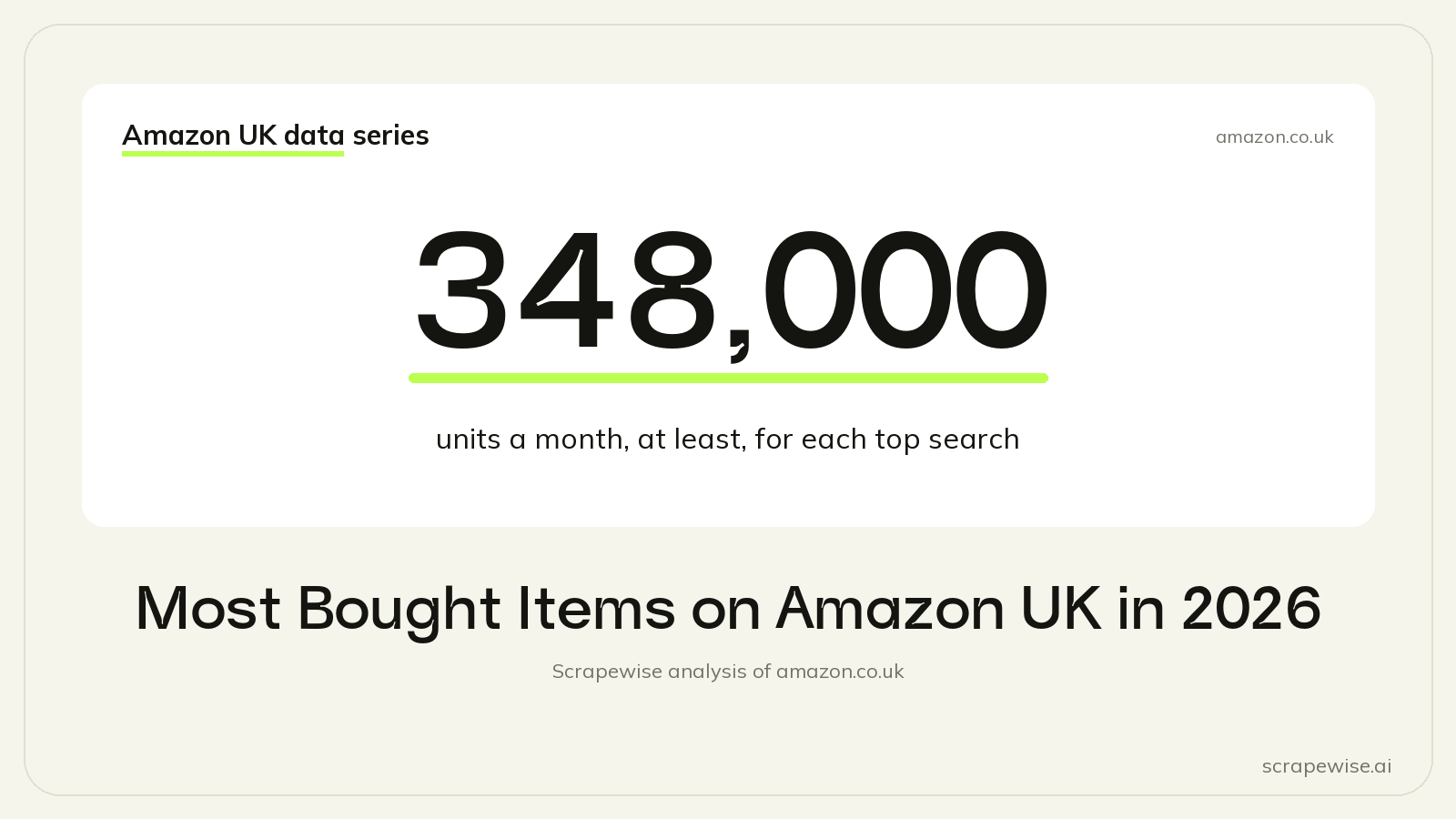
- The five most bought searches in our sample each sold at least 348,000 units a month.
- Face moisturiser, shampoo and deodorant sit in the top five, with face moisturiser at a minimum of 427,000 units a month.
- Products labelled 5K+ bought in past month have a median price of £9.09, against £19.99 for priced products with no label.
The most bought items on Amazon UK are everyday refills: the five busiest searches in our sample, face moisturiser, shampoo, deodorant, cat food and dog food, each sold at least 348,000 units a month. We added up Amazon's own "bought in past month" labels on 197,022 products from amazon.co.uk search results of 23 to 24 September 2026.
The Data
Amazon does not publish sales per product. It does print a short label on many search results, such as "1K+ bought in past month". The label is a floor, so a product marked 1K+ bought may have sold far more. We took the floor of every label in each search and added them up. The result is the minimum number of units the products in that search sold in the month.
| Search | Units a month, at least |
|---|---|
| Cat food | 458,000 |
| Face moisturiser | 427,000 |
| Dog food | 384,000 |
| Shampoo | 355,000 |
| Deodorant | 348,000 |
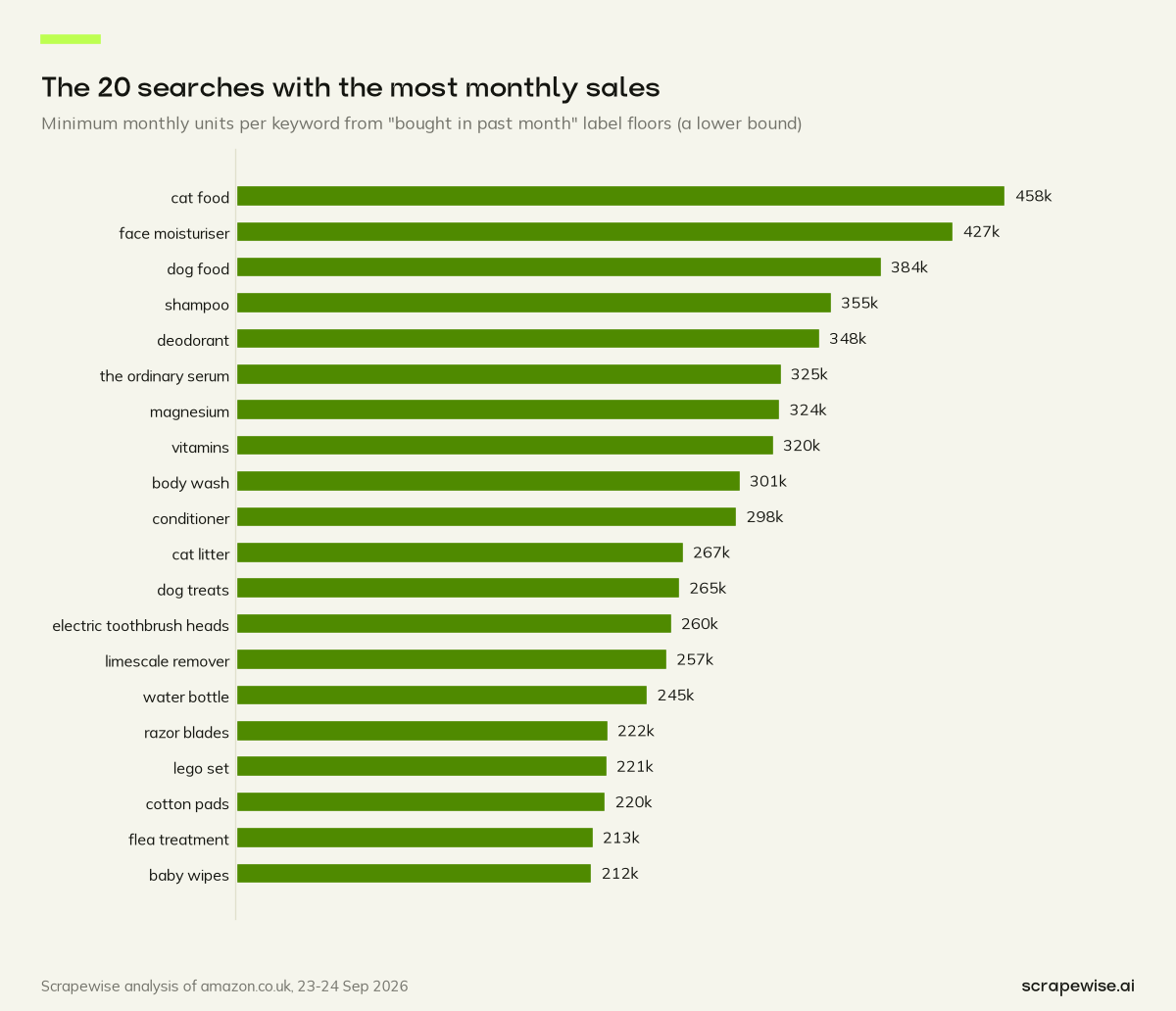
The list is short on surprises and long on things people run out of. Below the top five, the chart runs through serums, vitamins, body wash, cat litter, razor blades and baby wipes. Only two searches on the chart, water bottles and LEGO sets, are for things that do not get used up.
The Bathroom Shelf Leads
Three of the top five searches belong on a bathroom shelf. Face moisturiser sold at least 427,000 units a month in our sample, shampoo at least 355,000 and deodorant at least 348,000. All three sit in the beauty category. For totals by category rather than by search, see best selling categories on Amazon UK, and the beauty searches get their own breakdown in the Amazon UK beauty market.
These searches are full of listings that sell steadily. The higher label, 1K+ bought, sits on 47.6% of face moisturiser listings, 48.4% of shampoo listings and 51.2% of vitamin listings. Across all products, the same label appears on only 3.6%. Here, a thousand units a month is close to ordinary.
Where Almost Every Listing Sells
A second way to rank searches is by how many listings show any sales label at all. Here the top of the table looks like this:
| Search | Share of listings labelled |
|---|---|
| LEGO set | 99.6% |
| Cat food | 99.2% |
| Dog food | 99.0% |
| Vitamins | 96.6% |
| Shampoo | 95.9% |
Across all products in our sample, 36.6% carry a label. In cat food and dog food, almost every listing does, so a listing without a label is the rare one. Pet food gets a full breakdown in selling pet food on Amazon UK.
At the other end sit searches where labels are rare. Only 0.4% of denim jacket listings, 2.2% of battle rope listings and 2.6% of kalimba listings showed a label. Cats need feeding daily. Kalimbas, as far as we know, do not.
A missing label does not mean zero sales. It means the product sold fewer units than Amazon's smallest label, or sold them outside the month the label covers. So a low label share says "few products here sell steadily", not "nothing here sells".
What the Most Bought Products Look Like
In our sample, 7,181 products showed a label of at least 1K+ bought. The very top of that group, products labelled 5K+ bought, shows the profile most clearly.
- They are cheap. Priced products labelled 5K+ bought have a median price of £9.09. Priced products with no label have a median of £19.99. How labels change across price bands is covered in our post on the best price point to sell on Amazon.
- They are well rated. Rated products labelled 5K+ bought have a median of 4.6 stars and a median of 6,800 reviews.
- Amazon is often there. Amazon itself is among the sellers on 44.0% of products labelled 1K+ bought. We cover what that means in does Amazon compete with its sellers.
None of this proves that a low price or a high rating causes sales. Sales also bring reviews, and popular products attract Amazon. What it does show is the profile a new product walks into when it enters one of these searches.
What It Means for Sellers and Brands
The most bought searches are proven demand, and they are crowded for the same reason. If you plan to enter one, look past the headline number. Check how many listings already carry the 1K+ bought label, what the median price is, and whether Amazon sells there too. A search where the 1K+ bought label is close to normal needs a clear reason for a shopper to switch.
The searches with rare labels are the opposite case. Demand there may be thin or seasonal, and one late-September snapshot cannot tell the two apart. It shows where each search stood on the day we looked, not where it is heading.
For brands, label floors make a cheap demand signal for keyword research. Pull the same searches every month and compare the floors. A search whose floor keeps rising is worth a closer look. Our guide to competitor data beyond price tracking covers more signals of this kind. To find busy searches your range does not reach yet, use competitor assortment gap analysis.
How to Rank the Searches in Your Own Market
You can build the same table for your own keywords in an afternoon:
- List the searches your shoppers use, including the plain ones. The most bought items are often the dull ones.
- For each search, collect the first few results pages and note the "bought in past month" label on every product.
- Turn each label into its floor and add the floors up per search. Keep the result as "at least", never as a sales figure.
- Next to the floor, record the share of listings with any label and the median price. A high floor with a high label share means steady demand spread across many sellers. A high floor from a few listings means a few winners.
Run it again next month on the same list. The change in the floors tells you more than any single snapshot can.
How We Collected This Data
Only one scraper was needed here: the Amazon Search API. On each amazon.co.uk results page it reads every product's "bought in past month" label next to its price, star rating, review count and position, and the floors and medians above are made from nothing else. We ran it over the first 7 pages of 868 searches. One call fetches one results page, at €0.00015 per call or €0.15 per 1,000 calls. The Amazon Best Sellers API returns Amazon's own ranked best-seller chart for a category, but it was not used in this study, because we wanted demand per search. Register for an account to run the Search API on the keywords in your own category.
Curious how much the searches in your category really sell? Try it on your own keywords with 5 free requests, then pay only for the calls you make. Get started, or see pricing for the full rates.
Paste a marketplace URL — get structured market data
Size categories, track assortments, monitor trends. Clean feeds ready for your BI stack.
97% accuracy on Amazon benchmarks · no credit card · book a 15-min call →