
Key takeaways
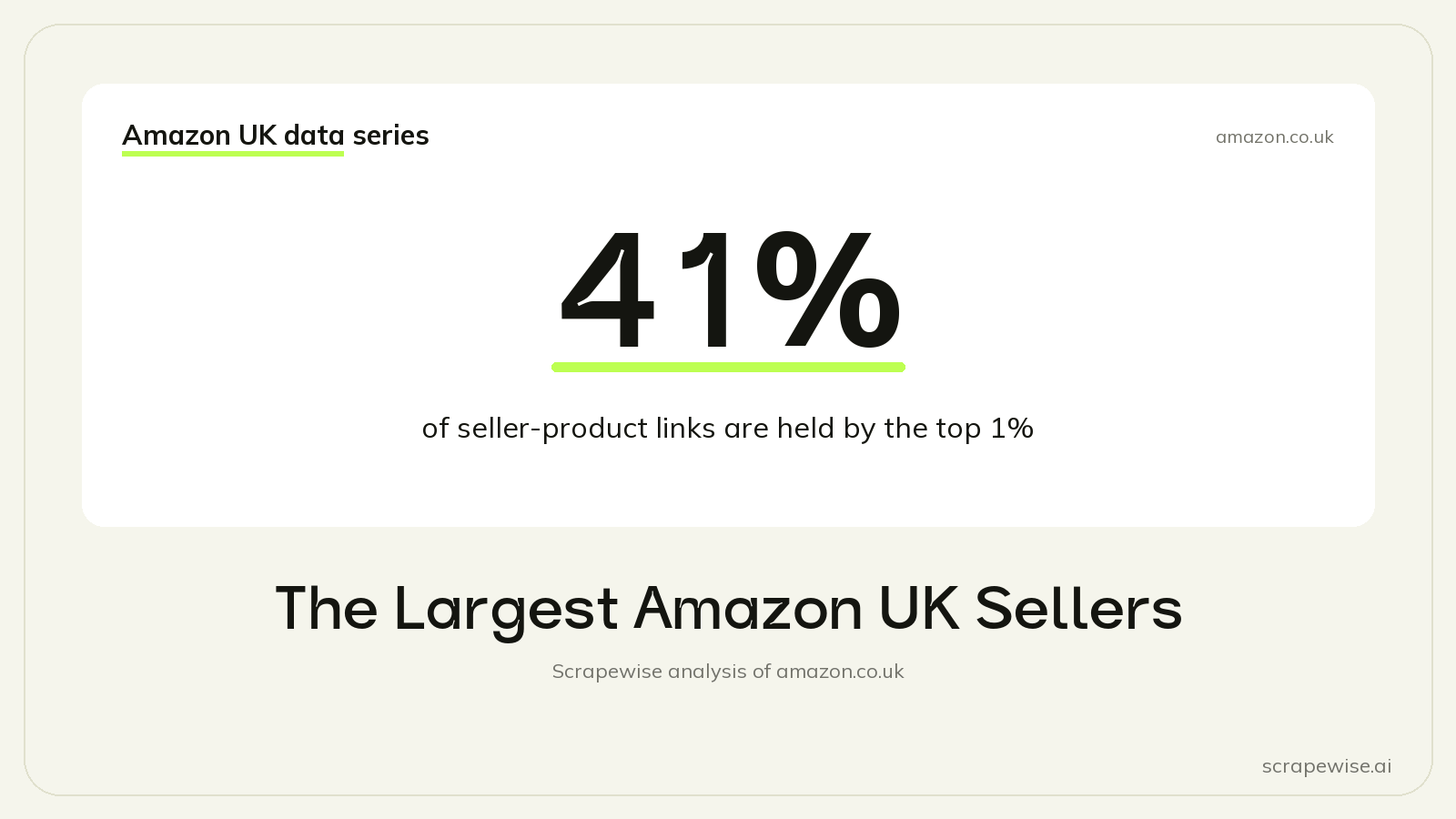
- The top 1% of sellers hold 41% of seller-product links in our sample, a measure of breadth, not revenue.
- In our sample, 80.4% of the top 1% sellers with a readable profile declare a UK business address.
- Four in ten linked sellers turned up on exactly one product in our sample.
The largest Amazon UK sellers are a small group with a very wide reach: the top 1% of sellers hold 41% of the seller-product links in our sample, and four in five of those whose profile we could read declare a UK business address. We counted 394,727 such links on amazon.co.uk on 23 to 24 September 2026.
The Data
"Largest" can mean several things on Amazon: most revenue, most units, most products. Revenue and units are not public, so we measured the one thing every offer page shows: which sellers offer which products. Each time a seller appeared on a product, we counted one link. Then we ranked sellers by how many links they hold.
| Measure | Value |
|---|---|
| Seller-product links counted | 394,727 |
| Sellers with at least one link | 51,458 |
| Share of links held by the top 1% of sellers | 41% |
| Share held by the top 1%, with Amazon's own accounts and their links left out | 33.2% |
| Share of links held by the top 10% of sellers | 70.1% |
| Share held by the top 100 sellers, with Amazon's own accounts and their links left out | 17.0% |
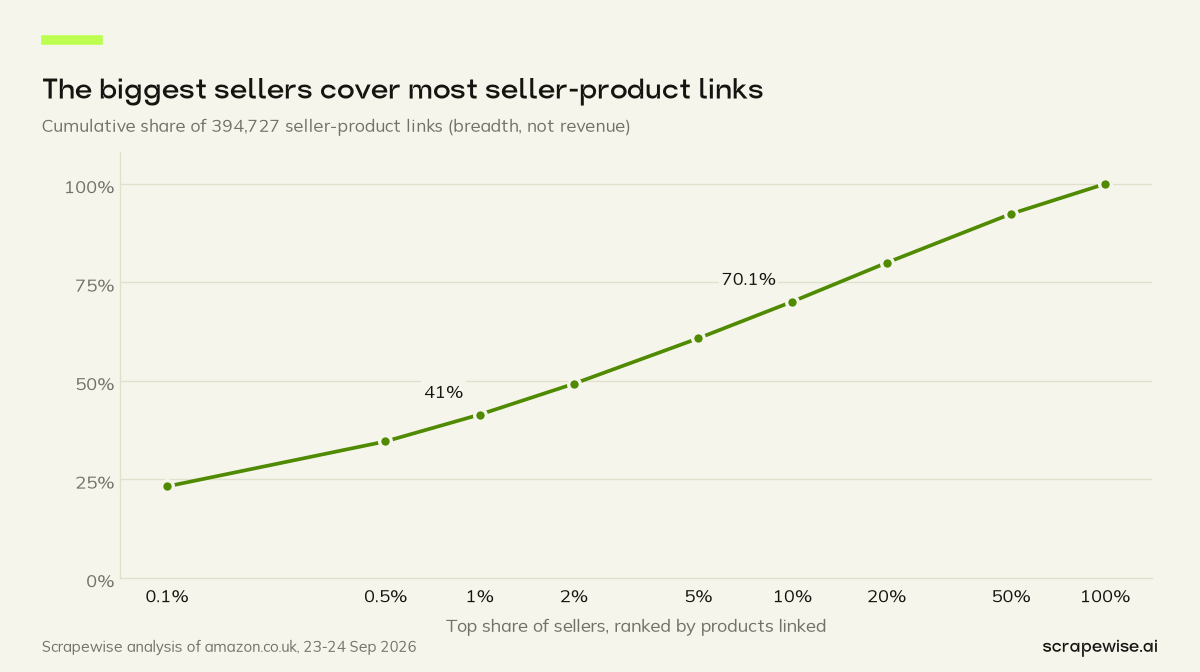
The curve climbs steeply and then flattens. The top 10% of sellers hold 70.1% of the links, and the remaining nine sellers in ten share what is left. Amazon's own seller accounts sit near the very top. Leave them out and the top 1% still hold 33.2% of links, so Amazon alone does not explain the concentration.
Who the Top 1% Are
We could read a seller profile for 506 of the top 1% sellers. Of those, 407 declare a UK business address, which is 80.4%, or four in five. Another 51 declare an address in the EU, 20 in the US and 11 in China. Sellers declaring a Hong Kong address were too few to report.
The top 100 look similar. In our sample, 78 of them declare a UK address, and fewer than 10 declare a China address.
That mix is very different from the seller base as a whole. Across all 55,660 seller profiles, 55.5% declare a China address and 29.2% a UK one, as we cover in Amazon UK sellers by country. So the many sellers and the widest sellers are two different groups. A plausible reading is that established UK retailers and distributors list large catalogues, while many overseas sellers each run a narrower range. That is a reading of the pattern, not something the data proves.
One more caveat belongs here. A wide seller is not the same as a big seller. A shop that lists hundreds of slow-moving spare parts holds more links than a brand that sells one product in huge volume. For sales volume, see our estimate in Amazon sales per review.
The Long Tail: Most Sellers Appear on One or Two Products
At the other end of the curve sits a very long tail. Of the 51,458 sellers linked to products in our sample, 41.7% appeared on exactly one product, and 59.6% on one or two.
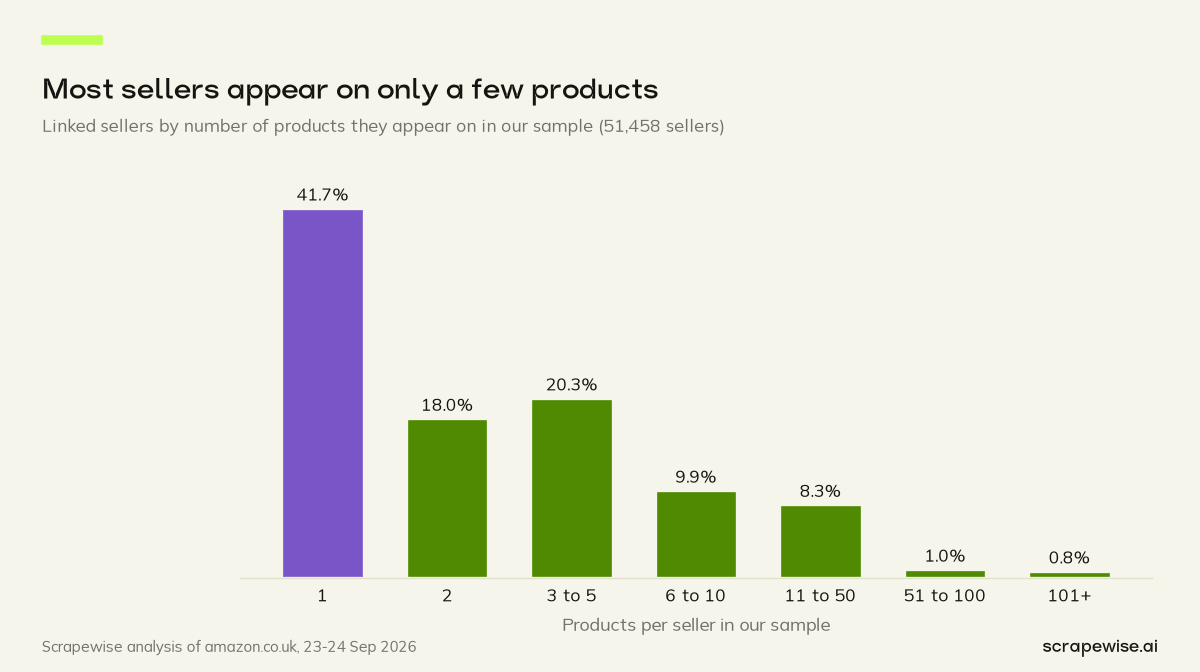
Four in ten sellers turned up on exactly one product in our sample. For them, the best-selling item and the whole catalogue are the same thing.
A sample of 868 keywords sees only part of each seller's range, so the true catalogues are larger. The seller profiles give a second view. Each profile we read came with a count of the products we saw that seller on across the wider 1,068-keyword pass. On that base, the median seller appeared on 2 products, and nine sellers out of ten appeared on 11 or fewer. The widest single profile appeared on 2,410 products.
The wider pass also shows a difference by declared address. Of UK-based sellers, 32.8% were seen on only one product, against 45.1% of China-based sellers. And 330 UK-based sellers appeared on 100 or more products, against fewer than 10 China-based sellers. These figures use the wider pass, so they are a different base from the 41.7% above.
What It Means for Sellers and Brands
If you track competitors on Amazon UK, the concentration works in your favour. A short list of wide sellers covers a large share of all the offers we saw. Monitor those first, then sample the long tail, where prices move one product at a time.
If you are a brand, expect many of the sellers on your products to be small. A seller with one product in our sample may be a reseller who bought one pallet, a returns trader or a new shop testing the market. None of that is wrong, but it is worth knowing who they are before a price drop surprises you. Our post on Amazon buy box competition shows how many products have only one seller at all, and the most competitive products on Amazon UK shows where the crowds gather.
If you are a seller planning growth, breadth is one route. The top of the curve is mostly shops with large catalogues, not shops with one hit product. Before you add range, check which products your competitors already cover. Our guide to competitor assortment gap analysis walks through that check, and our post on perfect positive feedback on Amazon covers what the feedback score on a seller profile does and does not tell you.
How to Find the Largest Sellers in Your Own Category
The same method works on a single category, and it needs no guesswork about revenue:
- Pick the searches that define your category and pull the first few results pages for each, so you have a list of products.
- Pull the offer page of every product. Each offer names a seller, so you can count how many products each seller appears on.
- Rank the sellers by that count and see how quickly the curve flattens. If a handful of sellers cover most products, your market is concentrated. If the list is long and flat, prices will move in many places at once.
- Pull the public profile of the top sellers for their declared business address and feedback, and keep the list as your watch list.
Repeat it every month or so. One snapshot shows who is widest today. A second one shows who is growing.
How We Collected This Data
Two Scrapewise scrapers built this post. The Amazon Offers API read the offer page of each product we found on amazon.co.uk and returned every offer's seller, price and condition. Counting which sellers appeared on which products gave the 394,727 seller-product links. The Amazon Seller API then looked up each seller ID and returned the public profile, with store details, positive feedback and the declared business address behind the country figures. Only aggregates appear here. Both scrapers charge €0.00015 per call, or €0.15 per 1,000 calls, and run daily, every few days, weekly or monthly, or on demand. Set up an account to map the sellers in your own category.
Which sellers cover the most products in your market? You can test it with 5 free requests and pay per call after that. Open a Scrapewise account or check the pricing page first.
Paste a marketplace URL — get structured market data
Size categories, track assortments, monitor trends. Clean feeds ready for your BI stack.
97% accuracy on Amazon benchmarks · no credit card · book a 15-min call →