
Priceva Alternatives: 6 Tools Compared
Short version: Priceva prices your catalogue, not your usage — every plan carries a price-check ceiling and a site count, so growing the SKU list or adding a competitor moves you up a tier rather than adding a line to the bill. Below: what each realistic Priceva alternative bills you for, what you can actually track, and the cases where staying on Priceva is the right call.
Six Priceva Alternatives, Side by Side
| Tool | Billed on | What you can track | Best for |
|---|---|---|---|
| ScrapeWise | €0.15 per 1,000 plain pages delivered | Any field on any public page | Teams who want the data and their own analysis layer |
| Priceva | Price checks and site count per plan | Price, stock, MAP, digital shelf | Retailers who want repricing and dashboards in one product |
| Prisync | Products tracked per month | Price and stock on supported sites | Small catalogues with a fixed competitor set |
| Price2Spy | Monitored URLs | Price, stock, MAP, with matching support | Teams who want the vendor to do the SKU matching |
| Competera | Quoted, enterprise | Price, elasticity, optimisation | Large retailers buying price optimisation, not just data |
| Minderest | Quoted, catalogue-sized | Price, MAP, assortment | Brands with reseller networks across several markets |
| Omnia Retail | Quoted, revenue-linked | Price, dynamic pricing rules | Retailers automating price changes at scale |
Which One Actually Fits
Stay on Priceva if
You want repricing rules and digital-shelf reporting in the same product as the data collection, and your catalogue fits comfortably inside a tier. Buying one tool instead of assembling two is a real advantage, and nothing on this list replaces the repricing half.
Move if the check ceiling is the constraint
The tell is deciding to check less often to stay inside a plan. Monitoring frequency should be a commercial decision about how fast you want to react, not an artefact of where the tier boundary sits.
Move if the site count blocks you
A 30- or 40-site limit is fine until a new regional competitor appears mid-quarter. If you find yourself removing a site to add a site, the ceiling is now shaping your competitive picture.
Move if you need more than price
Images, specifications, reviews, shipping terms and assortment gaps live on the same page as the price. Price-monitoring products deliberately return the price column. If you keep needing the rest, you are buying the wrong shape of tool.
Pick an enterprise platform if
You want elasticity modelling and automated price optimisation rather than a feed. Competera and Omnia Retail are built for that, with the sales cycle and contract that implies.
Do not choose ScrapeWise if
You want repricing rules, a digital-shelf dashboard or a vendor who maintains your SKU-to-competitor matching. ScrapeWise delivers rows by REST API and CSV with an AG Grid layer on top — the pricing logic is expected to live in your systems.
Priceva vs ScrapeWise
Why Teams Look Beyond Priceva
Your Catalogue Sets the Invoice
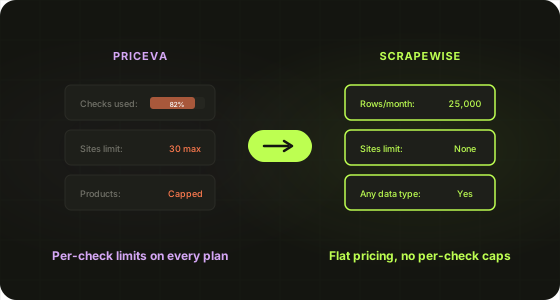
Plans are bounded by price checks and site counts — the Business tier around 35,000 checks across 30 sites. That means the bill tracks how big your catalogue is and how many rivals you watch, not how much work the platform did. Growth is punished by the pricing model rather than absorbed by it.
A Site Count Is a Ceiling on Your Market View
When a new regional competitor appears, the question should be whether they matter, not whether there is a slot free. Teams on capped plans routinely drop a monitored site to add a more urgent one, which quietly narrows the picture the pricing team is working from.
Frequency Becomes a Budget Decision
Checks per month is the same meter as checks per day multiplied by catalogue size. During a promotion, when you most want hourly visibility, that is exactly when the ceiling arrives. Per-page billing makes frequency a linear cost instead of a tier jump.
Price and Stock, and Then You Stop
Price-monitoring products return the price column because that is the product. The image, the specification block, the review count, the delivery terms and the assortment gaps are all on the page you already paid to fetch — and you get none of them. When the next question is about anything other than price, you need a second tool.
The Feed Stops at Your System's Door
Getting rows out on a schedule, into an ERP or a BI layer, is the difference between a report somebody reads on Monday and a number your systems act on overnight. Check the export path early — it is rarely the part of the demo you get shown.
Coverage Gaps Are Invisible Until Audited
A monitoring tool reports what it found. Knowing what it missed — delisted URLs, silently failing sites, a competitor that quietly started blocking — needs an explicit coverage number. Without one, a shrinking dataset looks exactly like a stable one.
Price Monitoring Without a Ceiling
Priceva is a capable product with a clean interface, genuine MAP monitoring and repricing built in — if you want one tool that goes from collection through to a price change, it does that and ScrapeWise does not. The question is whether your catalogue size and competitor count should be the thing that determines your invoice.
- ✕ Capped price checks per month
- ✕ Site count limits on every plan
- ✕ Frequency is bounded by the tier
- ✕ Price and stock, little beyond it
- ✕ Growing the catalogue moves you up a tier
- ✓ €0.15 per 1,000 plain pages delivered
- ✓ No site count, no check ceiling
- ✓ Check as often as the arithmetic justifies
- ✓ Any field on the page, same rate
- ✓ Adding SKUs adds pages, nothing else
What Tracking 5,000 SKUs Across 10 Competitors Costs
| 5,000 SKUs · 10 competitors · daily | Priceva | ScrapeWise |
|---|---|---|
| Checks needed per day | 50,000 | 50,000 pages |
| Checks per month | 1.5M | 1.5M pages |
| What the meter counts | Price checks, bounded by plan | Pages delivered |
| Plan required | Well past the 35,000-check Business tier | None — balance only |
| Monthly cost | Enterprise quote territory | €225 at €0.15 per 1,000 |
| Adding an 11th competitor | +5,000 checks/day and a site slot | +5,000 pages per check. Nothing else changes |
| Doubling to twice-daily checks | Doubles checks against the ceiling | Doubles pages. Same rate |
| Wanting the spec block as well as the price | Not in scope | Same page, same cost |
Pricing Comparison
Priceva
- - Free: 20 products, 20 sites
- - Business: from $99/mo — around 35,000 checks across 30 sites
- - Pro: higher check allowance, around 40 sites
- - Enterprise: custom pricing
- - Per-check billing scales with catalogue size and frequency
- - Site count limits on every plan
Scrapewise
- ✓ Pay-as-you-go: no monthly plan, no quota
- ✓ Plain pages: €0.15 per 1,000 (€0.00015 per page)
- ✓ Render: €0.75 per 1,000 · Super (residential proxy): €1.50 per 1,000
- ✓ You only pay for pages that are delivered
- ✓ No site count limits, no check ceiling, no seat fees
- ✓ 5 free requests on signup · top up from €5 · balance never expires
Moving Off Priceva
1. Export the matched URL list
The mapping between your SKUs and each competitor's product URL is the asset you actually paid for over the years. Export it before anything else. Rebuilding that mapping from scratch is the expensive part of any price-monitoring migration; the fetching is not.
2. Separate the feed from the repricing
Write down which Priceva features produce decisions — repricing rules, MAP alerts, digital-shelf reports — and which just produce data. Only the data half is a like-for-like migration. Be explicit about where the decision logic will live afterwards.
3. Note the fields you wish you had
Migration is the one moment when adding columns is free. List what the current feed does not return but your team keeps asking for — delivery terms, spec fields, review counts, assortment gaps — and include them in the new schema from day one.
4. Check the 36 ready-made endpoints first
If your competitors sell on common marketplaces or major retailers, an endpoint may already cover them. That removes the configuration step and free requests are enough to confirm the output shape before any spend.
5. Run both for two weeks
Keep Priceva live and run the new job alongside it. Diff the prices daily, and investigate every discrepancy rather than assuming the incumbent is right — this is usually where you find the stale matches that have been quietly wrong for months.
6. Cancel at the renewal, not before
Annual price-monitoring contracts rarely refund. Find the renewal date, cut over ahead of it with the parallel run complete, and let the subscription lapse. After that there is no tier to pick: you top up from €5 and pay for pages delivered.
Monitor Prices Without Hitting Caps
No per-check limits, no site count restrictions, no fields that are out of scope. ScrapeWise delivers price monitoring from any site your competitors sell on at €0.15 per 1,000 plain pages, and hands the rows straight to your own pricing logic.
Frequently Asked Questions
Common questions when comparing Priceva and its alternatives.
It depends what you are replacing. For a clean, uncapped data feed into your own pricing logic, ScrapeWise fits at €0.15 per 1,000 plain pages delivered. For a similar all-in-one with vendor-managed matching, Price2Spy or Prisync. For price optimisation rather than monitoring, Competera or Omnia Retail.