
Prisync Alternatives: 6 Tools Compared
Short version: every price-monitoring suite on this list bills you for the size of your catalogue. Prisync starts at $99/mo for 100 products and reaches $399/mo at 5,000, plus 20% for API access. ScrapeWise bills what actually arrives — €0.15 per 1,000 delivered pages, no plan, no SKU tier. Six alternatives compared below, including where ScrapeWise is the wrong answer.
Prisync Alternatives and Competitors at a Glance
Six alternatives, plus Prisync itself as the baseline. Five of the seven price your catalogue rather than your usage, which is why adding one competitor can move you up a tier without adding a single new product.
| Tool | Billed on | What you can track | Best for |
|---|---|---|---|
| ScrapeWise | Pages delivered — €0.15 per 1,000 | Any field on any public page: price, stock, promo, variants, ratings | Teams that outgrew a fixed schema or a supported-site list |
| Prisync | Products tracked, $99–$399/mo, +20% for API | Price and stock on supported sites | SMB Shopify retailers wanting plug-and-play repricing |
| Price2Spy | URLs monitored, per month | Price and stock, with MAP alerting | Long-running MAP programmes with a stable URL list |
| Competera | Enterprise contract, quoted | Price, elasticity modelling, AI repricing | Enterprise retail pricing teams with a data science function |
| Minderest | Products and markets tracked | Price and assortment across countries | European multi-country retail and manufacturer pricing |
| Omnia Retail | Enterprise contract, quoted | Price plus dynamic pricing strategy execution | Mid-market to enterprise retailers wanting strategy, not just data |
| Priceva | Products tracked, per month | Price, stock and repricing rules | Smaller catalogues wanting monitoring and repricing in one tool |
Which One Is Actually Right for You
Most comparison pages exist to tell you the answer is the company that wrote them. Here is the honest version, including the two cases where you should not pick us.
Stay on Prisync if
Your competitors are on the supported-site list, your catalogue is stable under a few thousand SKUs, and your main workflow is automatic Shopify repricing. That closed loop — competitor drops, your price moves — is genuinely faster to stand up than wiring data into your own engine, and it is the thing Prisync does best.
Choose Price2Spy or Priceva if
You want the same shape of product with different billing arithmetic. Price2Spy prices per monitored URL rather than per product, which is cheaper if you track few competitors per SKU and worse if you track many. Priceva bundles repricing at smaller catalogue sizes.
Choose Competera or Omnia Retail if
The problem is not visibility, it is what to do with it. Both sell pricing strategy — elasticity modelling, rule engines, optimisation — and both are enterprise contracts with an implementation project attached. Buy them for the decision layer, not for the data collection.
Choose Minderest if
You price across several European countries and need assortment and market coverage as much as price. Multi-country breadth is where it is strongest, and that is a genuinely hard thing to assemble yourself.
Choose ScrapeWise if
A strategic competitor sits on a site nobody supports, or you need fields beyond price — stock, promo badges, variant-level data, ratings — or your catalogue has grown past the point where per-SKU billing makes sense. You top up a balance and pay €0.15 per 1,000 delivered pages, with 5 free requests on every new account.
Do not choose ScrapeWise if
You want repricing rules and a Shopify integration inside the same product. We deliver the data layer — structured competitor rows into your systems — and your pricing engine decides what to do with them. If you want the decision made for you, Prisync or Competera is the correct tool and we will say so.
Prisync vs ScrapeWise
Why Teams Look Beyond Prisync
Per-Product Pricing Escalates Fast
Prisync charges $99/mo for 100 products, $199 for 1,000, and $399 for 5,000. API access adds another 20% on every tier. For a team tracking 5,000 SKUs across 10 competitors, that's $478/mo before any other use case. Teams that monitor 20,000+ products end up negotiating custom plans because the public tiers don't go that high. ScrapeWise bills per page delivered instead — €0.15 per 1,000 plain pages, API access included — so checking 5,000 products every day, about 150,000 pages a month, costs about €22.50, and there is no per-product ceiling.
Coverage Gaps on Non-Supported Sites
Prisync supports a curated list of websites. If your most important competitor sells on a niche marketplace, a regional retailer Prisync hasn't added, or a custom-built D2C storefront, you can request support — but you're waiting on the vendor's roadmap. Brand-protection teams and pricing managers in specialized verticals (pharma, auto parts, beauty grey market) hit this constraint hardest. ScrapeWise's visual builder works on any public site from day one, so coverage is your decision, not the vendor's.
Built for Repricing, Not for Analysis
Prisync's strongest workflow is automatic repricing through Shopify integration: see a competitor lower a price, change yours. That's powerful for retailers, but it's a closed loop. If you want to slice competitor data by category, time, brand, or promo period in your own dashboard, Prisync's pre-built reports won't take you there. ScrapeWise exposes everything through AG Grid Enterprise — the same dashboard your data team uses for BI — and exports cleanly to Looker, Tableau, or a warehouse.
You've Outgrown a Finished Product
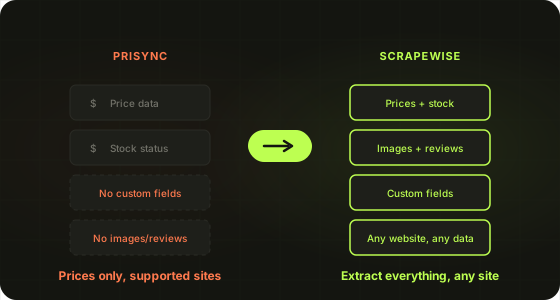
Prisync is genuinely well-built price monitoring software, and when its supported-site list, fixed schema, and per-product pricing fit your team, it's the right choice. Most teams hit a ceiling at one of three points: a strategic competitor appears on a site Prisync doesn't support, the data team wants stock and variant data alongside price, or the catalog grows past 5,000 SKUs and the bill starts climbing faster than the team's headcount. At that ceiling, switching to another finished product just moves you sideways. The real move is from product to infrastructure — same outputs (competitor prices in your BI tool), no per-product ceiling, any website you point at, any field you want extracted. That's where ScrapeWise fits.
- ✕ Costs scale per product count ($99–$399/mo + 20%)
- ✕ Only tracks prices on supported websites
- ✕ Limited dashboard customization, fixed reports
- ✕ Onboarding and catalog changes go through support
- ✕ Need separate tools for non-price data and analysis
- ✓ Pay-as-you-go pricing, no per-product limits
- ✓ Monitor any public website, no vendor approval needed
- ✓ AG Grid analytics with filtering, grouping, and pivots
- ✓ Visual builder: point, click, extract — self-serve
- ✓ One platform for prices, stock, variants, and custom data
What Tracking 5,000 SKUs Across 10 Competitors Costs
This is where per-SKU and per-page billing separate. 5,000 of your products checked against 10 competitor listings each, refreshed daily, is roughly 1.5 million pages a month. On a per-product subscription the same job is priced by how big your catalogue is, not by how much work it takes.
| 5,000 SKUs · 10 competitors · daily | Prisync | ScrapeWise |
|---|---|---|
| What the invoice is attached to | Number of products tracked | Number of pages delivered |
| Published plan | Platinum $399/mo at 5,000 products | None — you top up a balance, no plan |
| API access | +20% on the subscription tier | Included |
| Adding an eleventh competitor | More products tracked — can push you a tier | Costs the extra pages, nothing else |
| Going past 20,000 products | Custom plan, quoted | Same published per-page rate |
| Fields beyond price and stock | Not available — fixed schema | Any field on the page, at no extra rate |
| A competitor on an unsupported site | Request it, wait on the roadmap | Point the builder at it the same day |
Pricing Comparison
Prisync
- - Professional: $99/mo for 100 products
- - Premium: $199/mo for 1,000 products
- - Platinum: $399/mo for 5,000 products
- - API access: +20% on every subscription tier
- - Custom plans required above 5,000 products
- - 14-day free trial, no permanent free tier
- - Channel-based monitoring starts at $199/mo
Scrapewise
- ✓ Pay-as-you-go: no monthly plan, no quota
- ✓ Plain pages: €0.15 per 1,000 (€0.00015 per page)
- ✓ Render: €0.75 per 1,000 · Super (residential proxy): €1.50 per 1,000
- ✓ You only pay for pages that are delivered
- ✓ No per-product limits, no API surcharge
- ✓ 5 free requests on every new account
- ✓ No project, task or seat limits — your balance is the only limit
Moving Off Prisync
A price-monitoring subscription holds two things worth keeping: your product list and the competitor URLs matched to it. Both export. The rest is configuration that does not transfer, so a migration is really a rebuild of the extraction — typically under 30 minutes per target site.
Export the product list and the matched URLs
This is the asset you actually paid for over the years — the mapping between your SKUs and each competitor's product page. Get it out as CSV before you cancel anything. Rebuilding those matches by hand is the one genuinely slow part of switching monitoring tools.
Write down the competitors you gave up on
Every team on a supported-site product has a list of competitors they stopped asking about because the vendor did not cover them. That list is usually the real reason for the switch, so scope it in now rather than treating it as a later phase.
Decide what fields you actually want
Per-SKU products give you price and stock because that is what the schema holds. Now you can add promo badges, variant-level pricing, shipping cost, seller name or ratings. Pick the three or four that would change a decision, not everything that is visible.
Rebuild one competitor in the visual builder
Pick the competitor whose data you trust least today. Point the builder at a product page, select the fields, and run it against your 5 free requests. You are testing whether the output matches what Prisync reports, before anything is billed.
Run both in parallel for one cycle
Keep the subscription for a week and diff the two feeds on the same SKUs. This is the step teams skip and then regret — it is also the only honest way to compare accuracy rather than marketing claims, and it will surface stale matches on the old side.
Cut over and stop paying per SKU
Once the diff is clean, move the remaining competitors and cancel. Results land in a filterable grid, and go out as CSV or over the REST API, so whatever consumed the old export — a BI dashboard, a pricing sheet, your repricing engine — does not need to change.
Outgrow the Product. Move to Infrastructure.
Prisync is the right tool until it isn't — and the moment it isn't tends to come when your catalog grows, a competitor lands on an unsupported site, or your data team asks for more than what the reports surface. ScrapeWise is the infrastructure layer that sits where Prisync ends: any website, any field, your analytics, pay-as-you-go price.
Frequently Asked Questions
Common questions when comparing Prisync alternatives and competitors.
It depends on which limit you hit. If the bill is the problem, Price2Spy prices per URL rather than per product. If you need pricing strategy rather than visibility, Competera or Omnia Retail. If you price across several European markets, Minderest. If the problem is coverage or fields — a competitor on a site nobody supports, or data beyond price and stock — ScrapeWise, at €0.15 per 1,000 delivered pages with no per-product tier.