
Omnia Retail Alternatives: 6 Tools Compared
Short version: you are buying a repricing engine, and the competitor data is the ingredient it runs on. Omnia Retail bundles monitoring, dynamic pricing rules and channel feeds into one quoted platform — powerful if you want all three, expensive if you only needed the first. ScrapeWise sells the ingredient on its own, at €0.15 per 1,000 pages with no plan. Below: what each realistic Omnia Retail alternative bills you for, what you actually receive, and the cases where staying on Omnia is the right call.
Six Omnia Retail Alternatives, Side by Side
Six alternatives, plus Omnia Retail itself as the baseline. Before reading the price column, settle a prior question: are you buying a system that decides prices, or data that lets you decide them? The two are sold together often enough that teams end up paying for both when they needed one.
| Tool | Billed on | What you can track | Best for |
|---|---|---|---|
| ScrapeWise | Pages delivered — €0.15 per 1,000 | Any field on any product page | Teams that want the data and will apply their own pricing logic |
| Omnia Retail | Quoted, commonly revenue-linked | Competitor prices feeding dynamic pricing rules | Retailers who want repricing and channel feeds in one platform |
| Competera | Quoted, enterprise contract | Competitor prices feeding a pricing engine | Large retailers buying AI price optimisation as a platform |
| Minderest | Quoted on catalogue size | Price, stock and MAP across matched SKUs | Brands and retailers with large catalogues in Europe and LATAM |
| Prisync | Products tracked per month | Price and stock on tracked SKUs | SMB e-commerce with a published, self-serve price |
| Price2Spy | URLs tracked per month | Price and stock on tracked URLs | Teams that want per-URL control and MAP alerting |
| Priceva | Products and sites, capped per plan | Price and stock within plan limits | Mid-market retailers on a fixed catalogue size |
Which One Is Actually Right for You
Most comparison pages exist to conclude that whoever wrote them wins. Here is the version that names where we are the wrong answer.
Stay on Omnia Retail if
You want the full loop in one platform: monitor competitors, apply pricing rules, push updated prices out to your webshop and channel feeds. If repricing and feed management currently live in the same team and the same workflow, splitting them apart to save on the data layer is usually a bad trade.
Choose Competera if
You want demand modelling and recommended prices rather than rules you write yourself. Competera optimises; Omnia executes rules. Both are quoted, both are enterprise purchases, and they answer different questions.
Choose Minderest if
Your priority is managed matching at catalogue scale with MAP enforcement, especially across European and Latin American retailers, and repricing is secondary to knowing the market accurately.
Choose Prisync or Price2Spy if
You want a published rate card and a self-serve start, and simple repricing rules are enough. Both bill against your catalogue — tracked products or tracked URLs — which is transparent and also the ceiling.
Choose ScrapeWise if
Your pricing logic already lives somewhere you control — a spreadsheet, a BI model, an ERP — and what it lacks is current, trustworthy market data. No quote, no onboarding: sign up, spend 5 free requests, then pay €0.15 per 1,000 delivered pages on a balance that never expires.
Do not choose ScrapeWise if
You need prices written back to your storefront and your marketplace feeds automatically. We deliver rows; we do not push prices out. If the automated write-back is the reason you bought Omnia, that capability is the thing you would be giving up, and it is not a small one.
Omnia Retail vs ScrapeWise
Why Teams Look Past Omnia Retail
You Are Buying the Whole Loop to Get One Part
Monitoring, pricing rules and channel feeds arrive as a bundle. Teams that already have pricing logic in an ERP or a well-built model are paying for a decision layer they intend to switch off, in order to reach the competitor data underneath it.
Revenue-Linked Pricing Punishes the Good Year
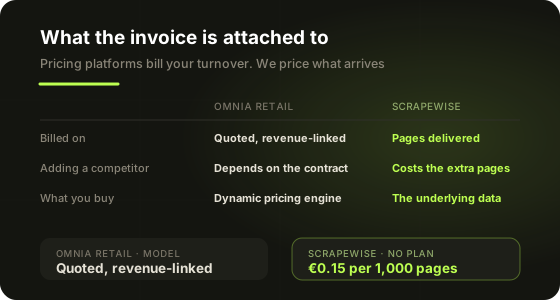
When the contract scales with turnover, a strong quarter raises the cost of the tool that helped produce it — while the workload, the SKU count and the number of pages fetched stay exactly the same. The meter is attached to your success rather than to usage.
No Published Price to Evaluate Against
Establishing whether the platform fits your budget takes a demo and a scoping conversation. For a team comparing four vendors in a week, a quote-only model makes the evaluation itself the project.
The Data Stays Inside the Platform
Competitor prices exist to drive the rules engine, not to be handed to your analysts. When someone wants eighteen months of history joined against margin data in your own warehouse, working inside the vendor's export options is a different experience from owning the rows.
Two Systems of Record for One Price
If the platform sets prices and your ERP also sets prices, reconciling the two becomes a standing job for someone. Pricing automation is most valuable when it is the only thing setting prices, and that is a bigger organisational change than a data subscription.
Implementation Is a Project, Not a Signup
Rules, strategies and stakeholder sign-off all come before the first useful output. That is reasonable for a pricing engine and expensive when what you actually needed was competitor prices this month. Evaluate the time to first data, not just the time to contract.
A Pricing Engine You Already Have.
Omnia Retail is a strong platform when you want monitoring, repricing and channel feeds working as one system — and for retailers without an internal pricing model, that bundle is worth the contract. But a large number of teams evaluating it already price well. What they lack is not a decision engine; it is a reliable, current, exportable picture of what the market did this morning.
- ✕ Quoted contract, commonly revenue-linked
- ✕ Demo and scoping before the first row
- ✕ You buy monitoring, rules and feeds as a bundle
- ✕ Competitor data lives inside the platform
- ✕ A strong revenue year raises the bill
- ✓ €0.15 per 1,000 delivered pages, published
- ✓ Self-serve signup, 5 free requests, no call
- ✓ You buy the data and keep your own pricing logic
- ✓ Rows export by CSV or REST API, yours to keep
- ✓ Revenue is irrelevant — pages are the meter
What the Meter Is Attached To
8,000 SKUs across 6 competitors, refreshed daily, is 1.44 million pages a month. Omnia's figure is quoted and commonly tied to turnover, so it cannot be printed here. What can be printed is which events move each bill — and a revenue-linked contract moves on events that have nothing to do with data volume.
| 8,000 SKUs · 6 competitors · daily | Omnia Retail | ScrapeWise |
|---|---|---|
| Pages per month | 1,440,000 | 1,440,000 |
| What you can work out before signing | Nothing — quoted, revenue-linked | €216 at €0.15 per 1,000 |
| Plain pages | Inside the contract | €0.15 per 1,000 = €216 |
| JavaScript-rendered pages | Inside the contract | €0.75 per 1,000 = €1,080 |
| A 30% revenue increase | Commonly raises the contract | No change — pages did not change |
| Adding a seventh competitor | Depends on the contract | Costs the extra pages, nothing else |
| Wanting shipping cost as well as price | Outside the pricing data model | Same page, same cost |
| A month you pause monitoring | Billed — contract term | Nothing — balance never expires |
Pricing Comparison
Omnia Retail
- - No public rate card — pricing is quoted
- - Commonly structured against turnover or assortment size
- - Evaluation runs through a demo and a scoping call
- - Monitoring, dynamic pricing and feed management sold as a platform
- - Adding competitors or fields depends on the contract
- - Contract terms rather than pay-as-you-go
Scrapewise
- ✓ Pay-as-you-go: no monthly plan, no quota, no contract
- ✓ Plain pages: €0.15 per 1,000 (€0.00015 per page)
- ✓ Render: €0.75 per 1,000 · Super (residential proxy): €1.50 per 1,000
- ✓ Your revenue does not affect the rate — pages do
- ✓ 5 free requests on every new account, no sales call
- ✓ Balance never expires, top-ups from €5
Moving Off Omnia Retail
This is the most involved migration on the site, because the platform does three jobs. Replacing the data layer is straightforward; replacing the rules engine and the channel write-back is a decision you should make deliberately before you start.
Separate the three jobs it does for you
Write down what Omnia currently owns: competitor monitoring, pricing rules, and pushing prices to your shop and feeds. Only the first is replaced by a data feed. If the other two are load-bearing, this is a re-architecture, not a swap — and it is better to know that in week one.
Check the renewal date before you plan anything
Quoted contracts carry notice periods and auto-renewal. Find the date and work backwards. A cutover scheduled just after renewal costs more than the tooling difference for a full year.
Export the matched competitor URL list
The mapping between your SKUs and competitor product URLs is the asset built over months of use. Export it before anything else — with that list in hand, the rebuild is mechanical rather than exploratory.
Decide where the rules will live
Most teams already have somewhere: a pricing sheet with margin floors, a BI model, an ERP job. Move the rules there first, still fed by Omnia, and confirm they produce the same prices before you change the data source. Change one thing at a time.
Check the 36 ready-made endpoints, then run both for two weeks
Where your competitor domains are already covered by one of the 36 scraping API endpoints there is no build step at all. Then run both systems in parallel for two full weeks and diff daily — matching and promotion edge cases surface in the second cycle, not the first.
Keep the feed tooling you still need
If channel feed management was genuinely valuable, do not throw it away to win an argument about the data layer. Plenty of teams run a dedicated feed tool alongside a raw data source and end up with both cheaper and more transparent than the bundle.
Buy the Ingredient, Not the Whole Kitchen.
Omnia Retail is the right purchase when you want monitoring, repricing and channel feeds working as one system. If your pricing logic already lives somewhere you control and what it lacks is current market data, ScrapeWise delivers it at €0.15 per 1,000 pages — published, self-serve, no contract.
Frequently Asked Questions
Common questions when comparing Omnia Retail alternatives and competitors.
It depends which of Omnia's three jobs you are replacing. For AI-driven price optimisation, Competera. For managed monitoring and MAP at catalogue scale, Minderest. For a published, self-serve rate card at smaller scale, Prisync or Price2Spy. If your pricing logic already lives in your own systems and you only need the competitor data, ScrapeWise, at €0.15 per 1,000 delivered pages with no contract.