
Minderest Alternatives: 6 Tools Compared
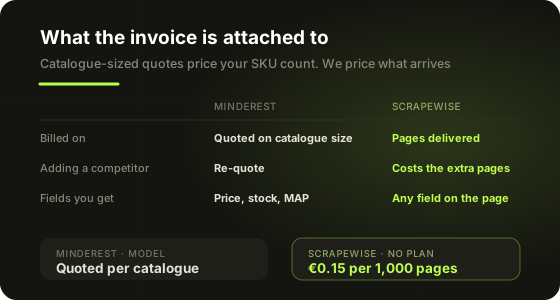
Short version: your catalogue size decides your invoice, and you find out the number on a call. Minderest quotes against how many SKUs you want matched and monitored — which means growing the catalogue raises the bill whether or not you are watching more competitors. ScrapeWise bills pages delivered instead, at €0.15 per 1,000, published and self-serve. Below: what each realistic Minderest alternative bills you for, what you actually receive, and the cases where staying on Minderest is the right call.
Six Minderest Alternatives, Side by Side
Six alternatives, plus Minderest itself as the baseline. The second column is the one worth arguing about: what the meter is attached to determines which growth in your business makes the bill go up.
| Tool | Billed on | What you can track | Best for |
|---|---|---|---|
| ScrapeWise | Pages delivered — €0.15 per 1,000 | Any field on any product page | Teams that want the data and will apply their own pricing logic |
| Minderest | Quoted on catalogue size | Price, stock and MAP across matched SKUs | Brands and retailers with large catalogues in Europe and LATAM |
| Competera | Quoted, enterprise contract | Competitor prices feeding a pricing engine | Large retailers buying AI price optimisation as a platform |
| Omnia Retail | Quoted, commonly revenue-linked | Competitor prices feeding dynamic pricing rules | Retailers who want rule-based repricing across channels |
| Prisync | Products tracked per month | Price and stock on tracked SKUs | SMB e-commerce with a published, self-serve price |
| Price2Spy | URLs tracked per month | Price and stock on tracked URLs | Teams that want per-URL control and MAP alerting |
| Priceva | Products and sites, capped per plan | Price and stock within plan limits | Mid-market retailers on a fixed catalogue size |
Which One Is Actually Right for You
Comparison pages normally conclude that whoever wrote them wins. This one names the cases where we lose.
Stay on Minderest if
You need product matching done for you at catalogue scale across European and Latin American retailers, MAP enforcement is a formal part of your channel policy, and you want Reactev's repricing sitting on top of the same data. That is a coherent package and swapping it for a raw feed is a step down unless you have somewhere to put the data.
Choose Competera if
You want demand modelling and recommended prices rather than monitoring — a pricing engine that tells you what to charge, not a dashboard that tells you what others charge. Different product, higher commitment.
Choose Omnia Retail if
Your priority is rule-based dynamic pricing pushed out to channels and marketplace feeds. Omnia is strongest where the repricing and the feed management live in one platform.
Choose Prisync or Price2Spy if
You want a published rate card and a self-serve start rather than a quote. Both are transparent about cost, and both attach the meter to your catalogue — tracked products in Prisync's case, tracked URLs in Price2Spy's.
Choose ScrapeWise if
You want current competitor data in your own systems and you already know how you want to price. No quote, no catalogue audit: sign up, spend 5 free requests, then pay €0.15 per 1,000 delivered pages on a balance that never expires.
Do not choose ScrapeWise if
You need managed product matching across tens of thousands of SKUs as a service, with someone else responsible for the match quality and a formal MAP violation workflow attached. That is what Minderest sells, and where it is a genuinely better fit than a data feed.
Minderest vs ScrapeWise
Why Teams Look Past Minderest
Your Catalogue Sets the Invoice
The quote is built around how many SKUs you want matched. Adding 5,000 products to your own range — a commercial decision with nothing to do with monitoring — raises the price of watching the market. The meter is attached to the wrong thing.
No Published Price to Evaluate Against
Finding out whether Minderest fits your budget requires a demo and a scoping conversation. For a team trying to compare four vendors in a week, a quote-only model means the evaluation itself becomes a project.
Price, Stock and MAP — Then You Stop
The data model is built around pricing fields. When someone asks whether competitors changed their delivery threshold, added a bundle, or altered a spec block, the answer is that those are not tracked. The page had that information; the platform did not collect it.
Scope Changes Go Through the Vendor
Widening to another retailer, adding a region, or pulling a field outside the original spec are conversations rather than actions. Predictable, and also the reason a question you wanted answered this morning gets answered next quarter.
A Dashboard Is Not a Data Feed
Reports inside a platform are fine until the rows need to reach your ERP, your BI tool or a repricer. Ask what the API returns and in what format before signing, because retrofitting an integration onto a reporting product is not a configuration change.
Price History Belongs to the Platform
The value of monitoring compounds with the length of the history behind it. If that history is only queryable inside the vendor's interface, leaving means starting the clock at zero — which is the switching cost nobody prices in at the start.
Priced on Your Catalogue, Not on the Market.
Minderest does managed matching at scale well, and for brands running formal MAP programmes across large reseller networks that service has real value. But if what you need is current competitor data you can query yourself, paying against your own SKU count is a strange arrangement — your catalogue grows for commercial reasons, and the monitoring bill follows it.
- ✕ Quoted against catalogue size
- ✕ Demo and scoping before the first row
- ✕ Growing your range raises the monitoring bill
- ✕ Price, stock and MAP — other fields are out of scope
- ✕ Scope changes go through the vendor
- ✓ €0.15 per 1,000 delivered pages, published
- ✓ Self-serve signup, 5 free requests, no call
- ✓ Catalogue size is irrelevant — pages are the meter
- ✓ Any field on the page, at no extra cost
- ✓ Add a competitor yourself, in minutes
What the Meter Is Attached To
20,000 SKUs across 5 competitors, refreshed daily, is 3 million pages a month. Minderest's figure is quoted and scoped to catalogue size, so it cannot be printed here. What can be printed is which events make each bill move.
| 20,000 SKUs · 5 competitors · daily | Minderest | ScrapeWise |
|---|---|---|
| Pages per month | 3,000,000 | 3,000,000 |
| What you can work out before signing | Nothing — quoted on catalogue | €450 at €0.15 per 1,000 |
| Plain pages | Inside the quote | €0.15 per 1,000 = €450 |
| JavaScript-rendered pages | Inside the quote | €0.75 per 1,000 = €2,250 |
| Adding 5,000 SKUs to your own range | Re-quote — catalogue grew | No change unless you fetch more pages |
| Adding a sixth competitor | Re-scope | Costs the extra pages, nothing else |
| Wanting the spec block as well as the price | Outside the data model | Same page, same cost |
| A month you pause monitoring | Billed — contract term | Nothing — balance never expires |
Pricing Comparison
Minderest
- - No public rate card — pricing is quoted
- - Quote is built around catalogue size and scope
- - Evaluation runs through a demo and a scoping call
- - Reactev repricing is a separate product on top
- - Adding competitors, regions or fields is a commercial conversation
- - Contract terms rather than pay-as-you-go
Scrapewise
- ✓ Pay-as-you-go: no monthly plan, no quota, no contract
- ✓ Plain pages: €0.15 per 1,000 (€0.00015 per page)
- ✓ Render: €0.75 per 1,000 · Super (residential proxy): €1.50 per 1,000
- ✓ Catalogue size does not affect the rate — pages do
- ✓ 5 free requests on every new account, no sales call
- ✓ Balance never expires, top-ups from €5
Moving Off Minderest
The technical rebuild is short. The part that needs care is the matching — that is the asset you are actually carrying across, and it is worth more than the scraper configuration.
Export the matched SKU-to-URL list
This is the single most valuable thing inside the platform: the mapping between your products and competitor product URLs, built over months. Export it first. With that list in hand the rest of the migration is mechanical.
Check the renewal date before anything else
Contracted vendors have notice periods. Find the renewal date and work backwards, because a cutover scheduled two weeks after auto-renewal costs more than the tooling difference for a whole year.
Note the fields you wish you had
While the old system is still running, write down every question you asked that it could not answer — shipping thresholds, bundle contents, seller name, spec attributes. Those go into the new extraction at no extra cost, because billing is per page, not per field.
Check the 36 ready-made endpoints first
Before building scrapers, check whether your competitor domains are already covered by one of the 36 scraping API endpoints. Where they are, there is no build step at all — you call the endpoint and rows come back.
Run both in parallel for two weeks
Not one. Matching disagreements surface in the second cycle — the variant that matched to the wrong pack size, the regional site with different pricing, the promotion that only runs on Thursdays. Diff daily and keep a list.
Rebuild the alerts where your team can see them
Once rows land in the grid or over the API, MAP and undercut alerts move into your own tooling — a spreadsheet rule, a BI threshold, an ERP job. The gain is that the logic becomes visible and editable by the people who own pricing.
Pay for What You Collect, Not What You Sell.
Minderest prices your catalogue. ScrapeWise prices what arrives: €0.15 per 1,000 delivered pages, any field on the page, no quote and no contract. Growing your own range should not make watching the market more expensive.
Frequently Asked Questions
Common questions when comparing Minderest alternatives and competitors.
It depends what you are replacing. For pricing optimisation with demand modelling, Competera. For rule-based dynamic pricing tied to channel feeds, Omnia Retail. For a published, self-serve rate card at smaller scale, Prisync or Price2Spy. If you want the underlying competitor data in your own systems and will apply your own pricing logic, ScrapeWise, at €0.15 per 1,000 delivered pages with no contract.