
Oxylabs Alternatives: 6 Tools Compared
Short version: a proxy pool is not a price feed. Oxylabs sells bandwidth across six product lines — residential, datacentre, ISP, mobile, Web Scraper API, Web Unblocker — and once the page arrives, somebody on your team still has to parse it. ScrapeWise delivers finished rows at €0.15 per 1,000 pages, no plan, no minimum. Below: what each realistic Oxylabs alternative bills you for, what you are still building afterwards, and the cases where staying on Oxylabs is the right call.
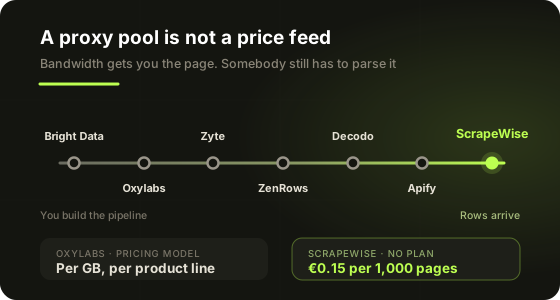
Six Oxylabs Alternatives, Side by Side
Six alternatives, plus Oxylabs itself as the baseline. Price is the column people read first and the one that decides least. The third column is the real question: after the bandwidth bill clears, what is still on your engineering backlog?
| Tool | Pricing model | What you still build | Best for |
|---|---|---|---|
| ScrapeWise | Pay-as-you-go, €0.15 per 1,000 delivered pages | Nothing — validated rows arrive | Price and product data on a schedule, run by business teams |
| Oxylabs | Per GB, priced separately per product line | Parser, schema, scheduling, monitoring | Large residential pools and wide country coverage |
| Bright Data | Per GB, Web Unlocker plans from $499/mo | Parser, schema, scheduling, monitoring | Petabyte-scale enterprise across many data types |
| Decodo | Per GB, lower entry point | Parser, schema, scheduling, monitoring | Smaller teams that want residential IPs without an enterprise contract |
| Zyte | Per 1,000 requests | Extraction schema and the pipeline around it | Scrapy teams that want anti-bot inside the API |
| ZenRows | Monthly request quota | The whole extraction layer | Developers who need an unblocking API, not data |
| Apify | Compute units plus per-actor rental | Actor selection, orchestration, glue code | Developers who want a marketplace of ready-made actors |
Which One Is Actually Right for You
Most comparison pages exist to conclude that the company who wrote them wins. Here is the version that names the cases where we lose.
Stay on Oxylabs if
Your bottleneck genuinely is IP quality — you need residential or mobile exits in specific countries, at volume, and you already have engineers who own the parsing layer and want to keep owning it. Oxylabs is a strong proxy network. That is the job it does, and it does it.
Choose Bright Data if
You need the same infrastructure but at a scale where dedicated enterprise support and a wider product surface matter more than the entry price. It is a lateral move from Oxylabs, not an escape from the build-it-yourself model.
Choose Decodo if
You want residential IPs and the Oxylabs commercial floor is the only thing in your way. Cheaper entry, same architecture — you are still writing the parser and still buying bandwidth rather than data.
Choose Zyte or ZenRows if
You have a working scraper in Python or Node and only the connection layer keeps failing. Both drop in with minimal code change and bill per request instead of per gigabyte, which is easier to forecast. The schema, retries and alerting stay yours.
Choose ScrapeWise if
You want competitor prices, stock levels and product records landing in your systems, and you do not want to run a scraping stack to get them. No plan, no quota, no bandwidth meter — you top up a balance and pay €0.15 per 1,000 delivered pages, with 5 free requests on every new account.
Do not choose ScrapeWise if
You need raw proxy access to point your own crawler at, or your targets are outside e-commerce and marketplace data — ad verification, sneaker bots, SERP harvesting at scale. We deliver structured rows from product pages. If you want an IP pool and nothing else, Oxylabs is the correct tool and we will tell you so.
Oxylabs vs ScrapeWise
Why Teams Leave Oxylabs
Gigabytes Are a Strange Unit for Products
You plan in SKUs and competitors. The invoice arrives in bandwidth. A heavy product page with large images costs multiples of a lean one for the same single price you wanted, and nobody can forecast next month from a SKU count.
The Page Arrives. The Price Does Not
A proxy returns HTML. Turning that into price, availability and title is a parser somebody writes, tests and then maintains — per target site, indefinitely. That work is invisible on the Oxylabs invoice and very visible on your backlog.
Six Product Lines to Choose Between First
Residential, datacentre, ISP, mobile, Web Scraper API, Web Unblocker — each priced separately. Before you extract a single row you are making a procurement decision about which products you need and at what commitment tier.
Failed Runs Still Consume Bandwidth
A blocked request, a redirect to a bot wall, a page that renders empty — the traffic is spent regardless. You pay for the attempt, not the outcome, which is the opposite of how a data budget should behave.
You Still Need the URL Before the API Helps
Every scraper API starts from a list of URLs you supply. Building that list — finding which competitor product pages correspond to your catalogue, and keeping it current as both catalogues turn over — is the unglamorous half of monitoring, and it sits outside the API.
Parsers Are Yours to Keep Alive
Where parsing is on your side, every site redesign lands on your team. The failure is quiet: the request still succeeds, the field comes back empty or wrong, and the first person to notice is whoever trusted the number downstream.
You Wanted Prices. You Bought Bandwidth.
Oxylabs is a serious proxy network and the right purchase when IP quality is genuinely your constraint. But most teams comparing it against alternatives are not trying to buy exits in 190 countries — they are trying to see what four competitors charge for 3,000 SKUs every morning. Those are different products, and only one of them arrives finished.
- ✕ Pick between six product lines before starting
- ✕ Billed per GB — page weight sets the cost
- ✕ Write and maintain a parser for every target
- ✕ Failed runs still consume bandwidth
- ✕ Engineers own the pipeline indefinitely
- ✓ One platform, one rate card
- ✓ Billed per page delivered — €0.15 per 1,000
- ✓ Extraction is our job, not your backlog
- ✓ Only delivered pages are charged
- ✓ Business teams run it without developers
What Monitoring 5,000 SKUs Daily Costs
5,000 SKUs across 6 competitors, refreshed daily, is 900,000 pages a month. Per-GB and per-page billing cannot be directly compared — page weight decides the gigabyte side, so the Oxylabs total depends on which sites you crawl. What is comparable is the floor before a single row arrives, who writes the parser, and what a failed run costs.
| 5,000 SKUs · 6 competitors · daily | Oxylabs | ScrapeWise |
|---|---|---|
| Pages per month | 900,000 | 900,000 |
| What the meter counts | Gigabytes transferred | Pages delivered |
| Plain pages | Per GB — total depends on page weight | €0.15 per 1,000 = €135 |
| JavaScript-rendered pages | Separate product, separate rate | €0.75 per 1,000 = €675 |
| Residential-proxy pages | Separate product, separate rate | €1.50 per 1,000 = €1,350 |
| Failed runs | Bandwidth spent, nothing delivered | Not billed |
| Parser build and upkeep | Your engineers, indefinitely | Included in the per-page rate |
| Adding a seventh competitor | More bandwidth, plus a new parser | Costs the extra pages, nothing else |
Pricing Comparison
Oxylabs
- - Billed per GB of traffic, not per page
- - Residential, datacentre, ISP and mobile priced separately
- - Web Scraper API and Web Unblocker are further products
- - Better per-GB rates require commitment tiers
- - Bandwidth is consumed whether or not the run succeeds
- - Trial credits available on request
Scrapewise
- ✓ Pay-as-you-go: no monthly plan, no quota
- ✓ Plain pages: €0.15 per 1,000 (€0.00015 per page)
- ✓ Render: €0.75 per 1,000 · Super (residential proxy): €1.50 per 1,000
- ✓ You only pay for pages that are delivered
- ✓ 5 free requests on every new account
- ✓ Balance never expires, top-ups from €5
Moving Off Oxylabs
There is nothing to port. Proxy credentials and parser code do not transfer to a managed feed — a migration here is a rebuild of the extraction, typically under 30 minutes per target.
Pull last month's bandwidth report
Not to compare rates — to find out which targets actually consume the budget. Teams are usually surprised: two or three heavy sites carry most of the gigabytes while the SKUs that matter commercially sit on lean pages.
List the fields, not the products
Write down what your pipeline emits at the end: price, availability, title, URL, sometimes shipping and a spec block. That list is the whole migration scope. Whatever it took to get there on Oxylabs is not something you carry across.
Check the 36 ready-made endpoints first
Before rebuilding anything, look at whether your target is already covered by one of the 36 scraping API endpoints. If it is, there is no build step at all — you call the endpoint and rows come back.
Sort the rest by what they actually need
Most e-commerce pages are plain HTML at €0.15 per 1,000. Only pages that hide price behind JavaScript need render at €0.75, and only sites that refuse datacentre IPs need residential at €1.50. Sorting the list is what turns a vague bandwidth budget into a number you can check.
Run both in parallel for one cycle
Keep Oxylabs running for a week and diff the two outputs on the same SKUs. This is the step teams skip and then regret — it is the only honest way to compare delivery rates instead of marketing claims.
Cut over and stop buying bandwidth
Once the diff is clean, move the remaining targets and let the commitment lapse at renewal. There is no plan to negotiate on our side — you top up a balance, and a month where you scrape nothing costs nothing.
Buy the Data, Not the Gigabytes.
Oxylabs is the right purchase when IP quality is your actual constraint and you have engineers who want to own the parsing layer. If what you need is competitor prices in your systems every morning, ScrapeWise delivers finished rows at €0.15 per 1,000 pages — no plan, no bandwidth meter, no parser to maintain.
Frequently Asked Questions
Common questions when comparing Oxylabs alternatives and competitors.
It depends what you are replacing. For like-for-like proxy infrastructure, Bright Data at the enterprise end and Decodo at the lower end are the closest swaps. For an unblocking API to drop into existing scraper code, Zyte or ZenRows. If what you actually want is the data — competitor prices and product records arriving as validated rows with no parser to maintain — ScrapeWise, at €0.15 per 1,000 delivered pages with no monthly plan.