
Key takeaways
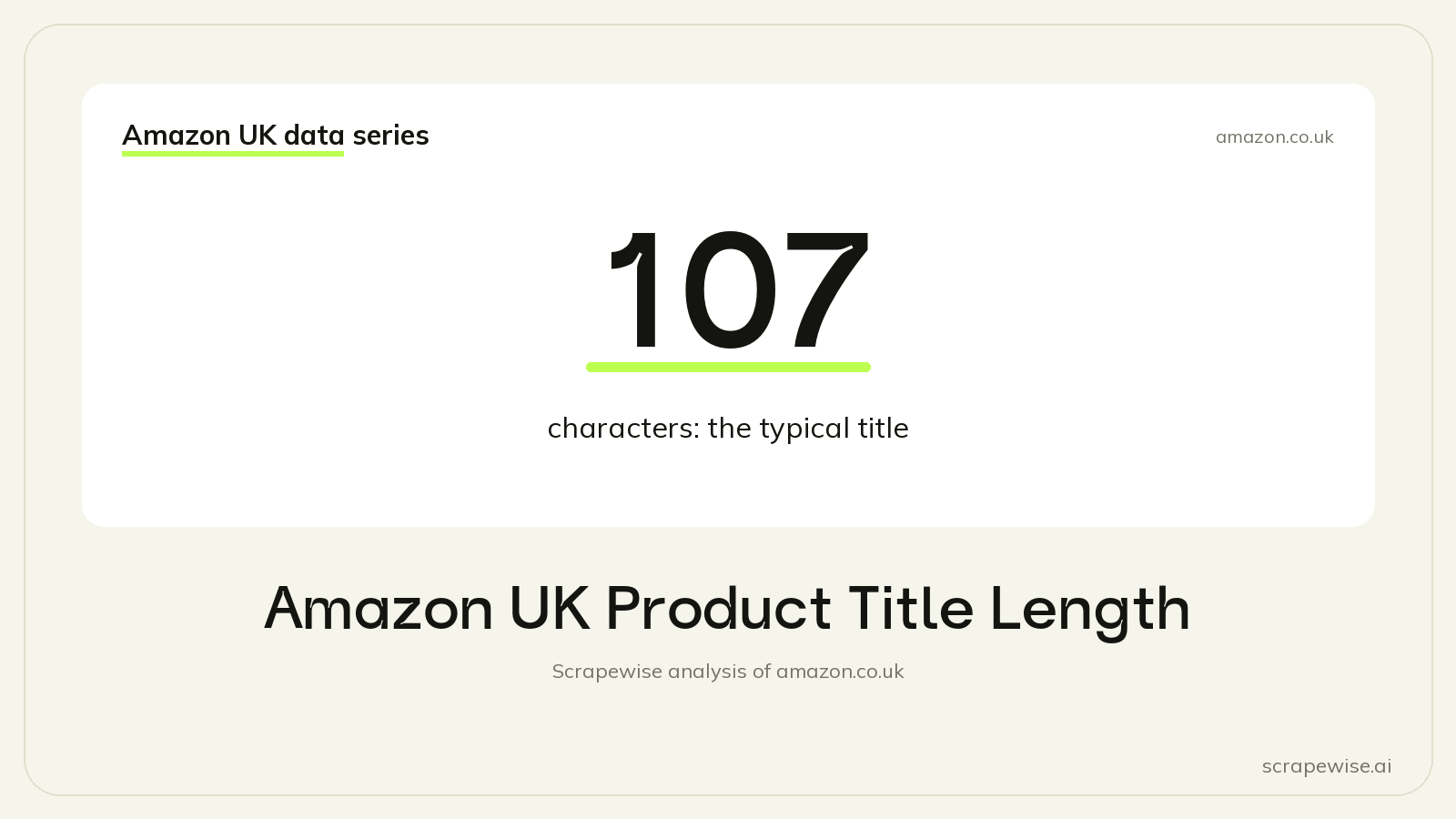
- The median Amazon UK product title is 107 characters, and 34.5% of titles run to 150 characters or more.
- Median title length rises from 98 characters on page 1 to 113 on page 7 of search results.
- 235 titles still carry the year 2025 and 712 carry the year 2026.
The typical Amazon UK product title runs 107 characters, the median across the 197,022 products in our sample, and titles on page 1 of search are shorter, at a median of 98. We checked every title in a snapshot of amazon.co.uk taken on 23 to 24 September 2026.
The Data
We counted the characters in every product title we collected, exactly as the title appeared in search results. The middle of the range is tidy. The ends are not.
| Measure | Title length |
|---|---|
| Median, all products | 107 characters |
| Median, page 1 of search | 98 characters |
| Median, page 7 of search | 113 characters |
| Longest tenth of titles start at | 189 characters |
| Share of titles at 150 characters or more | 34.5% |
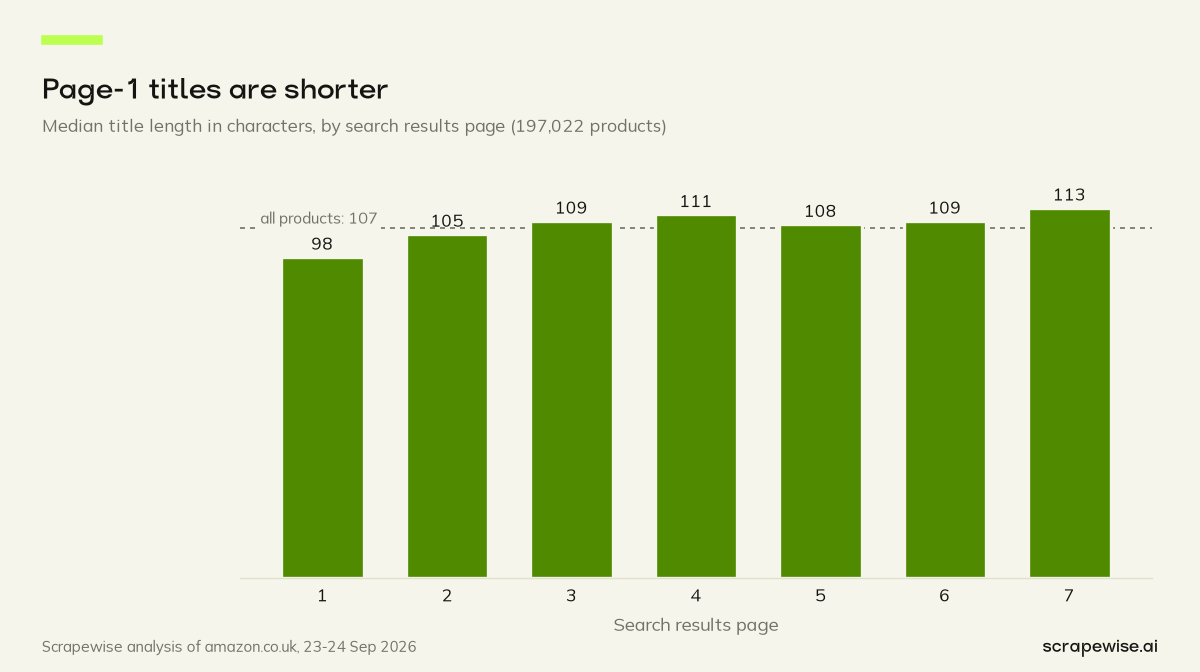
Long titles are common. 34.5% of titles run to 150 characters or more, so this is a habit of the whole market. Page 1 pulls the other way, with titles you can often read at a glance on a phone.
Page 1 Titles Are Shorter
Title length grows as you move down the results. The median is 98 characters on page 1 and 113 on page 7. The rise wobbles from page to page, but the first and last pages are clearly apart.
That does not prove short titles rank better. A simpler reading fits the data. Amazon is among the sellers on 23.8% of page 1 products, against 12.8% on page 7. On single-seller listings where Amazon is the only seller, the median title is 93 characters, shorter than any other seller group we measured. More Amazon listings on page 1 would pull the page 1 median down.
Big brands are the other likely factor. A well-known brand can lead with its name and a short product type, because shoppers already know what it is. A new seller tends to pack the title with every search term that might help. For the wider page 1 picture, from reviews to labels, see our post on how to rank on page 1 of Amazon.
Title Length by Seller Group
On single-seller listings, we can link each title to the seller's declared business address. The gap between groups is wide.
| Seller group, single seller only | Median length |
|---|---|
| Amazon | 93 characters |
| EU countries | 106 characters |
| United States | 115 characters |
| United Kingdom | 123 characters |
| Hong Kong | 126 characters |
| China | 133 characters |
Sellers with a declared China address write the longest titles, at a median of 133 characters, and Amazon's own listings the shortest. UK-based sellers sit in between at 123. Length tells you about listing style. It is no guide to quality, and a long title full of useful search terms can be a sensible choice for a brand nobody knows yet.
The groups also sell different things. Sellers with a declared China address hold large shares of single-seller listings in crafts, electronics and office supplies, categories where titles tend to carry sizes, counts and compatible models. Part of the gap may come from the product mix rather than the writing style alone.
The Words Sellers Reach For
We also counted how often common selling words appear in titles. Each one is in a small share of titles, but across 197,022 products even a small share adds up to hundreds or thousands of listings.
| Word or phrase | Share of all titles |
|---|---|
| kids | 3.9% |
| portable | 3.8% |
| waterproof | 3.6% |
| gift or gifts | 2.7% |
| pack of | 2.6% |
| heavy duty | 2.6% |
| premium | 1.5% |
| upgraded | 0.3% |
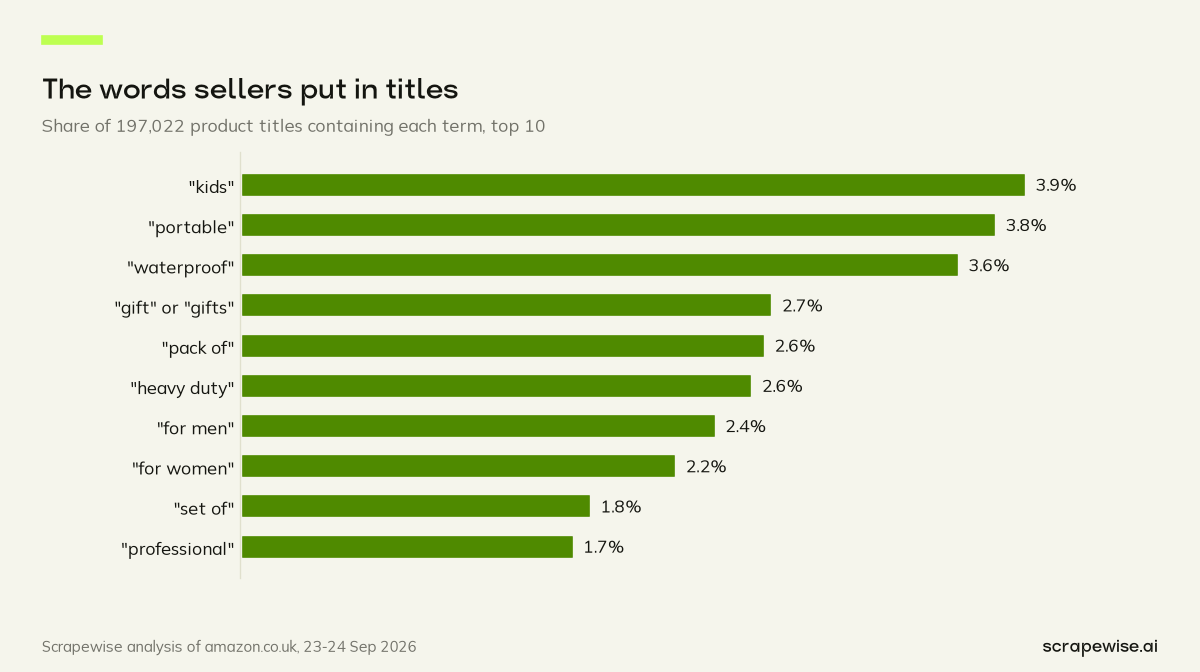
The list splits into three kinds of word. "Kids" and "gift" say who the product is for. "Portable", "waterproof" and "heavy duty" name a feature. "Pack of" gives a quantity, which is the most useful of the lot for a shopper comparing prices, and the one a price monitor most needs to read correctly.
Only 0.3% of titles call the product upgraded. The rest, presumably, are the original. The word is more common on single-seller listings from sellers with a declared China address, at 0.7%, than from UK-based sellers, at 0.1%.
Years show up too. 712 titles carry 2026 as the first year they mention. In September 2026, 235 titles still carry the year 2025. Some copy ages faster than the product.
What It Means for Sellers and Brands
Put the words that sell near the start of the title. Search results and phone screens often cut long titles short, so the product type, the brand and the key feature should come first. The typical title is 107 characters, so the end of it is the part most likely to be cut.
Check your titles against the page you want to reach. If page 1 for your search is full of short, brand-led titles, a very long keyword list will look out of place, even if it helps the listing get found.
Go easy on buzzwords. "Premium" and "upgraded" appear in few titles, and they tell a shopper little. A plain fact, such as the size, the pack count or the material, does more work in the same space.
Dates need upkeep. A year in the title helps in its own year and looks stale the next. If you use one, put a reminder in the calendar to change it in January.
Watch how rivals change their titles. A competitor that shortens its titles, adds a pack size or drops a buzzword is testing something. A weekly pull of the titles on your main searches shows those changes without anyone reading page after page by hand.
Identical titles are not identical products either. Two listings can share a title and differ in pack size, which is why title matching alone breaks price comparisons. We cover that in same product, different price on Amazon. For a structured way to compare your range with rivals, see our guide to competitor assortment gap analysis, and for the full dataset, our Amazon UK marketplace statistics report.
How We Collected This Data
Three Scrapewise scrapers fed this post, one after the other. First, the Amazon Search API collected seven pages of results for each of 868 searches on amazon.co.uk. Each row carried the product's full title, search page and position, which gave us the lengths, the page split and the word counts. The Amazon Offers API returned the sellers on each product, so we could find the single-seller listings and see whether Amazon was the seller. The Amazon Seller API returned each seller's declared business address, which set the seller group; we publish only aggregates.
Each of the three costs €0.00015 per call, or €0.15 per 1,000 calls, and hands over its rows through the REST API or a CSV/Excel export. Create an account to pull the titles from your own searches.
Want to see how your titles stack up against page 1? Try it with 5 free requests, then pay as you go. Sign up here or compare pricing.
Paste a marketplace URL — get structured market data
Size categories, track assortments, monitor trends. Clean feeds ready for your BI stack.
97% accuracy on Amazon benchmarks · no credit card · book a 15-min call →