
Key takeaways
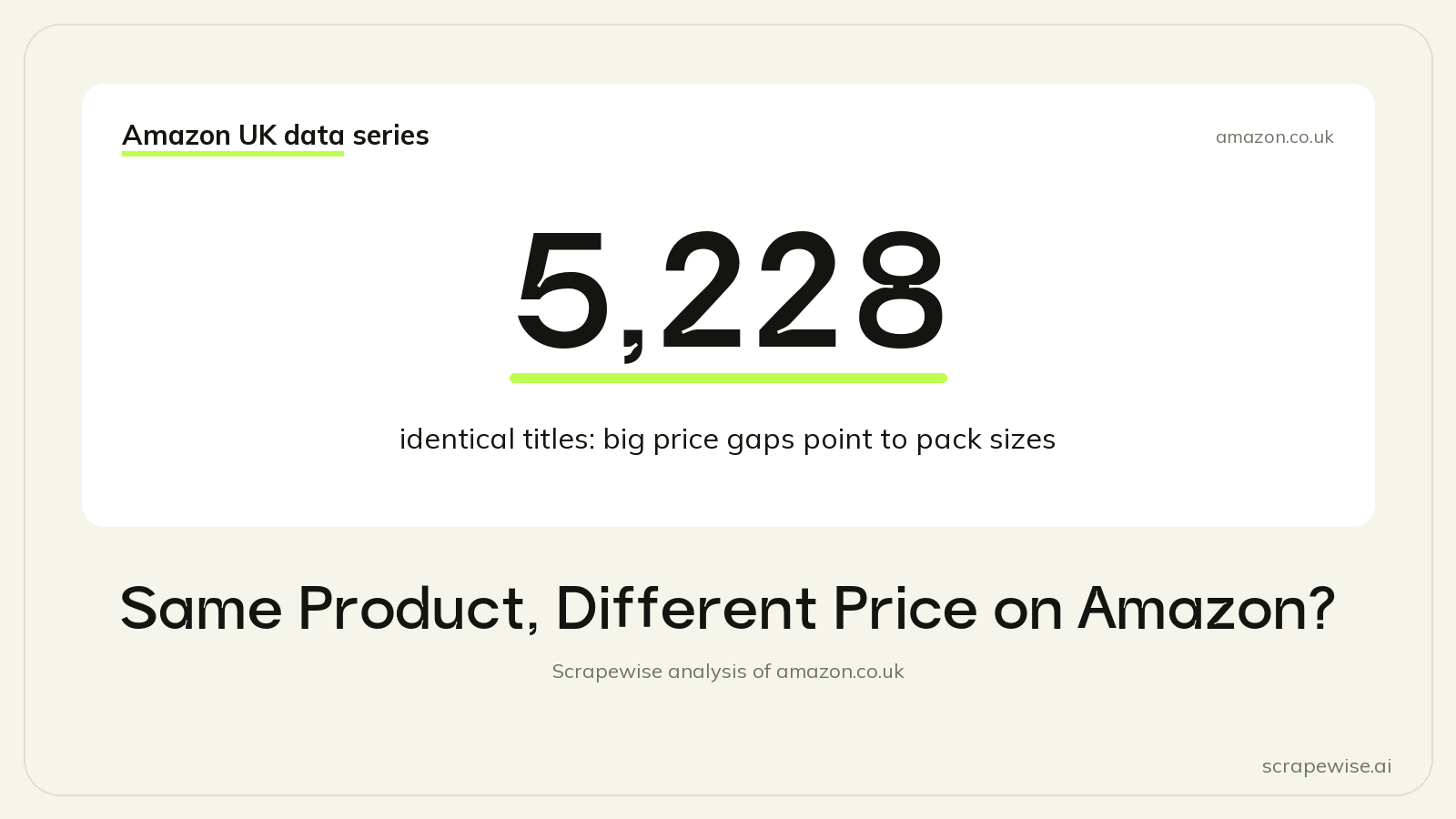
- 5,228 identical titles appear on two or more Amazon UK product pages, covering 11,607 listings.
- The median price gap inside a group of identical titles is 8.7%.
- 324 identical-title groups are priced 2x or more apart, and the types with the most such groups are sold in several sizes or counts.
When the same product title shows different prices on Amazon UK, the gap is usually small: across 5,228 identical titles listed on two or more product pages, the median price gap is 8.7%, and the big gaps mostly point to pack sizes. We matched the titles word for word in amazon.co.uk search results collected on 23 to 24 September 2026.
The Data
On Amazon, every product page has its own ASIN. In theory, one product gets one page. In practice we found 5,228 titles that appear, word for word, on two or more separate product pages. Together those groups hold 11,607 listings.
| Measure | Value |
|---|---|
| Titles found on two or more product pages | 5,228 |
| Listings inside those groups | 11,607 |
| Median gap between the cheapest and dearest listing in a group | 8.7% |
| Groups priced 2x or more apart | 324 |
| Widest gap between identical titles | 18x |
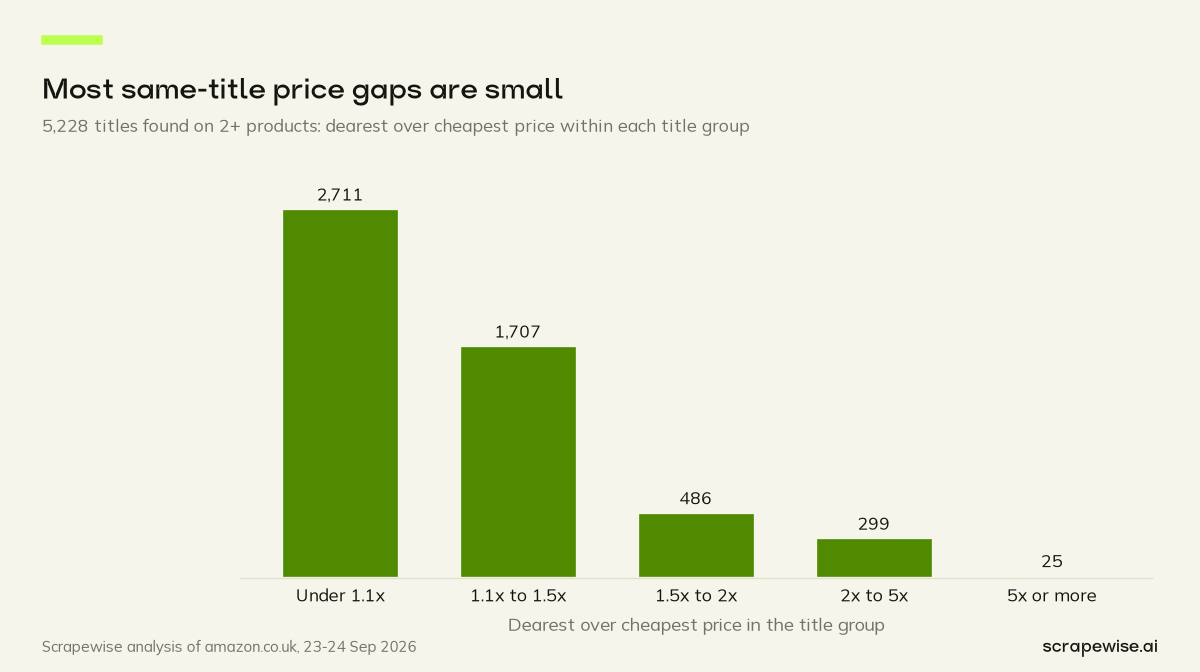
Most groups sit at the left of the chart. Identical titles are also a small minority of the market: the 11,607 listings in these groups are a small slice of the 197,022 products we checked, so most listings have a title of their own. The median gap of 8.7% is the kind of difference you would expect from two sellers pricing the same item a little differently, or one listing carrying a small discount on the day. Those gaps are real, and they are what price monitoring is built to catch.
Where the Big Gaps Come From
The interesting part is the long tail: 324 groups where the dearest listing costs at least twice as much as the cheapest. The widest gap between identical titles was 18x. It is tempting to read that as "the same product at 18 times the price". Most of the time, it is not.
When we looked at which product types those 324 groups belong to, a pattern stood out. The types with the most such groups are things sold in several sizes, weights or counts:
- Fitness kit: barbells, dumbbell sets, adjustable dumbbells, weight plates, kettlebells and pull-up assist bands.
- Supplements: whey protein, glutamine, apple cider vinegar tablets and mass gainer.
- Consumables: shampoo, conditioner, cotton pads, baby wipes, printer paper and highlighters.
- Baby formula, which comes in several tin sizes.
Not every type fits the pattern. Drills also appear near the top, where a bare tool and a kit with batteries could plausibly share a title.
A listing for a single dumbbell and a listing for a set can share one title. So can a single bottle of shampoo and a multipack. Two listings can carry the same title, word for word, and still disagree about how many bottles are in the box. The title is the same; the product in the parcel is not.
This is why we read most big gaps as pack sizes, and why "up to 18x" appears in this post only as the widest title gap, never as a same-product price difference.
How to Spot a Pack-Size Gap
You do not need a data team to tell a pack-size gap from a real price difference. A few checks catch most of them:
- Work out the price per unit. If two listings share a title but one costs much more, divide each price by the count, weight or volume. When the unit prices land close together, the gap was the pack.
- Read the end of the title. Sellers sometimes add the size or count at the very end, after the part that stays the same across listings, so the words that differ are easy to miss.
- Look for round multiples. A gap that lands close to a round multiple, such as a price that is almost exactly double, often points to a twin pack rather than a markup.
- Check the product page. The specs and variant table usually state the size, even when the title does not.
If a gap survives all four checks, it is probably a real price difference, and that is the kind worth acting on.
Identical Titles Are Not Identical Products
If you compare prices across listings, whether as a shopper, a brand or a price analyst, the lesson is the same: a title is a description, not an identifier. Sellers write titles for search, and some reuse one title across several sizes.
A matching rule that pairs listings by title alone will do two wrong things at once. It will report a large price gap between a single item and a multipack, and it will hide the real, smaller price differences between genuinely identical products underneath that noise.
A better match uses more than the title:
- The product ID where one exists: ASIN inside Amazon, EAN or GTIN across shops.
- Size, weight, volume or count, read from the product page and normalised to a unit price.
- Variant attributes such as colour or strength, where the same title covers several.
Our deeper guides on product matching for price monitoring and AI product data matching cover how to do this at scale. If you rely on barcodes, our post on EAN and GTIN matching failure modes lists the ways that goes wrong too. On one product page the gap is smaller: on multi-offer products, the dearest new offer asks a median 1.34x the cheapest, as our study of the price difference between Amazon sellers shows.
What It Means for Sellers and Brands
For sellers, identical titles across sizes are a double-edged habit. They help each listing rank for the same search, but they also invite a shopper to compare a single item with a multipack and wonder why one is so dear. Putting the pack size or weight at the front of the title removes the doubt.
For brands, this data is a warning about price reports. A report built on title matching will flag "price gaps" that are really pack sizes, and someone will spend a morning chasing them. A report that normalises to a unit price will show which gaps are worth a call. For how price levels differ across whole categories, see average price on Amazon UK by category.
The complete Amazon UK marketplace report shows how this finding fits with the rest of the dataset.
How We Collected This Data
The data comes from the Amazon Search API, which we ran over results pages 1 to 7 on amazon.co.uk for 868 keywords. It returned the ASIN, the full title and the listed price of each product, which was enough to group identical titles and measure the gap inside each group. It is charged at €0.00015 per call (€0.15 per 1,000 calls), one results page per call. The Amazon Product API was not used in this study. It returns a single product page as one row with specs and variants, which is where pack size and count usually live, so it is the next step if you want to match by unit price. Both can run daily, every few days, weekly or monthly, or on demand, with rows through the REST API or a CSV/Excel export. Create a login to find duplicate titles in your own searches.
Which of your price gaps are real, and which are just a bigger box? Sort them out with 5 free requests, then pay as you go. Join here or go over the pricing.
Paste a marketplace URL — get structured market data
Size categories, track assortments, monitor trends. Clean feeds ready for your BI stack.
97% accuracy on Amazon benchmarks · no credit card · book a 15-min call →