
Key takeaways
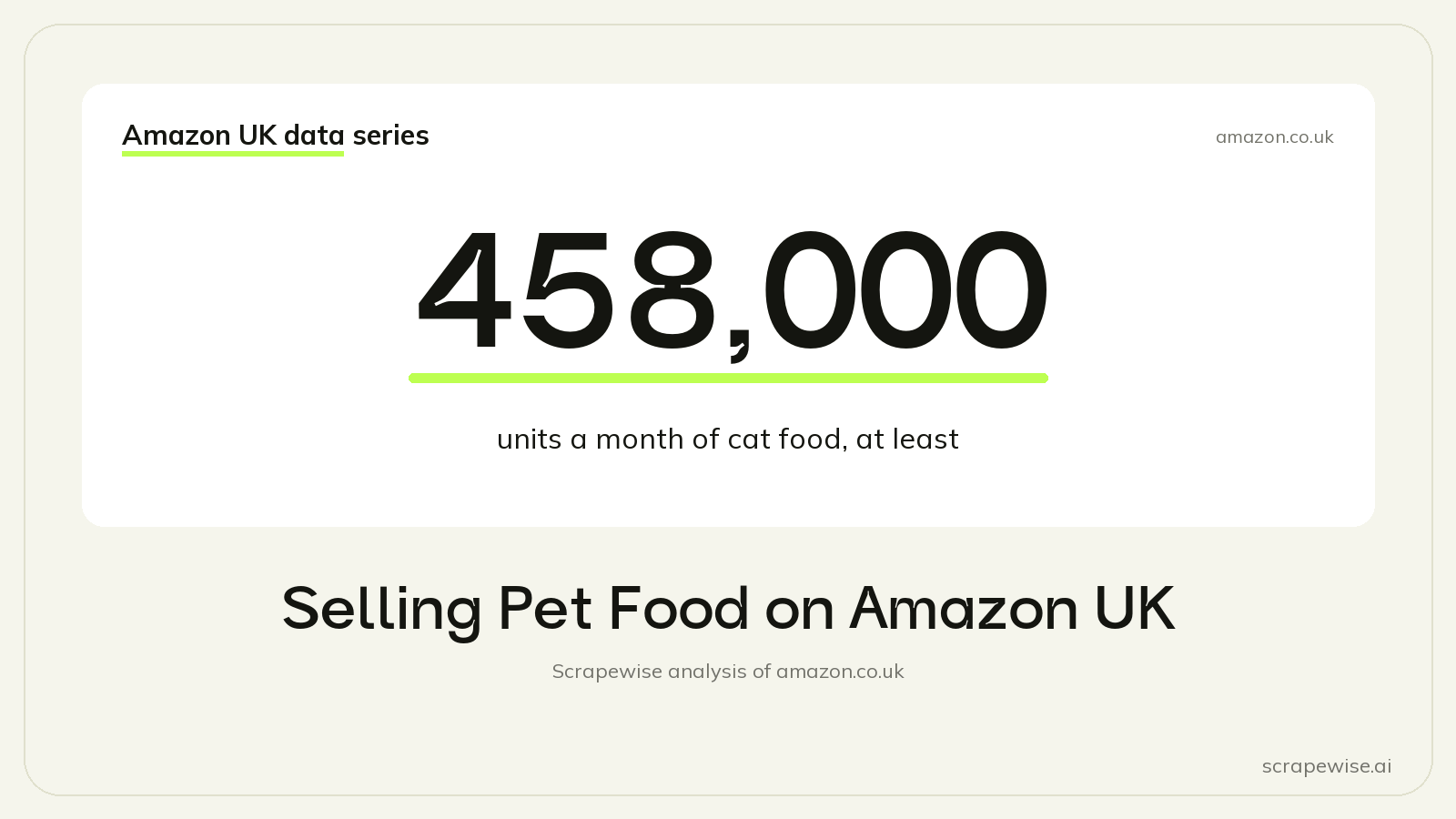
- Listings in the cat food search showed at least 458,000 units bought a month, the highest sales floor of any search in our sample.
- Among products with offer data, dog food listings averaged 7.70 sellers and cat food listings 6.98, and Amazon was among the sellers on 66.2% and 67.6% of them.
- Every rated dog food listing we saw scored 4 stars or more.
Selling pet food on Amazon UK means entering a large and crowded market: listings in the cat food search showed at least 458,000 units bought a month, and among products with offer data, dog food listings drew 7.70 sellers each on average. The figures come from pet searches in a snapshot of amazon.co.uk taken on 23 to 24 September 2026.
The Data
Pet food is two searches, really, and both are big. The cat food search has the highest sales floor of any of the 868 keywords in our sample, and dog food is not far behind. Here is how the two compare:
| Measure | cat food | dog food |
|---|---|---|
| Units bought a month, at least | 458,000 | 384,000 |
| Listings with a "bought in past month" label | 99.2% | 99.0% |
| Mean sellers per listing, products with offer data | 6.98 | 7.70 |
| Listings where Amazon is among the sellers | 67.6% | 66.2% |
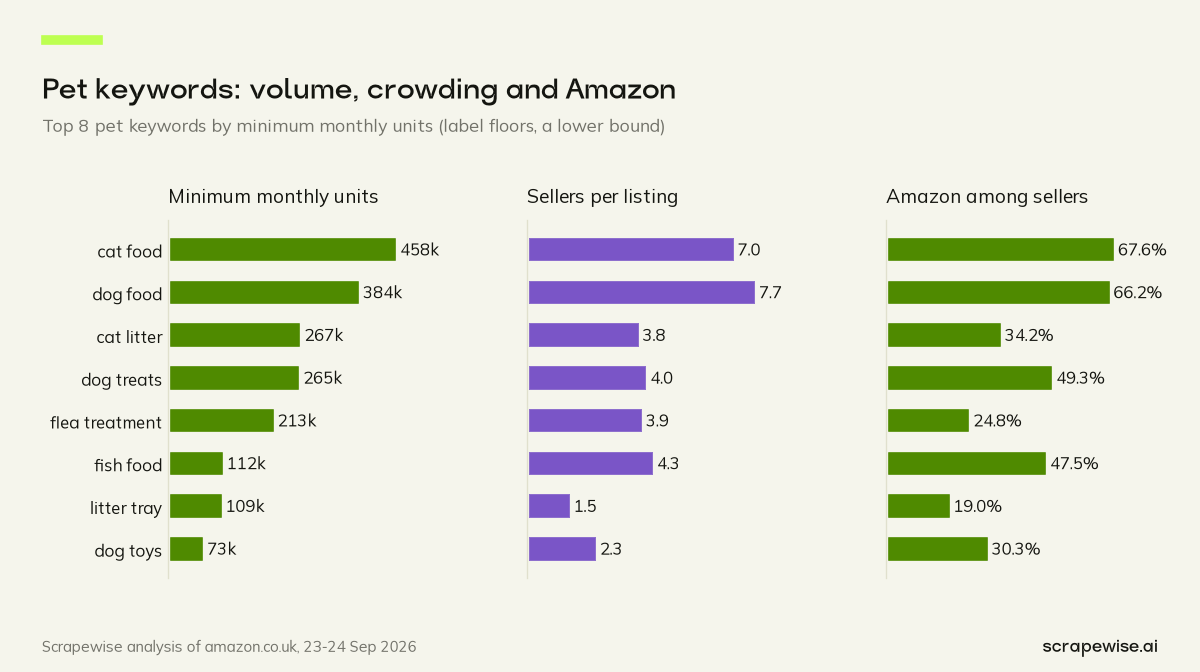
Cat food shows a higher sales floor than dog food, at least 458,000 units a month against at least 384,000. The cats will not be surprised. Both numbers are floors built from Amazon's rounded labels, so the real volumes are higher, and the gap between them could be larger or smaller than it looks.
The label shares are the striking part: 99.2% of cat food listings and 99.0% of dog food listings carry a "bought in past month" label. Across all 197,022 products in our sample, the figure is 36.6%. In pet food, a listing without a sales label is hard to find.
The Pets Category as a Whole
Pet food sits inside a wider pets category that is healthy but less extreme. Across all pets searches, products showed at least 2.43 million units bought a month, out of at least 29.5 million for our whole sample. The share of pets listings with a sales label, 42.8%, is above the 36.6% for all products, but nowhere near the pet food searches.
Prices across the category are ordinary. The median priced pets product costs £16.99, exactly the same as the median across all priced products.
The food searches pull far ahead of the rest of the category, and the likely reason is simple. A bag of food empties on a timetable, while a pet bed or a grooming brush can last for years. Monthly labels reward the products that keep coming back into the basket.
Crowded Listings, With Amazon on Most of Them
The volume attracts sellers. Among products with offer data, a dog food listing carries 7.70 sellers on average and a cat food listing 6.98. For comparison, 72.1% of all products with offer data have a single seller. Dog food is the second most crowded search in our sample, after LEGO sets, as our post on the most competitive Amazon products shows.
Amazon is part of that crowd. It was among the sellers on 67.6% of cat food listings and 66.2% of dog food listings, against 17.2% of products across the whole sample. On most pet food listings, third-party sellers share the offer page with Amazon itself. For how that plays out on price, read does Amazon compete with its own sellers.
Our capture stops at about 11 sellers per product, so on the busiest pet food listings the real seller count is likely higher than we recorded.
Ratings: A Generous Audience
Dog food is also one of the best-rated searches we measured. Every rated dog food listing we saw scored 4 stars or more. For comparison, 89% of all rated products in our sample reach 4 stars or more.
High ratings across the board mean stars do little to set one dog food listing apart from another. When every rated listing clears 4 stars, shoppers have to decide on price, pack size, brand and delivery instead. For a wider view of what counts as a strong score, see what is a good Amazon rating.
What It Means for Sellers and Brands
For resellers of branded pet food, the numbers describe a crowded market. On most listings you share the offer page with several other sellers, and on most of them Amazon is one of those sellers. Winning there usually comes down to price and stock, day after day.
For pet food brands, a crowded listing is a pricing and control question. Many resellers on the same page make it harder to hold a consistent price, which is where MAP monitoring for brands comes in. It helps to know who is selling your product on Amazon, and at what price, before a price war starts on your own listing.
For new entrants, the high label shares cut both ways. They prove the demand, but they also mean almost every competing listing already has sales history and reviews. A new pet food product starts behind a queue of listings that are nearly all, by Amazon's own labels, already selling.
For category analysts, remember that label floors understate volume and that the pets category mixes food with toys and accessories. For how pets compare with the other categories, see our ranking of best selling categories on Amazon UK, and for the wider method, the complete Amazon UK marketplace report.
Questions to Ask Before You List Pet Food
Before you commit stock or ad spend to a pet food listing, the data points to a short checklist:
- How many sellers are already on the offer page, and is Amazon one of them?
- Does the listing carry a sales label, and how high is it? In pet food, a missing label is itself a warning sign.
- How do your landed costs compare with the lowest offer on the page, after fees and delivery?
- Is there a pack size, flavour or format that the crowded listings do not cover?
The last question matters most for new brands. Competing head-on with a listing that already has several sellers and Amazon is a price fight. A different pack size or recipe starts its own listing, with its own offer page.
How We Collected This Data
Two Scrapewise scrapers built this picture. The Amazon Search API covered the pet searches in our set of 868 amazon.co.uk keywords, seven pages each, and returned each product's price, star rating and "bought in past month" label. The Amazon Offers API read each product's offer page and returned one row per offer, with the seller and whether it was Amazon, which gave us sellers per listing and Amazon's presence. Both bill €0.00015 per call, or €0.15 per 1,000 calls. Put them on a schedule and the dashboard keeps a price history for every listing you follow. Create an account to follow the pet food listings you sell on.
Have pet products of your own to check? Begin with 5 free requests and pay as you go from there. Sign up here or compare pricing.
Paste a marketplace URL — get structured market data
Size categories, track assortments, monitor trends. Clean feeds ready for your BI stack.
97% accuracy on Amazon benchmarks · no credit card · book a 15-min call →