

Introduction
Off-the-shelf MAP monitoring software has a fundamental limitation: it only watches the retailers you manually configure it to watch. When a new unauthorized reseller appears on a regional marketplace, or a distributor starts leaking product to grey-market channels you've never heard of, your SaaS tool is blind to it.
Brands with serious MAP programs are solving this differently. Instead of relying on a closed tool with a fixed retailer list, they're building their own monitoring layer on top of scraping infrastructure — giving them coverage of any URL, any marketplace, any region, on their own schedule.
This guide covers how to build that system: what data to collect, how to structure product matching, how to set scraping cadence by category, and how to wire it into an alert and evidence workflow. We'll also cover the MAP policy context that determines what you're actually enforcing, because the best scraping infrastructure in the world doesn't help if your policy has gaps.
The numbers make the business case clear. 58% of brands report MAP violations as a recurring issue. Priceva's data shows ~30% of tracked products show serious MAP deviations daily, resulting in an average 18% margin loss. Brands with automated enforcement see 40-80% fewer violations. The gap between those outcomes is almost entirely about monitoring coverage and speed — both of which are data infrastructure problems, not policy problems.
Finding the listing is half the job: each one has to be tied to the right SKU and pack size before a price or a seller counts as a violation. Scrapewise matches marketplace listings to your products and feeds MAP monitoring with seller and price rows.
What is MAP Monitoring?
MAP monitoring is the automated process of tracking advertised prices across all your sales channels to ensure retailers comply with your Minimum Advertised Price policy.
A MAP policy sets the lowest price a retailer can publicly advertise your product — not the price they ultimately sell it for. Retailers can still offer lower prices at checkout, but they cannot display those prices in product listings, Google Shopping feeds, email campaigns, or any public-facing marketing.
The distinction matters legally. In the United States, MAP policies remain legal under federal antitrust laws because they restrict advertising, not actual resale prices. However, enforcement is entirely your responsibility. Without active monitoring, even well-intentioned retailers drift below MAP under competitive pressure, and unauthorized sellers undercut everyone.
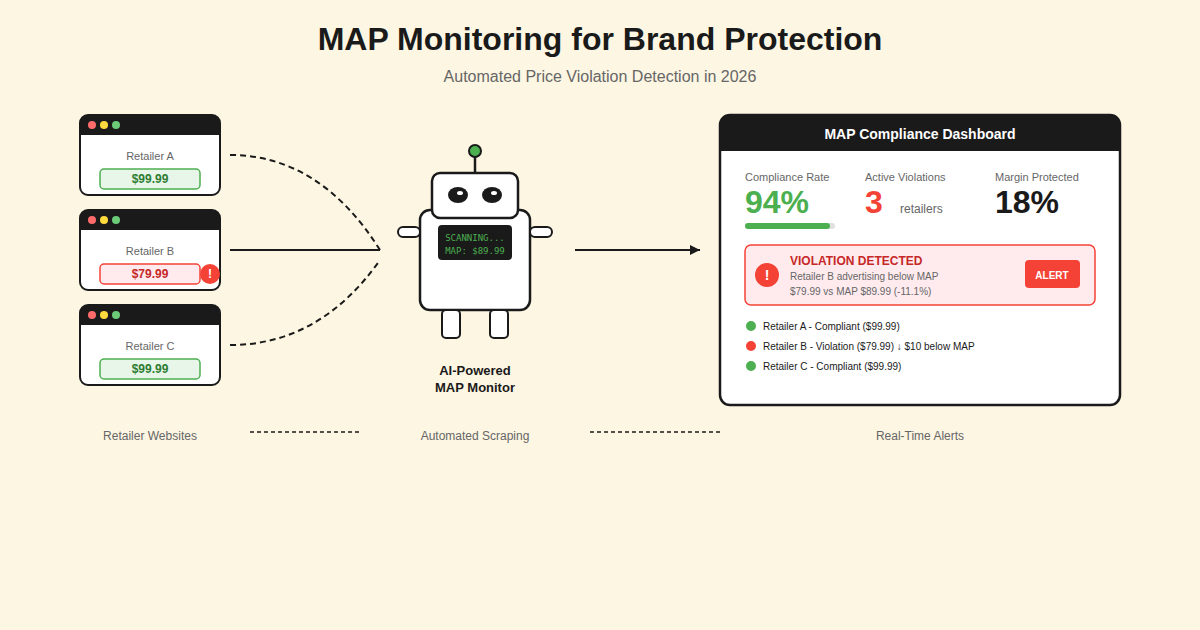
Modern MAP monitoring systems work by continuously scraping product listings across authorized retailers, marketplaces like Amazon and eBay, Google Shopping feeds, and even social media ads. They match products using SKUs, GTINs, or AI-powered product recognition, then flag any advertised price that falls below your defined threshold.
Why MAP Compliance Matters More in 2026
The e-commerce landscape has shifted dramatically. Three forces make MAP enforcement more critical — and more difficult — than ever before.
Price transparency is absolute. Comparison shopping tools, browser extensions like Honey, and AI shopping assistants surface every price difference instantly. One retailer advertising below MAP doesn't just capture sales — they make your compliant partners look overpriced. According to Priceva's MAP monitoring data, about 30% of tracked products show serious MAP deviations daily, resulting in an average 18% loss in profit margins for affected brands.
Marketplaces have multiplied. Your products now appear on Amazon, eBay, Walmart Marketplace, regional platforms, social commerce, and countless niche retailers. Manual price checking across this ecosystem is impossible. The price monitoring software market itself is projected to reach $2.17 billion by 2026, reflecting how seriously brands take automated price intelligence.
Anti-bot defenses have intensified. Ironically, the same protections that make websites harder to scrape also make it harder for brands to monitor their own pricing. Sites use sophisticated fingerprinting, behavior analysis, and real-time traffic monitoring to detect automated access. This means DIY monitoring scripts break constantly, and brands need professional-grade scraping infrastructure to maintain visibility.
For brands that sell through distributors, MAP violations aren't just about lost margin. They signal to compliant retailers that playing by the rules puts them at a disadvantage. Over time, this erodes channel relationships and can push reliable partners toward competitors who enforce their policies.
How Automated MAP Monitoring Works
Effective MAP monitoring combines web scraping, product matching, and alert systems into a continuous compliance workflow. Here's what happens behind the scenes.
Data collection begins with automated scrapers that visit retailer websites, marketplace listings, and advertising platforms on a scheduled basis — often daily or even hourly for fast-moving categories. These scrapers must handle JavaScript-rendered pages, login walls, regional pricing differences, and anti-bot protections. Platforms like ScrapeWise use AI-powered extraction that adapts automatically when websites change their layouts, eliminating the maintenance burden that breaks traditional scraping approaches.
Product matching identifies your specific SKUs across different retailers, even when product titles, images, or descriptions vary. This typically uses a combination of GTIN/UPC matching, SKU lookup, and increasingly, AI-based product recognition that can match products visually or semantically.
Violation detection compares collected prices against your MAP thresholds. Good systems distinguish between the advertised price and promotional tactics like "see price in cart" that may or may not violate your policy depending on how it's structured. They also capture screenshots as evidence for enforcement actions.
Alerting and reporting notify your team immediately when violations occur. The best platforms prioritize alerts by severity — distinguishing a $5 deviation from a catastrophic 40% discount — and provide historical data to identify repeat offenders versus one-time errors.
Enforcement integration connects monitoring data to your compliance workflow, whether that's automated warning emails, CRM updates, or documentation for legal action against unauthorized sellers.
Building a MAP Monitoring Scraper: What to Collect and How Often
This is the part most guides skip. Here's the field-level detail for a production MAP monitoring scraper.
Fields to capture per listing:
| Field | Why it matters |
|---|---|
advertised_price |
The displayed price — what MAP covers |
cart_price |
May differ from advertised (see "add to cart for price" tactic below) |
was_price / strikethrough_price |
Evidence of implied discount even if advertised price is compliant |
seller_name |
Distinguish authorized vs unauthorized sellers, especially on Amazon |
marketplace_seller_id |
Stable identifier even when seller display names change |
product_identifier (SKU/GTIN/EAN) |
Required for cross-retailer product matching |
listing_url |
Permanent link for evidence capture |
screenshot_hash |
Verifiable screenshot for enforcement documentation |
scraped_at (timestamp with timezone) |
Flash sales often last only hours — timestamp precision matters |
region / country_code |
MAP thresholds differ by market; same SKU may have different minimums |
Scraping cadence by category:
Not all products need the same monitoring frequency. Scraping everything hourly is expensive and unnecessary.
- High-velocity / promotional categories (electronics, footwear, sporting goods): every 4–6 hours during peak retail hours. Flash sales and coupon drops often resolve within a day.
- Mid-velocity (home goods, apparel, beauty): daily is usually sufficient. Violations tend to persist for days before they're caught or corrected.
- Long-tail / low-volume SKUs: 2–3x per week. The violation risk here is lower; save your scraping budget for priority products.
- New product launches: hourly for the first 30 days. Pricing discipline is most fragile at launch when unauthorized sellers are sourcing early stock.
Product matching across retailers:
The hardest part of MAP monitoring at scale isn't scraping — it's correctly identifying your product in a listing where the title, image, and description may all be different from your master catalog.
The matching hierarchy, in order of reliability:
- GTIN/EAN/UPC exact match — most reliable, works across Amazon, eBay, Google Shopping
- Manufacturer part number (MPN) — reliable for B2B and industrial categories
- SKU lookup via retailer-specific product ID — requires maintaining a mapping table per retailer
- AI semantic matching — fallback for private-label or bundle scenarios where standard identifiers are absent; compares product titles, descriptions, and images using embedding similarity
For brands with large catalogs, a separate product matching microservice fed by scraped data works better than trying to do matching inline in the scraper. ScrapeWise's product matching API handles this layer, returning structured matches with confidence scores so your violation detection logic only acts on high-confidence hits.
Evidence capture for enforcement:
MAP violation enforcement requires documentation that can withstand a retailer dispute. For each detected violation, capture:
- Full-page screenshot with visible URL, timestamp, and price
- The raw HTML price element (in case the screenshot is disputed)
- Session replay if the violation requires a "see price in cart" interaction
- Historical price array for the same SKU at that retailer (shows pattern vs one-off error)
Store screenshots with a content-addressable hash so you can prove the image hasn't been altered since capture. This matters when violations go to legal.
Common MAP Violation Tactics to Watch
Retailers have developed sophisticated methods to advertise below MAP without appearing to violate the letter of your policy. Your monitoring system needs to catch these tactics.
"See price in cart" or "Add to cart for price" hides the actual price until the customer takes an action. Whether this constitutes a MAP violation depends on your policy language. Recent case law suggests that prices displayed within shopping carts may fall outside MAP protection, making clear policy definitions essential.
Bundle pricing combines your product with accessories or services at a "discount" that effectively prices your item below MAP. Monitoring systems need to identify when your products appear in bundles and calculate the implied individual price.
Coupon stacking layers multiple promotional codes to reach below-MAP prices. While the base advertised price may be compliant, the effective price after applying readily available coupons might not be.
Time-limited flash sales drop prices briefly, hoping the violation goes undetected before monitoring catches it. This is why daily or hourly monitoring matters more than weekly spot-checks.
Regional or international arbitrage exploits different MAP thresholds across markets. A product might be compliant in one country but violate policy when resold into another market through gray-market channels.
Building Your MAP Monitoring Stack
For brands serious about MAP compliance, the monitoring stack typically includes several components.
Web scraping infrastructure forms the foundation. This can be an in-house solution using tools like Scrapy or Playwright, a managed scraping service, or a purpose-built competitive price monitoring platform. The key requirements are reliability across diverse websites, automatic adaptation to site changes, and compliance with rate limits to avoid being blocked.
Product data management maintains your master catalog with SKUs, GTINs, MAP prices by region, and any promotional periods where different thresholds apply. This needs to integrate with your monitoring system so price comparisons are always current.
Alert and workflow management routes violations to the right team members and tracks resolution status. Many brands integrate this with existing CRM or ticketing systems rather than managing it separately.
If you are weighing a vendor suite for this layer, see what PriceSpider Brand Monitor and Prowl do for MAP compliance.
Evidence capture stores screenshots, timestamps, and price history for each violation. This documentation is essential for enforcement conversations and potential legal action against unauthorized sellers.
Reporting and analytics reveal patterns over time: which retailers violate most frequently, which products are most affected, seasonal trends, and the financial impact of violations.
Connecting Monitoring Data to Your Enforcement Workflow
Monitoring without enforcement is just expensive observation. Once your scraper detects a violation, the data needs to flow somewhere actionable.
Violation prioritization by severity. Not all violations are equal — route them differently:
- ≥20% below MAP, major retailer: immediate escalation, same-day response
- 5–20% below MAP, authorized retailer: automated warning email with screenshot attached, 48-hour resolution window
- <5% deviation, first occurrence: log and monitor for recurrence before acting
- Unauthorized seller: separate workflow (trademark claim, marketplace report, distributor leak investigation)
Automated evidence packaging. When your scraper flags a violation, automatically assemble: screenshot, URL, price history for that SKU at that retailer, and the seller's marketplace ID. Send this package directly to your enforcement template. The goal is zero manual data gathering between detection and first contact.
Unauthorized sellers require different tooling. You cannot enforce MAP against sellers who never agreed to your policy — but you can identify which distributors are leaking product to them. Cross-reference the unauthorized seller's marketplace ID against known fulfillment patterns to trace the supply chain leak. Scraping the seller's other listings often reveals which brands they carry, giving you a clearer picture of the distribution gap.
The ROI of MAP Monitoring
The business case for automated MAP monitoring is straightforward when you quantify what violations cost.
Direct margin loss occurs when compliant retailers match violator prices to stay competitive. If your MAP exists to protect a 30% margin and violations push street prices down 15%, you've lost half your margin across every sale.
Channel conflict erodes relationships with partners who follow the rules. When they see competitors gaining advantage through violations you don't address, they question whether compliance benefits them. Some may leave for brands that enforce better; others may start violating themselves.
Brand perception damage accumulates subtly. When consumers consistently find your "premium" products discounted below list price, they question whether the premium positioning is real. This affects willingness to pay across all channels, including direct sales.
Enforcement cost without monitoring is prohibitively high. Manual price checking across even a modest distribution network takes dedicated staff time that grows linearly with your catalog size and channel count. Automated monitoring scales far more efficiently.
Brands that implement comprehensive MAP monitoring typically report margin recovery that far exceeds the cost of monitoring tools. The 18% margin loss associated with uncontrolled violations represents an enormous opportunity for brands that take enforcement seriously.
Conclusion
Off-the-shelf MAP tools give you a dashboard. What they don't give you is coverage beyond their supported retailer list — and that's exactly where violations are hardest to detect and most damaging (grey market channels, new regional marketplaces, social commerce sellers).
The brands recovering the most margin are treating MAP monitoring as a data infrastructure problem, not a software subscription problem. That means owning the scraping layer, defining your own product matching logic, setting cadence by category, and capturing evidence in a format that holds up in enforcement.
The field collection guide, cadence rules, and matching hierarchy above are a starting point. For teams that don't want to maintain scraping infrastructure themselves, ScrapeWise handles the data collection and product matching layer — delivering structured, deduplicated price data to whatever alert or enforcement workflow you're already running.
The monitoring is the easy part to automate. The harder problem is making sure your coverage is actually complete.
Related reading: once violations are detected, the next step is a repeatable process. See the MAP enforcement workflow: detect, escalate and resolve.
Paste a marketplace URL — spot MAP violations instantly
Catch unauthorized sellers and gray-market listings across marketplaces. No per-SKU fees.
Not ready to sign up? See all 19 sellers on one Amazon listing →
97% accuracy on Amazon benchmarks · no credit card · book a 15-min call →