
Key takeaways
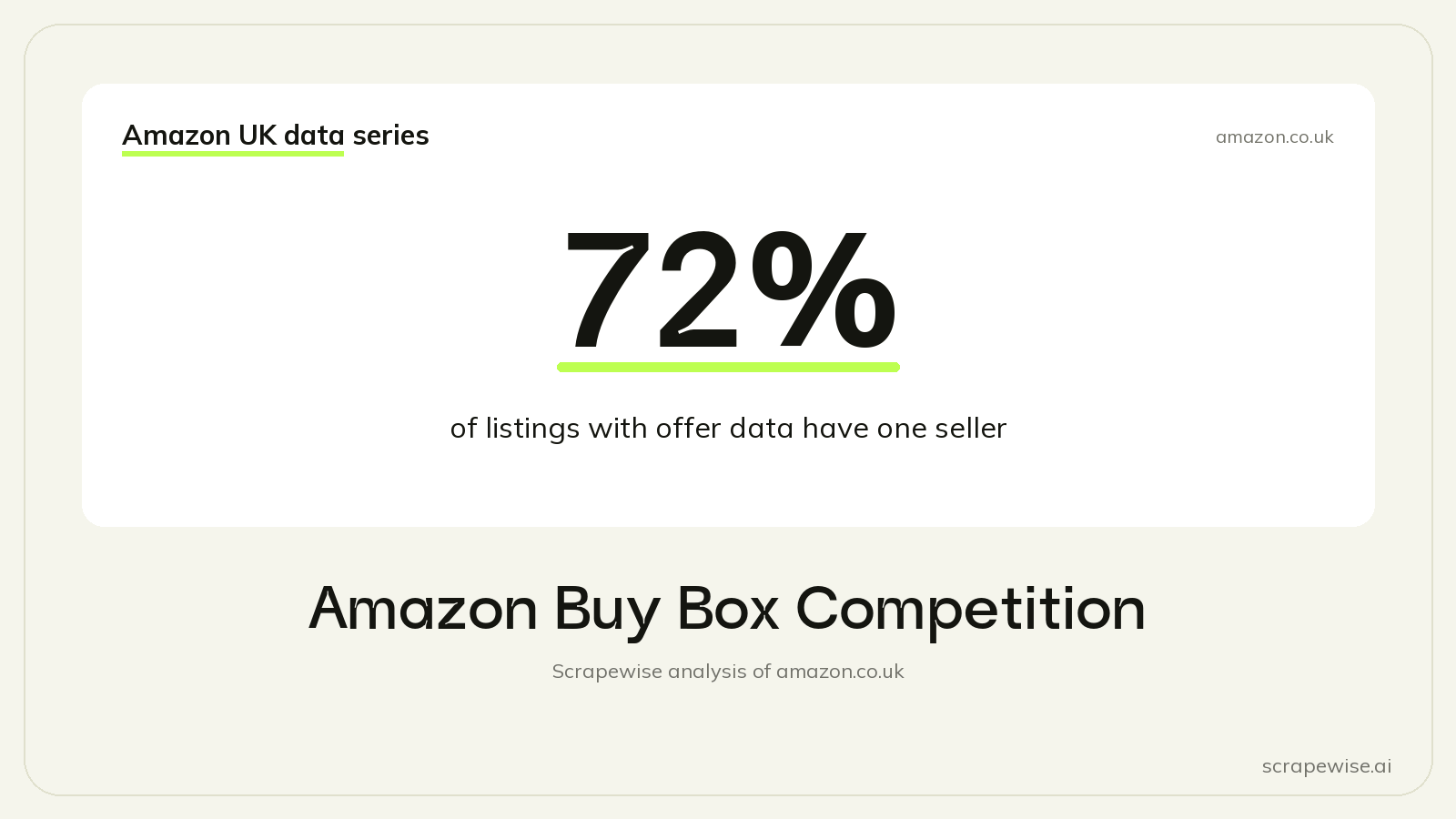
- 72.1% of products with offer data had a single seller, so the buy box had one candidate.
- Among products with offer data, listings with 10+ sellers showed a sales label 64.4% of the time, against 34.0% with one seller.
- The mean product with offer data had 2.01 sellers, and our capture stops at about 11.
Most Amazon UK listings have no buy box contest: of the products in our sample with offer data, 72.1% had a single seller, and only 3.6% had 10 or more. We opened the offer page of each product we found in search on amazon.co.uk, on 23 to 24 September 2026, and counted the sellers on it.
The Data
The table splits the products with offer data by the number of distinct sellers on the offer page.
| Sellers on the offer page | Share of sample |
|---|---|
| 1 | 72.1% |
| 2 | 10.1% |
| 3 | 4.4% |
| 4 to 9 | 9.7% |
| 10+ | 3.6% |
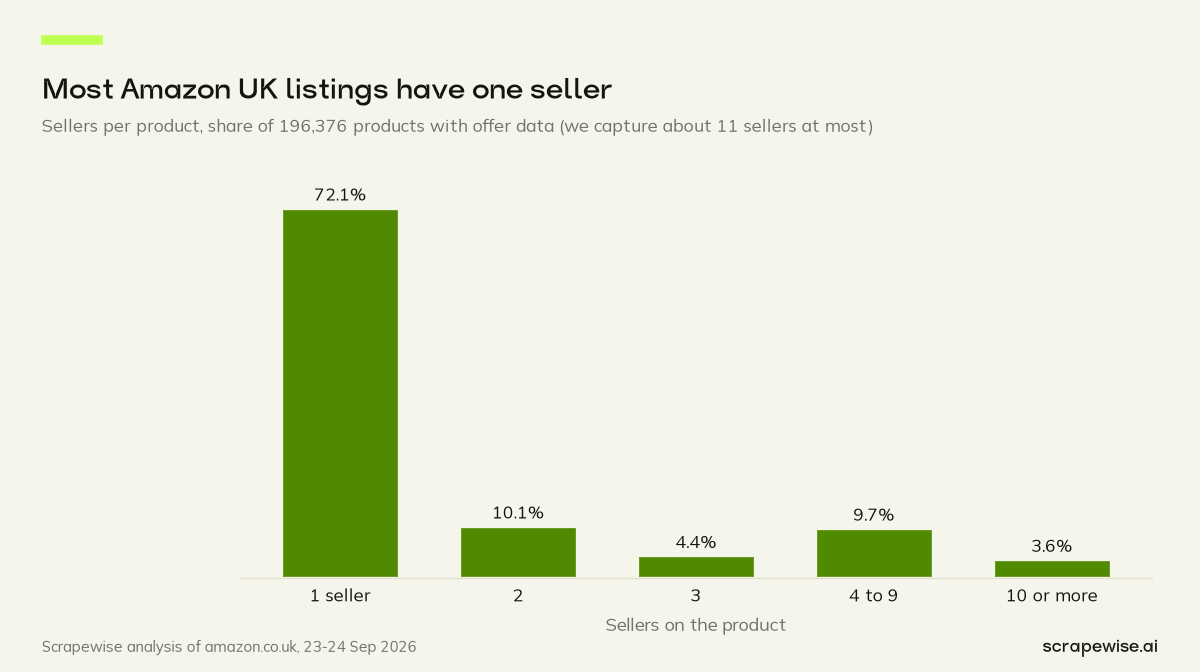
The mean was 2.01 sellers per product. A small group of crowded listings pulls that figure up. The typical product has one seller.
What the Seller Count Means for the Buy Box
A buy box contest needs at least two offers. On 72% of listings with offer data there is one seller, so the buy box there is less a contest and more a formality. That seller still has rivals. They are other products in the same search, not other sellers on its own offer page.
The real contests sit in the rest of the sample. Two sellers share 10.1% of products, three share 4.4%, and 9.7% have 4 to 9 sellers. At the crowded end, 3.6% have 10 or more.
Two limits apply. We capture about 11 sellers per product at most, so the 10+ group is undercounted: a listing with many more sellers looks the same in our data as one with 10+. And this is one moment in time. Sellers join and leave listings as stock runs out, so a single-seller listing today may have company next month.
This post counts sellers. It does not say which offer Amazon features, because that question only arises where there are several offers. Our study of whether Amazon competes with its own sellers adds one piece: where Amazon is among the sellers, 10.1% of products have 10+ sellers, against 2.3% where it is not. For the offer-level answer, our test of whether the lowest price wins the Amazon Buy Box finds that the featured offer is the cheapest new offer on 84.6% of multi-offer products.
Crowded Listings Sell More Often
The more sellers a listing has, the more often it carries Amazon's "bought in past month" label. The table uses products with offer data.
| Sellers on the listing | Share with a sales label |
|---|---|
| 1 | 34.0% |
| 2 | 36.3% |
| 3 to 4 | 36.9% |
| 5 to 9 | 49.4% |
| 10+ | 64.4% |
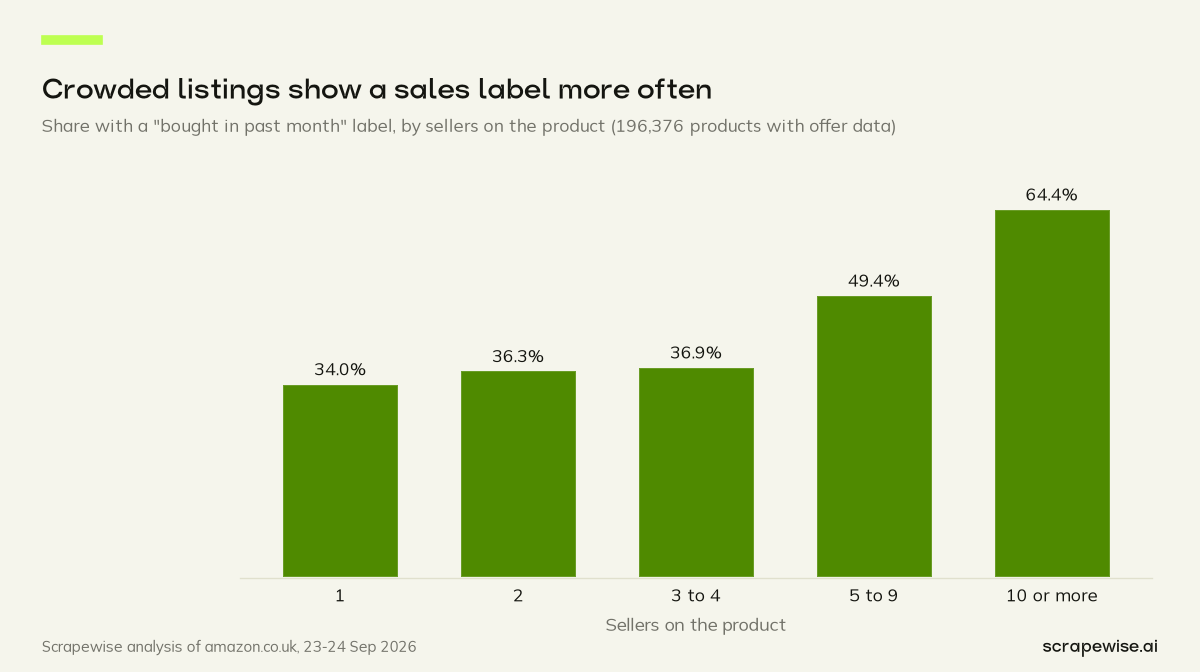
The top sales band follows the same pattern. Among single-seller listings, 2.4% showed "1K+ bought in past month". Among listings with 10+ sellers, 16.8% did. Median review counts climb too, from 92 on single-seller listings to 860 on listings with 10+ sellers.
This is a correlation, and it can run both ways. Sellers pile onto listings that already sell, because that is where the demand is. More sellers can also mean more stock and sharper prices, which helps a listing sell. Our data cannot separate the two. It does show that crowded listings are usually proven ones.
Why So Many Listings Have One Seller
Our data counts sellers. It does not record why a listing has only one, but the usual reasons are ordinary. A seller that creates a listing for its own brand is often the only one that stocks it. A bundle or a custom colour gets a listing of its own, which nobody else sells. And many products sell too few units to tempt a second seller.
Seen the other way, a second seller is a signal in itself. It means someone else thought the product worth stocking, which fits the label pattern in the previous section.
How to Use Seller Counts
Before you source a product to resell, open its offer page and count. Then read these together:
- The number of sellers. One seller means nobody shares the listing today, and also that nobody else has proven it worth stocking. Ten or more means proven demand and a crowded page.
- The sales label. On a crowded listing, the label describes demand you would share with everyone else on the page.
- The review count. On a single-seller listing, the reviews belong to that seller's history. A new listing of your own would start from zero.
What It Means for Sellers and Brands
For private label sellers: most listings in our sample had one seller, so your fight is for search position and reviews. The buy box rarely comes into it. Our look at the most competitive products on Amazon UK shows which searches have the most sellers per listing and which are quiet.
For wholesale and resale sellers: crowded listings show labels more often, but the demand is split between every seller on the page. A label says the listing sells. It does not tell you what your share will be. Price and fulfilment decide that, which is why Amazon repricing and MAP monitoring tools exist.
For brands: a listing with many sellers is worth watching. Some sellers may be authorised resellers and some may not, and the seller list on the offer page is the first place that shows up.
For every other headline number from the same snapshot, see our Amazon UK marketplace statistics for 2026.
How We Collected This Data
Two Scrapewise APIs produced these numbers. The Amazon Search API read results pages 1 to 7 on amazon.co.uk for 868 keywords and gave us each product's sales label, review count, price and position. The Amazon Offers API then opened the offer page of every product found and returned one row per offer, with the seller, price, shipping, condition, ships-from and featured-offer fields. For this post we only needed the number of distinct sellers per product. Counting sellers by opening offer pages one at a time is possible. It is also how weekends disappear. Both APIs are billed at €0.00015 per call, which works out at €0.15 per 1,000 calls. Our guide to scraping Amazon and eBay marketplace data covers the wider setup, or you can open an account and count the sellers on the listings you follow.
How crowded is your own category? Try it with 5 free requests and pay per call after that: create your login, or check the pricing first.
Paste a marketplace URL — get structured market data
Size categories, track assortments, monitor trends. Clean feeds ready for your BI stack.
97% accuracy on Amazon benchmarks · no credit card · book a 15-min call →