

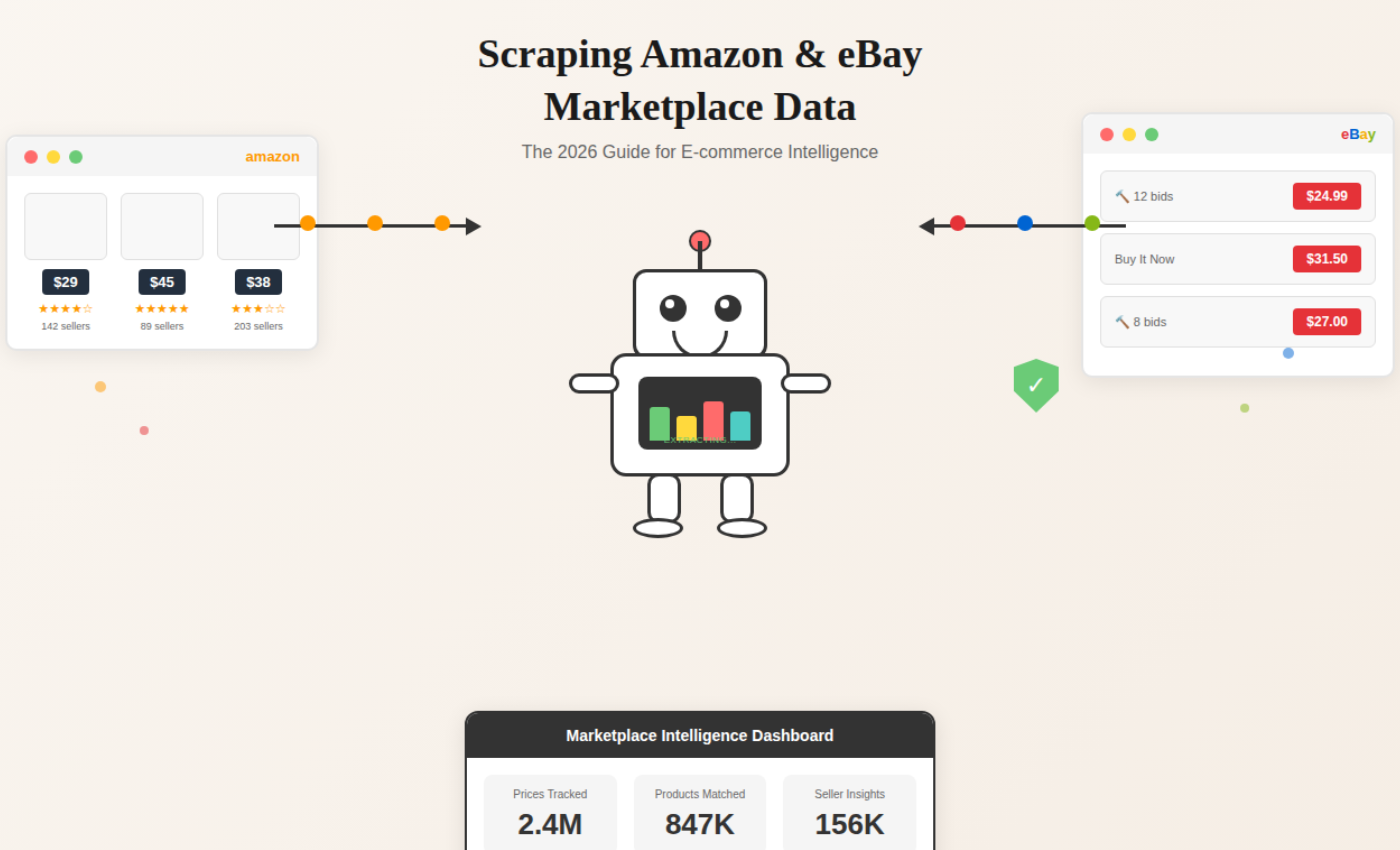
Every pricing decision your competitors make on Amazon and eBay happens in real time. Every stockout, every flash sale, every review that shifts consumer sentiment — it's all public data waiting to be captured. The question isn't whether marketplace data scraping delivers competitive advantage. It's whether you can extract it reliably at scale.
Consider the velocity: Amazon reviews prices of millions of products every 2 minutes, with high-demand electronics repricing every 10-15 minutes. Prices vary by 23% on average between peak and off-peak hours. Across the broader market, 58% of Fortune 500 companies now use web scraping tools for competition monitoring — and retail and e-commerce accounts for 36.7% of all web scraping, the largest share of any industry.
What is Marketplace Data Scraping?
Marketplace data scraping is the automated extraction of product information, pricing, inventory levels, seller metrics, and customer reviews from e-commerce platforms like Amazon, eBay, Walmart, and regional marketplaces. Unlike accessing data through official APIs (which often provide limited or delayed information), scraping captures the complete picture that customers see—including competitor pricing strategies, promotional patterns, and real-time availability.
The practice has evolved far beyond simple price monitoring. According to Mordor Intelligence's 2025 market analysis, the web scraping market reached $1.03 billion in 2025 and is projected to hit $2 billion by 2030, with e-commerce representing the largest use case. Price and competitive monitoring specifically is climbing at a 19.8% compound annual growth rate—faster than any other scraping application.
Modern marketplace scraping captures six distinct data layers: product specifications and attributes, dynamic pricing and promotional intelligence, seller performance metrics, inventory and availability signals, search ranking metadata, and customer sentiment from reviews. Each layer feeds different business decisions, from competitive price monitoring to demand forecasting and assortment planning.
If the end goal is competitor prices rather than raw HTML, scraping is only step one: the rows still have to be cleaned and matched to your own products. Scrapewise does scrape, clean and match in one place; see product matching and competitor price tracking.
Why Marketplace Data Matters for E-commerce Businesses
The global e-commerce market exceeded $7 trillion in 2025, but competition has intensified to the point where milliseconds matter. On Amazon alone, brands can lose the Buy Box—and with it, the vast majority of sales—within seconds if their pricing falls out of alignment with competitors.
Consider the scale of opportunity. Amazon hosts over 9.7 million registered sellers worldwide, with 1.9 million actively selling in 2025. More than 60% of Amazon sales come from third-party sellers making independent pricing decisions. eBay processes millions of auction and fixed-price transactions daily across 190 markets. Without automated monitoring, tracking even a fraction of this activity manually is impossible.
Real-time marketplace intelligence enables several critical capabilities. Dynamic pricing optimization becomes possible when you can see competitor prices change throughout the day rather than checking manually once per week. Product data extraction reveals gaps in your catalog versus competitors and identifies emerging product trends before they peak. Review sentiment analysis exposes quality issues affecting competitor products—opportunities to differentiate through better offerings. As Semrush's competitive intelligence research emphasizes, understanding how competitors price their products is essential for refining your own positioning strategy.
The Harvard Business Review found that unauthorized retailers violate MAP policies 50% of the time, with even authorized retailers showing a 20% violation rate. Without automated monitoring across marketplaces, brands cannot enforce pricing policies or protect channel relationships.
How to Scrape Amazon Product Data
Amazon presents the most valuable—and most challenging—target for marketplace scraping. The platform's anti-bot defenses have evolved into a sophisticated multi-layer system that analyzes everything from IP reputation to mouse movement patterns. Understanding these defenses is the first step toward successful extraction.
Amazon's detection architecture operates across six layers. IP reputation and ASN analysis flags datacenter traffic immediately—the success rate of using datacenter proxies directly dropped to near zero in 2026. TLS fingerprinting compares the cryptographic signature of your connection against known browser profiles. Browser environment detection examines hundreds of characteristics from canvas fingerprints to installed fonts. Behavioral biometrics analyze mouse movement trajectories, click timing, and scroll patterns. CAPTCHA challenges deploy when other signals suggest automation. And machine learning models calculate a "human likelihood score" for every request in real time.
Successful Amazon scraping requires addressing all layers simultaneously. Residential proxies are now essential—traffic from AWS, Google Cloud, or Azure is blocked almost immediately. Browser fingerprint consistency matters more than ever, as changing fingerprint values mid-session triggers instant detection. Request patterns must mimic human behavior: variable timing, realistic navigation paths, and appropriate dwell times on pages. According to Ahrefs' guide on web crawlers, modern crawlers must navigate increasingly sophisticated detection systems while respecting site policies.
The data available from Amazon includes product titles, descriptions, specifications, pricing (including lightning deals and Subscribe & Save options), seller information, inventory indicators, customer reviews and ratings, search rankings, and sponsored product placements. For brands monitoring their own products, this data reveals unauthorized sellers, MAP violations, counterfeit listings, and competitive positioning in real time.
Platforms like ScrapeWise.ai handle the technical complexity of Amazon extraction—proxy rotation, fingerprint management, CAPTCHA solving, and anti-detection measures—delivering structured data feeds rather than requiring businesses to maintain scraping infrastructure themselves.
How to Scrape eBay Listing Data
eBay presents different challenges than Amazon. Where Amazon optimizes around standardized product listings, eBay is a live marketplace with auctions, fixed-price offers, refurbished goods, collectibles, and private sellers. The platform's "organized chaos" creates unique intelligence opportunities.
eBay's anti-bot measures are generally less aggressive than Amazon's, but the platform still employs rate limiting, IP blocking, and CAPTCHA challenges for suspicious traffic patterns. The bigger challenge is data complexity: auction items have bid histories and time-remaining signals, condition varies from new to "for parts," and pricing includes shipping costs that dramatically affect true competitive position.
Key data points from eBay scraping include listing titles and item specifics (brand, condition, size), current price and "Buy It Now" price, bid count and bid history for auctions, shipping costs and estimated delivery times, seller ratings and transaction history, item location and international shipping availability, and "watchers" count indicating demand signals.
For e-commerce businesses, eBay data serves several strategic purposes. Price monitoring across both new and secondary markets reveals true price floors for your products. Auction data exposes real-time demand signals—items with many watchers but few bids indicate price sensitivity, while bidding wars reveal products where supply constrains demand. Seller performance tracking identifies which competitors deliver the fastest shipping or highest customer satisfaction.
eBay's Terapeak tool, integrated into Seller Hub, provides some market intelligence, but it's limited to eBay's own platform and doesn't enable automated data feeds or integration with external pricing systems. Comprehensive competitive intelligence requires scraping that captures eBay alongside Amazon, Walmart, and other marketplaces in a unified view.
Technical Challenges and Solutions
The technical landscape of marketplace scraping in 2026 resembles an arms race. Anti-bot systems from Cloudflare, DataDome, PerimeterX, and Akamai have deployed machine learning models that learn traffic patterns and adapt defenses in real time. Traditional scraping approaches fail more often than they succeed against major platforms.
TLS fingerprinting has become a primary detection vector. When a scraper claims to be Chrome via its User-Agent header but exhibits Python requests library characteristics during the TLS handshake, detection systems flag the inconsistency immediately. JA4 fingerprinting, which emerged in 2023, resists the permutation attacks that previously defeated JA3 detection.
Browser fingerprinting extends far beyond User-Agent strings. Sites collect canvas fingerprints, WebGL renderer information, audio context signatures, installed fonts, screen dimensions, timezone data, and hundreds of other data points. Headless browsers expose automation markers throughout this fingerprint—consistent signals that differ from real browsers.
Behavioral analysis represents the final frontier. Real users scroll with variable velocity, pause to read content, move their mouse in curved paths with micro-jitters, and occasionally misclick. Bots navigate in straight lines at constant speeds directly to target data. Even with perfect technical fingerprints, behavioral patterns reveal automation.
Solutions have evolved to match. Stealth browsers like Camoufox, SeleniumBase UC Mode, and Nodriver modify automation signals to match real browsers. Residential proxy networks provide IP addresses from actual ISPs rather than datacenters. AI-powered scrapers adapt to layout changes automatically rather than breaking when sites update their structure. As Backlinko's research on data-driven content demonstrates, original data provides significant competitive advantages—but acquiring that data requires sophisticated technical infrastructure.
For businesses without dedicated engineering teams, managed scraping services handle this complexity. Rather than building and maintaining anti-detection infrastructure, you define the data you need—products, prices, sellers, reviews—and receive structured feeds on your schedule. The AI-powered web scraping approach uses visual parsing rather than brittle CSS selectors, maintaining extraction accuracy even when platforms change their page layouts.
Data Points Worth Extracting
Not all marketplace data delivers equal value. Focusing extraction on high-impact data points maximizes intelligence while minimizing scraping complexity and costs.
Pricing intelligence goes beyond current list prices. Capture price history to identify promotional patterns and seasonal trends. Track "Add to Cart" and "Buy Box" prices separately from displayed prices—some platforms show different values. Monitor shipping costs, which can shift competitive position by 10-20% on lower-priced items. Extract any available data on promotional codes, bundle discounts, or subscription pricing.
Inventory and availability signals reveal demand patterns competitors try to hide. Stock indicators ("Only 3 left in stock") suggest products approaching stockout. Delivery time estimates indicate whether inventory ships from local fulfillment or distant warehouses. "Currently unavailable" listings with active customer reviews represent potential opportunities where competitors have exited.
Seller metrics expose the competitive landscape at the seller level rather than just the product level. Extract seller ratings, review counts, and response times. Track fulfillment methods (FBA vs. merchant-fulfilled on Amazon, Top Rated status on eBay). Identify which sellers consistently win the Buy Box and at what price points.
Review and sentiment data drives product development and marketing. Beyond star ratings, analyze review text for recurring complaints or praise. Track review velocity—sudden spikes often indicate quality issues or review manipulation. Compare sentiment between your products and competitors to identify differentiation opportunities. For comprehensive approaches to this analysis, Moz's competitive research frameworks offer valuable methodologies.
Search and ranking metadata reveals platform algorithms. Track which products appear for target keywords and how positions shift over time. Identify sponsored vs. organic placements. Monitor "Amazon's Choice" and "Best Seller" badges that influence customer purchasing decisions.
Building Your Marketplace Intelligence Pipeline
Effective marketplace intelligence requires more than raw data extraction. The pipeline from scraping to business decision includes data collection, validation, normalization, storage, analysis, and action.
Collection frequency depends on category velocity. Fashion and electronics where prices change multiple times daily require near-real-time monitoring. Stable categories like industrial supplies might need only daily or weekly updates. Match your refresh cadence to the pace of your market—over-collecting wastes resources while under-collecting creates blind spots.
Data validation catches extraction errors before they corrupt your analysis. Implement sanity checks: prices shouldn't change by more than 50% overnight without investigation, product titles shouldn't suddenly become empty, seller counts shouldn't spike or crash unexpectedly. Flag anomalies for human review rather than automatically incorporating potentially bad data. As HubSpot's marketing analytics research emphasizes, data quality directly determines decision quality.
Normalization enables cross-platform comparison. Amazon and eBay use different category structures, condition descriptors, and seller metrics. Map these to a unified schema so "New" on Amazon equals "Brand New" on eBay, and seller ratings translate to comparable scales. Without normalization, multi-marketplace analysis produces misleading conclusions.
Storage architecture depends on query patterns. Time-series databases excel for price history analysis. Document stores handle the varied structures of product listings. Whatever you choose, maintain historical data—the ability to analyze "what prices were competitors charging during last year's Black Friday?" depends on having archived that data in advance.
Analysis transforms data into decisions. Build dashboards showing your competitive position across key products. Set alerts for significant price changes from major competitors. Generate reports correlating competitor stockouts with your sales spikes. Connect pricing intelligence to your repricing systems for automated response.
Best Practices for Ethical Scraping
Marketplace scraping operates in legal and ethical gray areas that require careful navigation. While scraping publicly available data is generally legal, violating terms of service, overloading servers, or misusing extracted data creates business and legal risks.
Respect rate limits even when not technically enforced. Aggressive scraping that degrades platform performance harms legitimate users and increases the likelihood of detection and blocking. Spreading requests over time with realistic delays costs little and significantly reduces risk.
Focus on public data. Product prices, descriptions, and seller information that any visitor can see is generally fair game. Customer personal information, private communications, or data behind authentication represents off-limits territory with serious legal implications.
Consider the source of truth. Prices on Amazon and eBay are intended to be seen by customers—that's the entire point of listing them publicly. Scraping this data for competitive intelligence is fundamentally different from accessing internal systems or circumventing access controls.
Document your practices. If your scraping activities ever face legal scrutiny, clear documentation showing ethical practices, rate limiting, and legitimate business purposes provides important protection. "We monitor public prices to stay competitive" is defensible; "We hammer their servers to extract everything possible" is not.
Work with specialists who understand compliance. Managed e-commerce market data extraction services maintain up-to-date knowledge of platform terms, legal developments, and best practices—reducing risk compared to ad-hoc in-house scraping.
Common Mistakes to Avoid
Tracking too many competitors poorly beats tracking fewer competitors well. Monitoring 50 sellers with 60% data accuracy produces worse intelligence than monitoring 10 sellers with 95% reliability. Start focused, prove value, then expand.
Confusing price matching with price strategy leads to margin destruction. Automatically matching every competitor price drop is a race to the bottom. Use marketplace intelligence to inform pricing decisions, not to replace human judgment about when to compete on price versus when to differentiate on value. Neil Patel's guide to competitive analysis provides frameworks for strategic rather than reactive competitor response.
Ignoring data quality until it causes problems wastes resources and erodes trust in insights. Wrong prices, mismatched products, or stale data can drive costly business decisions. Build validation into your pipeline from day one rather than retrofitting after errors surface.
Building when you should buy consumes engineering resources better spent elsewhere. The technical complexity of modern anti-bot systems means scraping infrastructure requires constant maintenance. Unless marketplace intelligence is your core business, evaluate whether managed services deliver better ROI than in-house development.
Treating scraping as an IT project rather than a business capability limits value realization. The insights matter more than the technology. Ensure business stakeholders define what decisions the data should support, then work backward to required data points, refresh frequency, and integration requirements.
Conclusion
Marketplace data from Amazon, eBay, and other platforms has become essential infrastructure for e-commerce competition. The intelligence gap between businesses with real-time competitive visibility and those operating on weekly manual checks translates directly to margin and market share differences.
The technical challenges are real—anti-bot systems in 2026 require sophisticated countermeasures—but they're solvable either through in-house engineering investment or managed scraping services. The more fundamental question is what you'll do with the intelligence once you have it.
Start by defining the business decisions marketplace data should support. Competitive pricing? Assortment planning? MAP enforcement? Demand forecasting? Work backward from decisions to required data points, then build or buy the infrastructure to deliver reliable feeds. The data is there, publicly visible to every customer. The only question is whether you're capturing it.
Paste any URL — ScrapeWise handles the anti-bot
Managed infrastructure that adapts when sites change. No proxies, no code, no per-request fees.
Not ready to sign up? See 12 real Amazon rows, 972 columns →
97% accuracy on Amazon benchmarks · no credit card · book a 15-min call →