
Key takeaways
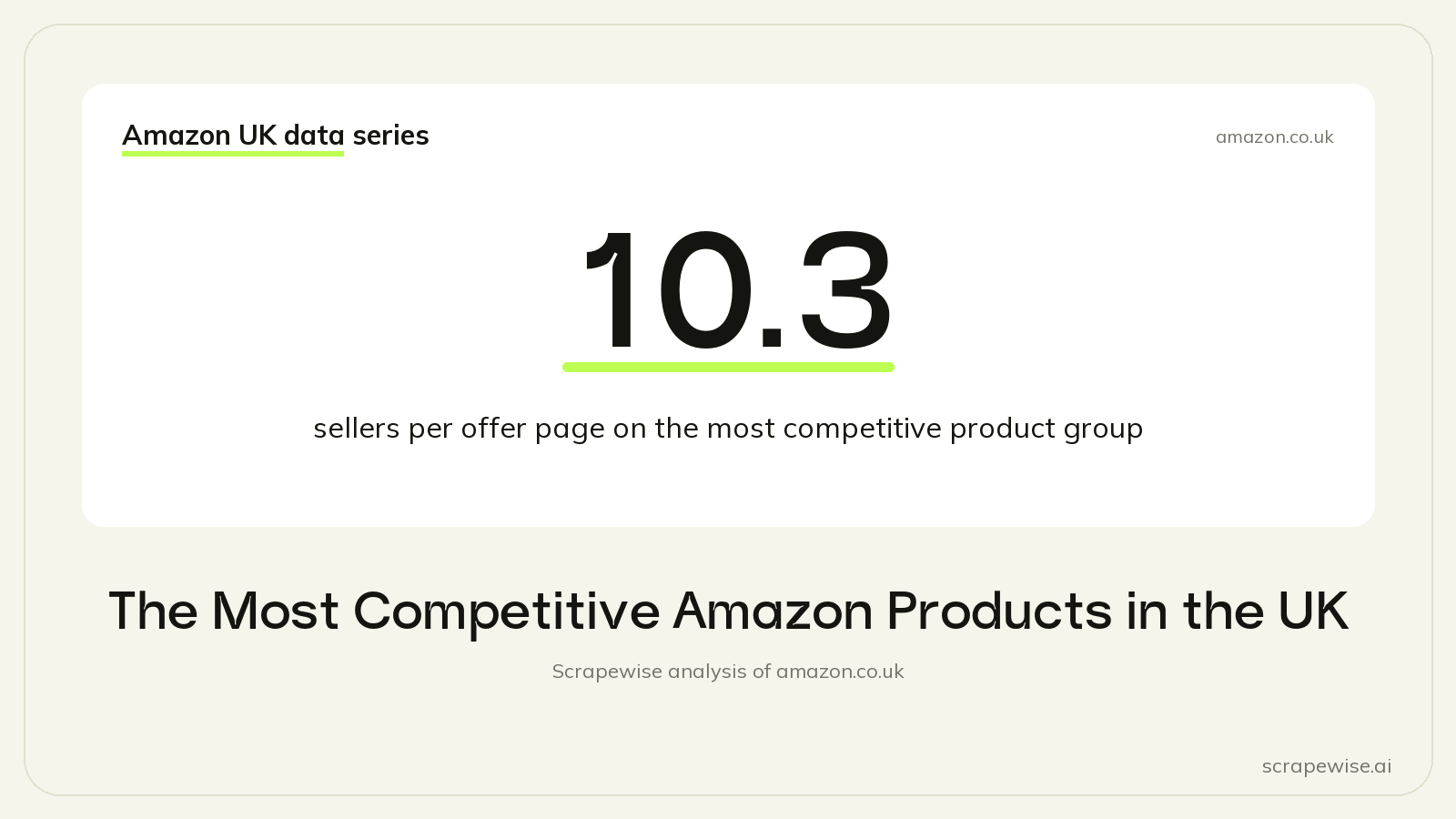
- LEGO sets drew 10.3 sellers per listing on average among products with offer data, and Amazon was one of them on 96.5% of LEGO listings.
- Among products with offer data, listings with 10 or more sellers showed a sales label 64.4% of the time, against 34.0% for single-seller listings.
- At the calm end, 98.0% of house number listings with offer data had a single seller.
The most competitive Amazon products in our UK sample are LEGO sets: among products with offer data, a LEGO listing shows 10.3 sellers on average, and Amazon is one of them on 96.5% of listings. The seller counts come from a snapshot of amazon.co.uk taken on 23 to 24 September 2026, read one offer page at a time.
The Data
Most Amazon UK listings are not crowded at all. Across 196,376 products with offer data, 72.1% had a single seller, the mean was 2.01 sellers, and only 3.6% had 10 or more. A shared offer page is the exception, which makes the few crowded searches worth a closer look.
These are the crowded searches from our fact pack, with the mean number of sellers on each listing's offer page:
| Search keyword, as typed | Mean sellers per offer page |
|---|---|
| lego set | 10.3 |
| dog food | 7.70 |
| cat food | 6.98 |
| body lotion | 5.83 |
| sunscreen | 5.78 |
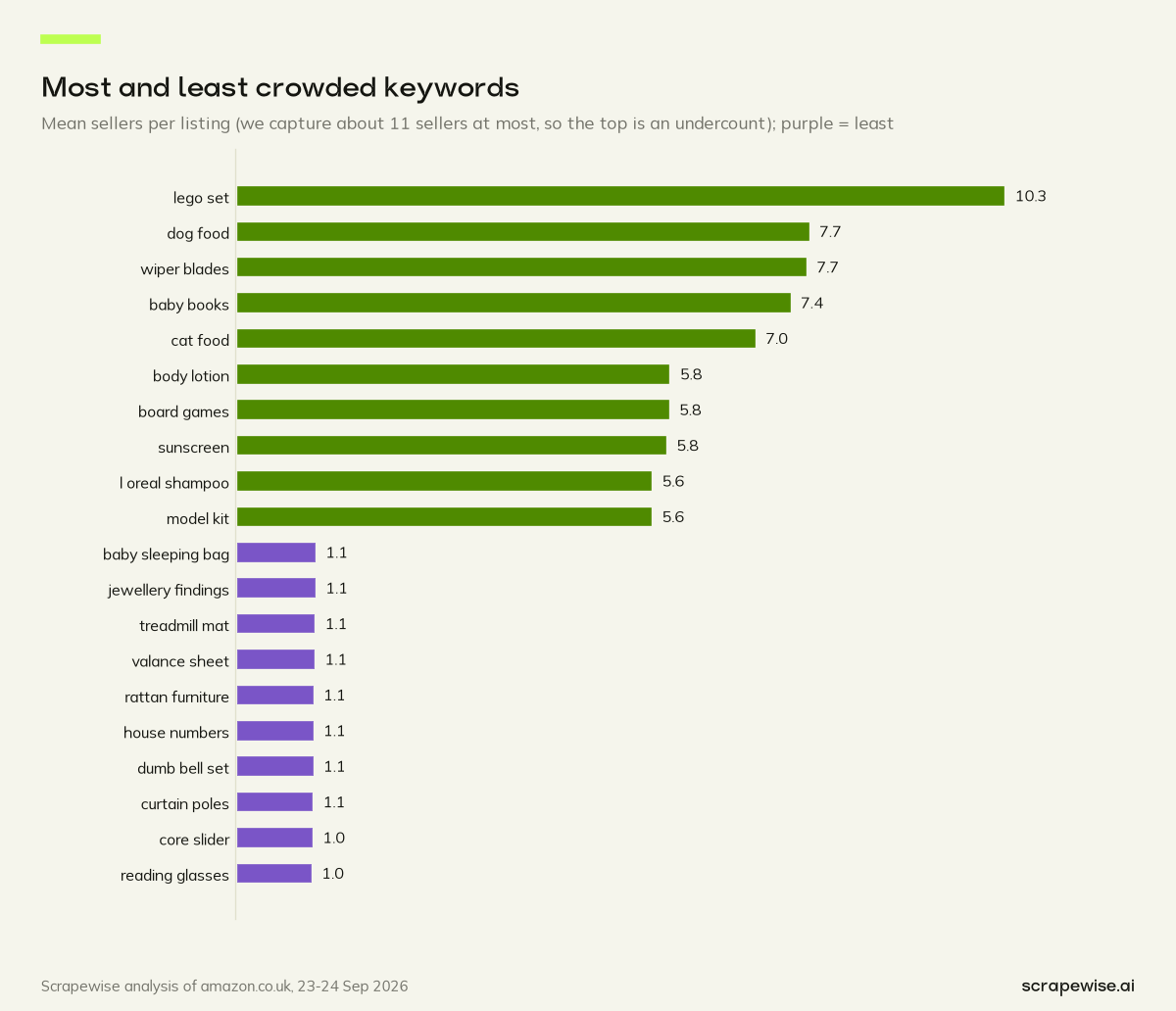
LEGO is well clear of the field. Dog food, in second place, averages 7.70 sellers. Even 10.3 is likely an undercount, because our capture of each offer page stops at about 11 sellers. On LEGO pages, the cap works rather like a bouncer.
The product itself invites a crowd. A sealed, branded box is the same product whoever ships it, so any reseller with stock can join the same page. For how LEGO sells and rates, see our look at the Amazon UK toy market.
What Crowded Listings Have in Common
Crowded listings sell more, or at least they show more signs of selling. Among products with offer data, listings with 10 or more sellers showed a "bought in past month" label 64.4% of the time, against 34.0% for listings with one seller. The gap at the top is wider still: 16.8% of the crowded listings carried the "1K+ bought in past month" label, against 2.4% of single-seller listings.
Reviews point the same way. The median crowded listing had 860 reviews; the median single-seller listing had 92. None of this proves that sellers chase demand, since a popular product may simply attract resellers over time. It does show that the busy offer pages and the busy products are, by and large, the same pages.
The pattern fits the searches in the table. LEGO, dog food, cat food, body lotion and sunscreen are branded, standard items that shoppers buy again and again. They are easy to source from wholesalers and easy to list, because the listing already exists. If you want the full distribution of sellers per product, our post on Amazon buy box competition breaks it down band by band.
Where Amazon Shows Up
Across all products in our sample, Amazon itself was among the sellers on 17.2% of listings. On the crowded searches it turns up far more often. It was among the sellers on 96.5% of LEGO listings and 71.2% of Bosch drill listings. The big pet food searches show the same pattern.
Where Amazon sells alongside other sellers, those listings carry 3.76 other sellers on average. So a crowded listing often means sharing the page with Amazon and a few resellers at once. Whether Amazon's offer is the cheapest on those pages is a separate question, which we look at in does Amazon compete with its own sellers.
The Quiet End: One Seller per Listing
At the other end of the scale sit searches where almost every listing has exactly one seller. House numbers top that list: 98.0% of house number listings with offer data have one seller. Shoppers tend to arrive knowing exactly which number they need. Curtain poles are almost as calm, at 97.2%.
A calm offer page does not mean a calm market. Here each seller tends to run its own listing, likely because many of these products are made to order or sold under the seller's own brand. The competition moves from the offer page to the search results. A single-seller listing still has rivals. They are just one scroll away instead of one click away.
What It Means for Sellers and Brands
For resellers, the seller count on an offer page is the first thing to check before buying stock. On a listing with ten or more sellers, including Amazon, the price is set by the crowd, and margins follow. A listing with one or two sellers leaves more room, but also less proof that the product sells.
For brands, a crowded listing is a pricing question. When many resellers sell the same product on one page, a brand needs to know who is selling below its policy price and how often. Our guides to MAP monitoring for brand protection and Amazon repricing and MAP violation software cover the monitoring side.
For private label sellers, the quiet end is the normal case. Your listing may have one seller, you, but your real competitors are the other listings on the same search page. Track their prices and positions as closely as your own offer page.
For analysts, remember the cap. We record about 11 sellers per product at most, so any mean close to the cap understates the real crowd. Report crowded listings as "10 or more" rather than as an exact number. The same rule applies across the full Amazon UK marketplace report, where every seller count carries this caveat.
How to Check the Competition Before You List
Before you add stock to an existing listing, a quick check of the offer page saves guesswork:
- Count the sellers on the offer page, and note whether Amazon is one of them.
- Look at the "bought in past month" label and the review count, which show whether the listing sells at all.
- Compare the lowest offer with your landed cost, including fees and shipping.
- Repeat the check over a few weeks. One look is one moment, and sellers can join or leave a listing at any time.
Doing this for one listing takes a few minutes. Doing it for a few hundred listings every week is where a scraper earns its keep.
How We Collected This Data
Counting sellers took two Scrapewise scrapers. The Amazon Search API found the products, working through seven results pages for each of 868 searches on amazon.co.uk, and returned each one with its keyword, review count and "bought in past month" label. The Amazon Offers API then read each product's offer page and returned one row per offer, with the seller, price and condition, plus whether Amazon was the seller. We counted distinct sellers per product and averaged them per keyword. Both are priced at €0.00015 per call, or €0.15 per 1,000 calls, and deliver their rows through the REST API or a CSV/Excel export. Create an account to count the sellers on the listings you care about.
How crowded are the offer pages in your own category? Find out with 5 free requests, then pay as you go. Sign up here or compare pricing.
Paste a marketplace URL — get structured market data
Size categories, track assortments, monitor trends. Clean feeds ready for your BI stack.
97% accuracy on Amazon benchmarks · no credit card · book a 15-min call →