
Key takeaways
- The priciest listing in our sample was a drone priced at £14,728.00.
- 173 priced products were listed at £1,000 or more, and 37 were priced under £1.
- In the fishing bait search, the dearest result cost 164x the median price for that search.
The most expensive item on Amazon UK in our sample was a drone priced at £14,728.00, and 173 priced products sat at £1,000 or more, but most of the top prices look like placeholders rather than real offers. We sorted every listed price in a snapshot of amazon.co.uk search results, taken on 23 to 24 September 2026, from the top down.
The Priciest Listings in Our Sample
These three sit at the top of the price list, shown by product type only. We do not name the listings or the sellers.
| Product type | Category | Listed price |
|---|---|---|
| Drone | Toys & Games | £14,728.00 |
| Chocolate fountain | Kitchen & Dining | £11,999.99 |
| Chocolate fountain | Kitchen & Dining | £11,111.99 |
A chocolate fountain at £11,999.99 is either a placeholder or a very serious fountain. Neither fountain had a single review.
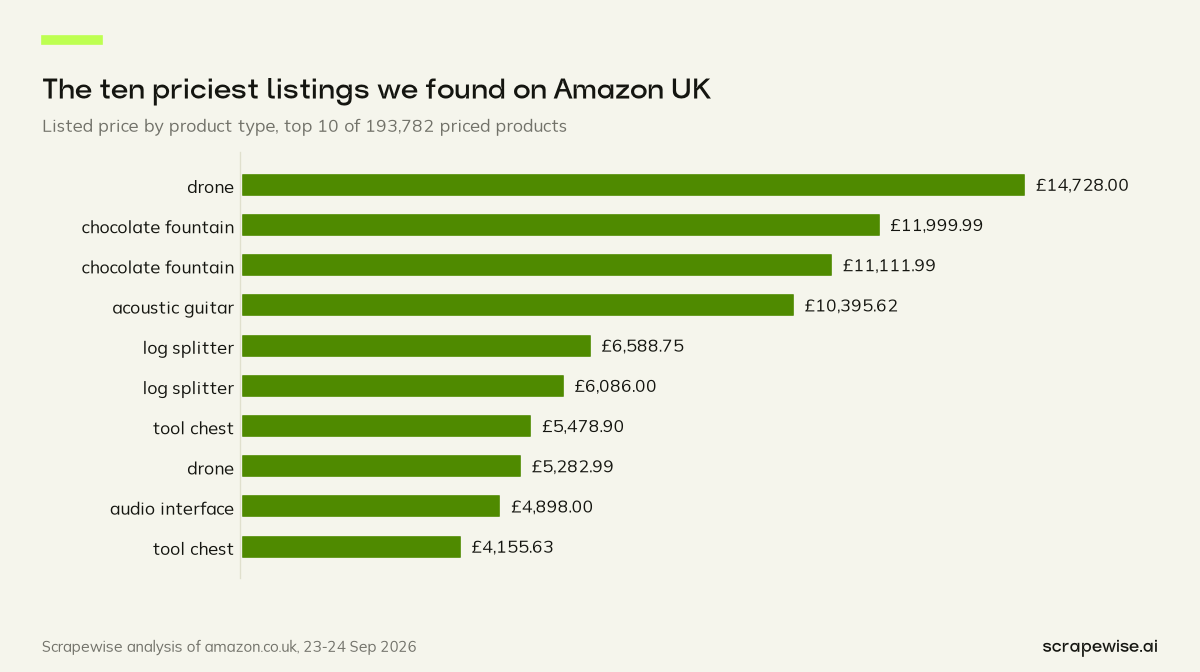
For scale, the median priced product in the same snapshot cost £16.99. A handful of listings sit so far above that line that one of them can bend a category average on its own.
Why These Prices Are Probably Not Real
Three signals point the same way.
First, the two chocolate fountains had no reviews at all. A product that has never been reviewed can still be real, but a five-figure product that nobody has reviewed is more likely a listing that is not meant to sell.
Second, the digits. A price of £11,111.99 looks like what someone types when a price field will not accept a blank.
Third, the gap to the rest of the search. Within a single keyword, we compared the dearest result with the median price for that keyword:
| Search | Category | Dearest result vs median price for that search |
|---|---|---|
| Fishing bait | Camping & Fishing | 164x |
| Acoustic guitar | Arts, Crafts & Music | 153x |
| Drone | Toys & Games | 148x |
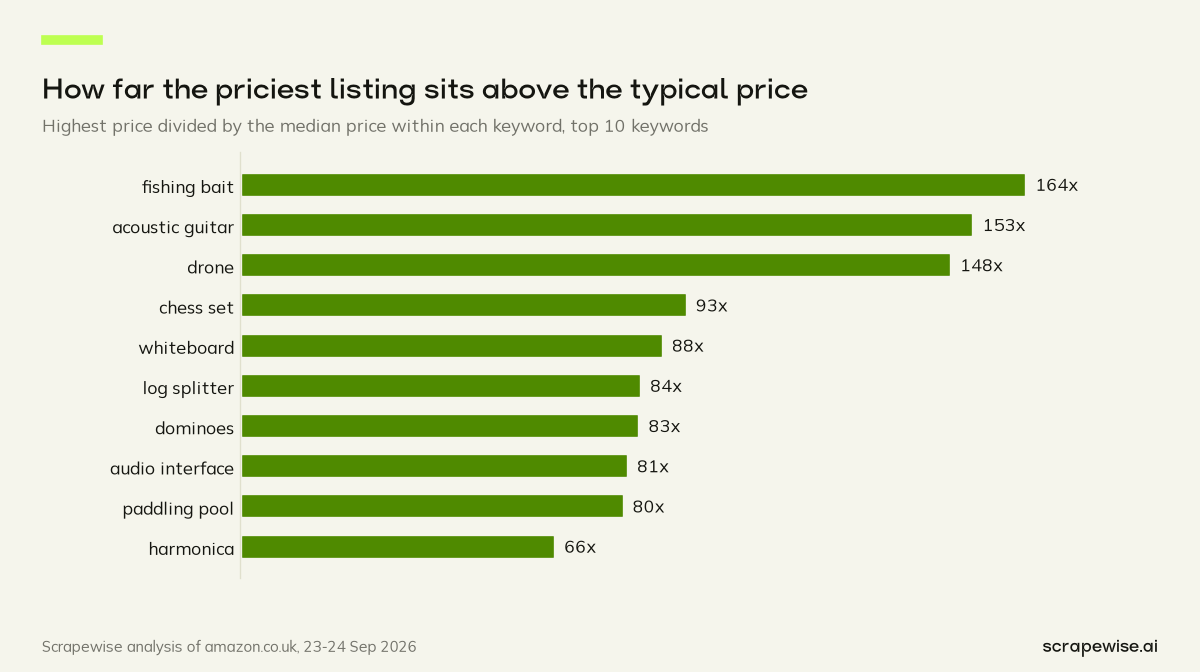
The fishing bait case shows a second trap. The dearest result in that search was a bait boat, a different and much larger product that the same search also returns. So an outlier is not always a wrong price. Sometimes it is a right price on the wrong product.
We cannot see why a seller chose any of these prices. Likely readings include a listing parked while out of stock, a price set high to stop orders, or a typing slip. Some very high prices may be real, too: professional drones and log splitters can cost thousands. The point is that a price monitor cannot tell the two apart from the price alone, so it needs rules.
The cheap end has its own noise. In our sample, 37 priced products were listed under £1. Some are real low-cost items; others are likely per-unit prices, add-on items or entry errors. The same rules apply in both directions.
What One Outlier Does to a Price Report
A median ignores a placeholder. A mean does not. Picture a small search with a few dozen results, most of them priced in the tens of pounds, and one listing parked at a five-figure price. The median barely moves. The mean jumps, and every chart built on it now says the category got much dearer overnight.
Real searches show the risk. Our drone search had a result at 148x the search median, and the acoustic guitar search one at 153x. A report that averages either search without an outlier rule is partly reporting on one listing.
The same thing happens over time. A placeholder that appears on Monday and disappears on Wednesday looks like a price spike and a price cut in a history chart. Anyone who reprices against that history, or reports it to a buyer, is reacting to a listing nobody could buy.
In this study we kept every price in the raw data, flagged the extremes, and used medians for every headline. None of that needs special tools.
Outlier Rules a Price Monitor Needs
If you track prices on Amazon or anywhere else, these rules keep placeholder prices out of your numbers. None of them needs a data scientist.
- Compare with the median of the same group. Judge each price against the median for the same search, product type or matched product, never against a mean across everything. The mean likes a £14,728.00 drone far more than the median does.
- Flag, do not delete. Mark a price that sits far above its group median as "needs review" and keep the raw value. Deleting it hides the one case where the price really did change.
- Use the evidence around the price. An extreme price with no reviews and no sales label is a much stronger placeholder signal than an extreme price on a product with a long review history.
- Check the product as well as the price. A result that is several times dearer than its neighbours may be a different product that the search pulled in, as the bait boat was.
- Look at the history. A price that spikes for one run and falls back is noise. A price that stays high is a decision someone made.
- Treat both tails the same way. Prices under £1 need the same review as prices over £1,000.
How far checking by eye can go is covered in our comparison of manual price checking against automated collection. The rules above also slot into any price monitoring automation workflow, and our price scraping guide for ecommerce covers the collection side.
What It Means for Sellers and Brands
Sellers should know that a listing parked at a silly price still appears in search results and in every competitor's dataset. If you use a very high price to pause sales, expect price monitors to flag it as an outlier.
For brands, extreme prices create false alarms. A brand that checks resellers for pricing policy breaches will see listings that look wildly overpriced. Before acting on one, check whether anyone could actually buy it at that price.
Analysts should report medians. Our study of the average price on Amazon UK by category uses medians for exactly this reason, and the cheapest things on Amazon UK shows the other end of the same price list. Price endings tell a story too: our charm pricing study shows how real Amazon prices tend to be set.
For the full picture across all 16 categories, see our Amazon UK marketplace statistics for 2026.
How We Collected This Data
The outliers in this post were found with one Scrapewise data API, the Amazon Search API, across pages 1 to 7 of 868 keywords. It returned the listed price, star rating, review count, "bought in past month" label, title and page position of each product, so every price could be set against the median of its own search. The Amazon Product API was not used in this study, but it is the natural next step for checking an outlier on the product page itself. Search calls are billed at €0.00015 per call, or €0.15 per 1,000 calls. With a Scrapewise account you can pull the same fields for your own searches and run the outlier rules above on them.
Suspect a placeholder price is skewing your own category report? Test a few of your searches with the 5 free requests every new account gets. Sign up, and see pricing for regular runs.
Paste a marketplace URL — get structured market data
Size categories, track assortments, monitor trends. Clean feeds ready for your BI stack.
97% accuracy on Amazon benchmarks · no credit card · book a 15-min call →