
Key takeaways
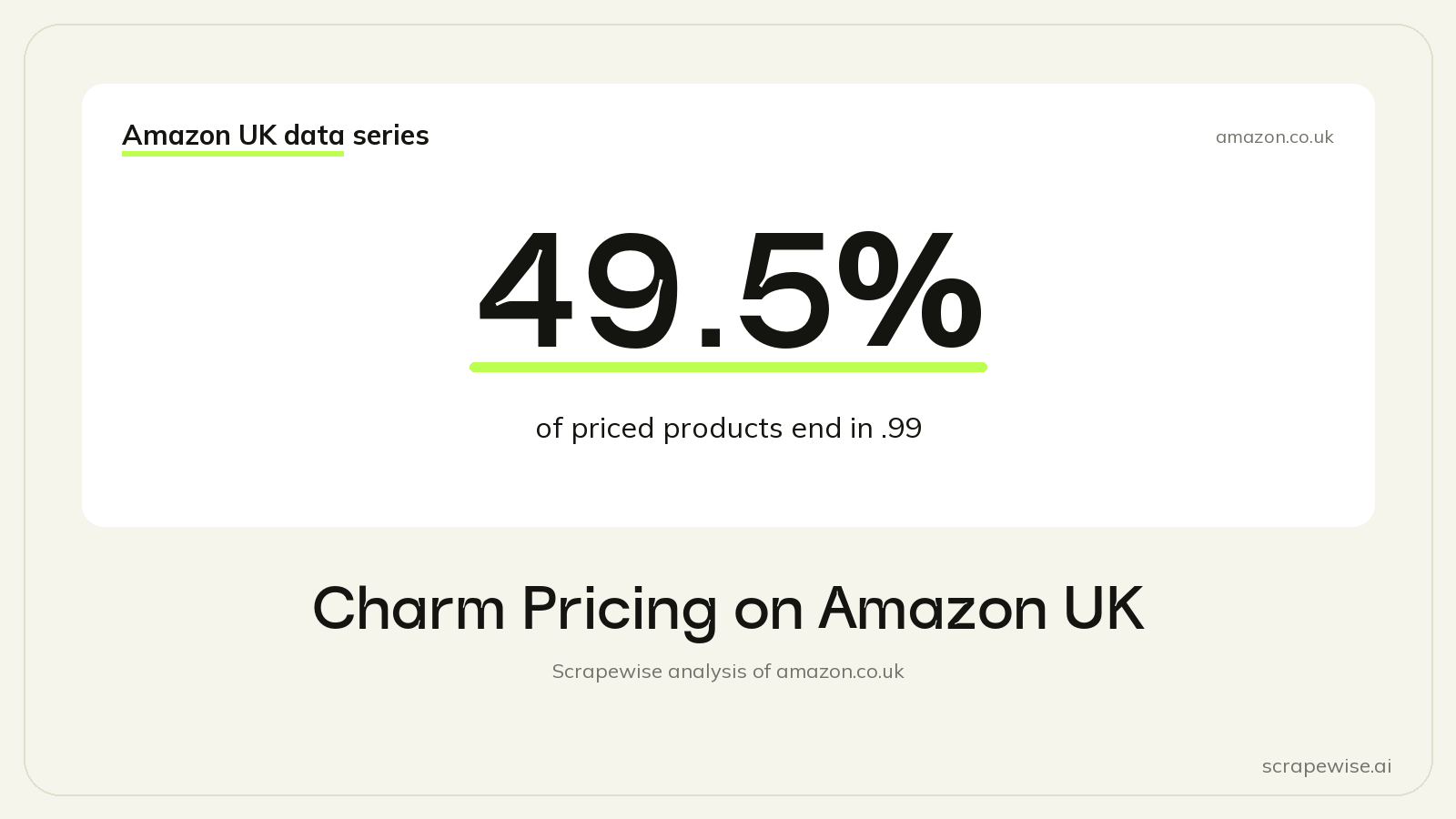
- 49.5% of priced Amazon UK products end in .99, and 62% of prices end in a 9.
- £9.99 is the most common price, used by 6,914 priced products.
- On single-seller listings, only 27.4% of Amazon's own prices end in .99, against 59.8% to 65.7% for UK, US, China and Hong Kong-based sellers.
Psychological pricing on Amazon UK is the norm: 49.5% of the 193,782 priced products in our sample end in .99, and 62% of prices end in a 9. The prices come from a snapshot of amazon.co.uk search results taken on 23 to 24 September 2026. Amazon's own listings are the clear exception.
How Amazon UK Prices End
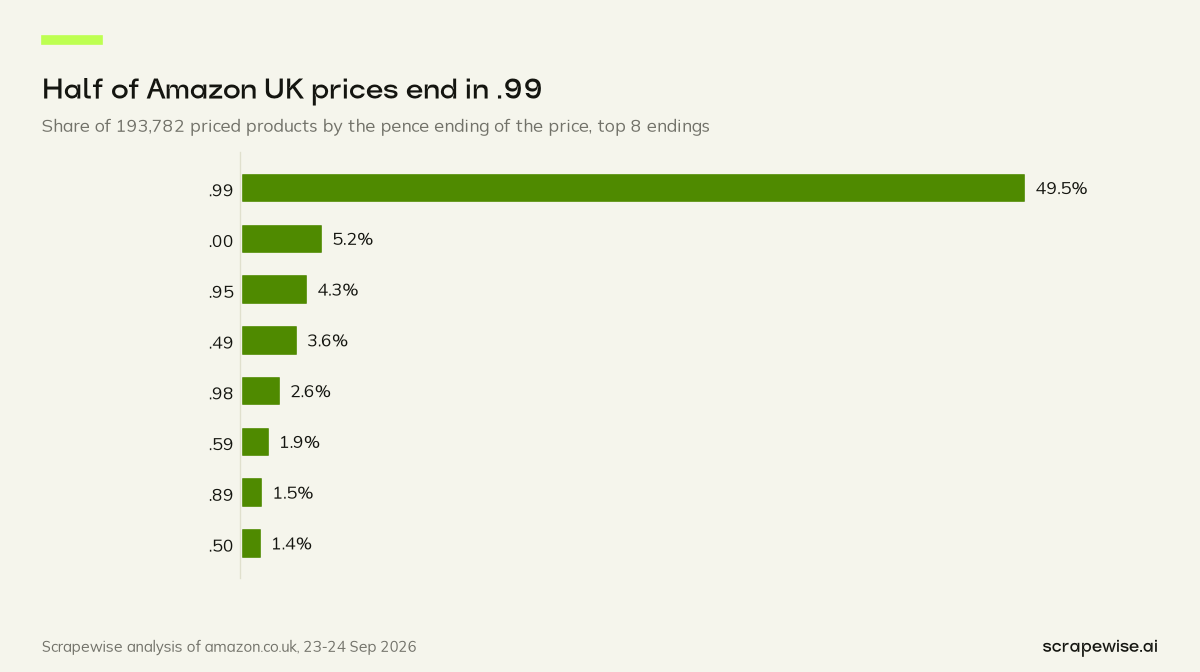
We took the pence part of every price and counted how often each ending appears. One ending dominates.
| Price ending | Share of priced products |
|---|---|
| .99 | 49.5% |
| .00 (whole pounds) | 5.2% |
| .95 | 4.3% |
| .49 | 3.6% |
| Any ending in 9 | 62% |
The .99 ending is far more common than a whole-pound price. Add the .49, .89, .79 and other endings that finish in 9, and 62% of priced products end on that digit.
Our data cannot say whether .99 makes shoppers buy more. It shows how often the ending is used, and by whom.
Who Uses .99 and Who Does Not
To see which sellers pick .99 prices, we looked at listings with exactly one seller. On those, the price belongs to one seller, so we can group listings by who sells them: Amazon itself, or a marketplace seller grouped by its declared business address.
| Seller group | Share of single-seller prices ending in .99 |
|---|---|
| Hong Kong-based sellers | 65.7% |
| China-based sellers | 61.7% |
| US-based sellers | 60.2% |
| UK-based sellers | 59.8% |
| EU-based sellers | 45.8% |
| Amazon | 27.4% |
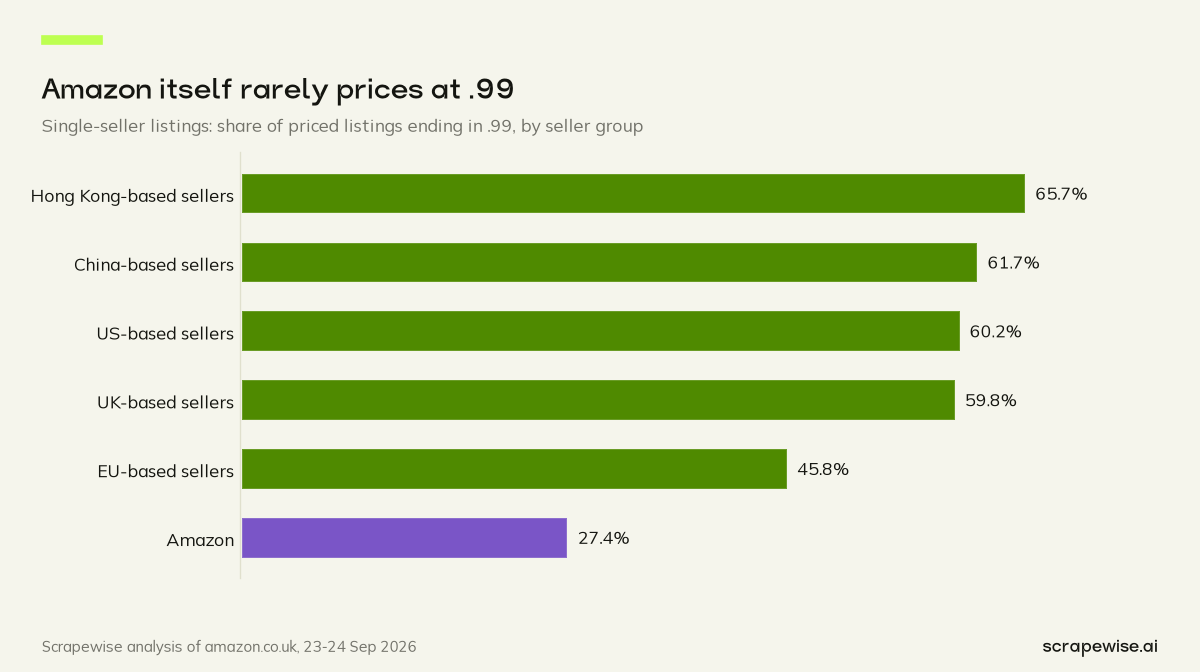
Marketplace sellers based in the UK, the US, China and Hong Kong behave almost the same way. Between 59.8% and 65.7% of their single-seller prices end in .99. Amazon, it turns out, is not a big fan of the .99 ending. Its sellers more than make up for it.
EU-based sellers sit in between at 45.8%. The data does not tell us why, and we would rather leave the gap unexplained than guess.
Whole-pound prices are the other side of the story. Products priced at an exact pound amount have a median price of £36.00, against £16.99 for the median priced product, and Amazon is among the sellers on 44.3% of them. Round prices lean towards dearer items and towards Amazon's own stock.
The Most Common Price Points
The single most common price in our sample is £9.99, carried by 6,914 priced products, or 3.6% of them. That is 6,914 products standing one penny short of a tenner. Next come £19.99, £14.99 and £12.99.
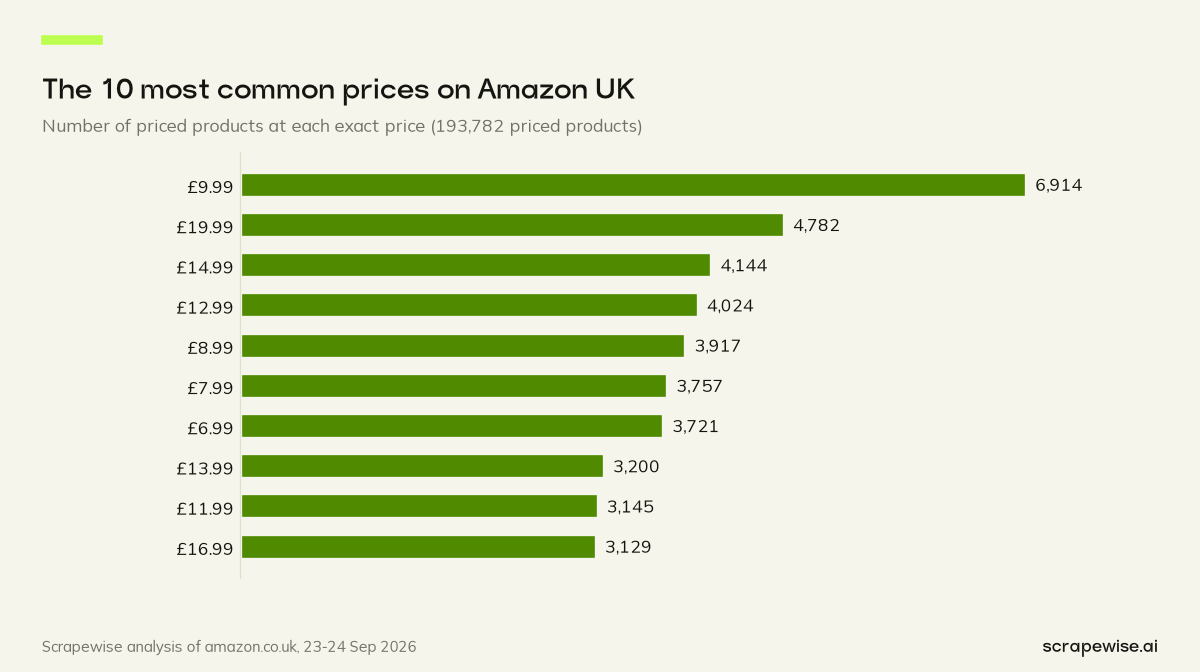
The top four prices all sit one penny under a round number of pounds. We look at the gap between just-below and exact round prices in more detail in price threshold psychology, and at the one category that mostly skips .99 in the Amazon UK beauty market.
Why the Habit Is So Strong on a Marketplace
The usual explanation for charm pricing is the left-digit effect: shoppers read £9.99 as "nine pounds something" before they register the pence. Whether or not that holds for every shopper, a marketplace adds its own pressure. On a search results page, a product sits right next to its competitors, often with near-identical photos. The price is one of the few things a shopper can compare at a glance, so small differences in the first digit are visible in a way they are not on a shop shelf.
There is also a copying effect. When most competitors in a search sit at £9.99, a new seller who picks a round ten pounds looks like the odd one out, and one who drops to .49 gives away money on every sale for a first digit that is already the same. Joining the cluster is the low-risk choice, and the price point data fits that reading.
What the Endings Mean for Price Monitoring
Endings also matter when you collect prices at scale. A few habits make the data easier to use:
- Watch for threshold crossings. A move from just under a round pound amount to just over it crosses a line most sellers avoid. A move of the same size below the line does not. Treat the first as the bigger signal.
- Flag round prices separately. Whole-pound prices are rarer and dearer, and Amazon sells on more of them. A competitor who switches to round prices may be changing position as well as price.
- Store the raw price. A report that rounds £9.99 up to the nearest pound hides the pattern sellers care about.
What It Means for Sellers and Brands
If you sell on Amazon UK, a .99 price puts you in the majority. That has two sides.
- Matching the habit is safe. A .99 price looks normal to shoppers, because about half of the prices in our sample end that way.
- Breaking it sends a message. Amazon uses .99 far less often than its marketplace sellers do, so a round price can read as a retailer's price. Some brands will want that and others will not.
- Watch the price points. Competitors cluster at £9.99, £14.99 and £19.99. A product priced just above one of those points sits next to a crowd that looks cheaper by a few pence.
- Collect more than once. One snapshot shows where prices sit today. It cannot show how often sellers move between price points, or who moves first.
Our guides on how to track competitor pricing strategies and price scraping for e-commerce teams cover how to automate it.
How We Collected This Data
This post used three Scrapewise data APIs on amazon.co.uk. The Amazon Search API ran 868 keywords, pages 1 to 7, and returned each product's displayed price, which gave us the endings and the price points. The Amazon Offers API returned the offers on each product, so we could find listings with one seller and see whether Amazon was that seller. The Amazon Seller API returned the declared business address from each seller's public profile; we publish only aggregates. Each of the three is billed at €0.00015 per call (€0.15 per 1,000 calls), and scheduled runs build a price history, so a competitor's jump across a round pound shows up next to the old price. To pull the price points for your own category, set up an account.
For the rest of the study, including seller, rating and search findings, read the Amazon UK Marketplace Report 2026.
Want to see which endings your competitors pick? Run 5 free requests on one of your own searches first. Sign up, and see pricing before you scale up.
Paste a marketplace URL — get structured market data
Size categories, track assortments, monitor trends. Clean feeds ready for your BI stack.
97% accuracy on Amazon benchmarks · no credit card · book a 15-min call →