

To track a competitor's pricing strategy online, record the same products on their site every day for at least 8 to 12 weeks. Log the price, any promotion, the shipping cost and the stock status. A single price check tells you what something costs today. A few months of history tells you how that competitor makes pricing decisions.
This guide is about reading those decisions. If you still need the data itself, start with our guide to building a competitive pricing database, then come back here.
What Does a Competitor Pricing Strategy Look Like in the Data?
A pricing strategy shows up as a pattern over time. It rarely shows in one price. Premium sellers stay above the market and rarely discount. Discounters sit at the bottom all year. Matchers move within a day or two of someone else. High-low sellers swing between a list price and deep, regular promotions.
Here is how the common strategies tend to look once you have a few months of daily prices:
| Strategy | What the price history shows | What to watch |
|---|---|---|
| Premium positioning | Prices 10% or more above the market median, few discounts | Whether they hold when others cut |
| Everyday low price | Flat line near the bottom of the market | Shipping fees and bundle sizes, where the margin often hides |
| Price matching | Changes that follow another seller within 24 to 48 hours | Who moves first |
| High-low promotions | List price most of the time, then sharp, regular drops | Promo length, depth and calendar |
| Dynamic or algorithmic pricing | Many small moves, sometimes several a day | Reaction to stock levels and to your own price |
| Psychological pricing | Prices ending in .99 or .95, anchored "was" prices | How often the "was" price was actually charged |
The labels matter less than the behavior. One retailer can run premium pricing on its own brands and aggressive matching on branded bestsellers. That is why you track at product level and then group products by category.
Which Signals Should You Track Beyond the List Price?
The list price is only part of the offer. Shoppers compare what they pay at checkout, so track the discount, the promotion type, shipping cost and free shipping threshold, stock status, bundle or multi-buy offers, and the seller. Without these fields, a competitor that moves margin into shipping looks like it never changed anything.
A practical field list for each product and each check:
- Regular price and current selling price
- Promotion text and type (percentage off, fixed amount, multi-buy, coupon, member price)
- Shipping cost and the free shipping threshold
- Stock status, and the delivery estimate if one is shown
- Seller name, for marketplaces where many sellers share a listing
- Pack size or bundle contents, so you compare like with like
- Date and time of the check
Marketplace prices and a competitor's own webshop often differ. If a brand sells on Amazon and on its own site, track both. The gap between the two is part of the strategy.
For marketplaces and comparison engines, one product page can list many sellers. You can pull every store's price for one product on Google Shopping to see the whole spread for that product in one place.
How Do You Track Competitor Pricing Strategies Online, Step by Step?
Pick 3 to 5 direct competitors and match the products you both sell. Collect the fields above at least once a day, keep every result with a date, and compare each check with the one before. After a few weeks you have a history you can read and a short daily list of changes to review.
The setup itself is covered in detail elsewhere, so here is the short version:
- Choose competitors and matched SKUs. Match on EAN or GTIN where the page shows one, then on brand, model and pack size. A wrong match ruins every comparison built on it.
- Set the schedule. Daily is enough to see promotions and matching. Around big sales events, make sure no day is missed for your busiest products.
- Capture price and promo fields together. Store the promotion text next to the price so you can explain each drop later.
- Keep the history. Strategy only appears over time, so never overwrite yesterday's row.
- Flag changes. Compare each run with the last one and review only the products that moved.
Our price monitoring automation guide walks through scheduling, matching and change detection in depth. If you are choosing software, this comparison of competitive price monitoring tools covers the main options.
Prices can also depend on location. Big-box retailers often show different prices and stock per store. For Walmart, you can collect prices as one Walmart store shows them by setting the ZIP code and store, then repeat the check for each region you compete in.
Manual, Spreadsheet or Automated Tracking?
Manual checks work for a small list of products. Past that, people skip days, and gaps in the history hide exactly the moves you want to see. Spreadsheets with import formulas break when a site changes its layout or blocks the requests. An automated tool costs money but keeps a clean daily record without anyone opening competitor websites.
How Do You Read the Pattern?
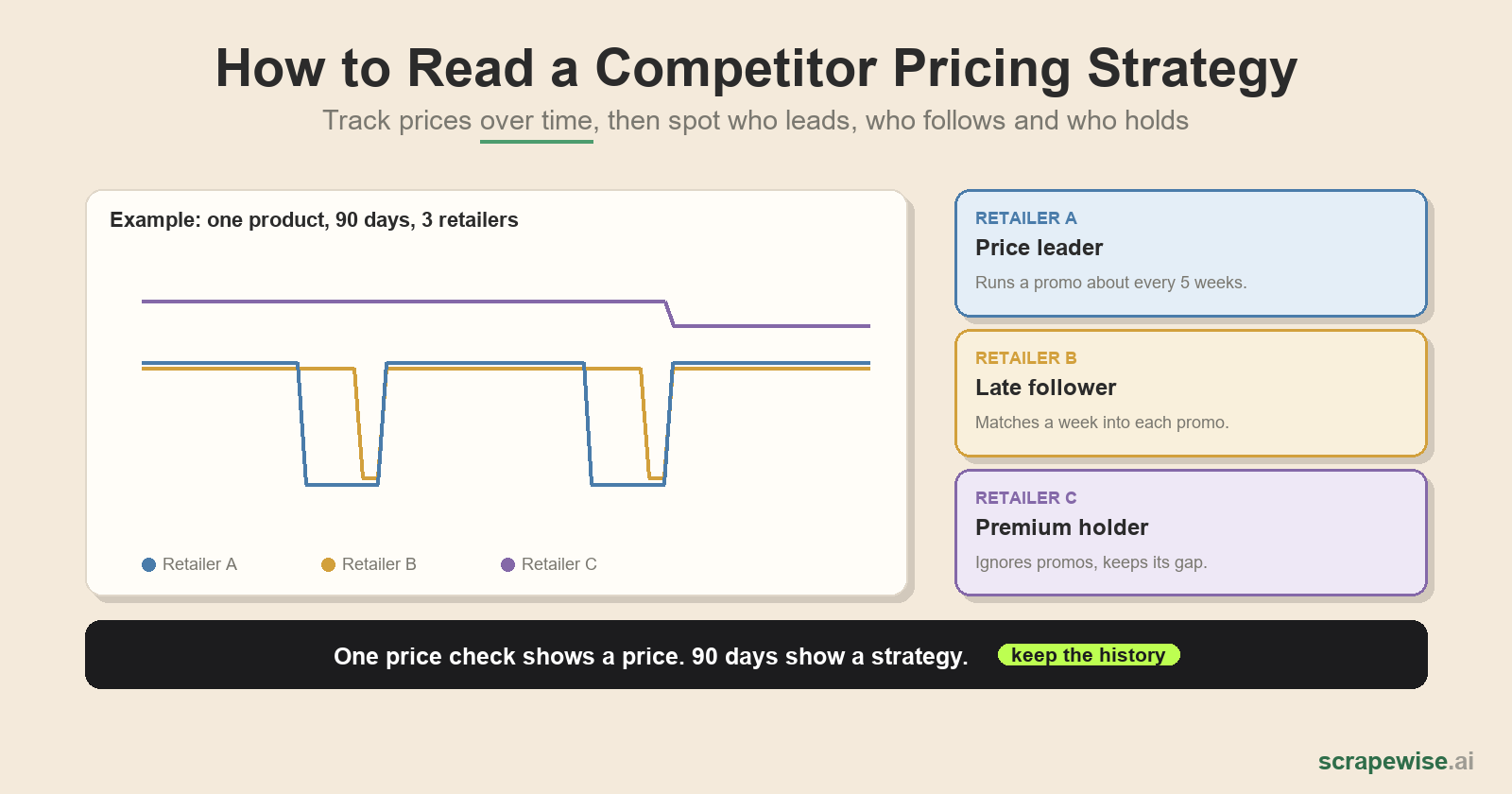
Line up at least 8 weeks of daily prices for the same product across competitors. Then look for three things: who moves first, who follows and how fast, and whether discounts come back on a schedule. Those answers tell you whether a competitor leads the market, follows it or runs a promotion calendar.
Take an example with invented numbers for one product across 90 days:
| Days | Retailer A | Retailer B | Retailer C |
|---|---|---|---|
| 1 to 20 | €129 | €129 | €139 |
| 21 to 27 | €109 (promo) | €129 | €139 |
| 28 to 30 | €109 (promo) | €109 | €139 |
| 31 to 55 | €129 | €129 | €139 |
| 56 to 62 | €109 (promo) | €129 | €139 |
| 63 to 65 | €109 (promo) | €109 | €139 |
| 66 to 90 | €129 | €129 | €135 |
Reading it:
- Retailer A is the price leader with a promo cycle. It drops by about 15% for 10 days, roughly every 5 weeks.
- Retailer B is a follower. It matches A about a week into each promotion and goes back up when A does. Its repricing is probably manual or checked weekly.
- Retailer C holds a premium position. It ignores both promotions and only trims its price slightly near the end.
With this history you can predict A's next promotion around day 91 and plan for it. You can also expect B to follow late again.
A few more patterns worth knowing:
- Prices that change several times a day in small steps usually point to repricing software.
- A price that rises a week before a "sale" and then drops back to its old level is an inflated reference price. In the EU, Article 6a of the Price Indication Directive requires an announced reduction to show the lowest price of at least the previous 30 days.
- Out-of-stock periods followed by a higher price often mean a supplier cost increase, which is likely to reach you as well.
How Should You Respond to a Competitor's Pricing Strategy?
Match a competitor only on products where shoppers compare prices and the competitor is a real alternative for them. Hold your price where you win on stock or delivery speed. Compete on shipping or bundles when a price cut would cost more margin than the sales it brings back.
Some rules of thumb, based on the patterns above:
| What you see | A sensible response |
|---|---|
| A leader runs a regular promo cycle | Plan your own promotion around it, or hold and push stock availability while their promo stock runs low |
| A follower copies you within days | Avoid small cuts. They get matched and both of you lose margin |
| A premium seller never discounts | Leave the gap. Shoppers who buy there are not comparing on price |
| An algorithmic seller reacts to your price | Test small changes on a few SKUs first and watch the reaction |
| A competitor moves margin into shipping | Compare total landed price, and consider a lower free shipping threshold |
Before you start collecting, check the rules where you operate. Our guide to whether price scraping is legal in the EU covers the main court cases and a compliance checklist.
Check the numbers before you react. Work out what a cut costs in margin on your expected volume. Track how the competitor responds to your change too, because your move becomes part of their data.
If you want this tracking to run without a team checking sites by hand, see how competitor price tracking works in ScrapeWise. You add the competitor pages once and choose a schedule, and the results arrive in your dashboard, as a CSV export or through the REST API. Pricing is per page: €0.15 per 1,000 plain pages, €0.75 per 1,000 pages that need a browser and €1.50 per 1,000 pages that need residential proxies, with 5 free requests to start. Details are on the pricing page.
For a one-off check of one product against one competitor, try our free competitor price checker.
Paste a competitor URL — start tracking prices in 60 seconds
Any e-commerce site, any SKU count. Clean structured feeds on your schedule, no code required.
97% accuracy on Amazon benchmarks · no credit card · book a 15-min call →