

How to Build a Competitive Pricing Database (Without Enterprise Budget)
Your competitor just dropped prices on 200 SKUs overnight. By the time your team notices — maybe Tuesday's trading meeting, maybe a Slack message from a frustrated sales rep — you've already lost three days of margin and market share. You know you need a competitive pricing database. You also know that Competera wants six figures and Minderest doesn't even list their pricing publicly.
Here's the thing: you don't need an enterprise platform to build a reliable competitive pricing database. Mid-market retailers across Europe are assembling pricing intelligence systems that deliver 80% of the value at 20% of the cost — using a combination of web scraping, smart data structuring, and focused product matching.
This guide walks you through exactly how to do it.
What Is a Competitive Pricing Database?
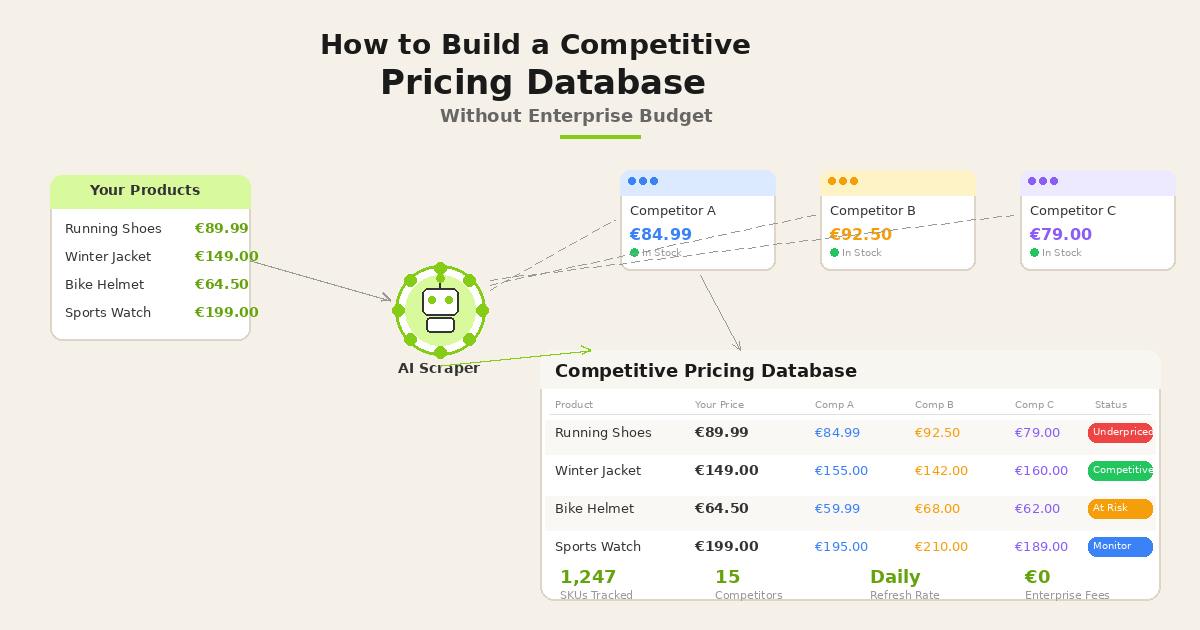
A competitive pricing database is a structured, continuously updated repository of competitor product prices, stock availability, promotions, and related data points. Unlike a one-off price check or a spreadsheet someone updates manually on Fridays, a proper pricing database is automated, historically rich, and designed for analysis.
At its core, it answers three questions: what are my competitors charging right now, how have their prices changed over time, and where do I have room to adjust my own pricing without leaving money on the table?
Enterprise retailers have been building these systems for over a decade, typically through expensive SaaS platforms like Competera, Intelligence Node, or Omnia Retail. These platforms deliver excellent data quality — Competera advertises a 99% quality SLA, Omnia leads G2's Winter 2026 Grid for Retail Pricing Software — but they come with enterprise price tags that start in the tens of thousands annually.
For a mid-market retailer tracking 500 to 10,000 SKUs across 10 to 50 competitors, that math doesn't always work. The good news is that the underlying technology — web scraping, product matching, and data normalization — has become dramatically more accessible.
Why Mid-Market Retailers Need a Competitive Pricing Database
If you're running an e-commerce operation with €5M to €100M in revenue, you're in the pricing pressure zone. You're big enough that competitors actively monitor your prices, but not big enough to have a dedicated pricing science team or a six-figure software budget.
Margin protection in a race-to-bottom market. European e-commerce turnover hit €842 billion in 2024, growing 7% year-over-year. With that growth comes intensifying price competition — particularly in categories like electronics, sporting goods, and home furnishings where comparison shopping is the default behavior. Without systematic competitor price tracking, you're pricing blind.
Cross-border pricing complexity. If you sell in multiple European markets, your competitors vary by country. A Swedish outdoor retailer competes against different players in Germany than in Finland. Your competitive pricing database needs to account for regional differences — different competitors, different VAT rates, different promotional calendars, and different consumer expectations around pricing. If Germany, Austria or Switzerland is one of those markets, an Idealo scraper is the fastest way to see every merchant price for a given EAN in one pull — Idealo is the default comparison engine DACH shoppers check before they buy.
Speed of price changes. The most aggressive competitors now adjust prices multiple times per day based on inventory levels and demand signals. Manual monitoring simply can't keep up. Even weekly price checks miss the majority of competitor movements. By the time you react, the window of opportunity has closed.
Data-driven category management. A competitive pricing database doesn't just tell you what to price today — it reveals competitor patterns over time. Which competitors lead price drops? Which ones follow? When do seasonal promotions typically start? This pattern recognition transforms pricing from reactive to strategic.
How to Build a Competitive Pricing Database: Step by Step
Step 1: Define Your Competitive Set and Priority SKUs
Don't try to monitor everything. Start with the products that matter most. Typically, 20% of your SKUs drive 80% of revenue. Focus your initial database on these high-impact products, plus any SKUs where you suspect you're losing sales on price.
For each priority SKU, identify 5 to 15 competitors who sell the same or directly comparable products. In European e-commerce, this usually means a mix of pure-play online retailers, marketplace sellers (Amazon, eBay, Bol.com), and omnichannel retailers with online stores.
Document the competitor URLs where each product is listed. This becomes the foundation of your scraping targets.
Step 2: Set Up Automated Data Collection
This is where most mid-market retailers hit a wall. Manual price checking doesn't scale, and building custom scrapers in-house requires engineering resources you may not have. There are three practical approaches.
Option A: In-house scraping (technical team required). If you have Python developers, frameworks like Scrapy or Playwright can be configured to extract pricing data from competitor sites. The challenge is maintenance — competitor sites change layouts frequently, anti-bot measures evolve, and JavaScript-heavy e-commerce sites require headless browser rendering that adds complexity. In-house scrapers typically break within weeks and require constant upkeep.
Option B: Self-serve scraping platforms. Tools like Browse AI, Octoparse, or Apify offer no-code or low-code interfaces for setting up web scrapers. These are more accessible than building from scratch, but you're still responsible for managing the scraping infrastructure, handling failures, and ensuring data quality.
Option C: Managed scraping services. Platforms like ScrapeWise.ai handle the entire data collection layer — building the scrapers, maintaining them when sites change, handling anti-bot challenges, and delivering clean, structured data. This is the approach that most closely mirrors what enterprise tools like Competera and Skuuudle provide, but at a price point accessible to mid-market retailers. The key advantage is that self-healing scraper infrastructure means your data pipeline doesn't break when a competitor redesigns their product page.
Regardless of which approach you choose, aim for daily data collection at minimum. For fast-moving categories like electronics, twice-daily or more frequent updates may be necessary.
Step 3: Solve the Product Matching Problem
This is the hardest technical challenge in building a competitive pricing database, and it's where many DIY efforts fall apart. The same product listed on different retailer sites often has different names, different images, and different product identifiers. A Samsung Galaxy S24 Ultra might be listed as "Samsung S24 Ultra 256GB Titanium Black" on one site and "Galaxy S24U 256 TB" on another.
Effective product matching requires a combination of approaches: matching on standardized identifiers (EAN, UPC, MPN) when available, using fuzzy text matching on product names and descriptions for the rest, and layering in manual validation for high-value SKUs.
AI-powered product matching has improved dramatically — modern systems can achieve 90%+ match accuracy automatically, with human review for edge cases. But this is genuinely hard, and it's worth investing in getting right. A competitive pricing database with bad matches is worse than no database at all, because it leads to pricing decisions based on wrong data.
Step 4: Structure Your Database for Analysis
Once you're collecting clean, matched pricing data, structure it for the analyses that actually drive decisions. At minimum, your database should include the date and time of each price observation, the competitor name and URL, the product identifier (your SKU mapped to competitor SKU), the current price (distinguishing between regular and promotional prices), stock availability status, and shipping cost if visible.
Store historical data — don't just overwrite with current prices. The historical dimension is what transforms a price tracker into a strategic pricing database. Over time, you'll accumulate the data needed to identify competitor pricing patterns, seasonal trends, and promotional cycles.
For storage, a simple PostgreSQL database works well for most mid-market operations. If your team is more comfortable with spreadsheets, Google Sheets or Airtable can work for smaller product sets (under 1,000 SKUs), but you'll hit performance limits quickly as your database grows.
Step 5: Build Reporting and Alerting
A database is only valuable if your team actually uses it. Build two layers of access.
Real-time alerts for significant price movements. Define thresholds — for example, notify the category manager when a competitor drops below your price by more than 5%, or when a key competitor goes out of stock on a high-margin product. Keep alerts focused; too many notifications lead to alert fatigue.
Weekly analysis dashboards that show your price positioning across the competitive set. Key metrics include your price index (your average price relative to the market average), the number of products where you're the cheapest vs. most expensive, and competitor pricing trends over the past 30 to 90 days.
Tools like Looker Studio (free), Metabase (open-source), or even well-structured Google Sheets can serve as the reporting layer. The analysis tools matter less than the discipline of reviewing the data regularly and translating insights into pricing actions.
Common Challenges and How to Solve Them
Challenge: Scraper breakage and data gaps. Competitor websites change frequently, and traditional CSS-selector-based scrapers break when layouts update. This is the #1 reason DIY competitive pricing databases fail. Solution: Use AI-powered scraping that understands page structure semantically rather than relying on brittle selectors. Or use a managed service where scraper maintenance is someone else's problem.
Challenge: Handling marketplace complexity. On Amazon or eBay, the same product has multiple sellers with different prices. Which price do you track? Solution: Track the Buy Box winner price (or the lowest price from a fulfilled-by-marketplace seller) as your primary reference. Also track the number of sellers and the price range — a product with 15 sellers within €2 of each other has different competitive dynamics than one with 3 sellers and a €30 spread.
Challenge: Promotional vs. regular pricing. Competitors run promotions, bundle deals, and loyalty discounts that complicate true price comparison. Solution: Capture both the displayed price and any strike-through / original price. Flag promotional periods separately in your database so your trend analysis distinguishes between genuine price strategy changes and temporary promotions.
Challenge: Cross-border VAT and currency differences. If you operate across EU markets, prices need normalization. Solution: Store prices in their original currency alongside a normalized comparison currency (usually EUR). Factor in VAT differences when comparing — a €99 product in Germany (19% VAT) has a different pre-tax margin than the same product at €99 in Sweden (25% VAT).
Challenge: Data quality and match accuracy. Bad matches lead to bad pricing decisions. Solution: Implement a confidence scoring system for your product matches. Use high-confidence automated matches for routine monitoring, but require human validation for any match that triggers a pricing action. Invest in quality over coverage — 500 accurately matched SKUs are worth more than 5,000 poorly matched ones.
Advanced Strategies for Getting More From Your Pricing Database
Track stock availability alongside pricing. A competitor's price is only relevant if they actually have the product in stock. When a major competitor goes out of stock on a popular SKU, you have a window to hold or even raise your price. Your competitive pricing database should track stock status as a first-class data point, not an afterthought.
Build category-level price indices. Beyond individual SKU tracking, calculate your competitive price positioning at the category level. Are you consistently 3% cheaper on outdoor clothing but 8% more expensive on footwear? Category-level indices reveal strategic gaps that SKU-level data can obscure.
Monitor promotional patterns. After 6 to 12 months of data collection, your database becomes a goldmine for predicting competitor behavior. Retailers tend to follow patterns — same Black Friday strategy year after year, same end-of-season markdown timing. Use this intelligence to time your own promotions for maximum impact.
Integrate with your repricing workflow. The ultimate goal is a closed loop: competitive data feeds into pricing rules, rules generate recommended price changes, and your team approves or adjusts. This doesn't require expensive dynamic pricing software. Even a well-structured spreadsheet with formulas that reference your pricing database can automate the initial recommendation, leaving your team to apply judgment on the final decision.
Conclusion
Building a competitive pricing database used to require an enterprise budget and a dedicated data engineering team. That's no longer the case. With modern web scraping infrastructure, AI-powered product matching, and accessible analytics tools, mid-market retailers can assemble a pricing intelligence system that rivals what the largest retailers use — at a fraction of the cost.
The key is starting focused: pick your top-revenue SKUs, identify your real competitors, set up automated data collection through a managed scraping platform, and build simple reporting that your pricing team will actually use. Expand from there as you prove the ROI.
The retailers who win on pricing in 2026 aren't necessarily the ones with the biggest budgets. They're the ones with the best data — collected reliably, matched accurately, and acted on consistently.
Paste a competitor URL — start tracking prices in 60 seconds
Any e-commerce site, any SKU count. Clean structured feeds on your schedule, no code required.
97% accuracy on Amazon benchmarks · no credit card · book a 15-min call →