

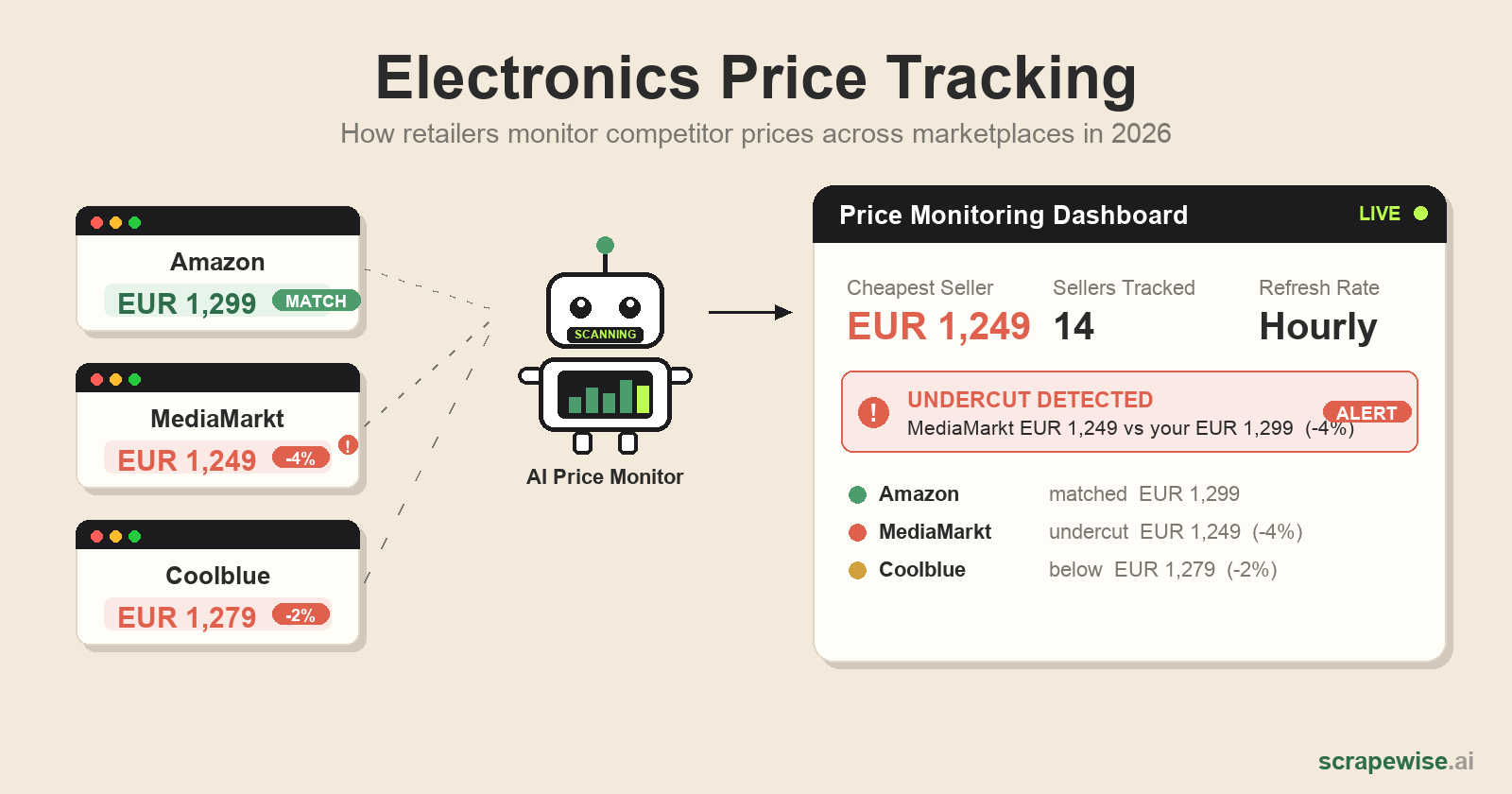
Electronics is the hardest category in retail to price. Margins are thin, prices move multiple times a day, and the same SKU sits side by side on Amazon, MediaMarkt, Coolblue, Otto, and a dozen comparison engines — each with its own price. Miss a competitor's flash discount on a popular TV or GPU for even a few hours and you either lose the sale or sell below margin to win it back.
This guide is for pricing and category managers at electronics retailers and brands who need to track competitor prices and price history across marketplaces. It covers how to choose a tool, the realistic options in 2026, and the specific reasons electronics price tracking breaks where general price monitoring works fine.
How to Choose an Electronics Price Tracking Tool (30-Second Framework)
Three questions decide which tool fits:
- How many SKUs and retailers? Under ~1,000 SKUs across a handful of mainstream sites → a self-serve SaaS tracker is enough. Thousands of SKUs across marketplaces, comparison engines, and regional retailers → you need a managed data layer.
- Do you need price history, not just current price? Spot prices tell you where you stand today. Price history tells you whether a competitor is systematically undercutting you or running a one-day promo — a different decision entirely.
- How JavaScript-heavy are your targets? Most modern electronics storefronts load prices dynamically. Tools that parse static HTML silently return stale or missing prices on exactly the sites that matter most.
A price gap only means something when the competitor listing is the same product and pack size as yours, so check how each tool matches products. Scrapewise scrapes the pages, cleans the prices (per unit, one currency) and matches the same product across shops, so you get a ready competitor price comparison instead of raw pages.
Quick Comparison: Electronics Price Tracking Options 2026
| Approach | Best for | Price history | Marketplace + engine coverage | JS-heavy sites |
|---|---|---|---|---|
| Self-serve SaaS trackers | <1,000 SKUs, mainstream sites | Limited window | Amazon, eBay, Google Shopping | Mixed |
| Comparison-engine feeds (Idealo, Pricerunner) | Catalog visibility on the engine | Engine-side only | Engine catalog only | N/A |
| Browser-based monitors | JS-heavy mid-market catalogs | Yes | Configurable | Strong, slower refresh |
| Managed scraping (ScrapeWise) | Multi-marketplace at scale | Yes, your retention | Any public site | Strong |
Why Electronics Price Tracking Breaks Where General Monitoring Works
Prices change intraday, not daily. Consumer electronics — GPUs, phones, TVs, laptops — reprice with demand, stock, and competitor moves. A daily refresh cadence, which is fine for slow-moving categories, misses most of the action. If your tool refreshes once a day, you are pricing against yesterday.
The same product has many identities. A single laptop SKU appears under different titles, bundle configurations, and EANs across retailers. Matching "the same product" across Amazon, Otto, and a brand storefront is a non-trivial problem. Weak matching produces phantom price gaps that send your team chasing prices that don't actually compete. This is where AI-powered product data matching earns its keep.
Dynamic pages defeat static scrapers. MediaMarkt, Coolblue, and most large electronics retailers load prices client-side. Tools built to parse raw HTML return empty fields on these sites — and the gap is invisible until you audit coverage. See our walkthrough on how to scrape JavaScript-heavy e-commerce sites for why this happens and how to handle it.
Comparison engines are a coverage source, not a strategy. Idealo, Pricerunner, and Geizhals show you where you rank on the engine — useful, but only for products and sellers listed there, and only with the engine's own refresh logic. They don't cover marketplace third-party sellers or your competitors' own storefronts.
What "Price History" Actually Buys You
Current price is a snapshot. Price history is the signal. With a few weeks of tracked data you can tell the difference between:
- A structural undercut — a competitor consistently sitting 4% below you on a product family, which calls for a pricing or sourcing response.
- A promotional blip — a 48-hour sale you should not chase to the bottom.
- A stock-out reaction — a competitor raising prices because they're out of stock, which is your window to capture margin.
None of these are visible from a single scrape. The retailers who price electronics well treat history as a first-class dataset — retained on their side, queryable, and tied to alerts that fire on patterns, not single data points. For the analytics side of this, see real-time data analytics for retailers and wholesalers.
Building an Electronics Price Tracking Setup
A practical setup has four layers:
- Coverage — every place your products and competitors appear: marketplaces (Amazon, eBay, Otto, bol.com, Allegro), comparison engines (Idealo, Pricerunner, Geizhals), and competitor storefronts (MediaMarkt, Coolblue, brand DTC sites).
- Matching — reliable product matching across those sources so you compare the same product, not similar-looking listings.
- Frequency — refresh aligned to how fast your category moves. For electronics, that usually means several times a day on high-velocity SKUs, less on the long tail.
- Alerts on patterns — notifications driven by sustained moves and rank changes, not every minor fluctuation, so the team acts on signal instead of noise.
The build-vs-buy decision usually comes down to coverage and maintenance. Off-the-shelf SaaS tools are quick to start but cap out on coverage and break when sites change. Building in-house gives control but turns into a permanent maintenance project — the hidden cost of scraper maintenance is the line item teams consistently underestimate.
Where Managed Data Extraction Fits
For retailers tracking electronics prices across many marketplaces and JS-heavy storefronts, the bottleneck is rarely the dashboard — it's coverage and upkeep. ScrapeWise operates as a managed data layer: you define the products and sources you need, and you receive structured price and availability data — with anti-bot handling, product matching, and selector maintenance managed for you. That feeds your own competitor price tracking and repricing workflows rather than locking your data inside a vendor dashboard.
The question isn't "which tracker has the nicest UI." For electronics, it's "which approach actually returns complete, current, correctly-matched prices across every site that competes with me." That is the difference between repricing on real data and repricing on the gaps your tool didn't tell you about.
Paste a competitor URL and start tracking prices
Any e-commerce site, any SKU count. Clean structured feeds on your schedule, no code required.
Not ready to sign up? See 40 rows of real Google Shopping price data →
97% accuracy on Amazon benchmarks · no credit card · book a 15-min call →