

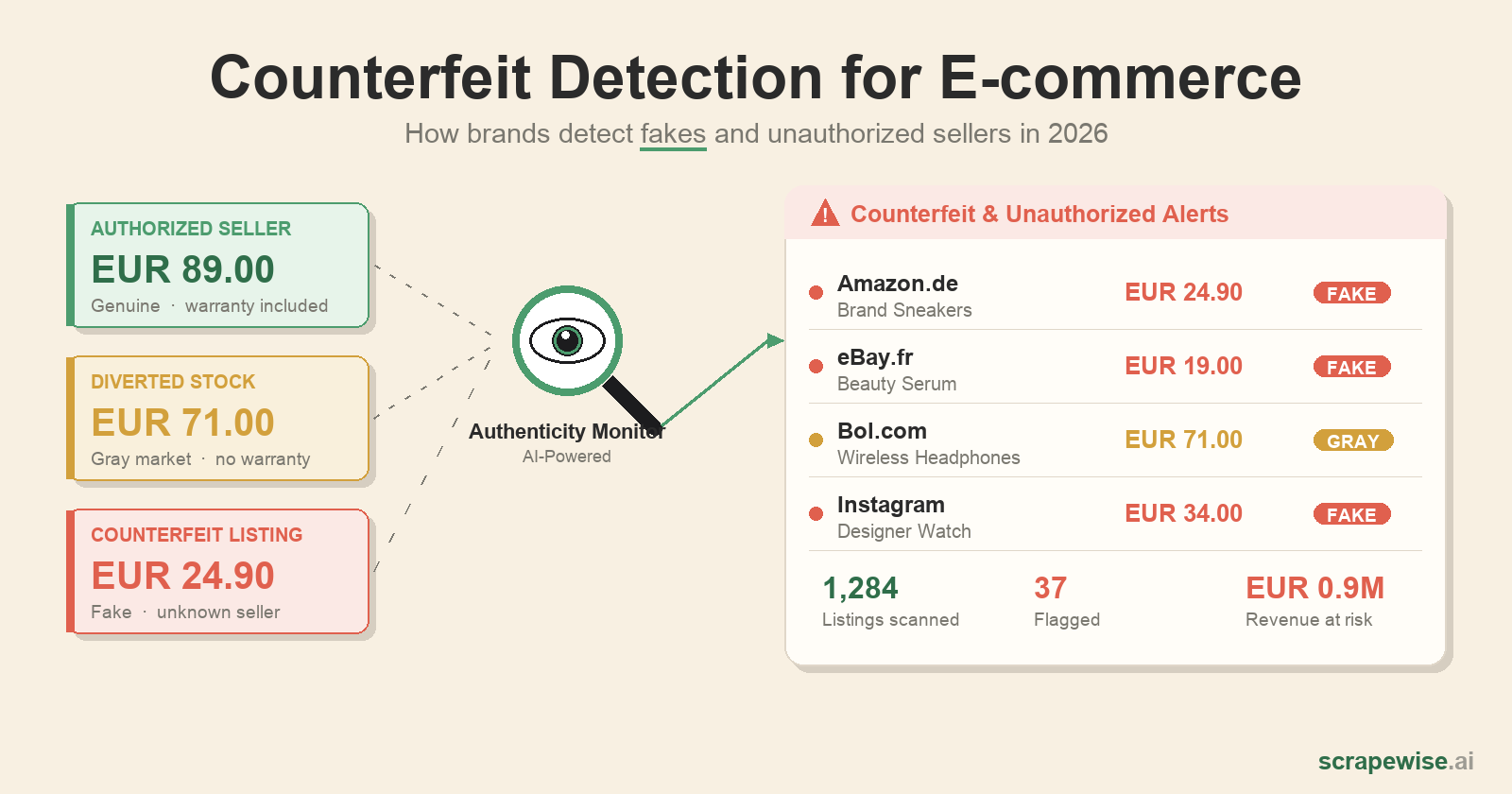
A counterfeit version of your product on a global marketplace does more damage than a lost sale. It ships without your warranty, fails to meet your quality standard, and when the customer has a bad experience they blame your brand — not the counterfeiter. For mid-size e-commerce brands without a dedicated brand-protection team, the hard part isn't deciding to act. It's seeing the problem across dozens of marketplaces and thousands of listings before it compounds.
This guide explains how brands detect counterfeit listings at scale in 2026: how counterfeiting differs from the gray market, what an automated detection workflow looks like, and how to choose tooling that fits a mid-market budget.
Counterfeit vs Gray Market: Why the Distinction Decides Your Response
These two problems get lumped together and need completely different responses.
- Counterfeit goods are fake. They infringe your trademark and are illegal in essentially every jurisdiction. The response is takedown and enforcement — and platforms are obligated to help once you prove ownership.
- Gray market goods are genuine products sold outside your authorized channels — parallel imports, diverted stock. They're usually legal, so the response is channel governance and pricing, not takedown. We cover that case in gray market monitoring for European brands.
Getting this wrong is expensive in both directions: filing IP complaints against legitimate resellers wastes effort and invites disputes, while treating counterfeits as a pricing problem leaves illegal listings live. Detection has to classify which problem each listing represents.
Finding the listing is half the job: each one has to be tied to the right SKU and pack size before a price or a seller counts as a violation. Scrapewise matches marketplace listings to your products and feeds MAP monitoring with seller and price rows.
How to Choose a Counterfeit Detection Approach (Quick Framework)
- How many marketplaces and regions? A handful of mainstream platforms in one region → marketplace-native tools may suffice. Global coverage across regional marketplaces → you need broad, configurable monitoring.
- Do you need evidence, or just alerts? Enforcement requires defensible evidence — listing snapshots, seller data, timestamps — not just a flag.
- Are you protecting a brand or a catalog? Trademark/Brand Registry tools protect a brand identity. Detecting counterfeits of specific products across the open web is a data-coverage problem that those tools don't fully solve.
Quick Comparison: Counterfeit Detection Options 2026
| Approach | Coverage | Evidence quality | Best for |
|---|---|---|---|
| Marketplace-native (Amazon Brand Registry, etc.) | That marketplace only | Strong on-platform | Brands concentrated on one platform |
| Dedicated brand-protection suites | Broad, vendor-defined | Strong, structured | Enterprises with budget + team |
| Manual / VA monitoring | Whatever a person can check | Inconsistent | Very early-stage, low listing volume |
| Managed scraping + classification (ScrapeWise) | Any public marketplace or site | Snapshots + seller data | Mid-market, multi-marketplace coverage |
An Automated Counterfeit Detection Workflow
Effective detection is a pipeline, not a single tool.
Step 1: Define your authentic baseline
Document your authorized sellers, official product titles, EANs/UPCs, price ranges, and packaging. Counterfeits and unauthorized listings are deviations from this baseline — you can't detect deviations without one.
Step 2: Cast a wide monitoring net
Continuously scan the marketplaces where your products and fakes appear — Amazon, eBay, and regional platforms like Allegro, bol.com, and others relevant to your markets. Counterfeiters follow demand, so coverage must extend beyond the obvious platforms. This is fundamentally a product data extraction problem: pulling listing, seller, price, and image data at scale.
Step 3: Classify each suspect listing
Flag listings that deviate from the baseline — implausible prices, unauthorized sellers, mismatched titles or images, suspicious bulk availability. The goal is to separate counterfeits (illegal, takedown) from gray market (genuine, governance) from authorized sellers (no action). Image-level signals matter here; see multimodal market intelligence for how visual data sharpens classification.
Step 4: Capture evidence automatically
For every confirmed counterfeit, capture a listing snapshot, seller identity, price, and timestamp at detection. Platforms and IP processes move faster when you arrive with structured evidence instead of a screenshot you took after the listing changed.
Step 5: Escalate on a tiered ladder
Not every listing needs the same response. Automated documentation for low-severity cases, Amazon Brand Registry complaints and IP claims for clear infringement, and legal escalation for repeat, high-volume counterfeiters.
Common Counterfeit Detection Challenges
Listings reappear faster than you take them down. Counterfeiters spin up new seller accounts continuously. Detection that runs daily (or faster) and infrastructure that doesn't break when marketplace layouts change — see self-healing scraper infrastructure — keeps pace where periodic manual checks fall behind.
Seller anonymity. Marketplace sellers hide behind generic names. Combining listing data with shipping origin, packaging, and serial signals helps trace the source rather than playing whack-a-mole with individual listings.
Global, multi-language coverage. Counterfeits surface on regional marketplaces in local languages. Monitoring has to span platforms and languages, which is exactly where single-marketplace tools fall short.
Distinguishing fakes from legitimate resale. Aggressive takedowns against genuine resellers backfire. Classification — counterfeit vs gray market vs authorized — has to be built into the workflow, not bolted on after a complaint is filed.
Which Software Stops Whack-a-Mole Counterfeit Listings Automatically?
Global brands break the whack-a-mole cycle with brand-protection platforms that detect fake listings and file takedowns without a person handling each URL. Red Points, MarqVision, BrandShield and Corsearch work this way. On Amazon, Project Zero adds automated protections and a self-service removal tool. ScrapeWise supplies detection data that can feed any of them.
| Software | What it automates | Best fit |
|---|---|---|
| Red Points | Detection and removal of infringing listings, with seller risk scores that surface repeat infringers, across marketplaces, social media, websites and ads | Brands that want high-volume enforcement run as a service |
| MarqVision | AI detection and takedowns across marketplaces, social media and websites | Fashion, beauty and other consumer brands with global exposure |
| BrandShield | AI detection with takedowns across marketplaces, social media, domains and ads | Brands that also face phishing and impersonation |
| Corsearch (including Incopro, acquired in 2021) | Online brand protection alongside trademark services | Enterprises with large trademark portfolios |
| Amazon Project Zero | Automated protections and self-service counterfeit removal, on Amazon only | Brand Registry brands that sell mostly on Amazon |
| ScrapeWise | Scheduled collection of listing, seller, price and image data from any public marketplace, plus Amazon seller lookups | Brands feeding their own or a vendor's enforcement workflow, especially on regional marketplaces |
Vendor descriptions from each company's website, checked September 2026.
What breaks the cycle is automation that links each new listing back to sellers you already know (same images, titles, prices or shipping origin), so one enforcement action covers the whole network instead of one URL. ScrapeWise does not file takedowns. It supplies the fresh structured listing and seller data those links depend on, including from regional marketplaces you pick yourself.
Where Managed Data Extraction Fits
Most counterfeit detection failures are coverage failures: the fake was live for weeks on a marketplace nobody was watching. ScrapeWise operates as a managed data layer — you define the products and marketplaces to watch, and you receive structured listing, seller, price, and image data with anti-bot handling and selector maintenance managed for you. That feeds your classification and enforcement workflow, the same way it powers MAP and brand monitoring for unauthorized-seller detection.
For organizations tracking counterfeit trade at a policy level, bodies like the EUIPO publish ongoing research on the scale of the problem — useful context, but your brand needs listing-level visibility to act. Detection at scale is a data problem first and an enforcement problem second. Solve the data problem and the enforcement ladder has something to climb.
Related reading: fakes are also sold through social channels. See how brands monitor unauthorized sellers on Instagram, TikTok and WhatsApp.
Paste a marketplace URL — spot MAP violations instantly
Catch unauthorized sellers and gray-market listings across marketplaces. No per-SKU fees.
Not ready to sign up? See all 19 sellers on one Amazon listing →
97% accuracy on Amazon benchmarks · no credit card · book a 15-min call →