

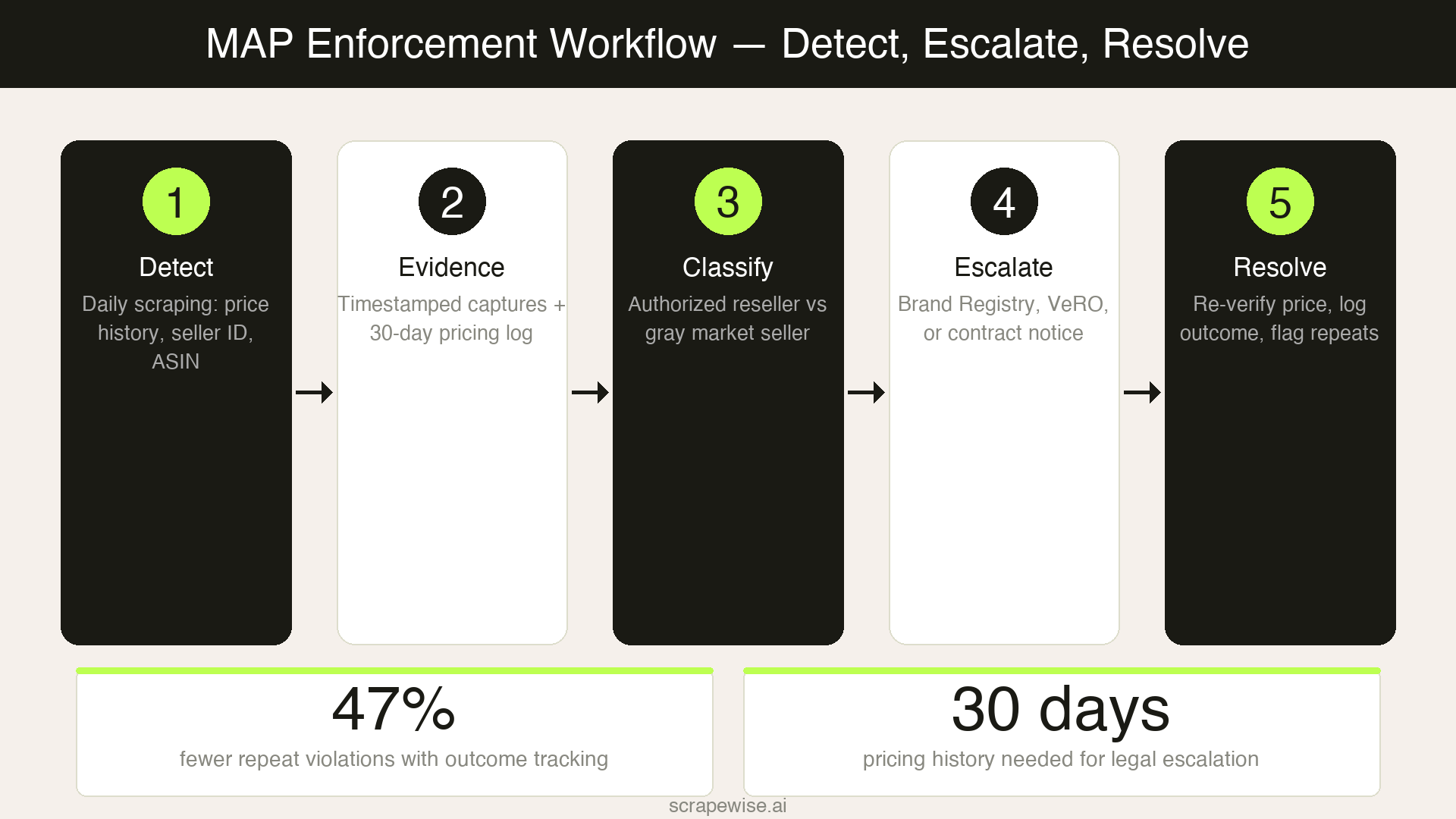
Finding a MAP violation is the easy part. Enforcing it is where most brand protection programs fall apart.
The average brand with an active price monitoring program detects dozens of MAP violations per week across Amazon, eBay, Google Shopping, and regional marketplaces. Without a defined enforcement workflow — who acts, what evidence is required, which escalation path applies — those detections pile up into a backlog that neither the brand team nor the legal team ever clears. The violations keep running. The authorized distributors keep complaining. And the brand's MAP policy becomes, in effect, advisory.
This guide covers what happens after you detect a MAP violation: how to gather court-ready evidence, which escalation path to use for each seller type, how to track resolution, and where automation closes the gap between detection speed and enforcement capacity.
Before You Escalate: Choose the Right Path
The biggest mistake in MAP enforcement is treating every violation the same. Applying a cease-and-desist workflow to an authorized reseller who dropped price by 2% burns the relationship and achieves nothing. Sending a polite email to a gray market operator who has been running below-MAP for six months achieves even less.
Use this decision matrix before escalating any violation:
| Seller Type | Violation Pattern | First Action | Escalation Path |
|---|---|---|---|
| Authorized reseller | First offense, small gap | Internal email notice | MAP warning letter → suspension |
| Authorized reseller | Repeat offender | Formal MAP warning | Distributor agreement termination |
| Unauthorized marketplace seller | Unknown sourcing | Marketplace policy report | Amazon Brand Registry / eBay VeRO |
| Unauthorized marketplace seller | Gray market sourcing | Evidence package + legal | Brand Registry + cease & desist |
| Social commerce seller | TikTok Shop / Instagram | Platform takedown request | DSA complaint (EU) + legal |
| Drop shipper | Pricing arbitrage | Seller identification | Distributor audit + Brand Registry |
Get the seller classification right first. The escalation path, tone, and evidence requirements are entirely different for each type.
Step 1 — Evidence Gathering: What You Need Before You Act
MAP enforcement fails in legal proceedings and marketplace disputes when the evidence is thin. Screenshots taken manually, on-demand, after the fact rarely survive scrutiny — sellers can change prices immediately after a complaint is filed, and marketplace systems often don't preserve historical pricing data.
Evidence packaging for MAP enforcement requires four elements:
Timestamped price capture
Automated, scheduled scraping of listing prices with UTC timestamps. Not a manual screenshot. Timestamps must be verifiable and match the listing URL exactly. For Amazon and eBay, this means capturing the ASIN/item_id alongside the price and seller data — not just the product page.
Pricing history, not just a snapshot A single below-MAP price is contestable. A 30-day pricing history showing continuous below-MAP operation is not. Time-series data showing the violation pattern — when it started, how far below MAP, whether it worsened over time — is what converts a complaint into a winning enforcement action.
Seller identity data Business name, seller handle, marketplace account ID, and, where visible, the seller's stated location and return address. For Amazon third-party sellers, the seller profile page often reveals a registered business name that can be cross-referenced against distributor lists. This is how you identify an authorized reseller operating a shadow account.
Product confirmation Listing images, product title, and identifiers (UPC, EAN, ASIN, MPN) confirming the listing is genuinely your product — not a counterfeit or "compatible with" misrepresentation. For MAP enforcement, confirming authenticity is not optional: a MAP policy only applies to genuine branded products.
According to Amazon's Brand Registry documentation, violation reports without sufficient product identification data are automatically deprioritized. The evidence bar on Amazon is higher than most brands expect.
Step 2 — Escalation Paths by Channel
Amazon: Brand Registry First, Legal Second
For unauthorized sellers on Amazon, Brand Registry is the fastest first step. File under "pricing policy" violations if Amazon's category supports it, or under "selling without authorization" if you can demonstrate the seller has no distribution agreement.
What Brand Registry can and cannot do: Amazon does not enforce MAP policies as a platform rule — MAP is a brand-to-seller agreement, not an Amazon policy. Brand Registry handles trademark, authenticity, and listing manipulation claims. For pure MAP price violations by authorized sellers, Amazon enforcement is not available. You must handle those contractually, through your distribution agreement.
For unauthorized sellers running below MAP, the Brand Registry path works when combined with an "unauthorized distribution" claim — which requires demonstrating that no distribution agreement exists. This is where seller identity data from Step 1 becomes essential.
Evidence required for Brand Registry report:
- Brand name and registered trademark number
- Seller Account ID on Amazon
- ASIN and listing URL
- Description of the unauthorized distribution claim (not the price violation)
- Supporting documentation (distribution agreement showing seller is not authorized)
European brands using Amazon EU marketplaces (Amazon.de, Amazon.fr, Amazon.nl) should note that the EU's Digital Services Act now requires Amazon to verify commercial seller identities. This creates an additional pressure point: sellers who cannot verify business identity under DSA can be reported to Amazon for removal on regulatory grounds — separate from Brand Registry claims. This is a meaningful new enforcement lever for EU-based brand teams.
eBay: VeRO Program
eBay's Verified Rights Owner (VeRO) program handles unauthorized seller and intellectual property claims. Like Amazon, eBay does not enforce MAP policies directly — VeRO works through intellectual property, trademark, and authenticity claims.
For below-MAP gray market sellers on eBay, the effective path is a VeRO report citing unauthorized distribution of trademarked goods, combined with a parallel notice to the seller. Response time via VeRO is typically faster than Amazon Brand Registry for straightforward unauthorized distribution claims.
Authorized Reseller Violation: Direct Contractual Path
MAP violations by authorized resellers are a contract enforcement issue, not a platform enforcement issue. The escalation sequence follows your distribution agreement:
- First notice: Email from the brand's channel compliance team, citing the specific listing, timestamp, and observed price. No legal language. Give 48 hours to correct.
- Second notice: Formal MAP warning letter citing the specific clause in the distribution agreement, the violation history (use your pricing history data), and the consequences of continued violation (typically: suspension of account, withholding of co-op funds, or termination).
- Suspension: Temporary suspension of order processing or account access, per the terms of the agreement. This is the enforcement lever most brands underuse.
- Termination: Termination of the distribution agreement for repeated violation. Requires documented violation history — which is why the evidence packaging step is non-negotiable.
According to Mayer Brown's guide to MAP policy enforcement, the most common reason MAP enforcement fails is not lack of legal grounds — it's lack of documented violation history. Without a systematic record of prior notices and seller responses, termination actions face legal challenge.
Social Commerce: Platform Takedown + DSA Leverage
Gray market sellers on TikTok Shop and Instagram Shopping represent the fastest-growing MAP enforcement challenge in 2026. The unauthorized sellers on social commerce post covers the detection layer in detail — but enforcement on social platforms follows a different path than marketplace enforcement.
For EU brands, the Digital Services Act creates a mandatory seller verification requirement for commercial sellers on TikTok Shop, Meta Commerce, and other major platforms. Gray market sellers who cannot verify business identity can be reported to the platform under DSA obligations — a more powerful mechanism than standard IP complaints, particularly for sellers in Asia-Pacific markets who lack EU business registration.
For non-EU markets, direct platform takedown requests through TikTok's IP protection portal and Meta's IP reporting tool are available, but evidence requirements are high and response times are inconsistent. Legal notices sent directly to the seller — using contact information extracted from the social profile — often produce faster results.
Step 3 — Tracking Resolution: Close the Loop
Most MAP enforcement programs fail at the resolution tracking stage. Violations are detected, notices are sent, and then the follow-up process breaks down: nobody checks whether the price was corrected, nobody records the outcome, and the same sellers reappear in the next monitoring cycle.
Effective resolution tracking requires:
A violation register — a running log of every enforcement action taken, indexed by seller account ID, marketplace, product, and violation date. This register is the primary asset in any legal escalation and the data source for identifying repeat offenders.
Automated re-verification — after a violation notice is issued, scheduled re-scraping of the specific listing 48–72 hours later to confirm price correction. If the price has not corrected, the violation escalates automatically to the next tier.
Resolution outcome codes — standardized outcomes for each violation: Corrected (seller adjusted price within notice period), Removed (listing taken down), Escalated (referred to legal), No Response (seller did not act), Terminated (distribution agreement ended). These codes allow pattern analysis: which sellers are repeat offenders, which marketplaces generate the most violations, which product categories are highest-risk.
Gartner's research on channel compliance programs finds that brands with systematic resolution tracking reduce repeat violations by an average of 47% within 12 months compared to brands that track violations without outcome data. The insight is straightforward: sellers who know enforcement is tracked are more likely to maintain compliance.
Step 4 — Automation: Closing the Detection-to-Enforcement Gap
The detection-to-enforcement gap — the time between a violation appearing on a marketplace and a notice being issued — is where MAP programs lose credibility with both sellers and distributors. A violation that runs for three weeks before a notice is issued signals to the market that enforcement is inconsistent.
Closing the gap requires automation at two points:
Detection: Scheduled, daily web scraping of authorized and unauthorized seller listings across target marketplaces. This is covered in detail in the MAP monitoring and brand protection guide — the key principle is that daily scraping replaces alert-based monitoring, which reacts to indexed listings rather than catching violations at first appearance.
Evidence packaging: Automated compilation of timestamped price captures, seller data, and ASIN/product identifiers into structured evidence packages. This eliminates the manual assembly step that turns a 2-hour enforcement workflow into a 2-day bottleneck.
For brands monitoring price compliance across multiple marketplaces, the same data feed that powers MAP violation detection can power evidence packaging with no additional collection cost — the architecture is identical, the output just needs to be structured for legal use rather than analyst review.
What a Complete MAP Enforcement Stack Looks Like
| Layer | Function | Tool Type |
|---|---|---|
| Data collection | Daily scraping of marketplace listings, seller profiles, pricing | Managed scraping service (ScrapeWise) |
| Signal detection | Below-MAP flagging, seller classification, repeat offender identification | Internal analysis or brand protection platform |
| Evidence packaging | Timestamped captures, pricing history, seller identity compilation | Automated pipeline from collection layer |
| Escalation management | Violation register, notice tracking, outcome recording | CRM or dedicated brand protection software |
| Marketplace enforcement | Brand Registry reports, VeRO filings, DSA complaints | Platform tools + legal team |
| Legal escalation | Cease & desist, distribution agreement termination | External legal counsel + evidence packages |
Where ScrapeWise fits: ScrapeWise provides the data collection layer — structured, scheduled web data from marketplaces and social platforms, formatted for both analyst review and evidence packaging. Limitation: ScrapeWise does not provide a built-in violation register, automated notice workflows, or pre-built dashboards. If your team needs turnkey brand protection software with workflow automation, platforms like Red Points or Corsearch are more appropriate starting points. ScrapeWise is the right choice when you need high-volume, multi-channel listing data that off-the-shelf tools don't cover — particularly for social commerce channels and regional European marketplaces.
For brands already running gray market monitoring alongside MAP enforcement, the data collection layer is shared: gray market violations and MAP violations often originate from the same unauthorized sellers, and monitoring both from a single data feed reduces collection overhead significantly.
If you are looking at an enterprise suite instead, our guide to how PriceSpider Brand Monitor and Prowl handle MAP compliance explains what each Wayvia product covers.
Building a Defensible Enforcement Record
The long-term value of a systematic MAP enforcement workflow is not just in the violations it stops — it's in the enforcement record it builds.
Distribution agreement terminations, marketplace arbitration claims, and litigation all depend on documented evidence of prior notice and seller response. Brands that can produce a timestamped violation register, a documented notice history, and a record of seller responses are in a fundamentally stronger legal position than brands relying on one-off screenshots and email chains.
According to Backlinko's research on brand protection program outcomes, brands with systematic enforcement records resolve legal disputes 2.3x faster and at lower cost than brands without structured documentation. The upfront investment in evidence infrastructure pays off not just in deterrence but in reduced legal overhead when enforcement escalates.
A well-structured MAP enforcement workflow — detection, evidence, escalation, tracking — is ultimately a risk management program. The goal is not to catch every violation in real time. It's to build a consistent enough enforcement signal that repeat violations become the exception, not the norm.
If your brand is dealing with MAP violations across channels that manual monitoring isn't catching fast enough, get a quote from ScrapeWise to discuss a custom data collection pipeline for MAP enforcement evidence packaging.
Paste a marketplace URL — spot MAP violations instantly
Catch unauthorized sellers and gray-market listings across marketplaces. No per-SKU fees.
Not ready to sign up? See all 19 sellers on one Amazon listing →
97% accuracy on Amazon benchmarks · no credit card · book a 15-min call →