
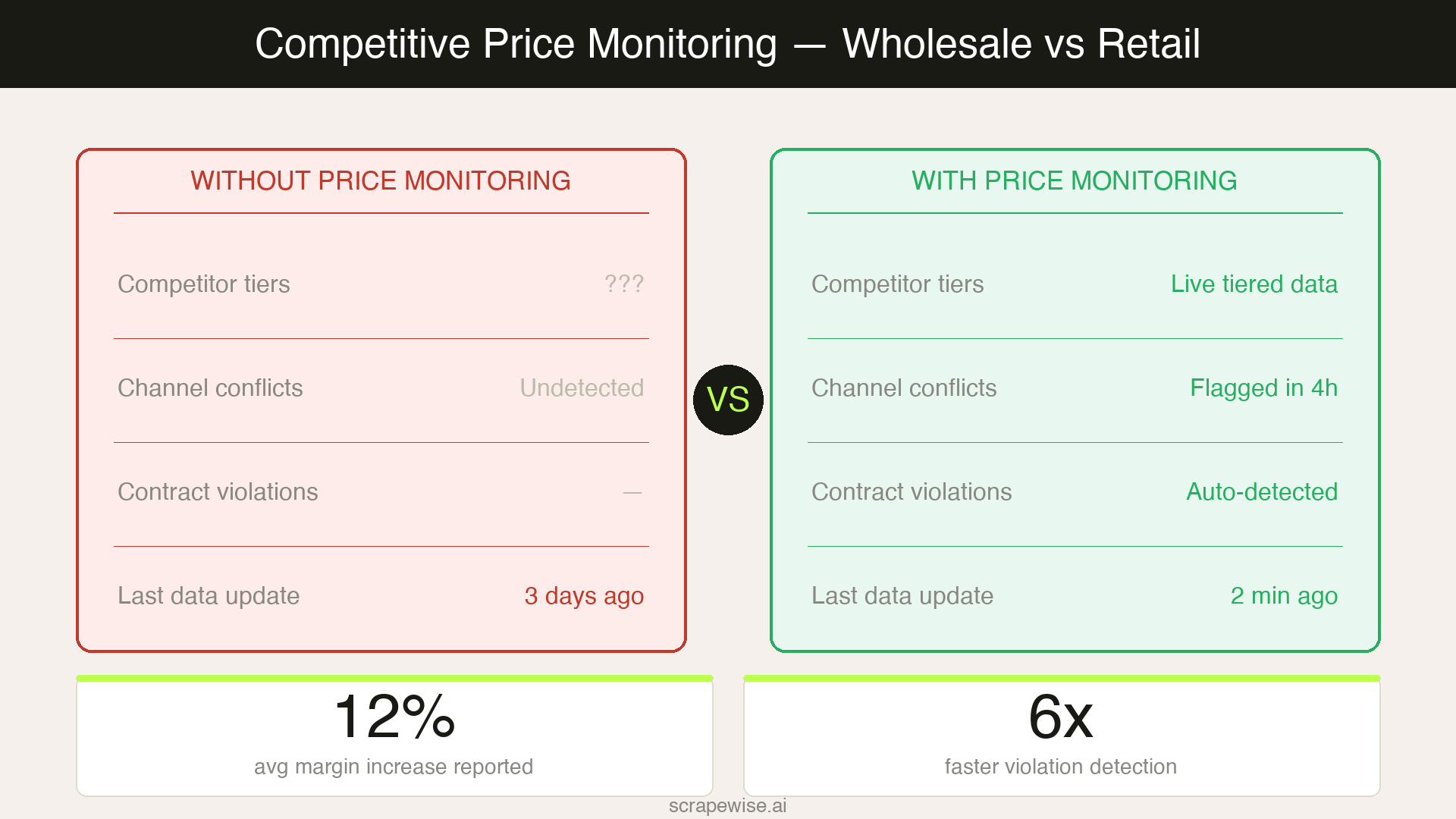
Most competitive price monitoring guides are written for e-commerce teams tracking Amazon listings. If you work in wholesale or B2B distribution, you've probably noticed those guides miss the point entirely.
Your pricing doesn't live on a product page. Your competitors don't publish their volume discounts. Your "price" is a negotiated starting point that varies by customer, order size, and geography. And when a distributor breaks a pricing agreement, it won't show up in any standard monitoring tool.
This guide is for wholesale and distribution pricing teams who need competitive intelligence that actually maps to how B2B pricing works in 2026.
Why Wholesale Price Monitoring Requires a Different Approach
Retail price monitoring is relatively straightforward: find the URL, extract the price, track changes. The product is the same everywhere, the price is public, and the competitive landscape is a list of comparable SKUs.
Wholesale pricing is structurally different in three ways.
Prices are relational, not published. Your competitors offer tiered pricing — unit price drops as order quantity increases. Unless you're placing test orders at multiple volumes, you'll never see their full pricing structure from a product page alone.
Competition happens across channels. In wholesale, you're not just competing with other distributors. You're also managing how your own authorized partners price your products downstream. A distributor undercutting another in the same region is a competitive pricing problem — but it's also an internal channel conflict.
Compliance is part of the pricing picture. Contract pricing enforcement — ensuring distributors honor minimum resale prices, territory pricing, or agreed margins — requires monitoring what's actually showing up in market, not just what's on a price list.
These differences mean that tools built for retail price monitoring often fail wholesale teams. According to McKinsey's analysis of S&P 1500 companies, a 1% improvement in pricing discipline translates to an 8–11% increase in operating profit. For distributors with thin margins, the stakes of getting competitive price monitoring wrong are significantly higher than for retailers.
The Three Competitive Price Monitoring Challenges Unique to Distribution
1. Tiered Pricing Visibility
Wholesale pricing almost always involves volume tiers. A competitor might offer a 5% discount at 50 units, 12% at 250 units, and 18% at 1,000 units. If you're only monitoring their list price, you're missing the competitive structure that actually influences buying decisions.
Uncovering tier structures requires more sophisticated data collection than simple price scraping:
- B2B marketplace monitoring: Platforms like Amazon Business, Faire, and industry-specific portals often display tiered pricing for verified business buyers. This data is publicly accessible when accessed through a business account.
- Request-for-quote (RFQ) data: Some competitors publish indicative pricing grids for standard SKU ranges on their websites or as downloadable price lists.
- Distributor portal monitoring: If a competitor's authorized distributors list products with pricing, that pricing often reflects agreed resale tiers — a useful proxy for understanding the original purchase price structure.
The key insight for wholesale teams is that competitive price monitoring isn't just about the lowest visible price. It's about reconstructing the full pricing architecture that determines who wins the deal at each volume band.
2. Channel Conflict Detection
One of the most damaging pricing problems in wholesale distribution is when your own authorized resellers are undercutting each other — or worse, undercutting your direct sales team.
A distributor in Germany selling below the agreed regional floor price won't appear in any standard competitive monitoring tool. But it's actively destroying margin and undermining the value proposition you've built with other channel partners.
Channel conflict monitoring requires tracking:
- Product listings across B2B marketplaces: Amazon Business, eBay Business, Alibaba, and regional B2B platforms where resellers list inventory
- Reseller websites: Authorized distributors' product pages, where they may be listing at prices outside their agreement
- Regional pricing variations: The same SKU appearing at significantly different prices across geographies within a single territory
European distributors face particular complexity here. EU single market rules limit certain forms of territorial pricing restriction, but authorized dealer networks can still define pricing floors. Monitoring compliance across markets like Germany, the Netherlands, and the Nordics — where distribution channels are dense and multi-layer — requires systematic data collection across dozens of reseller sites simultaneously. You can read more about the technical side of tracking marketplace data at scale in the ScrapeWise guide to e-commerce market data extraction.
3. Contract Pricing Enforcement
If your distribution agreements include minimum advertised price (MAP) clauses, resale price maintenance terms, or territory pricing floors, you need more than a monitoring tool — you need an enforcement data pipeline.
This means:
- Regular automated checks of distributor advertised prices against agreed terms
- Timestamped evidence collection (URLs, prices, screenshots) when violations are detected
- Trend data showing whether a violation is a one-time event or a systematic pricing pattern
The difference between retail MAP monitoring and wholesale contract enforcement is scope and specificity. Retail MAP monitoring checks whether resellers are advertising below a floor price. Wholesale contract enforcement often involves customer-specific pricing agreements, territory restrictions, and tiered compliance obligations that vary by distributor relationship. For a detailed look at how enforcement workflows operate, see the MAP enforcement workflow guide.
How B2B Pricing Teams Actually Use Competitive Intelligence
In retail e-commerce, competitive price data feeds directly into repricing algorithms — a 10-minute refresh cycle and automated rule-based response. Wholesale pricing teams use competitive data differently.
Strategic benchmarking. Rather than reacting to daily price changes, B2B pricing teams use competitive data to set quarterly pricing strategy. Where is your pricing landing relative to competitors across each volume tier? Are you competitive at the 250-unit order level where mid-market buyers typically operate?
Win/loss analysis. When you lose a deal, was it on price? If your CRM captures lost deal reasons, correlating those with competitive pricing data at the time of the deal can reveal systematic pricing gaps — specific product categories, geographies, or volume bands where you're consistently losing on price.
Distributor negotiation leverage. Understanding what a distributor could source from a competing brand, at what price, gives your sales team concrete data to anchor negotiations. This is documented price intelligence that can be brought into a negotiation — not just intuitive market knowledge.
New market entry pricing. Before launching a product in a new vertical or geography, competitive price monitoring provides the benchmarks you need to set opening price points that are competitive without leaving margin on the table.
As HubSpot's B2B pricing research notes, pricing teams that use systematic competitive data as input to pricing decisions achieve better win rates across enterprise deal segments than those relying on field intelligence alone.
Building a Competitive Price Monitoring Workflow for Distributors
A practical wholesale price monitoring workflow has four components.
Data Sources
Not all pricing data lives in the same place. For wholesale teams, relevant data sources include:
- B2B marketplaces: Amazon Business, Faire, Orderchamp, and industry-specific portals
- Competitor websites: Product pages, downloadable price lists, reseller portals
- Distributor networks: Authorized reseller websites listing your competitors' products
- Trade publications and catalogs: Industry-specific publications that publish pricing surveys or benchmark reports
- Public tender databases: In regulated industries — government procurement, healthcare supply — public tenders publish volume pricing that provides competitive benchmarks
For most wholesale teams, product data extraction from these sources requires custom configuration. Wholesale pricing often lives in structured tables, PDFs, or behind authentication that requires business account access — none of which standard retail scrapers handle well. Tracking the upstream side of that — supplier price monitoring across Alibaba, supplier portals and competitor wholesalers — uses the same extraction layer and catches MOQ tier shifts your own cost base depends on.
Monitoring Frequency
Wholesale prices don't fluctuate daily the way retail prices do. A more appropriate cadence for most categories:
- Weekly scans for standard distributor pricing and B2B marketplace data
- Daily alerts for specific high-value products or key competitor categories
- Event-triggered monitoring around trade shows, promotion windows, or after a major cost input change
Output Integration
Raw competitive price data has limited value on its own. The goal is to feed it into the systems where pricing decisions are actually made:
- ERP pricing tables: Competitive benchmarks that inform suggested pricing updates
- CRM deal intelligence: Flagging live deals where competitive pricing is particularly aggressive
- Distributor compliance reports: Automated summaries of pricing adherence across your channel network
Alerting Logic
A well-designed wholesale price monitoring system generates alerts only when competitive data crosses thresholds that matter: a competitor moving below your tier floor on a strategic SKU, a distributor listing outside their agreed range, or a new entrant appearing in a key geography. Alert fatigue kills adoption — specificity is what makes a monitoring workflow usable.
Choosing the Right Tools for Wholesale Price Monitoring
Most off-the-shelf price monitoring software — Price2Spy, Prisync, Minderest — is designed for retail e-commerce. These tools excel at tracking public product page prices across large SKU catalogs. They tend to struggle with:
- Extracting prices from B2B portals that require business account authentication
- Handling tiered pricing tables rather than single SKU prices
- Custom data structures in industry-specific marketplaces
- Alert workflows built around contract terms rather than simple percentage changes
For wholesale and distribution teams, there are generally two approaches.
Specialist tools with B2B modules. Some platforms have added wholesale features to retail-focused cores. These work for simpler use cases but often have gaps in custom data extraction capability.
Managed data extraction platforms. Tools like ScrapeWise allow pricing teams to configure monitoring against any web source — B2B marketplaces, competitor portals, distributor networks — with custom data structures that map to wholesale pricing formats. This approach requires more initial configuration but provides the flexibility that wholesale pricing complexity demands.
The right choice depends on scope. If you're tracking 50 competitors across standard retail channels, a specialist retail tool may be sufficient. If you're monitoring distributor compliance across 200 resellers, tracking B2B marketplace tier data, or integrating competitive intelligence into an ERP pricing workflow, you need a more configurable data layer. For a full tool comparison across use cases, the competitive price monitoring tools guide covers the landscape in depth.
What to Look for in Wholesale Price Monitoring Software
Before selecting any platform, wholesale pricing teams should evaluate against these criteria:
Custom source support. Can the tool monitor any web source, or only a preset catalog of supported retailers? Wholesale monitoring requires covering dozens of industry-specific sources that generic tools don't include.
Structured data extraction. Can it handle pricing tables, multi-row tier data, and downloadable price lists — not just single-price product pages?
Authentication handling. Many B2B pricing sources require login. Can the tool manage authenticated sessions to access business pricing views?
Alert customization. Can you set contract-specific thresholds rather than just percentage-change alerts? Wholesale contract enforcement requires alerts tied to specific pricing terms in distribution agreements.
Integration outputs. Does the tool export in formats that connect directly to your ERP or pricing system? Manual CSV processing defeats the purpose of a monitoring workflow.
Pan-European coverage. For distributors operating in DACH, Benelux, or Nordic markets, the tool needs to reliably monitor regional B2B platforms and distributor networks — not just UK or US-based sources. According to Ahrefs' analysis of enterprise software evaluation patterns, B2B buyers in European markets place significantly more weight on regional compliance and data coverage than US counterparts during the procurement process.
Conclusion
Competitive price monitoring for wholesale and distribution is a different discipline from retail price tracking. The data sources, monitoring cadence, output formats, and alerting logic all need to be built around how B2B pricing actually works — tiered, relational, channel-dependent, and often locked behind authenticated portals.
The good news is that the commercial intelligence available to wholesale pricing teams has improved significantly. B2B marketplaces have proliferated, distributor networks have moved online, and the tools available for custom data extraction have matured to the point where systematic competitive monitoring is accessible without a dedicated data engineering team.
For wholesale teams building or upgrading their price monitoring capability, the starting point is a clear map of your competitive data sources — and a tools evaluation that tests against your actual data structures, not just a list of supported retail domains.
Paste a competitor URL and start tracking prices
Any e-commerce site, any SKU count. Clean structured feeds on your schedule, no code required.
Not ready to sign up? See 40 rows of real Google Shopping price data →
97% accuracy on Amazon benchmarks · no credit card · book a 15-min call →