
Most "competitor price tracking tools" roundups hand you a list and call it done. But picking the wrong tool — or the right tool with the wrong setup — costs pricing teams weeks of rework and leaves the actual intelligence problems unsolved.
This guide covers what competitor price tracking actually requires for B2B and distribution teams, how to build a tracking program that works at scale, and which tools fit which use cases. If you've already read a tools list and need to know what to do with one, start here.
What Is Competitor Price Tracking?
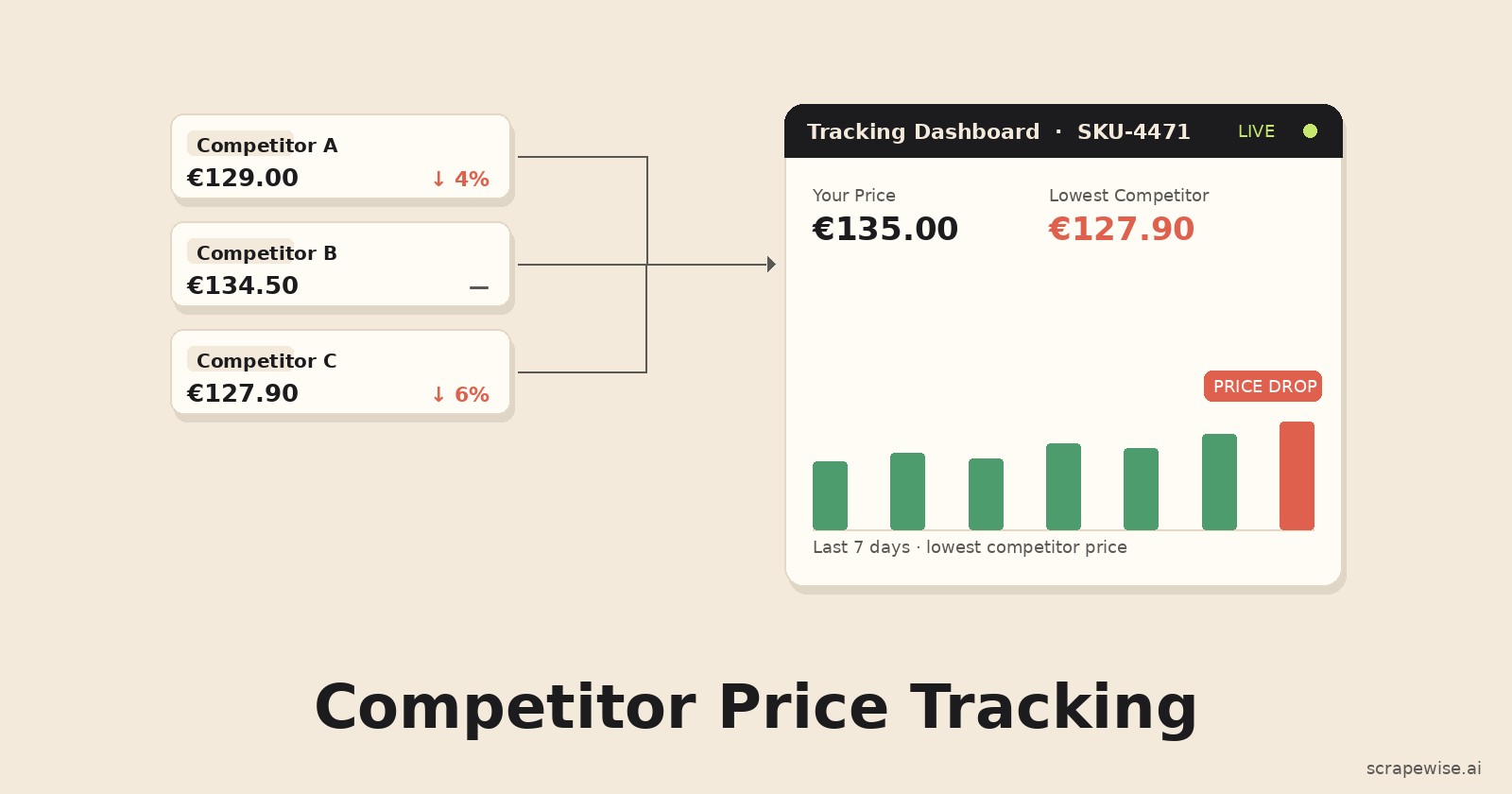
Competitor price tracking is the continuous monitoring of rival pricing across channels — websites, marketplaces, distributor portals, and reseller networks — to inform your own pricing decisions.
For retail e-commerce teams, this usually means watching Amazon listings. For B2B and distribution teams, it's more complex: you're monitoring tiered pricing structures, distributor price lists, contract pricing across regions, and channel-specific promotions that may only appear for logged-in buyers.
The fundamental problem is data freshness. Competitor prices change multiple times per day on high-volume platforms. A static spreadsheet updated manually once a week doesn't tell you when a competitor cuts price on your top 20 SKUs at 2pm on a Tuesday. Automated competitor price tracking solves this — but only if the underlying data collection matches the pace of the market.
The 5 Types of Competitor Price Data That Actually Matter
Not all price data is equal. Before choosing a tool, clarify which data types your team needs:
1. Street price (public website): The price any visitor sees. Most tools cover this well.
2. Marketplace price: Amazon Buy Box price, eBay listings, Google Shopping feeds. Requires marketplace-specific scrapers.
3. Distributor portal price: Prices shown only to logged-in distributor accounts. Requires authenticated scraping — most SaaS tools cannot access this.
4. Promotional price: Flash deals, coupon codes, bundle pricing. Requires tracking promotion start/end events, not just current prices.
5. Out-of-stock pricing: What happens to competitor prices when they're out of stock on a SKU. Often reveals opportunistic repricing patterns worth tracking.
Distribution teams typically need types 2–5. Tools designed for retail e-commerce usually only handle type 1 well.
Competitor Price Tracking Tools Compared (2026)
Here's how the major competitor price tracking tools perform across the criteria that matter for B2B and distribution teams:
| Tool | Update Frequency | Marketplace Coverage | Distributor Portal Access | SKU Limit | Starting Price |
|---|---|---|---|---|---|
| Prisync | Every 8h (standard) | Amazon, Google Shopping | No | 100–5,000 SKUs | €59/mo |
| Price2Spy | Up to 8x/day | Amazon, eBay, Google | No | 1,000–25,000 SKUs | €19.95/mo |
| Wiser | Real-time (enterprise) | Amazon, Walmart, Target | Limited | Unlimited (enterprise) | Custom |
| Omnia Retail | Daily–hourly | Amazon, bol.com, Kaufland | No | Unlimited (enterprise) | Custom |
| ScrapeWise | Custom (minutes–hours) | Any marketplace | Yes (authenticated) | Unlimited | Custom |
The right choice depends heavily on whether you need authenticated access and how many SKUs you track. For distribution teams monitoring distributor portal pricing specifically, SaaS tools with fixed scrapers typically fall short — you need a managed data layer that can authenticate and navigate behind login walls.
For a deeper comparison of individual tools, see our competitive price monitoring tools breakdown covering accuracy benchmarks across 500-SKU test datasets.
How to Set Up a Competitor Price Tracking Program
A tracking program is only as useful as the workflow attached to it. Here's the setup sequence that distribution and B2B teams use effectively.
Step 1: Define Your SKU Priority Tiers
Not every SKU needs daily tracking. Start by segmenting your catalog:
- Tier 1 (high-frequency): Your top 50–100 SKUs by revenue, tracked every 2–4 hours
- Tier 2 (daily): Next 200–500 SKUs, tracked once daily
- Tier 3 (weekly): Long-tail catalog, sampled weekly
This prevents tool costs from spiraling on large catalogs while keeping your critical competitive intelligence fresh.
Step 2: Map Your Competitor URLs Per SKU
Every SKU needs a competitor URL list — one entry per competitor per channel. This is the most labor-intensive setup step. A 500-SKU catalog with 5 competitors across 3 channels means 7,500 URL pairs to maintain.
Tools like Price2Spy and Prisync semi-automate this through product matching. For more complex catalogs where product names vary significantly between competitors, AI-powered product data matching reduces mapping effort by 60–80%.
Step 3: Configure Alerting Thresholds
Price drops below a threshold (e.g., 5% below your price) should trigger an alert. Configure separately for:
- Price undercut alerts (competitor drops below your price)
- Stock-out alerts (competitor goes out of stock — often a repricing opportunity)
- Promotion detection (competitor runs a limited-time offer)
Most tools support email alerts. Distribution teams usually pipe these into Slack or directly into pricing system webhooks.
Step 4: Build a Weekly Review Cadence
Real-time alerts handle tactical responses. Weekly reviews handle strategic ones:
- Which categories are seeing compression?
- Which competitors are most aggressive?
- Are there patterns in when competitors discount (end-of-quarter, Fridays, etc.)?
This cadence is typically owned by a pricing manager rather than the IT team. The output should feed directly into quarterly pricing reviews.
Step 5: Connect Data to Your Pricing System
Raw price data sitting in a dashboard has limited value. The most effective teams connect competitor price data directly to their pricing engine — either ERP repricing rules or a dedicated dynamic pricing tool.
For teams handling competitive price monitoring in wholesale and distribution, this integration step is where most of the competitive advantage is captured. Tracking without a response workflow is just expensive reporting.
Use Cases Specific to Distribution and B2B Teams
Distribution teams face pricing challenges that generic retail price trackers weren't built for. Three use cases illustrate why.
Contract Price Enforcement
A distributor agrees to sell your product at a minimum price. You need to verify this without calling every account every week. Automated tracking against known distributor URLs catches violations in near-real-time.
This use case requires tracking against specific URLs (not just broad marketplaces) and storing historical data for dispute resolution. Most entry-level tools don't retain history beyond 30–90 days.
Channel Conflict Detection
When a brand sells direct-to-consumer at a lower price than its distributors' wholesale cost-plus pricing allows, channel conflict erupts. Tracking your own pricing across channels alongside competitors' reveals these misalignments before they become reseller complaints.
European markets are particularly sensitive here. Germany's UWG (Unfair Competition Act) and France's pricing regulations create specific constraints around recommended retail prices that make systematic price tracking a compliance requirement, not just a competitive tool. Nordic and Benelux distributors managing multi-channel price parity face similar compliance pressures under local fair trade laws.
Promotions Intelligence
Flash sales and promotional events often don't appear in standard price feeds — they're JavaScript-rendered, session-gated, or only visible during specific time windows. Capturing promotion data requires scraping at higher frequency during known promotion periods (Black Friday, end-of-quarter clearance, trade show weeks).
For teams that need promotion data alongside standard price tracking, this is where managed e-commerce market data extraction tends to outperform fixed SaaS tools — the collection schedule can be adjusted dynamically to match promotion calendars.
Choosing the Right Competitor Price Tracking Tools for Your Team
The decision framework for competitor price tracking tools in 2026 comes down to three variables.
How many SKUs do you track? Under 1,000 SKUs: Prisync or Price2Spy cover most needs at low cost. Over 5,000 SKUs: you need enterprise pricing or a custom data layer.
Do you need authenticated access? If competitors sell through distributor portals, trade platforms, or login-gated sites, SaaS tools with fixed scrapers won't work. You need a managed data extraction service that can authenticate on your behalf.
How frequently do prices move in your category? FMCG and electronics change prices multiple times daily. Industrial B2B pricing changes monthly. Daily tracking is overkill for slow-moving categories and insufficient for fast-moving ones — right-size your frequency to category dynamics.
For teams that have outgrown fixed-scraper tools but aren't ready for full custom infrastructure, ScrapeWise provides a managed data layer that handles authenticated access, JavaScript-heavy sites, and custom delivery schedules — without requiring an in-house scraping team.
What Effective Competitor Price Tracking Looks Like in Practice
A Nordic sporting goods distributor running 3,200 SKUs across 12 European markets consolidated their price tracking program in early 2026. Before: four analysts updating spreadsheets weekly, two-day lag on price change detection. After: automated tracking with 4-hour refresh on Tier 1 SKUs, same-day alerting on competitor price cuts, and repricing decisions fed directly into their ERP.
The tool itself wasn't the differentiator — the workflow was. Choosing the right competitor price tracking tools is step one. Connecting them to a pricing response workflow is where the margin impact shows up.
Paste a competitor URL and start tracking prices
Any e-commerce site, any SKU count. Clean structured feeds on your schedule, no code required.
Not ready to sign up? See 40 rows of real Google Shopping price data →
97% accuracy on Amazon benchmarks · no credit card · book a 15-min call →