

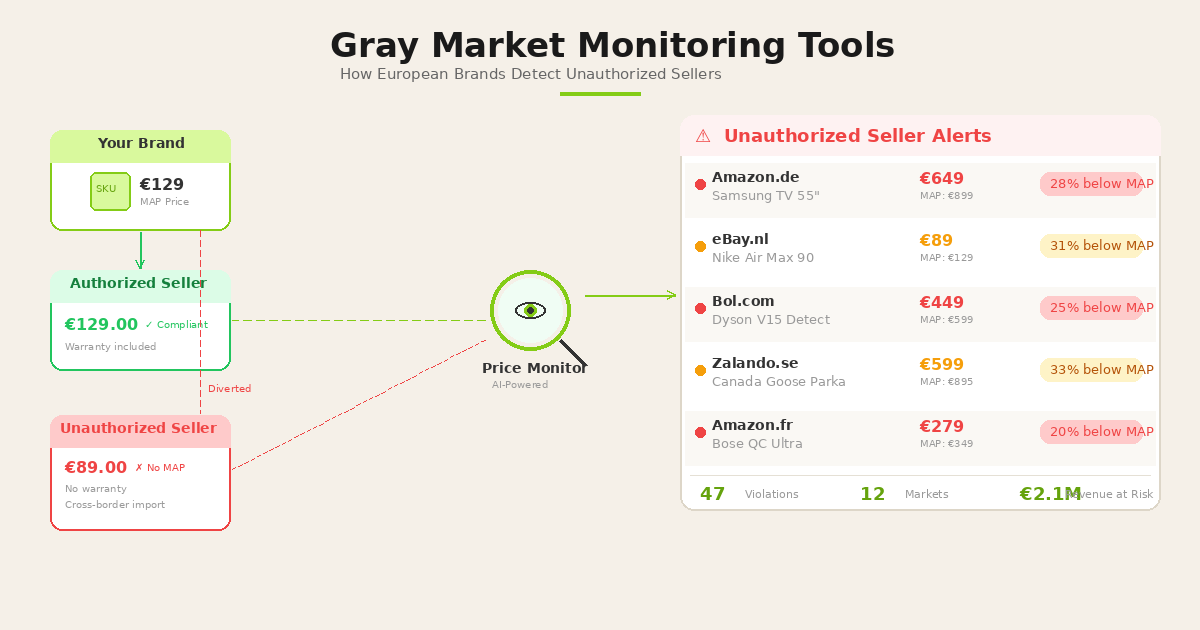
A Nordic electronics distributor discovers its flagship product listed at 25% below MAP on six Amazon storefronts — none of them authorized resellers. By the time the team reacts manually, the listings have been live for three weeks, undercutting authorized partners and eroding margins across the entire channel.
This scenario plays out daily across European e-commerce. Gray market sales in the IT sector alone exceed $20 billion globally, and with European B2C e-commerce turnover growing 7% to €842 billion in 2024, the surface area for unauthorized distribution keeps expanding. The question isn't whether gray market activity is affecting your brand — it's whether you have the monitoring tools to see it.
What Is Gray Market Monitoring and Why Does It Matter?
Gray market monitoring is the systematic tracking of product listings, pricing, and seller activity across online channels to identify unauthorized distribution. Unlike counterfeit detection, gray market monitoring focuses on genuine products being sold outside approved channels — parallel imports, diverted inventory, and unauthorized third-party resellers.
The distinction matters because gray market goods are legal in most jurisdictions. In the EU, the principle of trademark exhaustion means that once a product is sold within the European Economic Area, the trademark holder generally cannot restrict its resale within that territory. This legal gray zone makes monitoring and enforcement more nuanced than simple takedown requests.
For European brands specifically, the challenge is compounded by the EU's single market. Products intended for one country's distribution network can easily appear on marketplaces in another, creating pricing inconsistencies that damage relationships with authorized retailers. A German-market SKU showing up on a Dutch marketplace at a lower price point isn't a hypothetical — it's a Tuesday.
The scale of unauthorized distribution is staggering. According to Dentsu Tracking, roughly 500,000 mobile phones are bought and sold outside official channels every single day, with over 30% of all traded mobile phones passing through the gray market. MIT Sloan Management Review found that gray market sales amounted to 20-50% of authorized sales for some health and beauty manufacturers. In December 2024, the French competition authority fined 10 appliance manufacturers EUR 611 million for price-fixing through MAP-like policies — a reminder that enforcement must be data-driven, not heavy-handed.
Why Gray Market Monitoring Matters for E-commerce Brands
The business impact of uncontrolled gray market activity goes beyond lost revenue on individual sales. Here's what's actually at stake.
Pricing strategy collapse. When unauthorized sellers consistently undercut your MAP or recommended retail prices, authorized partners lose the incentive to carry your products. One industry analysis estimated that gray market sales cost US brands up to $63 billion — and as e-commerce grows, that figure scales with it. European brands face the same dynamic, especially in categories like electronics, cosmetics, and sporting goods where cross-border price arbitrage is most profitable.
Channel partner erosion. Authorized distributors who invest in brand presentation, warranty support, and customer experience expect pricing protection in return. When gray market sellers operate unchecked, your best partners may reduce order volumes or drop your brand entirely. This is particularly acute in Nordic and DACH markets, where retailer relationships tend to be longer-term and trust-based.
Brand perception damage. Gray market products often ship without local-language documentation, valid warranties, or proper after-sales support. When customers blame the brand rather than the seller for a poor experience, the reputational cost compounds over time. In Europe's mature e-commerce markets — where online shopper participation exceeds 89% in Denmark and 91% in Norway — negative reviews spread fast.
Regulatory exposure. The EU's Digital Services Act creates new obligations for online marketplaces to verify seller identity and ensure product compliance. Brands that can't demonstrate they're actively monitoring for unauthorized sellers may face harder questions from regulators about their own distribution governance.
Gray Market Monitoring Tools Compared
There's no single category of "gray market monitoring tool." In practice, European brands assemble coverage from three different types of platform, each with a distinct strength and blind spot. Choosing well means matching the tool category to the problem you're actually trying to solve — unauthorized-seller takedowns, MAP/RRP erosion, or supply-chain leak detection.
| Tool Category | Representative Platforms | Primary Strength | Best For | Key Limitation |
|---|---|---|---|---|
| Dedicated brand-protection suites | Red Points, MarqVision, Smart Protection | Automated detection plus enforcement workflows (test buys, takedown filing, seller outreach) | Brands needing end-to-end enforcement, not just alerts | Highest cost; coverage tuned to major marketplaces, weaker on niche EU platforms |
| Price-monitoring platforms with seller detection | Price2Spy, Prisync, Minderest | MAP/RRP violation alerts and seller-level price tracking across channels | Brands whose gray market problem shows up first as price erosion | Detects price anomalies, not the underlying diversion source; enforcement is manual |
| Custom web scraping infrastructure | ScrapeWise.ai | Configurable coverage of any site — including regional marketplaces and JavaScript-heavy storefronts that off-the-shelf tools skip | Brands needing coverage beyond Amazon/eBay, or feeding data into their own systems | You build the enforcement layer on top; the tool supplies the data |
How to read this table: If your priority is filing takedowns at scale, a dedicated suite earns its premium. If unauthorized sellers mainly hurt you through below-MAP pricing, a price-monitoring platform with seller detection covers the core need at lower cost. If your gray market activity hides on regional marketplaces (Bol.com, Allegro, Kaufland) that mainstream tools don't reach, a custom scraping approach gives you the coverage control the packaged suites can't. Many brands run a combination — a price-monitoring tool for daily MAP alerts plus custom scraping for the long-tail channels.
A practical note for European brands: counterfeit and gray market detection often overlap operationally but require different responses. If your monitoring surfaces products that aren't genuine, the enforcement path is legal IP action rather than channel management — see our guide to counterfeit detection and brand protection for that distinction.
What Software Should You Use to Scan Marketplaces for Gray Market Goods?
To scan marketplaces for grey market (gray market) goods, use software that finds every listing of your SKUs, checks each seller against your authorized-seller list and flags unknown sellers and below-RRP prices. For takedowns at scale, pick a brand-protection suite. For leaks that show up as price erosion, pick a price monitor with seller detection. For regional marketplaces, use configurable scraping such as ScrapeWise.
| If your main need is | Use | Examples |
|---|---|---|
| Filing takedowns and enforcing against sellers | Brand-protection suite | Red Points, MarqVision, Smart Protection |
| Catching MAP or RRP undercutting by unknown sellers | Price monitor with seller detection | Price2Spy, Prisync (MAP on Platinum), Minderest |
| Covering Bol.com, Allegro, Kaufland and dealer webshops | Configurable marketplace scraping | ScrapeWise |
Whichever you pick, check that it can search by EAN or SKU on every marketplace you sell on, compare sellers with your authorized-distributor list, and keep evidence such as the listing URL, seller ID, price and timestamp. ScrapeWise supplies that listing and seller data for any public site on pay-as-you-go pricing, and your team or enforcement tool does the seller matching. See how MAP monitoring works with ScrapeWise.
How to Build a Gray Market Monitoring System
Effective gray market monitoring combines technology, process, and enforcement. Here's a practical framework.
Step 1: Map Your Authorized Distribution Network
Before you can spot unauthorized sellers, you need a clean baseline. Document every authorized reseller, distributor, and marketplace partner — including the specific territories and channels they're approved for. This sounds obvious, but many brands discover gaps when they actually audit their distribution agreements.
Step 2: Deploy Automated Price and Seller Monitoring
Manual checks don't scale. You need automated tools that continuously scan marketplaces, comparison shopping engines, and competitor webstores for your products. The key capabilities to look for include cross-marketplace scanning (Amazon, eBay, Google Shopping, and local European platforms like Bol.com, Allegro, and Zalando), price anomaly detection that flags listings significantly below your MAP or RRP, and seller identification that matches listing data against your authorized partner database. In DACH markets specifically, Idealo is the dominant price comparison engine — since it aggregates every merchant selling a given EAN, it's often the fastest place to spot an unauthorized reseller undercutting your German price.
Tools like ScrapeWise.ai can automate the data side at scale: scheduled runs (daily, weekly or on demand) collect price and seller data across hundreds of competitor and retailer sites, and each row is matched to your SKU, so you can filter for unknown sellers and below-RRP prices in your own sheet or tool. The advantage of a web scraping approach is coverage: you're not limited to a single marketplace's API, but can monitor any site where your products might appear.
From Amazon Offer to Seller Evidence: What the Data Looks Like
The evidence that holds up in a conversation with a distributor is not a screenshot, it is the seller behind the offer. On Amazon that is two lookups: the offers on your ASIN, then the profile page of each seller. EU marketplaces must show business details for business sellers, so the seller page often gives you the company name, address and VAT number.
| Step | What you collect | Example row (sample) |
|---|---|---|
| 1. Offers on your ASIN | Seller name, seller ID, price, condition, ships from | "NordImport", A1B2C3..., EUR 164.00, new, ships from PL |
| 2. Seller profile page | Business name, address, VAT number (when Amazon shows them), feedback | NordImport Sp. z o.o., Poznań, PL VAT number, 92% positive |
| 3. Your check | Is the seller on your authorized list? Is the price below RRP or MAP? | Not authorized, 18% below RRP: escalate |
On Scrapewise, step 1 is the Amazon offers API and step 2 is the Amazon seller API; the MAP monitoring use case shows the full compliance row. We find and document the sellers; filing takedowns stays with you or your brand-protection tool. For a contact list of the sellers on your products, with the email, phone and VAT number they publish on Amazon, see Amazon seller leads.
Step 3: Analyze Patterns, Not Just Individual Listings
A single unauthorized listing is a nuisance. A pattern of listings from the same seller network, consistently sourcing product at below-wholesale prices, is a supply chain leak. Effective monitoring should help you identify clusters of unauthorized activity that point to specific diversion sources — an overstocked distributor, a regional wholesaler selling cross-border, or a liquidation channel feeding into marketplace resellers.
Step 4: Establish an Enforcement Escalation Ladder
Not every gray market listing warrants the same response. Build a tiered approach: start with automated alerts and documentation, escalate to cease-and-desist communications for persistent violators, and reserve platform enforcement actions (such as Amazon Brand Registry complaints or IP claims) for the most damaging cases. As legal experts note, deploying AI-driven monitoring alongside serial number tracking and test buy programs creates the most effective enforcement framework.
Step 5: Close the Loop with Distribution Partners
Share relevant monitoring data with your authorized partners. When they can see that you're actively protecting the channel, it reinforces loyalty and encourages them to report unauthorized activity they encounter. This collaborative approach is especially effective in European markets where distributor relationships are built on mutual transparency.
Common Gray Market Monitoring Challenges and Solutions
Challenge: Cross-border pricing complexity in the EU. Products sold legitimately in lower-price EU markets (like Poland or Romania) can be parallel-imported into higher-price markets (like Germany or Sweden). Solution: Implement regional pricing intelligence that tracks not just whether a product is listed below MAP, but whether the pricing pattern suggests cross-border diversion. Platforms built for competitive price monitoring can be configured to detect these inter-market flows.
Challenge: Marketplace seller anonymity. Amazon and eBay sellers can operate behind generic business names, making it difficult to trace back to the supply chain source. Solution: Use test buy programs combined with product data extraction to gather shipping origin data, packaging details, and serial numbers that help identify the diversion source.
Challenge: Speed of new unauthorized listings. Gray market sellers can spin up new marketplace accounts faster than brands can file complaints. Solution: Automate your monitoring with tools that provide daily (or more frequent) scans. Self-healing scraper infrastructure ensures your monitoring doesn't break when marketplace layouts change — a common issue with brittle monitoring setups.
Challenge: Distinguishing gray market from legitimate resale. Not every unauthorized listing is gray market. Some may be legitimate resellers operating within trademark exhaustion rules. Solution: Focus enforcement on listings that violate specific contractual or pricing agreements, rather than blanket attempts to control all resale. This is both legally safer and more resource-efficient.
Advanced Strategies for Gray Market Defense
Leverage AI for anomaly detection. Modern monitoring tools increasingly use machine learning to identify pricing patterns and seller behaviors that indicate gray market activity — before a human analyst would notice them. This is where AI-powered web scraping adds the most value: not just collecting data, but surfacing the patterns that matter.
Build a competitive pricing database. Gray market monitoring works best when combined with comprehensive competitive intelligence. When you know the full pricing landscape — what authorized competitors charge, what marketplace dynamics look like, and where price gaps create arbitrage opportunities — you can proactively adjust your distribution strategy rather than reactively chasing unauthorized listings.
Monitor beyond the major marketplaces. While Amazon and eBay get the most attention, gray market activity increasingly appears on social commerce platforms (TikTok Shop, Instagram), niche comparison sites, and regional marketplaces. European brands should monitor platforms like Bol.com (Netherlands/Belgium), Allegro (Poland), and JavaScript-heavy e-commerce sites that traditional monitoring tools can't access.
Align with EU regulatory frameworks. The Digital Services Act's transparency requirements for marketplaces mean that platforms must do more to verify seller identity. Brands that proactively engage with platform compliance teams — armed with monitoring data — will find enforcement easier and faster.
Conclusion
Gray market monitoring isn't optional for European brands operating in e-commerce — it's a cost of doing business in a market where cross-border trade and marketplace anonymity create constant exposure. The brands that protect their channel most effectively are those that combine automated monitoring tools with clear enforcement processes and strong partner relationships.
The technology stack doesn't need to be complex. Start with automated price and seller monitoring across your key channels, establish a baseline of authorized distribution, and build enforcement processes that scale with the problem. Tools like ScrapeWise.ai make the data collection part accessible even for mid-market brands without dedicated brand protection teams.
The gray market won't disappear. But with the right monitoring in place, you can contain its impact, protect your partners, and maintain the pricing integrity your brand depends on.
Related reading: a growing share of unauthorized sales starts outside marketplaces. See how brands monitor unauthorized sellers on Instagram, TikTok and WhatsApp.
Paste a marketplace URL — spot MAP violations instantly
Catch unauthorized sellers and gray-market listings across marketplaces. No per-SKU fees.
Not ready to sign up? See all 19 sellers on one Amazon listing →
97% accuracy on Amazon benchmarks · no credit card · book a 15-min call →