

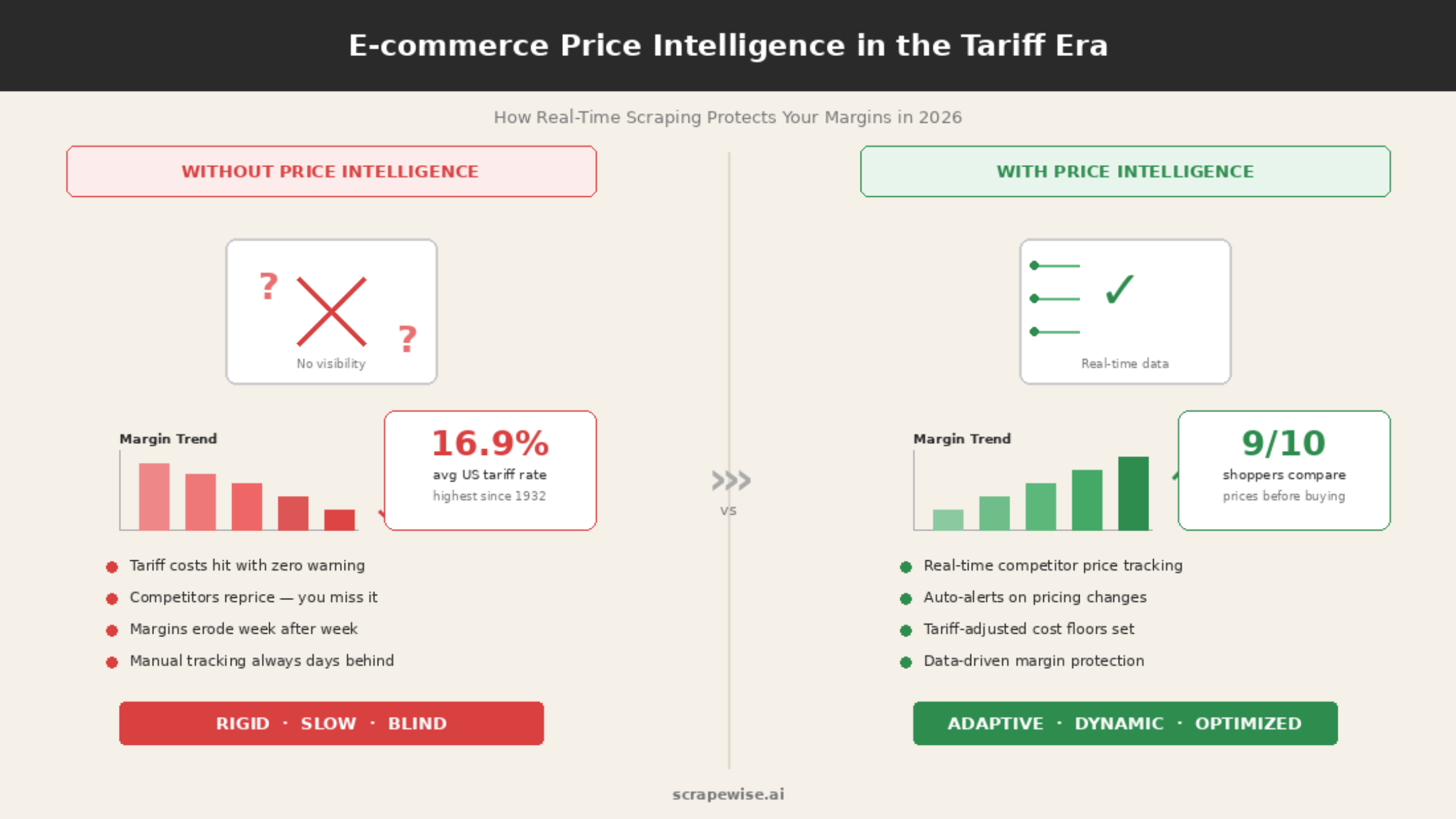
March 2026 update: The average U.S. effective tariff rate has now reached 16.9% — the highest since 1932 — with further increases expected across electronics, apparel, and consumer goods through Q2 2026. E-commerce teams that set up price intelligence infrastructure before the next round of changes will have a significant repricing advantage over those still reacting manually. This guide has been updated to reflect the current tariff environment.
If you run an e-commerce business in 2026, you already feel it. Import costs are climbing, competitors are repricing daily, and your customers are comparing every product across five tabs before clicking "buy." Welcome to the tariff era — where price intelligence isn't optional anymore. It's survival.
The new wave of U.S. tariffs has created the most volatile pricing environment in nearly a century. Businesses that rely on gut instinct or quarterly pricing reviews are getting squeezed from both sides: rising costs below and price-sensitive shoppers above. The e-commerce managers who thrive in this environment are the ones turning real-time pricing data into a competitive weapon.
This guide walks you through exactly how to build a price intelligence operation that protects your margins — even when tariffs shift overnight.
Why Tariffs Have Made Price Intelligence Urgent
The numbers paint a stark picture. According to the Yale Budget Lab, the average effective U.S. tariff rate reached 16.9% as of January 2026 — the highest level since 1932. That's not a minor adjustment. It's a structural shift in the cost base for any retailer sourcing internationally.
The ripple effects are already hitting the checkout page. Adobe's e-commerce tracking data showed that online prices jumped 4% in January 2026 alone — the largest single-month increase in the 12 years since the company started measuring. Meanwhile, research from the New York Federal Reserve found that roughly 77% of firms whose costs rose due to tariffs had already passed those costs on to consumers.
For e-commerce managers, this creates a double bind. Raise prices and risk losing customers to competitors who absorb the hit. Absorb the hit and watch margins shrink month over month. The only way to navigate this is with data — specifically, real-time competitor price data that tells you exactly where the market is moving and how much room you have.
According to Backlinko's analysis of consumer search behavior, the majority of online purchase journeys now start with a search query — and price comparison is one of the most common activities once a shopper lands on a product page. That makes your pricing position not just a financial decision, but a visibility decision.
This is why the price monitoring software market is booming. Industry estimates put it at roughly $710 million in 2025, with projections exceeding $1.4 billion by 2033, according to Archive Market Research. Businesses are betting heavily that competitive pricing data will be the difference between growing and going under. As Search Engine Land has reported, e-commerce sites that align pricing strategy with search intent see measurably better organic click-through rates.
What E-commerce Price Intelligence Actually Looks Like
Price intelligence sounds like a corporate buzzword, but in practice it's straightforward. It means systematically tracking what your competitors charge, how often they change prices, when they run promotions, and what products they keep in or out of stock. You then use that data to inform your own pricing decisions — whether that's matching, undercutting, or intentionally pricing above the market with a clear value justification.
In the tariff era, this becomes especially powerful because not every competitor responds to cost increases the same way. Some will absorb the tariff costs to protect volume. Others will pass 100% of the increase to consumers. A few will quietly exit certain product categories altogether. Each of those scenarios creates a different opportunity for you — but only if you see it in real time.
A practical e-commerce price intelligence operation typically includes three core activities: automated competitor price tracking across your key SKUs and marketplaces, stock availability monitoring that flags when competitors go out of stock on high-demand items, and historical pricing analysis that reveals seasonal patterns and competitive repricing cycles.
The key distinction from simple price comparison is that intelligence means understanding the why behind the numbers. When a competitor drops their price 15%, is it a tariff absorption strategy, a clearance sale, or a deliberate move to steal market share? Your response should be very different in each case.
How to Build a Tariff-Proof Pricing Strategy: Step by Step
Step 1: Map Your Tariff Exposure at the SKU Level
Before you can protect margins, you need to know which products are most exposed. Start by categorizing your catalog into three tiers based on tariff impact: high exposure (products sourced from heavily tariffed countries with limited domestic alternatives), medium exposure (products where you have some supply chain flexibility), and low exposure (domestically sourced or tariff-exempt goods).
This mapping exercise immediately tells you where to focus your monitoring efforts. High-exposure SKUs need daily or real-time competitor tracking because that's where pricing volatility will be highest. Low-exposure products might only need weekly checks.
Step 2: Set Up Automated Competitor Price Monitoring
Manual price tracking doesn't scale. If you're monitoring more than a handful of SKUs across three or more competitors, you need automation. Modern price monitoring solutions use web scraping to continuously collect competitor pricing data and deliver it to dashboards or directly into your pricing engine.
According to HubSpot's research on marketing automation trends, businesses that leverage data-driven decision-making see significantly better outcomes than those relying on manual processes. The same principle applies to pricing: automated collection and analysis reduces reaction time from days to minutes.
When evaluating price monitoring tools, focus on four capabilities: scraping reliability (can it handle JavaScript-heavy sites and anti-bot defenses?), data accuracy and freshness (how often is pricing data updated?), product matching (can it correctly match your SKUs to competitor listings, including when product names differ?), and alerting (does it notify your team instantly when a competitor makes a significant price move?).
Self-healing scraping infrastructure — the kind that adapts automatically when competitor websites change their layouts — is particularly important in fast-moving markets where pricing shifts daily. Without it, broken scrapers mean blind spots in your competitive data.
Step 3: Define Your Pricing Rules and Guardrails
Real-time data is only useful if you have a framework for acting on it. Before connecting any monitoring tool to your pricing, establish clear rules. These should include your minimum acceptable margin per product category, maximum price gap above or below your primary competitor, automatic repricing triggers (for example, reprice within two hours if a top-three competitor drops by more than 5%), and hard floors that prevent pricing below your landed cost plus tariff.
In the tariff era, that last point is critical. Your "cost floor" is now a moving target. If tariff rates change — and they have multiple times in the past 12 months — your entire pricing ruleset needs to update. Build this flexibility in from the start.
Step 4: Monitor Beyond Price
Sophisticated e-commerce managers know that price is only part of the picture. Competitor intelligence in 2026 also means tracking free shipping thresholds (which effectively change the real price consumers pay), bundling strategies (competitors may hold sticker price but add accessories or extended warranties), stock levels (being the only in-stock option on a high-demand product changes your pricing power dramatically), and promotional cadences (knowing when competitors run sales helps you time your own campaigns).
Tools that offer comprehensive product data extraction across these dimensions give you a much richer picture than price-only monitoring.
Step 5: Review, Learn, and Adjust Monthly
Price intelligence isn't a set-and-forget system. Schedule a monthly "pricing war room" meeting where your team reviews the competitive data from the past 30 days, evaluates which pricing rules worked (and which triggered unintended consequences), and adjusts your strategy based on changing tariff conditions, inventory levels, and competitive dynamics.
According to Moz's guidance on data-driven marketing strategies, businesses that build regular review cycles into their data operations outperform those that only react to crises. Semrush's competitive analysis research reinforces this: companies that systematically track competitor activity see 20-30% better positioning outcomes. The same is true for pricing. The retailers who win in 2026 are those reviewing competitive data weekly, not quarterly.
Common Challenges and How to Solve Them
Challenge 1: Data Quality and Product Matching. The biggest technical hurdle in price intelligence is ensuring your monitoring tool correctly matches your SKUs to competitor products. This is especially difficult in categories like fashion, electronics, or auto parts where the same product may appear under different names, SKU numbers, or bundled configurations. Solutions include EAN/UPC code matching for standardized products, AI-powered product data matching for non-standardized listings, and manual review queues for ambiguous matches.
Challenge 2: Competitors Blocking Your Scraping. E-commerce sites are increasingly deploying anti-bot measures that block automated data collection. According to industry research, nearly half of all internet traffic now comes from bots, which has driven websites to invest heavily in detection and blocking. The solution is using scraping infrastructure that rotates proxies, mimics human browsing patterns, and adapts automatically when blocked. AI-powered scraping approaches have made this significantly more reliable than traditional selector-based methods. Platforms built on AI-native extraction can handle even heavily protected competitor websites without breaking when layouts change.
Challenge 3: Acting Too Slowly on Price Changes. Tariff-driven pricing shifts can happen overnight — literally, when a new policy is announced. If your team takes days to analyze and respond, you're already losing sales or eroding margins. The fix is connecting your price monitoring directly to your repricing engine via API, so that competitive changes trigger automatic adjustments within your predefined guardrails. Platforms that can turn competitor websites into structured data feeds via APIs make this integration much smoother.
Challenge 4: Pricing Across Multiple Marketplaces. Many e-commerce businesses sell across their own site, Amazon, eBay, and regional marketplaces. Each channel may have different competitive dynamics and pricing norms. A strong price intelligence setup tracks competitors per channel, not just globally. What your competitor charges on Amazon may be very different from their direct site — and your response should account for that.
Challenge 5: Tariff Uncertainty. Perhaps the most unique challenge in 2026. With potential tariff expirations, new policies, and ongoing trade negotiations, the cost base for imported goods could shift multiple times this year. Build scenario planning into your pricing model: what happens to your top 20 SKUs if tariffs drop 5%? Rise 10%? Modeling these scenarios in advance means faster, calmer decision-making when policy changes hit.
Advanced Strategies for the Tariff Era
Dynamic Pricing with Tariff-Adjusted Floors. Rather than static pricing rules, leading retailers are implementing dynamic pricing engines that automatically adjust their cost floors based on current tariff rates. As Neil Patel's pricing research suggests, the brands winning in competitive markets are the ones that automate pricing responses while keeping strategic guardrails in place. When tariff rates shift, the system recalculates margins in real time and adjusts customer-facing prices within predefined bands. This approach ensures you never sell below cost while still remaining competitive.
Competitor Response Pattern Analysis. Over time, your price monitoring data reveals patterns in how competitors react to market changes. Some always match the lowest price. Others maintain premium positioning regardless. A few follow specific competitors rather than the market as a whole. Identifying these patterns using real-time data analytics lets you predict competitive moves before they happen and position accordingly.
Supply Chain Intelligence as a Pricing Input. In the tariff era, your competitors' supply chain decisions become pricing signals. If you notice a competitor gradually shifting inventory away from heavily tariffed categories, that may indicate they're exiting those product lines — creating an opportunity for you to capture market share. Combining price monitoring with broader market data extraction gives you this kind of strategic visibility.
Conclusion
The tariff era has made one thing clear: e-commerce businesses that treat pricing as a data problem — not an intuition problem — will be the ones that survive and grow. The tools exist. The data is accessible. The competitive landscape is more transparent than ever for those willing to invest in real-time intelligence.
Start with the basics: map your tariff exposure, automate your competitor tracking, and build pricing rules that adapt to changing costs. Then layer on advanced capabilities like dynamic repricing, pattern analysis, and supply chain intelligence as your operation matures.
The businesses that win in 2026 won't necessarily have the lowest prices. They'll have the best information — and the systems to act on it faster than everyone else. For a deeper look at the tools and approaches available, see our guide to competitive price monitoring tools.
Paste a competitor URL and start tracking prices
Any e-commerce site, any SKU count. Clean structured feeds on your schedule, no code required.
Not ready to sign up? See 40 rows of real Google Shopping price data →
97% accuracy on Amazon benchmarks · no credit card · book a 15-min call →