

The Market Is No Longer Just Text
For decades, competitive intelligence focused on parsing HTML: prices, product titles, meta descriptions, and structured schema. Analysts relied on structured feeds, API pulls, and keyword scraping to understand the market.
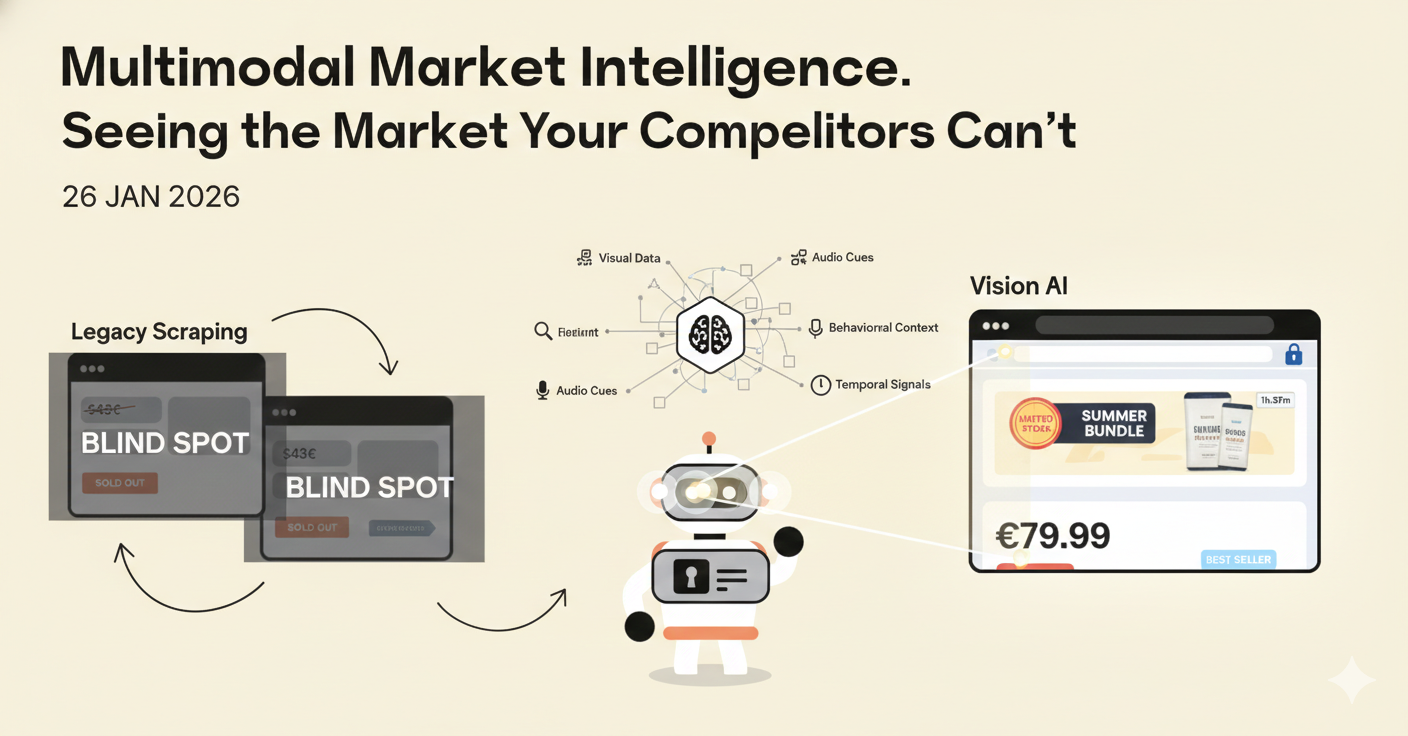
By 2026, this text-first approach is no longer sufficient. The most decisive competitive signals now exist in visual form: campaign banners, scarcity badges, countdown timers, mobile-exclusive layouts, bundle positioning, and app-specific UI states.
The shift is backed by massive consumer behavior changes. Google Lens alone processes nearly 20 billion visual searches per month as of 2025, while Pinterest Lens has been used over 850 million times in the first half of 2025. These numbers represent a fundamental change in how consumers discover and evaluate products.
If your intelligence stack only reads text, it is blind to the strategic intent embedded in design and perception.
Multimodal Market Intelligence (MMI) addresses this by combining text, visual, behavioral, and temporal signals into a single analytical layer. Vision AI doesn't just see the web; it interprets it like a human consumer would, at scale.
The Limits of Traditional Scraping
Modern e-commerce platforms intentionally hide critical signals from structured fields. Prices may exist in the code, but promotional urgency is often rendered dynamically in the browser. Discount banners may appear only after specific interactions. Mobile and desktop users may see entirely different product arrangements. Logged-in users often experience a completely personalized interface.
This creates a truth gap: the difference between what a legacy scraper captures and what a real human actually sees.
The problem compounds at scale. According to recent industry research, the computer vision for retail market is projected to grow from USD 4.23 billion in 2025 to USD 9.88 billion by 2029, at a CAGR of 23.6%. Retailers are investing heavily in visual intelligence because they understand that visual context drives conversion.
Ignoring this gap leads to misaligned pricing, flawed campaign predictions, and inaccurate market maps.
Visual-First Competition
Retailers and brands now use UI as a strategic instrument.
A product's price may be secondary to visual cues like "Best Seller" badges, scarcity indicators, and product positioning. Bundles are designed to visually anchor perceived value, and countdown timers manipulate urgency perception.
Vision AI in retail enables near real-time shelf intelligence—not just competitive data collection, but monitoring of on-shelf availability, display compliance, promo execution, and product positioning. This means you don't just know what competitors charge; you see how and where they sell.
These signals cannot be captured in tables or JSON; they exist entirely as pixels. Vision AI converts these pixels into actionable intelligence.
What Multimodal Market Intelligence Captures
MMI combines multiple dimensions:
Textual Data: Prices, product names, descriptions, and meta tags that traditional scrapers capture effectively.
Visual Data: Layout hierarchies, badges, colors, images, promotional banners, and design elements that influence perception.
Behavioral Context: Interaction states, device type variations, login-specific personalization, and user journey dependencies.
Temporal Signals: Animation timing, urgency decay patterns, countdown progressions, and campaign escalation phases.
A Vision AI system can detect which visual cues most influence customer perception, how campaigns escalate, and how product prominence affects conversion.
Computer Vision: Turning Pixels into Strategy
At the core of MMI is Computer Vision, trained to detect commercial intent patterns rather than generic images.
The global computer vision AI in retail market was estimated at USD 1.66 billion in 2024 and is projected to reach USD 12.56 billion by 2033, growing at a CAGR of 25.4%. This growth is driven by the rising demand for real-time customer behavior analytics, automated checkout systems, and enhanced inventory management powered by advanced visual recognition technologies.
Vision AI can identify banners and discounts, visual hierarchy patterns, product prominence signals, bundling logic, and dark pattern nudges.
For example, a 4K screenshot of a category page can reveal whether a product's price is emphasized or minimized, whether urgency is explicit or implied, how value is visually anchored, and whether premium perception is intentionally crafted.
Shelf image recognition AI is growing from $1.43 billion in 2024 to $1.82 billion in 2025, with AI-driven solutions achieving over 95% accuracy in auditing while reducing audit time by 50%.
Visual Veracity: Seeing the Market as Customers Do
One of the biggest failures of legacy scraping is template illusion: two users hitting the same URL do not always see the same page.
Visual Veracity solves this by rendering full browser sessions, capturing post-interaction states, observing lazy-loaded content, recording animation sequences, respecting viewport differences, and simulating real user journeys.
The result is ground truth intelligence: insights reflect what customers actually experience, not what legacy scrapers infer.
Modern visual search technology uses deep learning to analyze images in detail, recognizing colors, patterns, textures, and even how products are styled or positioned. This multimodal approach combines visual data with contextual information, creating intelligence that mirrors the human shopping experience.
Why Visual Context Matters for Pricing and Campaigns
Pricing, promotions, and perceived value are increasingly visual phenomena.
A higher price with a trust badge may outperform a lower price without context. Discounts that lack visual reinforcement often underperform. Urgency is perceived visually, not numerically.
Studies show that e-commerce stores using visual intelligence can see up to 30% increase in conversions. By offering more precise understanding of what customers see, visual intelligence keeps pricing strategies aligned with actual customer experience.
E-commerce companies using multimodal AI report 35% increases in conversion rates through personalized visual interactions. This demonstrates that visual context isn't optional—it's critical infrastructure for AI-driven pricing and campaigns.
Without visual intelligence, elasticity models misfire, A/B testing is misled, and competitor strategies are misinterpreted.
4K Scraping: Precision at Market Scale
Low-resolution scraping misses nuance. Modern Vision AI platforms operate in 4K resolution to capture microcopy, subtle color signals, faint icons, and layout details that influence behavior.
This precision allows accurate OCR, reliable icon classification, brand-compliant visual matching, and cross-device comparison fidelity.
Intelligent inventory management achieves 95-99% accuracy by using constant shelf monitoring and image recognition. This level of precision ensures that competitive intelligence reflects what real customers experience, not approximations.
For mobile-first competitors, this fidelity is essential because small design changes can drive significant behavioral shifts.
Multimodal Insights in Practice
Campaign Intelligence
Vision AI doesn't just track campaign start and end dates. It detects first visual appearance of a promotion, escalation phases in visual campaigns, countdown urgency ramps, and silent campaign withdrawals.
Vision AI provides in-store analytics for pricing that automates price collection using image recognition, delivering near real-time insights from shelves across your own stores and competitors. Combined with AI-driven dynamic pricing platforms, computer vision enables retailers to base pricing not on guesswork, but on accurate shelf intelligence.
This enables brands to respond before price changes occur, shifting from reactive to proactive intelligence.
Competitive Positioning
Vision models analyze visual dominance of categories, above-the-fold product prominence, how brands anchor premium perception visually, and private label positioning through layout.
Object detection and tracking represents 29.5% of the computer vision retail market, reflecting the core importance of identifying and tracking visual elements across competitive landscapes.
These insights produce visual market maps richer than any price list alone.
Feeding Multimodal Data Into AI Systems
Multimodal data isn't just for reporting. By 2026, it feeds directly into agentic pricing engines, campaign orchestration systems, recommendation algorithms, and brand safety monitors.
The global multimodal AI market is projected to surge from USD 2.99 billion in 2025 to USD 13.51 billion by 2031, growing at 28.59% CAGR. Retail and e-commerce are expected to grow at a 33.20% CAGR through 2031 as brands integrate camera feeds, text prompts, and purchase histories into unified intelligence systems.
Visual signals become first-class inputs, weighted alongside stock and textual data, enabling AI systems to anticipate market shifts before they occur.
Vision-language models currently account for 42% of multimodal AI adoption, making them the leading segment due to their widespread application in image captioning, visual question answering, and document processing—all capabilities relevant to market intelligence.
Legal, Ethical, and Competitive Considerations
Visual scraping captures publicly rendered truth, not proprietary databases. Regulators increasingly recognize screenshots as market facts, visual claims as competitive signals, and UI manipulation as an economic behavior.
63% of retailers consider AI essential for maintaining a competitive advantage and anticipate an average return on investment of 51% within three years of AI deployment. This widespread adoption signals that visual intelligence is becoming table stakes, not a gray area.
Vision AI is therefore defensive parity—if deployed responsibly, it creates compliant, defensible competitive intelligence.
The Strategic Advantage
Most companies still react to price changes or inventory reports. Vision-enabled firms react to visual intent and perception shifts, gaining days of competitive advantage.
62% of millennials prefer visual search capabilities over traditional text-based search, demonstrating that the next generation of consumers already operates in a visual-first mode. Intelligence systems that mirror this behavior capture signals that text-only systems miss entirely.
In saturated markets, the first mover isn't necessarily the cheapest—it's the most perceptive.
Linking to the Sovereign Data Moat
Multimodal intelligence generates proprietary insight that competitors cannot purchase: visual response patterns, campaign fingerprints, and UI-to-conversion correlations.
Over 52% of Fortune 500 companies integrated multimodal AI into their workflows in 2024, resulting in improved productivity and faster customer response times. Companies that own, protect, and analyze visual data build the foundation for a Sovereign Data Moat, where first-party intelligence compounds over time.
The difference between market leaders and laggards increasingly comes down to who sees the market as customers experience it—and who is still parsing text.
The Market Now Speaks in Images
By 2026, winning depends less on having more data and more on seeing the data that matters.
The global visual search market is projected to reach USD 150.43 billion by 2032, highlighting the immense scale of image-driven commerce. Organizations that fail to integrate visual intelligence into their AI strategies risk building models that are context-blind, reactive, and vulnerable to competitor manipulation.
The future belongs to those who see.
Paste a marketplace URL — get structured market data
Size categories, track assortments, monitor trends. Clean feeds ready for your BI stack.
Not ready to sign up? See 40 rows of Amazon Best Sellers data →
97% accuracy on Amazon benchmarks · no credit card · book a 15-min call →