

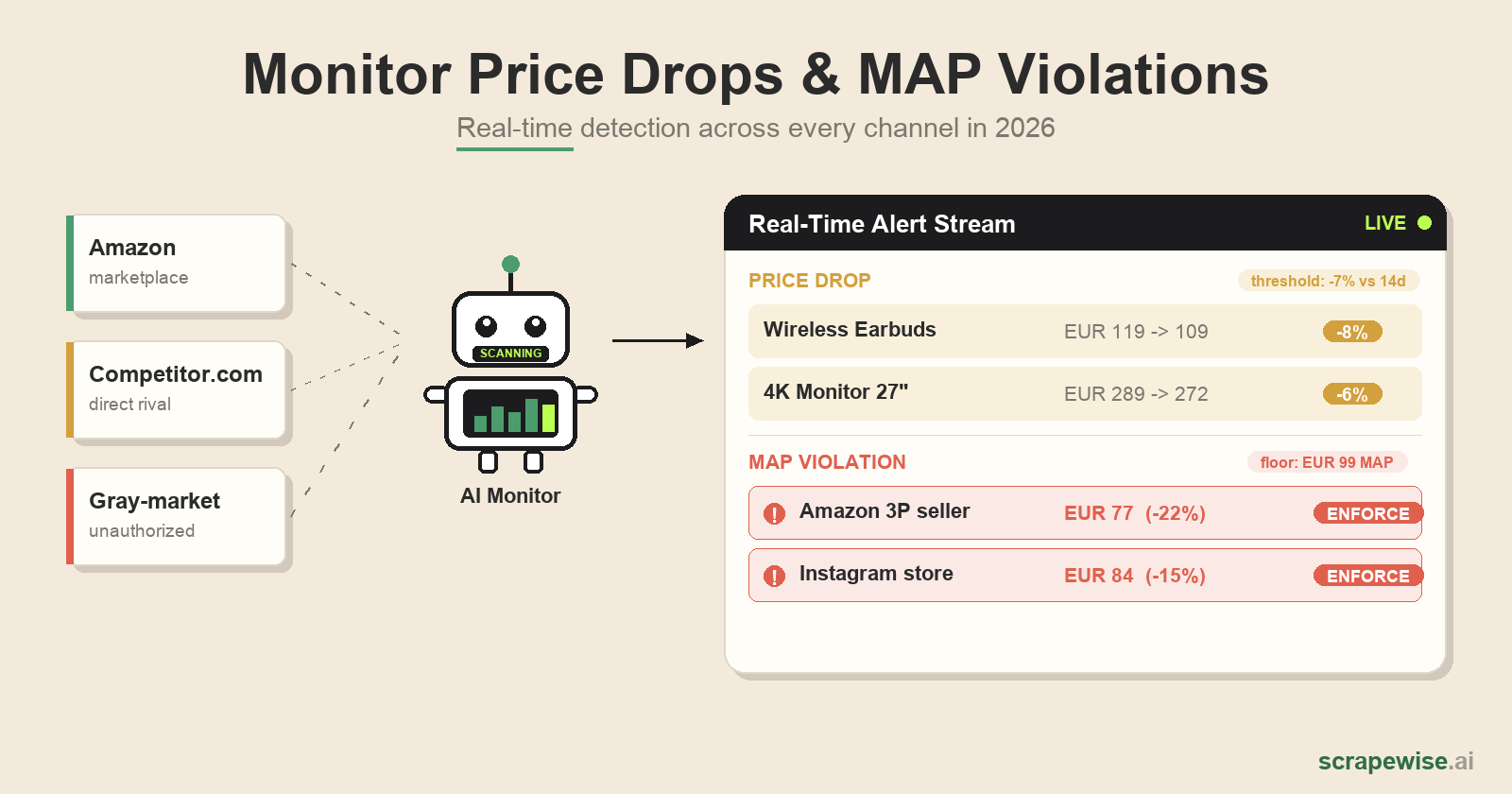
How to Monitor Competitor Price Drops and MAP Violations in Real-Time
A competitor cuts the price on your best-selling SKU at 9am. An unauthorized seller lists your flagship product 22% below MAP on a marketplace you don't watch closely. Both events cost you money for every hour they go undetected — and both are invisible to a team that checks prices manually once a week.
Real-time monitoring closes that gap. But "real-time" means different things for a competitor price drop you want to react to and a MAP violation you want to enforce against, and the workflow for each is different. This guide covers both: how to detect competitor price drops fast enough to respond, how to catch MAP violations across the channels where they actually appear, and what breaks when you try to run this in-house at scale.
Price Drops vs. MAP Violations: Two Problems, One Data Feed
Both problems start from the same raw input — a current price observed on a web page — but they ask different questions.
A competitor price drop is an external event you're reacting to: a rival lowered their price, and you need to decide whether to follow, hold, or ignore it. Speed matters because the window to win or keep the sale is short.
A MAP violation is an internal-policy event: someone is selling your product below the price floor you set for the channel. Speed matters because each violation erodes your authorized partners' margin and, left alone, drags the whole market price down. The data is the same; the alerting logic, the channels you watch, and the action you take are not.
| Competitor price drop | MAP violation | |
|---|---|---|
| Whose product | Competitor's | Yours |
| Trigger | Price falls vs. recent baseline | Price falls below your MAP floor |
| Why speed matters | Short window to win the sale | Margin leaks every hour it's live |
| Where to watch | Direct rivals, key marketplaces | All sellers of your SKUs, incl. gray market |
| Action | Reprice / hold decision | Enforcement: notice, escalate, delist |
The takeaway: build one collection layer, then split the alerting into two workflows.
Step 1: Define What "Real-Time" Actually Needs to Be
True per-second monitoring is rarely worth the cost. The right cadence is the one that's faster than your decision window.
- Fast-moving categories (electronics, FMCG, marketplaces with Buy Box dynamics): prices change multiple times a day; monitor your priority SKUs hourly or better.
- Mid-velocity retail: a few changes a week; several checks per day is plenty.
- Industrial / B2B / wholesale: monthly movement; daily is real-time enough.
Tier your catalog so you spend the high-frequency budget where it pays off. Your top 20 revenue SKUs might justify hourly checks; the long tail can run daily. This tiering is the single biggest lever on monitoring cost — covered further in our competitor price tracking buyer's guide.
Step 2: Set Alert Thresholds That Don't Drown You
Monitoring everything generates noise; the goal is to surface only events that warrant a decision. Two threshold types do most of the work.
For competitor price drops, alert on a percentage move against a rolling baseline, not against yesterday's price. A 2% wobble on a volatile SKU is noise; a 7% drop below the 14-day average is a signal. Tie the threshold to the SKU's normal volatility so stable products alert on smaller moves and jumpy ones don't cry wolf.
For MAP violations, the threshold is your policy floor: alert the moment any seller lists below MAP, with severity scaled by depth (how far below) and seller type (authorized vs. unknown). A 1% dip from an authorized partner is a conversation; a 22% dip from an unauthorized storefront is an enforcement case.
Route alerts by severity. A minor competitor drop goes into a daily digest; a deep MAP violation from an unknown seller pages someone. Drowning the team in low-severity pings is the fastest way to get monitoring ignored.
Step 3: Cover the Channels Where Violations Actually Hide
This is where most monitoring programs quietly fail. Competitor price drops usually happen on channels you already watch — the rival's own site, Amazon, a couple of comparison engines. MAP violations love the channels you don't: third-party marketplace sellers, gray-market storefronts, and sometimes login-gated B2B portals.
A monitoring program that only watches the obvious channels will report "no violations" while your margin leaks through the back door. Real coverage means:
- Direct competitor sites for price-drop reactions.
- Major marketplaces (Amazon, eBay, regional players) including third-party sellers, not just the Buy Box.
- Gray-market and unauthorized storefronts, which is where the worst MAP breaks appear — see our work on gray market monitoring.
- Authenticated portals where distributor or contract pricing lives — most SaaS trackers can't reach these at all.
ScrapeWise runs this coverage as a managed service through MAP & brand monitoring, specifically because the high-value violations sit in the channels that off-the-shelf tools skip.
Step 4: Turn Detection Into Action
Detection without a response loop is just expensive anxiety. Close the loop for both workflows.
For price drops, pipe the alert into your pricing process with enough context to decide quickly: the competitor's new price, your current price and margin at that level, the SKU's recent price history, and stock status on both sides. The decision is rarely "always match" — sometimes you hold because you have stock they don't, or because their cut is a short flash sale that will recover.
For MAP violations, the action is enforcement, and it benefits from an evidence trail: a timestamped record of the listing, the seller, the price, and a screenshot. That record turns a vague complaint into an enforceable notice and lets you track repeat offenders. Historical retention matters here — a violation you can prove ran for three weeks carries more weight than a single snapshot.
Why This Breaks When You Build It In-House
Standing up basic monitoring in-house is easy. Sustaining real-time, multi-channel monitoring is where teams stall, for predictable reasons:
- Anti-bot defenses. High-frequency checks on major marketplaces trip Cloudflare, DataDome, and Akamai. What worked in a weekend prototype gets blocked within weeks, and you inherit a perpetual anti-bot arms race.
- Coverage drift. Sites change layouts; your scrapers silently break and the "no violations" report is actually "no data."
- Authenticated channels. The portals where contract-price violations hide need login handling that off-the-shelf tools don't offer.
- History and scale. Event-level retention across thousands of SKUs and dozens of channels is an infrastructure problem, not a script.
This is the same build-vs-managed calculus we walk through in web scraping vs. API for retail data: a snapshot is cheap to build, but reliable, real-time, multi-channel collection is where a managed feed earns its keep.
A Monitoring Checklist
Before you call a monitoring program "real-time," confirm it does all of this:
- Tiered cadence — high-frequency on priority SKUs, daily on the tail.
- Smart thresholds — baseline-relative for price drops, policy-floor for MAP, severity-routed alerts.
- Full channel coverage — marketplaces, gray-market storefronts, and authenticated portals, not just the obvious sites.
- Action loops — repricing context for drops, evidence trails for violations.
- Reliability at scale — anti-bot resilience, layout-change detection, and historical retention.
Get those five right and you stop discovering price drops and MAP violations days late. ScrapeWise delivers this as a managed feed — tiered, multi-channel, with the evidence trail enforcement needs. Book a call and we'll scope your priority SKUs and channels first.
Paste your first URL — extract structured data in 24s
No code, no credit card. Connect to any website in minutes.
97% accuracy on Amazon benchmarks · no credit card · book a 15-min call →