

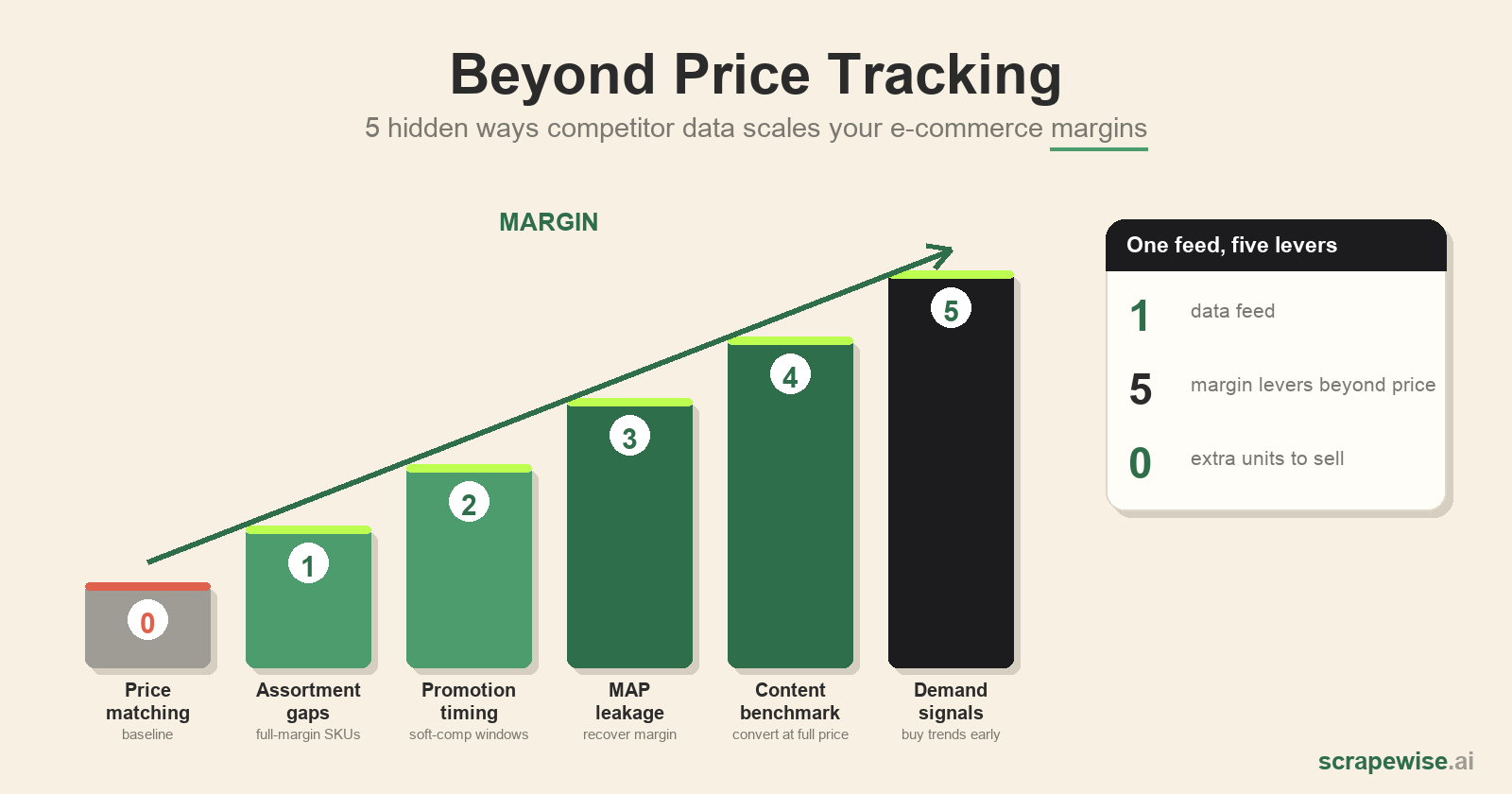
Beyond Price Tracking: 5 Hidden Ways Competitor Data Scales Your E-commerce Margins
Most e-commerce teams collect competitor data for exactly one reason: to make sure they aren't being undercut. They scrape rival prices, feed them into a repricing rule, and call it competitive intelligence. It isn't — it's price matching, and price matching is a race to the bottom that compresses margin on every SKU it touches.
The teams that actually grow margin treat competitor data as a decision layer, not a thermostat. The same data feed that tells you a rival dropped a price can also tell you which products to stock, when to run a promotion, where your brand is leaking value, and which categories are heating up before the demand shows up in your own sales. This guide covers five of those higher-margin uses — and what your data collection has to do to support them.
Why Price Matching Alone Erodes Margin
Price matching feels safe because it's reactive and measurable. A competitor cuts 4%, you cut 4%, you keep the sale. But run that loop across a catalog and three things happen.
First, you train your repricing engine to chase the most aggressive seller in every category — often a liquidator or a gray-market account that doesn't share your cost base. Second, you give up pricing power on products where you actually have an assortment, delivery, or brand advantage that customers would pay for. Third, you spend your entire data budget answering one low-value question ("what does the competitor charge?") and none of it on the questions that compound.
The fix isn't to stop tracking prices. It's to stop stopping at prices. Below are five uses that turn the same scrape into margin instead of erosion.
1. Assortment Gap Analysis — Stock What Sells, Skip What Doesn't
Every competitor's catalog is a free demand experiment they've already run. If three rivals carry a SKU and you don't, that's either a gap worth filling or a product they're all stuck holding. Competitor data tells you which.
By scraping competitor catalogs alongside their stock status and review velocity, you can map the products that are widely stocked and moving — the ones worth adding — versus the long tail everyone lists but nobody sells. This is far more profitable than blanket price matching because new, well-chosen SKUs come in at full margin instead of discounted margin.
The data requirement here is breadth and structure: you need full category coverage, normalized product attributes, and the ability to match competitor SKUs to your own. That's a product data matching problem as much as a scraping one — getting it wrong means comparing a 500ml bottle to a 750ml one and drawing the wrong conclusion.
2. Promotion Timing — Win the Calendar, Not the Discount
Most promotions are scheduled around internal calendars: payday, end of quarter, a holiday. Competitor data lets you schedule them around the market instead.
When you track competitor promotional history — start dates, depth, duration, and which SKUs get discounted — patterns emerge. You learn that a rival clears stock on a category every six weeks, or that they go quiet for ten days after a big push. That's your window to run a full-margin promotion into soft competition, or to hold your discount when the market is already saturated with deals and an extra cut would just burn margin you didn't need to spend.
This requires tracking promotional events, not just current prices — capturing the transition when a price drops and when it recovers. A static daily snapshot misses the flash sale that ran from 9am to 3pm. To catch those, your collection cadence has to match how fast the category moves, which for electronics and FMCG means intraday monitoring.
3. MAP & Channel Leakage — Protect the Margin You Already Have
For brands and distributors, the fastest margin win isn't winning new sales — it's stopping the value that's already leaking out of the channel. Unauthorized sellers and MAP (Minimum Advertised Price) violations quietly undercut your authorized partners, and every violation that sits live for three weeks is margin you funded walking out the door.
Competitor data, pointed at your own products across marketplaces, surfaces this leakage: who's selling below MAP, which storefronts aren't authorized resellers, and how far below your floor the market has drifted. The teams that monitor this systematically recover margin without selling a single additional unit. We cover the workflow in depth in our guide to monitoring competitor price drops and MAP violations in real time, and ScrapeWise runs it as a managed service through MAP & brand monitoring.
The data requirement is coverage of the channels SaaS price trackers usually skip — third-party marketplaces, gray-market storefronts, and sometimes login-gated portals where the real violations hide.
4. Content & Digital Shelf Benchmarking — Margin Through Conversion
Two listings at the same price don't convert at the same rate. The one with better images, a complete attribute table, more reviews, and richer A+ content wins the click and the sale — at full price. Competitor data that captures content, not just price, tells you where your listings are losing the conversion battle.
By benchmarking competitor product pages — image count, bullet completeness, review volume and rating, availability messaging — you find the listings where a content fix would lift conversion more than a price cut ever could. That's margin recovered on the page, not surrendered at checkout. This is the core promise of digital shelf analytics, and it's worth understanding where digital shelf tools end and raw web scraping begins before you buy a platform for it.
5. Demand & Trend Signals — Read the Market Before Your Sales Do
Your own sales data is a rear-view mirror: it tells you what already happened. Competitor data, read at scale, is closer to a leading indicator. When review velocity spikes across a category, when competitors start restocking a product they'd let lapse, or when new SKUs cluster around a feature, demand is shifting before it reaches your P&L.
Aggregated across a category, these signals let you buy into a rising trend at full margin instead of discounting your way out of a falling one. This is where competitor data crosses into market research — and where the value of structured, historical data compounds, because trends only show up when you can compare this month to the last twelve.
What These Five Uses Have in Common
Look at the table and a pattern appears: the high-margin uses of competitor data all demand more than a price scrape.
| Use case | What you track | Margin mechanism | Data requirement |
|---|---|---|---|
| Price matching (baseline) | Current price | Defend the sale | Daily price snapshot |
| Assortment gaps | Catalog + stock + reviews | Add full-margin SKUs | Broad coverage + SKU matching |
| Promotion timing | Promo events over time | Discount into soft competition | Event-level history |
| MAP & channel leakage | Your SKUs across channels | Recover leaked margin | Marketplace + gray-market coverage |
| Content benchmarking | Listing content + reviews | Lift conversion at full price | Digital-shelf field capture |
| Demand signals | Review velocity + restocks | Buy rising trends early | Historical, category-wide data |
Price matching needs a thin, daily snapshot. The other four need breadth, history, structure, and channels that most off-the-shelf price trackers don't reach. That's the real reason teams stay stuck at price matching: their data collection can't support anything more ambitious.
How to Move Up the Margin Ladder
You don't have to do all five at once. The practical sequence:
- Audit what you already collect. If you only have current prices, you're on rung one by default.
- Pick the leak that costs you most. For brands, it's usually MAP and channel leakage. For pure retailers, assortment gaps or promo timing.
- Match the data to the job. Event-level history for promotions, content fields for the digital shelf, channel breadth for leakage.
- Decide build vs. managed. In-house scraping can deliver a price snapshot; sustaining broad, historical, multi-channel collection through anti-bot defenses is where most teams stall — see our breakdown of web scraping vs. API for retail data.
The goal isn't more data. It's data shaped to answer the questions that protect and grow margin — not just the one that defends it.
ScrapeWise delivers competitor data as a managed feed built for these uses: broad catalog coverage, event-level history, multi-channel and gray-market reach, and digital-shelf fields — all matched to your own SKUs. If you've outgrown price matching, book a data strategy call and we'll map your highest-margin use first.
Paste your first URL — extract structured data in 24s
No code, no credit card. Connect to any website in minutes.
97% accuracy on Amazon benchmarks · no credit card · book a 15-min call →