

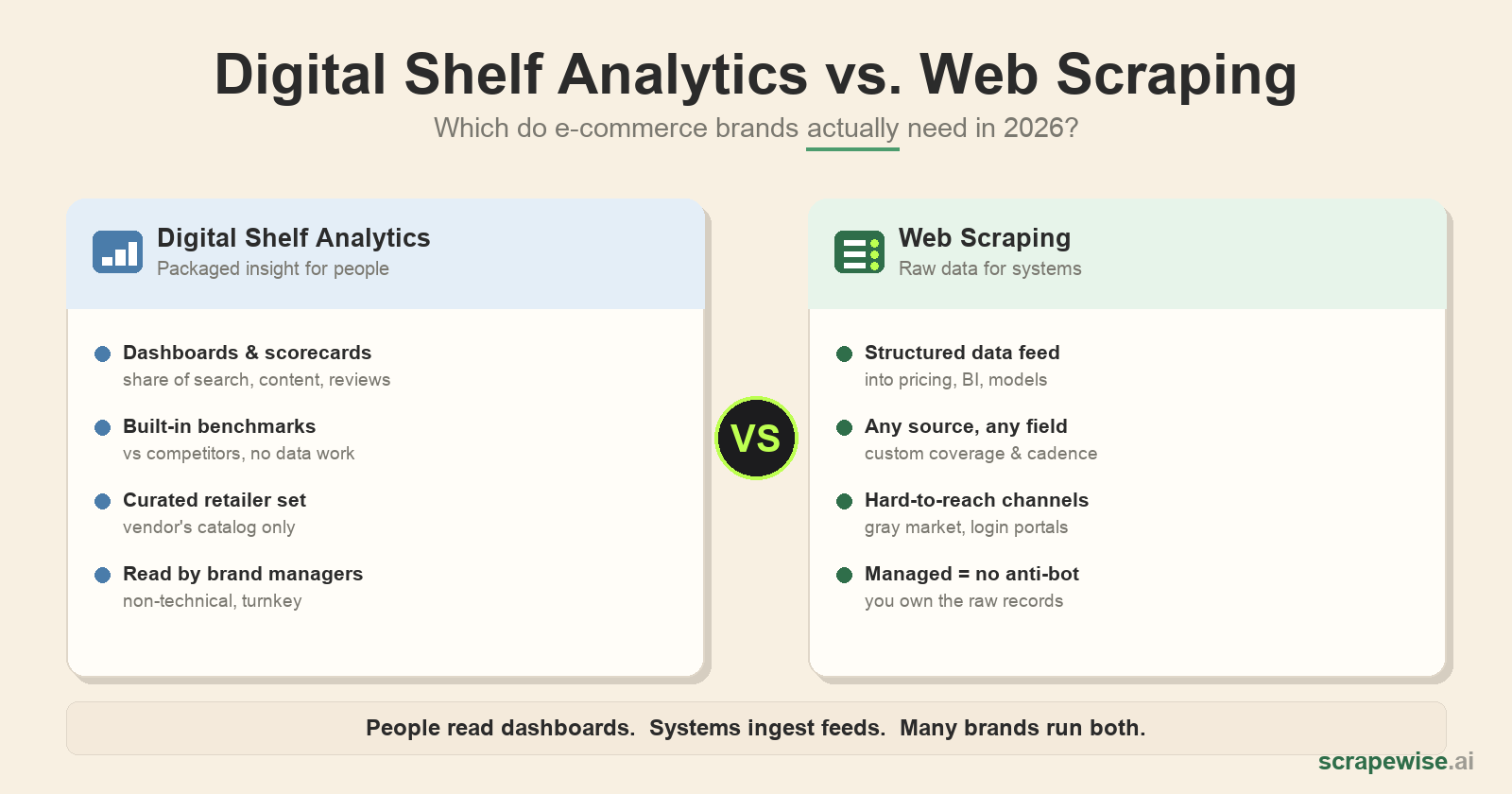
Digital Shelf Analytics vs. Web Scraping Tools: Which Do E-commerce Brands Actually Need?
A brand team wants to know how its products show up across retailers — search ranking, content quality, pricing, reviews, availability. A data team wants a clean feed of competitor prices and listings to plug into the systems it already runs. Both end up looking at the same two categories of tooling: digital shelf analytics platforms and web scraping tools. They are not the same purchase, and buying the wrong one means either paying for dashboards you won't use or inheriting an engineering project you didn't budget for.
This guide gives you the decision framework first — the one question that usually settles it — then breaks down what each category actually does, where they overlap, and the total cost most comparisons leave out.
The Decision Framework: Start Here
Before comparing features, answer one question:
Do you need packaged insight, or do you need raw data you'll act on in your own systems?
- If you need dashboards, scorecards, and alerts that non-technical brand and category managers can read and act on directly — and your use cases (share of search, content compliance, retail availability) line up with what a platform measures — you're shopping for digital shelf analytics.
- If you need a structured data feed to power your own pricing engine, BI, repricing logic, or a custom model — and you want control over fields, cadence, and coverage — you're shopping for web scraping (built or managed).
A useful tie-breaker: who consumes the output? If it's a person reading a chart, lean digital shelf analytics. If it's a system ingesting a feed, lean web scraping. Most of the confusion in this comparison comes from skipping this question and arguing features instead.
What Digital Shelf Analytics Platforms Do
Digital shelf analytics (DSA) platforms — Profitero, DataWeave, Salsify, and similar — measure how your products perform on the "digital shelf" across retailers. They take raw retail data and turn it into packaged metrics:
- Share of search — where your products rank for category keywords vs. competitors.
- Content compliance — whether listings meet your brand's image, title, and attribute standards.
- Pricing and promotion tracking — your prices and competitors' across retailers.
- Availability / out-of-stock — where you're losing sales to stockouts.
- Ratings and reviews — volume, sentiment, and trends.
The value is the analytics layer: scorecards a category manager reads on Monday, alerts when content drifts out of compliance, benchmarks against competitors. You're buying interpretation, not just data.
Best for: Brands selling through retailers that need their teams to monitor and improve retail execution without touching raw data.
Strengths: Turnkey dashboards, retailer-specific metrics, non-technical usability, built-in benchmarks.
Limitations: You consume the vendor's metrics and coverage — if a retailer, marketplace, or field isn't in their catalog, you can't easily add it. Pricing is typically enterprise and per-retailer/per-category. The data is harder to repurpose for custom systems, and you rarely get the raw underlying records.
What Web Scraping Tools Do
Web scraping tools — from DIY libraries and scraping APIs to fully managed data services like ScrapeWise — collect structured data from any web source and hand you the raw records. You decide what to extract, how often, and what to do with it.
- Any source, any field. Not limited to a vendor's retailer catalog — if it's on a page, it can be collected.
- Custom cadence. From daily to intraday on the SKUs that move fast.
- Raw, structured output. Feeds straight into your pricing engine, BI, or models.
- Hard-to-reach channels. Gray-market storefronts, regional marketplaces, and login-gated portals that packaged platforms skip.
Best for: Teams that will act on data in their own systems and need control over coverage, fields, and frequency.
Strengths: Full flexibility, broad and custom coverage, raw data ownership, cost that scales with what you actually collect rather than per-retailer licensing.
Limitations: You're responsible for turning data into insight — there's no built-in dashboard layer. DIY scraping carries an ongoing anti-bot and maintenance burden; a managed service like ScrapeWise removes that burden but, like the platforms, has no self-serve free tier — coverage is scoped to your needs, so pricing is custom and starts with a call.
Where They Overlap (and Where They Don't)
The overlap is real, which is why teams confuse them: both can tell you a competitor's price and whether your product is in stock. The divergence is what you get and who it's for.
| Digital shelf analytics | Web scraping tools | |
|---|---|---|
| Primary output | Packaged metrics & dashboards | Raw structured data feed |
| Best consumer | Brand / category managers (people) | Pricing engines, BI, models (systems) |
| Coverage | Vendor's retailer catalog | Any source you point it at |
| Custom fields | Limited to platform | Fully custom |
| Hard-to-reach channels | Usually no | Yes (gray market, portals) |
| Insight layer | Built in | You build it (or pair with BI) |
| Engineering required | None | DIY: high · Managed: low |
| Total cost driver | Per retailer / category | Volume of data collected |
The honest read: DSA platforms are web scraping plus an analytics layer, constrained to a curated retailer set. If your needs fit inside that set and you want the analytics done for you, the constraint is a feature. If your needs spill outside it — odd channels, custom fields, raw data for a model — the constraint becomes the reason you outgrow the platform.
The Total Cost Most Comparisons Skip
Sticker price isn't total cost. For digital shelf analytics, the hidden cost is coverage you can't get: the channel they don't track, the field they don't capture, the competitor marketplace outside their catalog — gaps you either live with or fill with a second tool.
For DIY web scraping, the hidden cost is engineering overhead: building scrapers is the easy 20%; the other 80% is maintaining them against layout changes and anti-bot defenses, which quietly consumes engineer-weeks. For managed web scraping, that overhead moves to the vendor, so the real cost is the data volume and the scoping conversation up front.
| Option | Sticker cost | Hidden cost | Carries the burden |
|---|---|---|---|
| Digital shelf analytics | Per retailer/category license | Coverage gaps outside catalog | Vendor (within catalog) |
| DIY web scraping | Low/tooling only | Ongoing maintenance & anti-bot | Your engineers |
| Managed web scraping | Custom (scoped) | Up-front scoping | Vendor |
So Which Do You Actually Need?
- Choose digital shelf analytics if brand or category managers need to read and act on retail-execution metrics themselves, your use cases fit a platform's retailer catalog, and you'd rather buy interpretation than build it.
- Choose web scraping (managed) if a system consumes the output, you need coverage or fields a platform won't give you, or you want raw data you own — without running scraping infrastructure yourself.
- Choose DIY web scraping only if you have the engineering capacity to maintain collection through anti-bot defenses indefinitely — most teams underestimate this, which is the recurring theme in our build-vs-managed retail data guide.
Plenty of brands run both: a DSA platform for the team's retail scorecards, and a managed data feed for the channels and custom fields the platform doesn't cover. They're complementary as often as they're alternatives.
If you need raw, structured competitor and retail data — including the channels digital shelf platforms skip — ScrapeWise delivers it as a managed feed. Book a call and we'll map which of your use cases need a feed and which are better served by a dashboard.
Paste your first URL — extract structured data in 24s
No code, no credit card. Connect to any website in minutes.
97% accuracy on Amazon benchmarks · no credit card · book a 15-min call →