

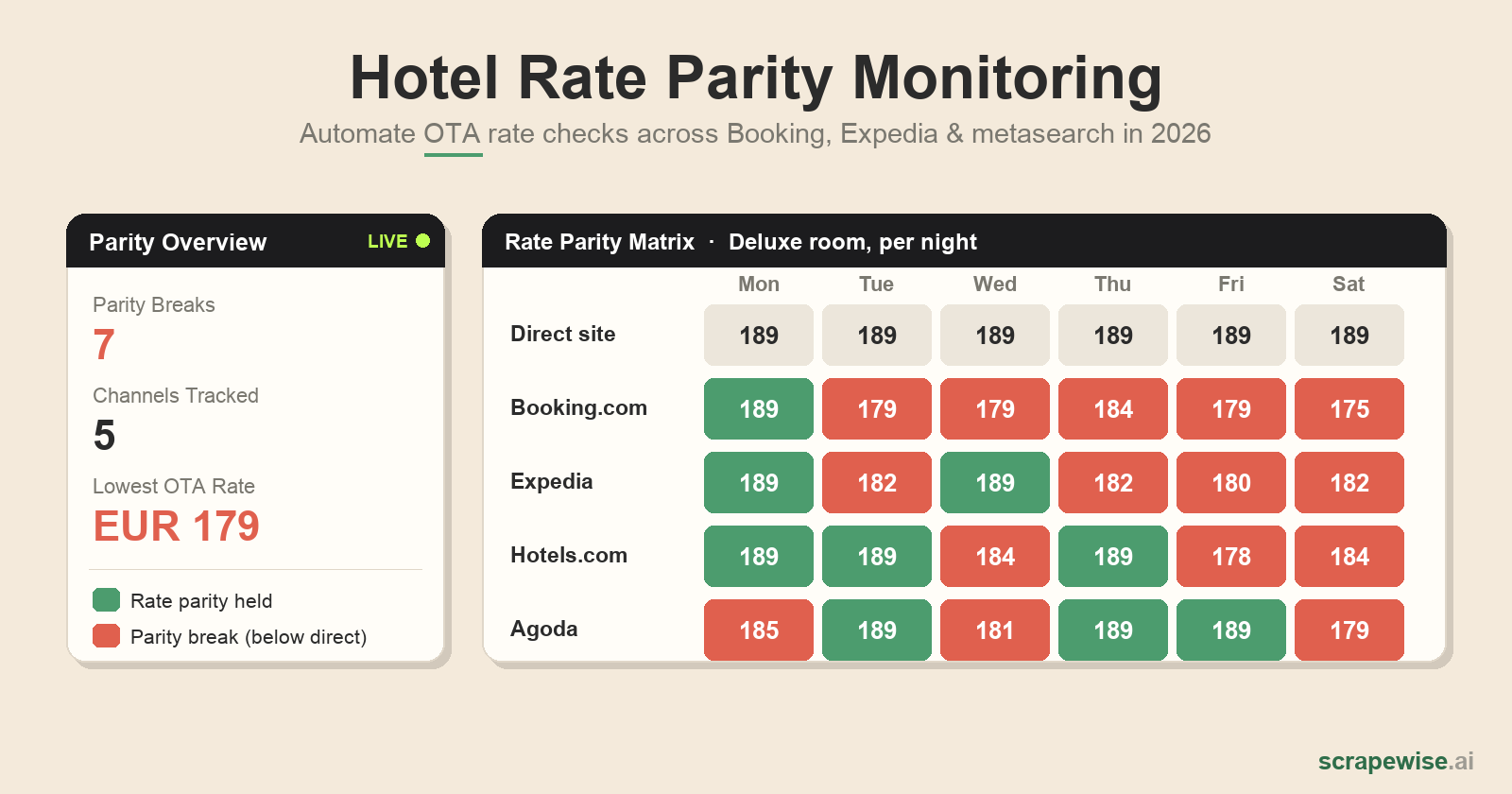
Rate parity sounds like a compliance chore until it costs you a booking. A guest sees your room €12 cheaper on an OTA than on your own site, books there, and you pay commission on a reservation you could have had direct — or worse, your direct-booking conversion quietly erodes because guests learn your site is never the best price. Multiply that across room types, date ranges, length-of-stay rules, and a dozen channels, and manual rate checks stop being feasible.
This guide is for revenue managers and hospitality teams who need to monitor rate parity and competitor rates across OTAs and metasearch in 2026: what to actually watch, why manual checks fail, and how automated monitoring works at scale.
What Rate Parity Monitoring Actually Tracks
"Rate parity" is shorthand for several distinct things you need to watch:
- Channel parity — your rate for the same room, date, and conditions across your direct site, Booking.com, Expedia, and other OTAs. Disparities here leak commission and undercut direct bookings.
- Competitor rates — what comparable hotels in your comp set charge for the same dates, so you can position rather than guess.
- Availability and restrictions — parity isn't just price. Minimum-stay rules, cancellation terms, and closed-out dates change the effective offer.
- Metasearch presentation — how your rate appears on Google Hotels, Trivago, and Kayak, where the cheapest visible rate wins the click.
A monitoring setup that only checks headline price misses most of where parity actually breaks.
How to Choose a Rate Monitoring Approach (Quick Framework)
- Single property or portfolio? One hotel with a few channels can start lighter; a group across regions and brands needs systematic, automated coverage.
- Do you need parity and comp-set rates? Channel-manager parity reports cover your own distribution. Competitor rate intelligence across a comp set is a separate data problem.
- How dynamic is your market? City-center and event-driven markets reprice constantly; leisure and remote properties move slower. Refresh frequency should match.
Quick Comparison: Rate Monitoring Options 2026
| Approach | Channel parity | Comp-set competitor rates | Metasearch view | Best for |
|---|---|---|---|---|
| Channel manager parity reports | Yes | No | Limited | Your own distribution |
| Rate-shopping SaaS | Partial | Yes | Yes | Revenue teams with budget |
| Manual / OTA spot checks | Ad hoc | Ad hoc | Ad hoc | Single small property |
| Managed scraping (ScrapeWise) | Yes | Yes | Yes | Portfolios, custom comp sets |
Why Manual Rate Parity Checks Fail
The matrix is too large. Parity isn't one number. It's rate × room type × date × length-of-stay × cancellation policy × channel. A human checking a handful of dates on two OTAs captures a tiny slice and misses the disparities that actually cost money.
Rates move intraday. OTAs and competitors reprice with demand and events. A spot check at 9am tells you nothing about the rate a guest sees at 7pm. By the time a manual audit surfaces a parity break, the bookings are already lost.
OTA and metasearch pages are dynamic and personalized. Prices load client-side and can vary by device, geography, and login state. Reading the "real" public rate reliably is the same technical challenge as any JavaScript-heavy site — static scraping returns stale or wrong numbers.
Disparities need history to interpret. A one-off parity break might be an OTA promo you can't control; a recurring one is a distribution problem. You only see the difference with tracked history, not a single screenshot.
Building an Automated Rate Parity Monitoring Setup
- Define the matrix — the room types, date windows, length-of-stay and cancellation conditions, and the channels and comp-set hotels that matter for your market.
- Capture rates as a public guest would see them — across your direct site, OTAs, and metasearch, accounting for geography and device where it affects displayed price.
- Refresh on market velocity — frequent checks in dynamic, event-driven markets; lighter cadence for slower properties.
- Alert on patterns — flag sustained parity breaks and comp-set moves, not every transient fluctuation, so revenue managers act on signal.
The recurring cost here is maintenance: OTA layouts change, anti-bot measures tighten, and brittle scrapers break silently. The hidden cost of scraper maintenance is why many teams either overpay for rate-shopping SaaS or quietly let coverage decay.
Where Managed Data Extraction Fits
For hotels and groups that need rate parity and custom comp-set intelligence across OTAs and metasearch, the bottleneck is reliable, complete data — not another dashboard. ScrapeWise operates as a managed data layer for travel and hospitality data extraction: you define the properties, channels, and date matrix you need, and you receive structured rate, availability, and restriction data — with anti-bot handling and selector upkeep managed for you. That feeds your revenue-management and parity workflows instead of locking the data in a tool that only watches your own distribution.
Rate parity monitoring isn't really about catching one OTA €12 out of line. It's about knowing, continuously and across the full matrix, where your rates stand against your channels and your comp set — so revenue decisions run on current data instead of yesterday's spot check.
Paste a marketplace URL — get structured market data
Size categories, track assortments, monitor trends. Clean feeds ready for your BI stack.
Not ready to sign up? See 40 rows of Amazon Best Sellers data →
97% accuracy on Amazon benchmarks · no credit card · book a 15-min call →