

The Price Monitoring Tool Buyer's Guide: How to Pick One That Won't Waste Your Budget
Your competitors changed their prices this morning. Some of them changed prices twice. If you found out by manually checking their websites — or worse, from a customer telling you they found a better deal — you already know you need a price monitoring tool.
But here's where most teams go wrong: they Google "best price monitoring tools," pick the one with the nicest dashboard, and sign up. Three months later, they're staring at incomplete data, broken scrapers, and a tool that covers Amazon but misses the regional competitors that actually matter.
Over 68% of mid-sized enterprises now use automated pricing tools. The problem isn't adoption — it's fit. A tool built for marketplace repricing won't help a brand monitoring MAP violations. A platform designed for US retailers won't cover Verkkokauppa.com in Finland, Bol.com in the Netherlands, or Idealo — the price comparison engine that dominates shopping decisions across Germany, Austria and Switzerland.
This guide helps you match your actual situation to the right type of price monitoring tool — before you waste budget on the wrong one.
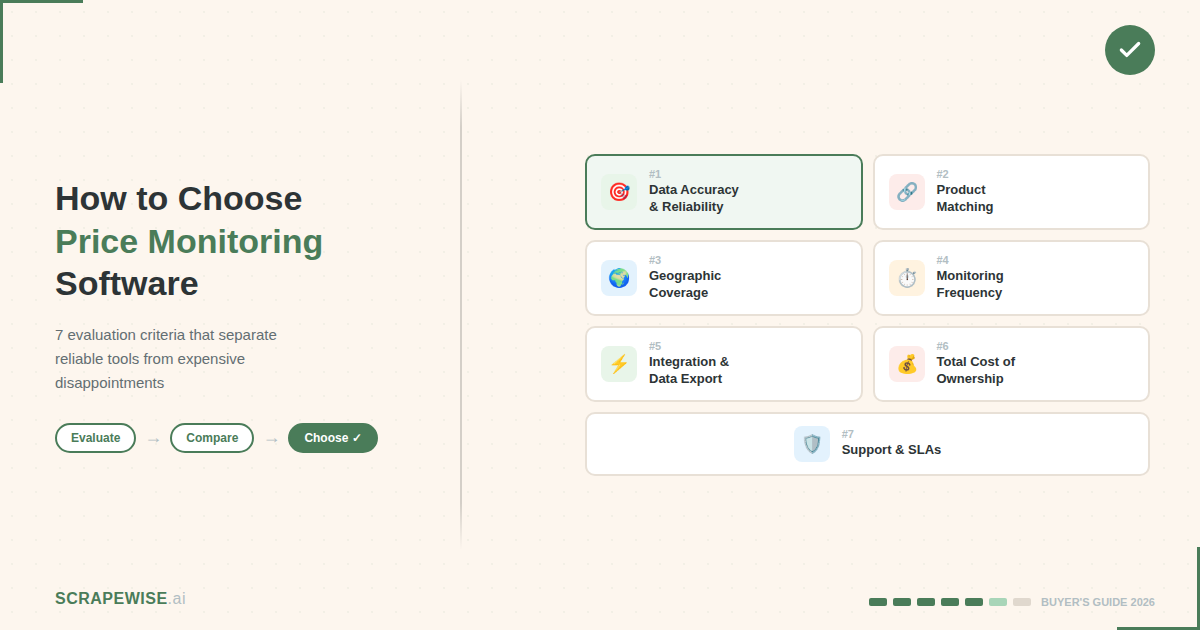
The Checklist in One Screen
Ten lines to take into every vendor call. Each one is explained further down.
- Name your buyer type first: marketplace seller, brand, mid-market retailer or multi-market operator.
- Test with your own competitor links, not the vendor's demo sites.
- Count how many of your price points come back filled and correct after two weeks.
- Put your hardest competitor sites into the trial, next to the easy ones.
- Check how products are matched: by EAN, by hand, or by title, attributes and pictures.
- Test the matching on your local-language product names.
- Ask whether the regional shops you compete with are covered, by name.
- Check how the data gets out: REST API, CSV or Excel export, and how often it is refreshed.
- Add up the full cost: setup, extra users, hard sites and your own maintenance hours.
- Do not buy more tool than your product count needs.
For a ranked list of products, see the price monitoring tools comparison. To see your own price next to one competitor before any trial, try the free competitor price checker.
Which Type of Price Monitoring Buyer Are You?
Before comparing features or reading vendor marketing, figure out which category you fall into. Each one leads to a fundamentally different type of tool.
The Marketplace Seller
Your situation: You sell on Amazon, eBay, or Bol.com. Prices change hourly. You need automated repricing to win the Buy Box, not just monitoring dashboards.
What you actually need: A repricing engine, not a monitoring tool. Platforms like Repricer are built specifically for this — they don't just show you competitor prices, they automatically adjust yours based on rules you set.
Warning sign you picked the wrong tool: You're manually updating prices after getting email alerts. That means your "monitoring tool" is creating work instead of eliminating it.
The Brand Protecting Its Pricing
Your situation: You're a manufacturer or D2C brand. Your retailers are supposed to sell at MAP (Minimum Advertised Price). Some of them don't. You need to catch violations across dozens of reseller websites.
What you actually need: MAP monitoring with violation alerting — the ability to track your own products across retailer sites and flag when someone undercuts the agreed price. This is a different workflow than competitive monitoring. For a deeper look, our guide on MAP monitoring and brand protection covers the enforcement side.
Warning sign you picked the wrong tool: You're spending hours manually matching your products to reseller listings because the tool can't find them automatically.
The Mid-Market Retailer Watching Competitors
Your situation: You sell 5,000–50,000 SKUs. You have 5–20 competitors you care about. You need daily price intelligence to inform your pricing strategy — not minute-by-minute repricing, but reliable data you can act on.
What you actually need: A price intelligence platform with strong product data matching and accurate scraping across non-marketplace websites. This is where most tools claim to be great but quietly fail, because your competitors' websites are harder to scrape than Amazon.
Warning sign you picked the wrong tool: More than 10% of your price points come back empty or obviously wrong.
The Multi-Market European Operator
Your situation: You sell across Germany, the Nordics, Benelux, or other European markets. The same product has different competitors and different prices on .de, .nl, .se, and .fi domains. You need cross-border price intelligence, not just single-market tracking.
What you actually need: A tool with genuine European coverage — not one that claims "global monitoring" but only scrapes Amazon and eBay. You need multi-currency normalization, local domain monitoring, and support that operates in CET business hours. Platforms like Minderest specialize in multi-country retail intelligence.
Warning sign you picked the wrong tool: Your pricing team maintains a separate spreadsheet for markets the tool doesn't cover.
The Five Questions That Separate Good Tools From Expensive Shelf-Ware
Once you know your buyer type, run every vendor through these five questions. They're ordered by importance — if a tool fails question one, the rest don't matter.
1. "How much of my data will actually come back clean?"
This is the question vendors least want to answer honestly. A price monitoring tool that collects data from 80% of your competitors means 20% of your pricing decisions are based on guesswork.
What to test during your trial:
- Load your actual competitor URLs — not the vendor's demo sites
- Check data completeness after two weeks (not two days)
- Specifically test competitors that use JavaScript-heavy storefronts (React, Vue, Angular). Many basic scrapers can't handle modern e-commerce sites at all
- Test competitors with anti-bot protection. If the tool returns empty data for Zalando, MediaMarkt, or other major European retailers, it will fail on the sites that matter most
According to Gartner research, poor data quality costs organizations an average of $15 million per year. In pricing, bad data doesn't just waste money — it actively causes bad decisions.
The benchmark: Demand 95%+ data completeness on your specific competitor list. Anything below that means the tool isn't actually monitoring your market.
2. "Will it correctly match my products to competitor listings?"
Product matching is where price monitoring tools quietly fall apart. The same product appears as "Nike Air Max 90 Essential" on one site and "AM90 ESS BLK/WHT" on another. Getting this wrong means you're comparing the wrong prices — which is worse than having no data at all.
Three approaches exist:
- EAN/GTIN matching — accurate when product codes are available, but many retailers don't expose them publicly
- Manual URL mapping — precise but impossible to scale beyond a few hundred SKUs
- AI-powered matching — uses product titles, descriptions, images, and attributes to identify the same product across different sites. This is where the industry is heading, and tools relying on exact-match logic alone will struggle with catalogs above 5,000 SKUs
For European retailers, matching gets harder. The same product has German, Dutch, Swedish, and Finnish descriptions. A tool that matches well in English may fail on localized catalogs. Test this specifically during your trial.
To see one way this works in practice, read how product matching links competitor rows to your own product list: a shared EAN or ID first, then text columns, then product pictures, with the unsure pairs left for your review.
3. "Does it cover the competitors I actually care about?"
This sounds obvious, but it's where the most money gets wasted. Many price monitoring tools excel at scraping marketplaces (Amazon, eBay, Bol.com) but struggle with individual retailer websites.
If your biggest competitive threat is a regional player — Elkjøp in the Nordics, Galaxus in Switzerland, XXL Sport in Scandinavia, Coolblue in the Netherlands — ask the vendor specifically whether they cover those domains. "Global coverage" in a marketing deck means nothing if it doesn't include the twenty websites your pricing team checks manually every week.
For retailers who need to monitor sites that aren't in any tool's pre-built list, flexible scraping platforms that can target any website offer an alternative to tools limited to pre-indexed retailers.
4. "Where does the data go after collection?"
Price data locked inside a vendor's dashboard is a bottleneck. Your pricing team needs data flowing into the systems they already use:
- ERP or PIM systems for automated pricing rules
- BI tools (Tableau, Looker, Power BI) for trend analysis and reporting
- E-commerce platforms for dynamic repricing based on competitive position
- Spreadsheets for ad-hoc analysis (this still matters — not every decision needs a dashboard)
Evaluate the vendor's API. Can you pull data programmatically? Does it support webhooks for real-time alerts? Can you export clean CSV/Excel files?
For teams building more sophisticated data pipelines, the ability to turn competitor websites into structured APIs is often more valuable than a pre-built dashboard. ScrapeWise.ai takes this approach — it runs on a schedule (daily at the fastest) or on demand and delivers structured data by REST API or CSV/Excel into your existing systems, where your own tools handle any alerting, rather than adding another dashboard to check.
5. "What's the actual total cost — not just the subscription?"
Vendor pricing models vary wildly, and the sticker price is rarely the full story.
Common pricing models:
| Model | How it works | Watch out for |
|---|---|---|
| Per SKU monitored | Pay per product tracked | Gets expensive fast at 10K+ SKUs |
| Per competitor | Pay per site monitored | Penalizes thoroughness |
| Tiered plans | Fixed monthly fee with limits | Overages charged at premium rates |
| Enterprise custom | "Contact sales" | Usually means €1,000+/month minimum |
Hidden costs most teams miss:
- Setup fees and onboarding charges
- Extra charges for API access or additional users
- Premium pricing for hard-to-scrape sites (anti-bot-protected, JavaScript-heavy)
- Engineering time maintaining self-service scrapers (10+ hours/week is common)
- Long-term contract lock-ins vs. month-to-month flexibility
For mid-market European retailers monitoring 5,000–50,000 SKUs across multiple markets, total costs typically range from €300 to €3,000 per month. Managed services often prove more cost-effective than SaaS dashboards when you factor in the engineering hours saved on scraper maintenance and product matching at scale.
The Build vs. Buy Decision
Before committing to any vendor, consider whether a commercial tool is the right answer at all.
Build in-house if you have a dedicated engineering team, need complete data pipeline control, and have very specific scraping requirements. Expect 3–6 months to production-ready, ongoing maintenance costs, and the constant challenge of keeping scrapers working as competitor sites change their code.
Buy a SaaS dashboard (Prisync, Price2Spy, Priceva, Competera) if you want a turnkey solution with visual reporting and standard pricing. The tradeoff: limited customization and data locked in the vendor's format.
Use a managed data service (ScrapeWise.ai) if you need the reliability of a dedicated platform without the engineering overhead. You get structured data delivered via API or export — without building or maintaining scraping infrastructure yourself.
Use a visual change detector (Visualping) if your monitoring needs are simple: fewer than 100 URLs, no product matching needed, and you just want alerts when a page changes.
The right answer depends on your team's technical capacity, your catalog complexity, and how central pricing intelligence is to your business strategy.
Five Mistakes That Cost Pricing Teams Months and Budget
Mistake 1: Choosing based on the dashboard, not data quality. Every vendor's demo looks great on screen. A beautiful dashboard showing wrong prices is worse than a spreadsheet showing right ones. Test accuracy first, always.
Mistake 2: Ignoring the product matching problem. If you sell across European markets with localized product names, automatic matching accuracy drops fast. Don't discover this after signing a 12-month contract.
Mistake 3: Underestimating maintenance. Self-service scraping tools look cheap until your team spends 10 hours a week fixing broken selectors and handling site changes. Factor engineering time into every cost comparison.
Mistake 4: Buying more tool than you need. A retailer tracking 500 SKUs against 5 competitors doesn't need an enterprise platform with AI repricing. Start with a solution that matches your current scale.
Mistake 5: Not testing with your hardest competitors. Every vendor demo uses clean, easy-to-scrape sites. Your real competitors have anti-bot protection, dynamic rendering, and inconsistent product structures. Test those first.
What European Retailers Should Watch in 2026
The European e-commerce landscape has specific dynamics that affect which price monitoring tool will work for you:
Cross-border pricing complexity is increasing. The EU's Digital Services Act and evolving VAT regulations mean pricing intelligence needs to account for regulatory costs — not just competitor prices. A price that's competitive in Germany might be margin-negative in Denmark once VAT and logistics are factored in.
Tariff volatility demands faster decisions. Three out of four e-commerce brands report concern about tariff impacts in 2026. Tools that integrate cost data alongside competitor prices — showing net margin impact, not just market position — are becoming essential.
Nordic and DACH markets require local coverage. The global tools cover Amazon. Fewer cover the regional players that actually drive competition in specific markets. If your competitors are local, your monitoring tool needs to be local too.
The pricing software market is projected to reach $21.55 billion by 2035, with Europe accounting for roughly 31% of usage. The tools are getting better — but only if you pick the right one for your situation.
Your Next Step
Don't start with a vendor shortlist. Start with three questions:
- What's my actual problem? Am I trying to reprice on marketplaces, catch MAP violations, track competitors, or build a pricing data pipeline?
- How many SKUs and competitors do I realistically need to monitor? Be specific — "a lot" isn't a number.
- What happens to the data after I collect it? If the answer is "I look at it in the vendor's dashboard," you might not need a sophisticated tool. If the answer is "it feeds into our pricing engine," you need strong API and export capabilities.
Once you've answered those, you'll know whether you need a repricing engine, a MAP monitor, a competitive intelligence platform, or a managed data service — and you'll save months of evaluating tools that were never built for your situation.
For a detailed comparison of specific platforms, our competitive price monitoring tools comparison ranks the leading tools by category and use case.
Paste a competitor URL and start tracking prices
Any e-commerce site, any SKU count. Clean structured feeds on your schedule, no code required.
Not ready to sign up? See 40 rows of real Google Shopping price data →
97% accuracy on Amazon benchmarks · no credit card · book a 15-min call →