

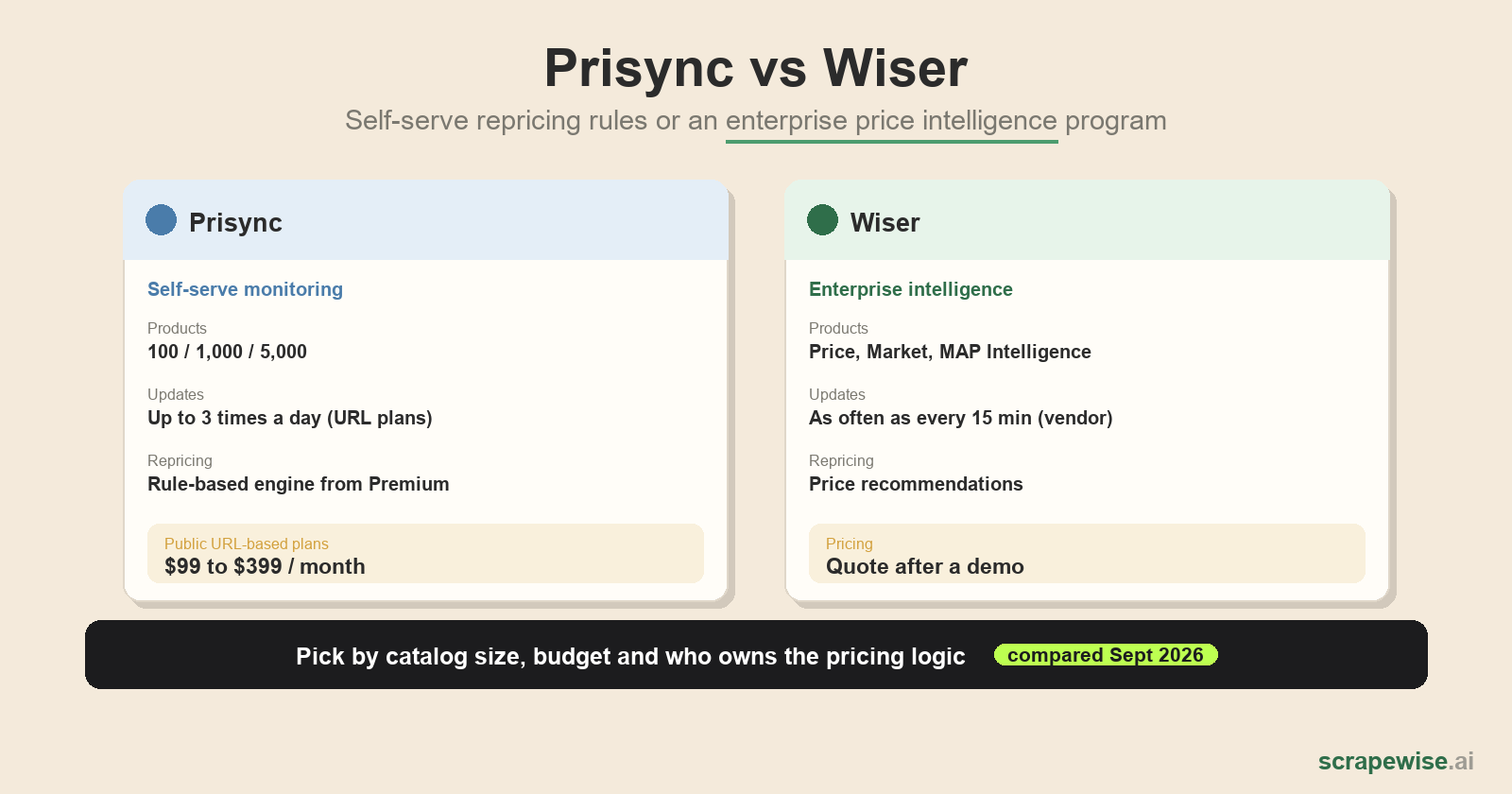
Prisync and Wiser both automate competitor price monitoring for ecommerce retailers, but they are sold to different teams. Prisync is self-service, with public plans from $99 to $399 a month for up to 5,000 products and a rule-based dynamic pricing engine from its Premium plan. Wiser (Wiser Solutions) is an enterprise suite with no public pricing, sold through a demo, that turns competitor data into price recommendations and MAP enforcement.
If you run a small or mid-sized webshop and want repricing rules this week, Prisync is the likely fit. If you are a large retailer or brand that needs price, shelf and reseller data across many channels, Wiser is built for that.
Which One Fits Your Situation?
Choose by catalog size, budget and how the pricing decision gets made. Prisync fits teams under 5,000 products that want to set their own repricing rules and pay a fixed monthly fee. Wiser fits enterprise retailers and brands that want a vendor-run data program, price recommendations and MAP enforcement, and can go through a sales process.
| Your situation | Better fit |
|---|---|
| Up to 5,000 products, want to start without talking to sales | Prisync |
| Need rule-based repricing on a fixed monthly budget | Prisync |
| Brand that needs to find and contact MAP-violating resellers | Wiser |
| Large catalog across many retailers, apps and marketplaces | Wiser |
| Need competitor prices refreshed many times a day | Wiser |
| Sources neither tool covers well, such as regional marketplaces or B2B catalogs | See the last section |
Quick Comparison
Prisync publishes its prices and limits, so its column is exact. Wiser publishes product descriptions but no prices, so its column describes what Wiser says its products do. All values were checked on prisync.com and wiser.com in September 2026.
| Feature | Prisync | Wiser |
|---|---|---|
| Type | Self-service price monitoring and dynamic pricing | Enterprise price, market and MAP intelligence |
| Pricing | URL-based plans $99, $199 and $399 per month | Not published, demo required |
| Product limits | 100, 1,000 or 5,000 products; larger catalogs by contact | Set per contract |
| Update frequency | Up to 3 times a day (URL-based), daily (channel-based) | Wiser says as often as every 15 minutes |
| Repricing | Dynamic pricing engine on Premium and Platinum | Price recommendations in Price Intelligence |
| MAP monitoring | Platinum plans only | Separate MAP Intelligence product with reseller enforcement |
| Product matching | You add competitor URLs per product | Wiser says matching is automatic |
| API | Extra 20% on the monthly fee | Live Prices API; data also by dashboard, CSV or plug-ins |
| Free trial | 14 days, no credit card | Demo |
Prisync: Transparent Plans and Rule-Based Repricing
Prisync is a good fit for retailers who want to see competitor prices and act on them without a long setup. You add your products and the competitor URLs for each one. Prices update up to three times a day on URL-based plans. From the Premium plan, the dynamic pricing engine can change your prices based on rules you set.
Prisync offers three pricing models, each with three plans for 100, 1,000 or 5,000 products:
| Prisync model | Professional (100 products) | Premium (1,000 products) | Platinum (5,000 products) | Updates |
|---|---|---|---|---|
| URL-based | $99/mo | $199/mo | $399/mo | Up to 3 times a day |
| Channel-based | $199/mo | $399/mo | $599/mo | Daily |
| Hybrid | $299/mo | $599/mo | $799/mo | Up to 3 times a day for URLs |
On channel-based and hybrid plans, each additional channel costs $100 a month on Professional or $200 a month on Premium and Platinum. The Professional plans don't include the dynamic pricing engine. MAP monitoring is only on Platinum, and API access adds 20% to the monthly fee. For more than 5,000 products, Prisync asks you to contact them, and no price is published for that.
Two limits apply. You maintain the list of competitor URLs yourself, and that list grows with every product and market you add. And three updates a day suits most categories, but it can lag behind competitors that change prices several times a day.
Wiser: Enterprise Price and MAP Intelligence
Wiser suits large retailers and brands that want a managed data program across many channels. It sells three products: Price Intelligence, Market Intelligence and MAP Intelligence. Wiser says it works with more than 750 brands and retailers, refreshes competitor prices as often as every 15 minutes and matches products automatically. Pricing is only available through a demo.
What each product covers, based on Wiser's own product pages:
- Price Intelligence tracks competitor prices, promotions and stockouts, and produces price recommendations. Data comes through dashboards, CSV files, an API or plug-ins.
- Market Intelligence covers digital shelf analytics.
- MAP Intelligence monitors resellers across websites, apps and marketplaces, flags unauthorized sellers and includes pre-built email templates for contacting violators.
The trade-off is buying style. You can't sign up and try Wiser on your own catalog in an afternoon. Scope, sources and price are agreed with the vendor. That suits a pricing team with an enterprise budget, and it slows down a small team that wants to test an idea first.
Dynamic Repricing: Prisync Rules vs Wiser Price Recommendations
Prisync automates repricing with rules. You set where your prices should stand against competitors, and from the Premium plan its dynamic pricing engine changes prices when market prices or stock change. Wiser's Price Intelligence works on recommendations. It turns fresh competitor data into suggested prices, and your team reviews them and rolls them out.
In practice the difference looks like this:
| Question | Prisync | Wiser |
|---|---|---|
| Who writes the pricing logic? | You, as rules | Wiser's product, as recommendations your team reviews |
| How fresh is the input? | Up to 3 updates a day | As often as every 15 minutes, according to Wiser |
| What does it need from you? | Competitor URLs per product and rule settings | Project scope agreed with Wiser |
| Where does it fit best? | Webshops with clear price rules per category | Retailers with a pricing team and many channels |
A rule engine is easy to understand and cheap to run, but it only knows what you tell it. Recommendations can take more signals into account, and they need people and process on your side to review them. Neither tool replaces the decision about when to match a competitor and when to hold. For that, see our guide on how to read a competitor's pricing strategy from price history.
What Reviews Say
Prisync has a clear public review record. On Capterra it scores 4.8 out of 5 from 129 reviews (September 2026), with 4.7 for ease of use, 4.9 for customer service, 4.5 for features and 4.7 for value for money. We couldn't verify a current Wiser Solutions score on Capterra or G2 in September 2026, so none is quoted here.
Prisync reviewers on Capterra most often praise the simple interface and fast support. The complaints that come up are setup time and occasional matching problems on some competitor websites.
For Wiser, read the reviews for Wiser Solutions on G2 yourself, and ask for customer references in your own category during the demo. Reviews from a brand policing resellers tell you little about how the product works for a retailer repricing electronics, and the other way around.
When Neither Fits: Custom Sources and Managed Data
Both tools work best on the sites they already handle. Neither is built for teams whose competitors sell on regional marketplaces, dealer sites or B2B catalogs, or for teams that want raw data in their own pricing model. In those cases, a scraping platform or a data API that delivers structured rows is often the simpler route.
ScrapeWise collects prices from any public website you point it at and bills per page delivered: €0.15 per 1,000 plain pages, €0.75 per 1,000 pages that need a browser and €1.50 per 1,000 pages that need residential proxies. You get 5 free requests to start and there is no monthly plan. Results come through the dashboard, a CSV export or the REST API. For common sources such as Amazon, Google Shopping and Walmart, there are also data APIs with a price per call. If you'd rather hand over the whole job, the managed service starts at €1,500 a month plus setup. See the pricing page for details.
ScrapeWise doesn't reprice your products. It supplies the competitor data that your own rules, your repricing tool or your pricing team work from.
How to Choose Between Prisync and Wiser
Start with three questions. How many products do you track? Do you want rules you control, or recommendations from a vendor-run program? Is MAP enforcement against resellers part of the job? Under 5,000 products with your own rules points to Prisync. Enterprise scale with reseller enforcement points to Wiser.
Before you sign, run the same test on both:
- Pick 50 products, including your hardest ones to match.
- Ask each vendor to show the competitor prices it finds for those products.
- Check a sample by hand on the competitor sites the same day.
- Price the setup you'd really need, including extra channels, API access and MAP monitoring.
For more options in this category, see our Prisync alternatives benchmark, the Wiser alternatives guide and our ranking of competitive price monitoring tools for 2026.
Paste a competitor URL — start tracking prices in 60 seconds
Any e-commerce site, any SKU count. Clean structured feeds on your schedule, no code required.
97% accuracy on Amazon benchmarks · no credit card · book a 15-min call →