

Short answer: Wiser has the more comprehensive feature set on paper — three products, faster refresh, automatic matching, MAP enforcement with reseller outreach. Price2Spy gives you more control over the thing that determines whether the data is correct, and you can verify it yourself in an afternoon instead of scheduling a demo. If you are a brand policing resellers across many channels, Wiser. If you are a retailer who needs to be able to audit why a competitor price is attached to your SKU, Price2Spy.
The reason "more comprehensive" is the wrong question is the subject of this post. Feature count is not what separates these two. Where matching lives, and who can inspect it, is.
Choose Before You Read
| Your situation | Better fit |
|---|---|
| Brand enforcing MAP against unauthorised resellers | Wiser |
| Need prices refreshed more often than a few times a day | Wiser |
| European specialty retail, DACH / Benelux / Nordics | Price2Spy |
| Need to audit why a competitor listing matched your SKU | Price2Spy |
| Want to test on your own catalogue before talking to sales | Price2Spy |
| Large catalogue across marketplaces, apps and retail channels | Wiser |
| Regional marketplaces, dealer sites or B2B catalogs neither covers | Neither — see below |
Two Products, Two Buyers
Price2Spy is a monitoring tool sold to retailers. Its architectural differentiator is that it renders pages in a headless browser rather than querying feeds or firing lightweight HTTP requests, which is why it copes with JavaScript-heavy storefronts that lighter scrapers miss. Plans are self-serve, and its Starter tier caps each product at 10 tracked competitors — the single most common trigger for teams outgrowing it. Refresh runs at 24 hours on Starter and 6 hours on Pro, with higher tiers going to several checks a day. All checked on price2spy.com/pricing.html in September 2026.
Wiser (Wiser Solutions) is an enterprise suite sold through a demo, with no published pricing. It runs three products: Price Intelligence (competitor prices, promotions, stockouts, and price recommendations), Market Intelligence (digital shelf analytics), and MAP Intelligence (reseller monitoring across websites, apps and marketplaces, with pre-built templates for contacting violators). Wiser says it works with more than 750 brands and retailers, refreshes as often as every 15 minutes, and matches products automatically. All checked on wiser.com in September 2026.
Line those up and Wiser is obviously broader. Which is exactly why the comparison needs a different axis.
Does Price2Spy or Wiser Deliver the More Comprehensive Feature Set?
Wiser does, and it is not close. Three products against one. Digital shelf analytics that Price2Spy does not attempt. Reseller enforcement workflow with outreach templates built in. Refresh measured in minutes rather than hours. Automatic matching instead of a URL list you maintain.
Here is why that answer should not decide your purchase.
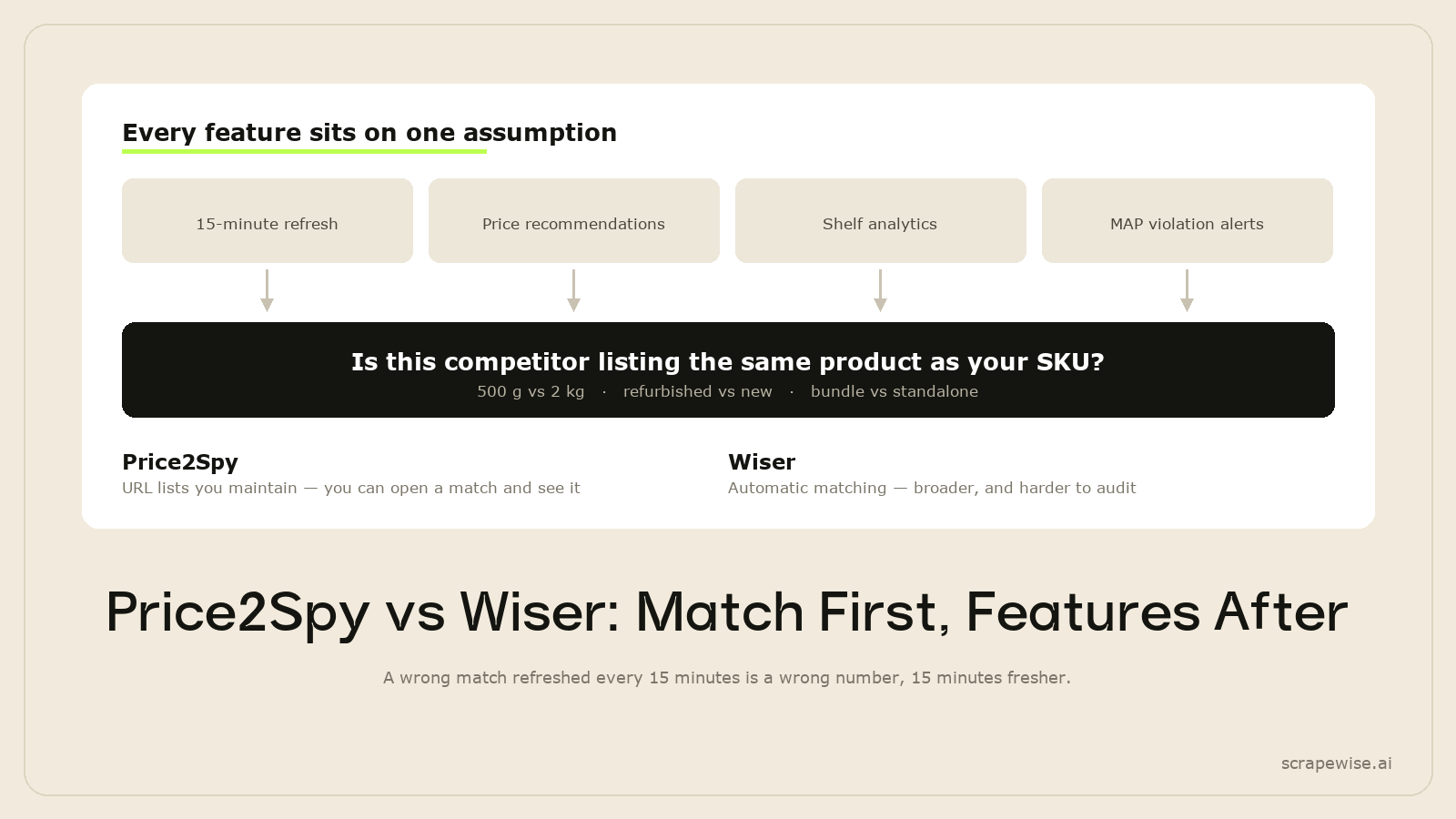
Every feature on that list is downstream of one question: is the competitor listing attached to your SKU actually the same product?
If it is not — if a 500 g pack got matched to your 2 kg SKU, or a refurbished unit to your new one, or a bundle to a standalone — then a 15-minute refresh delivers a wrong number fifteen minutes fresher. Digital shelf analytics analyses a shelf that is not yours. The MAP violation alert fires on a seller who is not selling your product. Every feature inherits the correctness of the match beneath it, and none of them repairs it.
So the real comparison is not feature count. It is which failure mode you can live with:
| Price2Spy | Wiser | |
|---|---|---|
| Matching approach | URL lists you maintain, or Automatch as a paid add-on module | Automatic, per Wiser's product pages |
| Who can audit a match? | You — the URL is right there | Wiser's process |
| Failure mode | Stale prices. 24h or 6h refresh lags fast-moving categories | Unverifiable matches. Wrong pairs are hard to spot and harder to trace |
| How you notice | A price you know changed yesterday is still showing yesterday's value | You mostly don't — a wrong match looks exactly like a right one |
| Cost of the failure | Bounded and visible | Unbounded and quiet |
A stale price announces itself. Somebody in the pricing meeting says "that's not what they're charging" and you go and look. A wrong match does not announce itself at all. It produces a confident, precise, incorrect number that people make decisions on for months.
That is the actual trade, and it is invisible in any feature table.
Refresh Frequency: How Much Do You Really Need?
Wiser's every-15-minutes figure is a genuine capability and it is oversold as a buying criterion. Before paying for it, check whether your competitors reprice that often.
Most do not. Outside marketplace-driven categories — consumer electronics on Amazon, some fashion during sale periods, anything with algorithmic sellers — retail prices move on a daily or weekly rhythm tied to promotional calendars, not an intraday one. Pull two weeks of price history on your twenty most important SKUs and count distinct changes. If the answer is "twice", a 15-minute refresh is buying you 96 identical readings a day.
Where it genuinely matters:
- Marketplaces with algorithmic repricers. Prices move continuously; a daily snapshot is close to noise.
- Flash sales and time-boxed promotions. A six-hour refresh can miss a four-hour promotion entirely.
- Your own automated repricing. If a rule engine acts on the data without a human in between, input latency becomes your reaction time.
Where it does not:
- Considered purchases with stable pricing — furniture, industrial supply, most B2B catalogues.
- Weekly pricing reviews. If the decision is made on Monday, Sunday night's data is as good as Monday morning's.
Price2Spy's 24-hour Starter refresh is a real constraint in the first group and close to irrelevant in the second. Be honest about which group you are in before paying the difference. Our write-up on reading a competitor's pricing strategy from price history covers how to make that call from your own data.
Coverage: Where Each One Is Actually Stronger
This is the most practical difference and the least discussed.
Wiser is stronger on US marketplaces. Its centre of gravity is American retail and marketplace channels, which follows from its MAP enforcement focus — that product is shaped by a US brand-protection market.
Price2Spy is stronger on European specialty retail. Its browser-rendering approach copes with smaller DACH, Benelux and Eastern European storefronts that run bespoke platforms rather than Shopify or Magento, which is exactly where feed-based and API-first tools return empty.
We measured Price2Spy at 83% coverage on a 500-SKU Amazon and Shopify benchmark, against 97% for ScrapeWise on the same list. On a 10,000-SKU catalogue, that 14-point gap is 1,400 products carrying no price data — enough to miss a competitor's flash sale or a systematic repricing move across a whole category. Full methodology in our Price2Spy alternatives benchmark.
The important part is that coverage is per target list, not a global property of the vendor. A tool at 83% on one catalogue may be at 95% or 60% on yours, depending entirely on which retailers you track. Do not buy either vendor's coverage claim. Test it against your own worst sites.
And note the thing neither number tells you: a 17% gap does not mean 17% of your dashboard is visibly empty. Much of it shows up as a stale value that looks exactly like a current one. Ask both vendors, explicitly, how a failed fetch is reported — blank, last-known value, or flagged. The answer matters more than the headline percentage.
Buying Process Is a Feature
Price2Spy is self-serve. Wiser is demo-gated with no published pricing.
That difference is usually filed under "procurement preference" and it has a direct effect on data quality, because it determines how fast you can falsify the vendor's claims.
With a self-serve tool you load 50 of your hardest SKUs, wait a day, and check the results by hand against the live competitor sites. You now know the real coverage and the real match accuracy on your catalogue, for free, before anyone signs anything.
With a demo-gated product you get a curated walkthrough on the vendor's data, and your own verification happens after a contract exists. That is not a criticism of Wiser specifically — it is how enterprise software is sold, and the support and scoping you get in exchange are real. But be clear that you are agreeing to a longer feedback loop, and push for a pilot on your own SKUs before signing rather than after.
The 50-SKU test that actually decides it
Run this identically against both. It takes an afternoon of setup and a day of waiting.
- Pick 50 SKUs, weighted toward the hard ones. Multipacks, size and colour variants, bundles, anything with a refurbished or marketplace-seller version. Do not pick 50 easy products — easy products make every vendor look identical, which is why sales demos use them.
- Ask each vendor to show the competitor listings it attaches to each SKU. Not the prices. The listings.
- Check every one by hand, same day, on the live competitor sites. Count three things: correct match, wrong match, no match found.
- Price the setup you would actually need — extra channels, API access, MAP monitoring, the matching service if it is billed separately. Compare configured totals, never headline plan prices.
Step 3 is the one people skip, and it is the only one that measures the thing this whole category is built on. A vendor that cannot show you its matched listings for inspection has told you something important about which failure mode you are buying.
When Neither Covers Your Sources
Both tools work best on the sites they already handle. If your competitors sell on regional marketplaces, dealer networks or B2B catalogues, or you want raw rows inside your own pricing model rather than a dashboard to read, neither is built for that.
ScrapeWise collects prices from any public website you point it at and delivers structured rows — through the portal data grid, a CSV export or the REST API. Billing is per page delivered: €0.15 per 1,000 plain pages, €0.75 per 1,000 pages that need a browser, €1.50 per 1,000 that need residential proxies. No monthly plan, a balance you top up from €5 that never expires, and 5 free requests to run the 50-SKU test above against us on the same terms. For common sources there are also ready-made data APIs priced per call.
Two honest limits. ScrapeWise does not reprice your products — it supplies the competitor data your rules, your repricing tool or your pricing team work from. And it does not ship MAP enforcement workflow with outreach templates; if reseller policing with built-in escalation is the job, Wiser is built for it and we are not.
For a direct two-way comparison, see ScrapeWise vs Price2Spy.
So Which Should You Pick?
- Wiser — you are a brand enforcing MAP across resellers, you need sub-hourly refresh for a genuine reason, and enterprise scoping and support are worth a demo cycle. The feature set is the broadest in this comparison and that breadth is real.
- Price2Spy — you are a retailer in European specialty markets who needs to be able to open a match and see the URL behind it. Browser rendering handles storefronts lighter tools miss, and self-serve means you verify before you commit.
- Either, decided by the 50-SKU test — for most buyers, match accuracy on their own hardest products separates these two more than any feature table will.
- Neither — your sources are regional marketplaces, dealer sites or B2B catalogues, or you want the raw matched rows in your own model rather than a dashboard.
For the wider field, see the Wiser alternatives guide, Prisync vs Wiser and our ranking of competitive price monitoring tools for 2026.
Paste a competitor URL — start tracking prices in 60 seconds
Any e-commerce site, any SKU count. Clean structured feeds on your schedule, no code required.
97% accuracy on Amazon benchmarks · no credit card · book a 15-min call →