

Your manager asks for a budget for competitor price monitoring. You open five vendor websites. Some show prices, some just say "contact sales". One charges per product, another per URL, a third per "channel". You can't line the numbers up.
In Estonia, many category managers still have an assistant who collects competitor prices by hand into a spreadsheet. That's usually the cost these tools replace, so it's the baseline to compare against. This guide explains what price monitoring software costs in 2026, how the four pricing models work, and what the same job costs under each one. All list prices come from the vendors' own pricing pages, checked on 9 November 2026.
How much does price monitoring software cost?
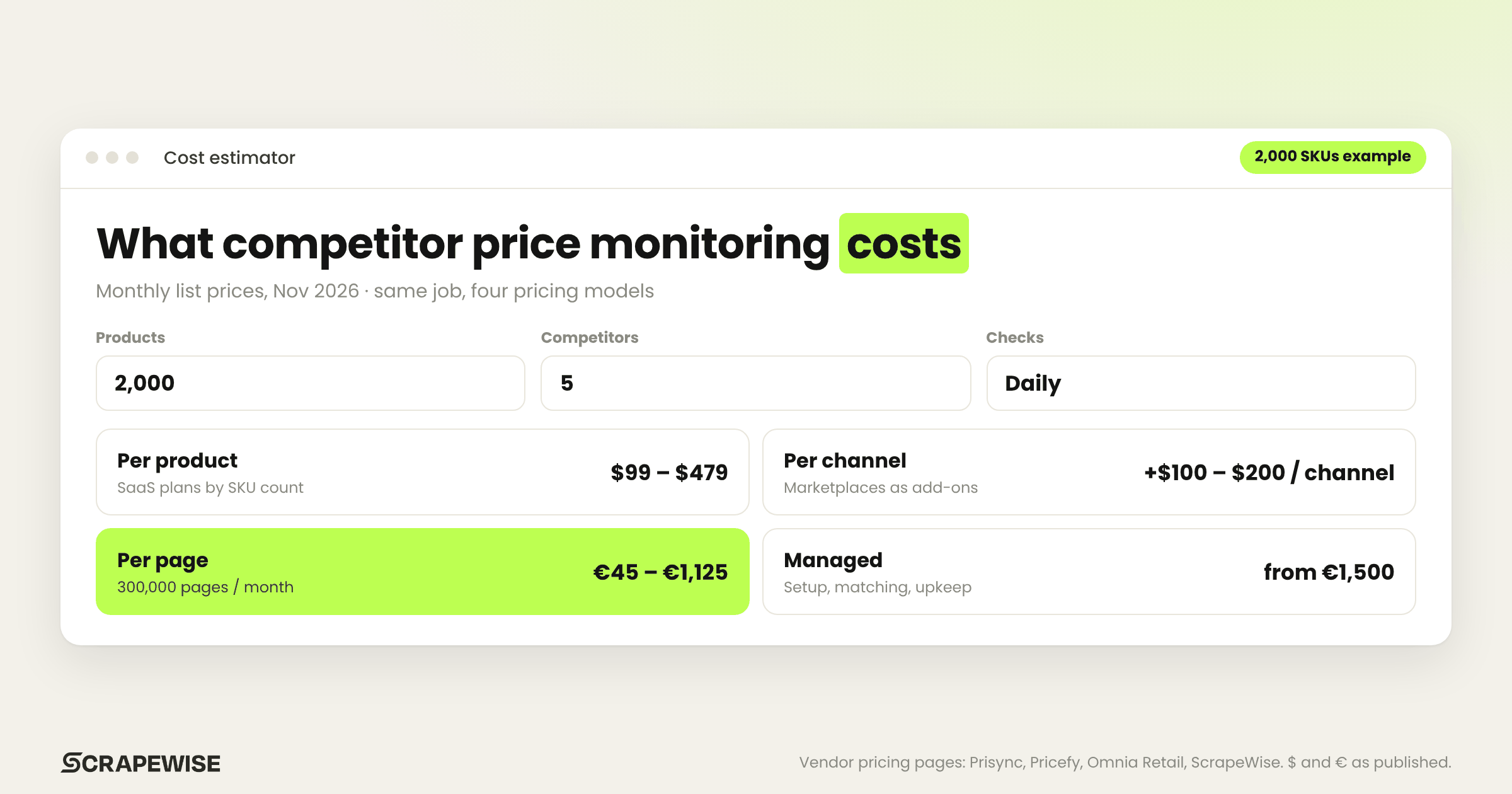
For 2,000 products checked daily against 5 competitors, published list prices in November 2026 run from about €45 a month on per-page pricing (simple sites) to $99–$479 on per-product tools such as Pricefy and Prisync, and from €1,500 for a managed service. Product count, competitor sites, check frequency and who does the matching move the price most.
How is price monitoring software priced?
Vendors charge in one of four ways: per product, per channel, per page collected, or a quote based on scope.
1. Per product (SKU tiers)
Most self-service tools we looked at work this way. You pay for how many of your own products you track. Paid plans usually allow unlimited competitors, though Price2Spy's Starter caps it at 10 and Pricefy's free plan at 5.
- Prisync lists URL-based plans at $99 a month for up to 100 products, $199 for up to 1,000 and $399 for up to 5,000. API access on the bigger plans costs an extra 20%, and above 5,000 products you have to ask for a quote.
- Pricefy has a free plan for 50 SKUs, then $49 for 100, $99 for 2,000, $189 for 15,000 and $499 for 25,000. Annual billing saves 25%.
Watch the tier edges. Going from 1,000 to 1,001 products on Prisync takes you from $199 to $399 a month.
2. Per channel
Some tools price marketplaces and comparison sites separately. Prisync's channel-based plans start at $199 a month for 100 products with one channel included, and each extra channel costs $100 to $200 a month. Track Amazon.de, Zalando and idealo on the channel-based Platinum plan and you pay $599 for the first channel plus $200 each for the other two: $999 a month.
3. Per page (usage-based)
Here you pay for the pages actually collected, not the number of products. The cost is products × competitors × checks per month. ScrapeWise, the company behind this blog, works this way. Its price list runs from €0.15 per 1,000 plain pages to €3.75 per 1,000 for the hardest sites, failed pages aren't charged, and the balance doesn't expire.
This model is cheapest when pages are simple and a daily check is enough. It costs more when competitor sites need a browser to load or block scrapers. ScrapeWise's scheduled runs go once a day at most, so if you need prices several times a day, a tool like Prisync (up to 3 checks a day) or Price2Spy Premium (up to 8) fits better.
4. Quote-based and managed
Enterprise tools and managed services price by scope.
- Omnia Retail starts at €399 a month for a single shop with up to 5 users. Its FAQ says the total depends on assortment size, number of markets and business size.
- Price2Spy has three plans. Starter allows up to 10 competitors, Basic adds MAP monitoring, and Premium adds API access, 3 user seats and up to 8 price checks a day. Its pricing page doesn't show prices; Premium is priced on request.
- Minderest has no pricing page. Its Capterra listing shows a starting price of €500, without saying per month or per year, and says to contact Minderest for details.
A managed service adds people to the software: the vendor sets up the competitor sites, does the product matching and fixes things when sites change. ScrapeWise's managed data service starts at €1,500 a month plus setup. Other vendors with a managed or premium tier, such as Price2Spy Premium and Omnia Enterprise, quote it on request.
What does it cost to monitor 2,000 products? A worked example
Here is the same job priced under each model: 2,000 products, 5 competitors, checked daily, using list prices only.
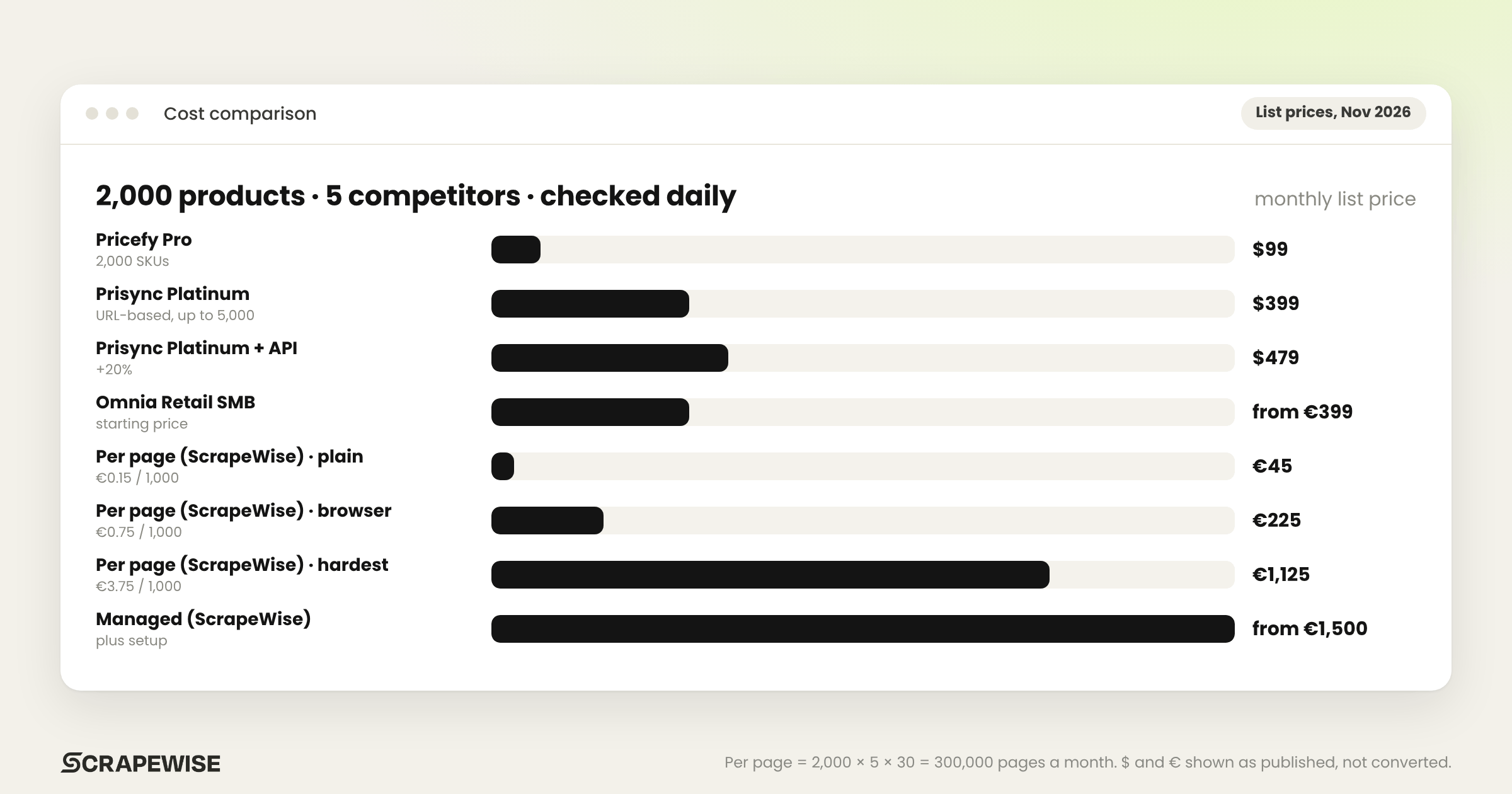
| Option | Pricing model | Monthly list price | Product limit | Price checks |
|---|---|---|---|---|
| Pricefy Pro | Per product | $99 ($74 billed yearly) | 2,000 | Daily |
| Prisync Platinum (URL-based) | Per product | $399, or $479 with API | 5,000 | Up to 3 a day |
| Prisync Platinum (channel-based) | Per channel | $599 incl. 1 channel, +$200 per extra | 5,000 | Daily |
| Omnia Retail SMB | Quote-based | From €399 | Depends on assortment | Not stated |
| ScrapeWise self-serve | Per page | €45 plain / €225 browser / €1,125 hardest | None, pay per page | Once a day at most |
| ScrapeWise Managed | Managed | From €1,500 + setup | Agreed scope | Once a day at most |
Prices checked 9 November 2026 on each vendor's pricing page. Dollar and euro prices shown as published, not converted.
- Per product: Pricefy Pro fits exactly at $99. Prisync needs the Platinum plan at $399, or $479 with API access.
- Per channel: Prisync's channel-based Platinum is $599 with one channel. Add two marketplaces and it's $999.
- Quote-based: Omnia's starting price is €399, and the real quote depends on your assortment and markets.
- Per page: 2,000 products × 5 competitors × 30 days = 300,000 pages a month. That's €45 if the pages are simple, €225 if they need a browser to load, and €1,125 if every site is heavily protected. Most catalogues are a mix. The €45 example on our pricing page is one competitor; this example has five.
- Managed: from €1,500 a month plus setup, with matching and maintenance included.
None of these numbers include product matching or the time someone spends fixing broken trackers. That's next.
What costs aren't in the list price?
Four costs rarely show up in the plan price: product matching, your team's time, extra checks per day, and add-ons like API access, extra channels and seats. On Prisync alone, API adds 20% and each extra channel costs $100–$200 a month.
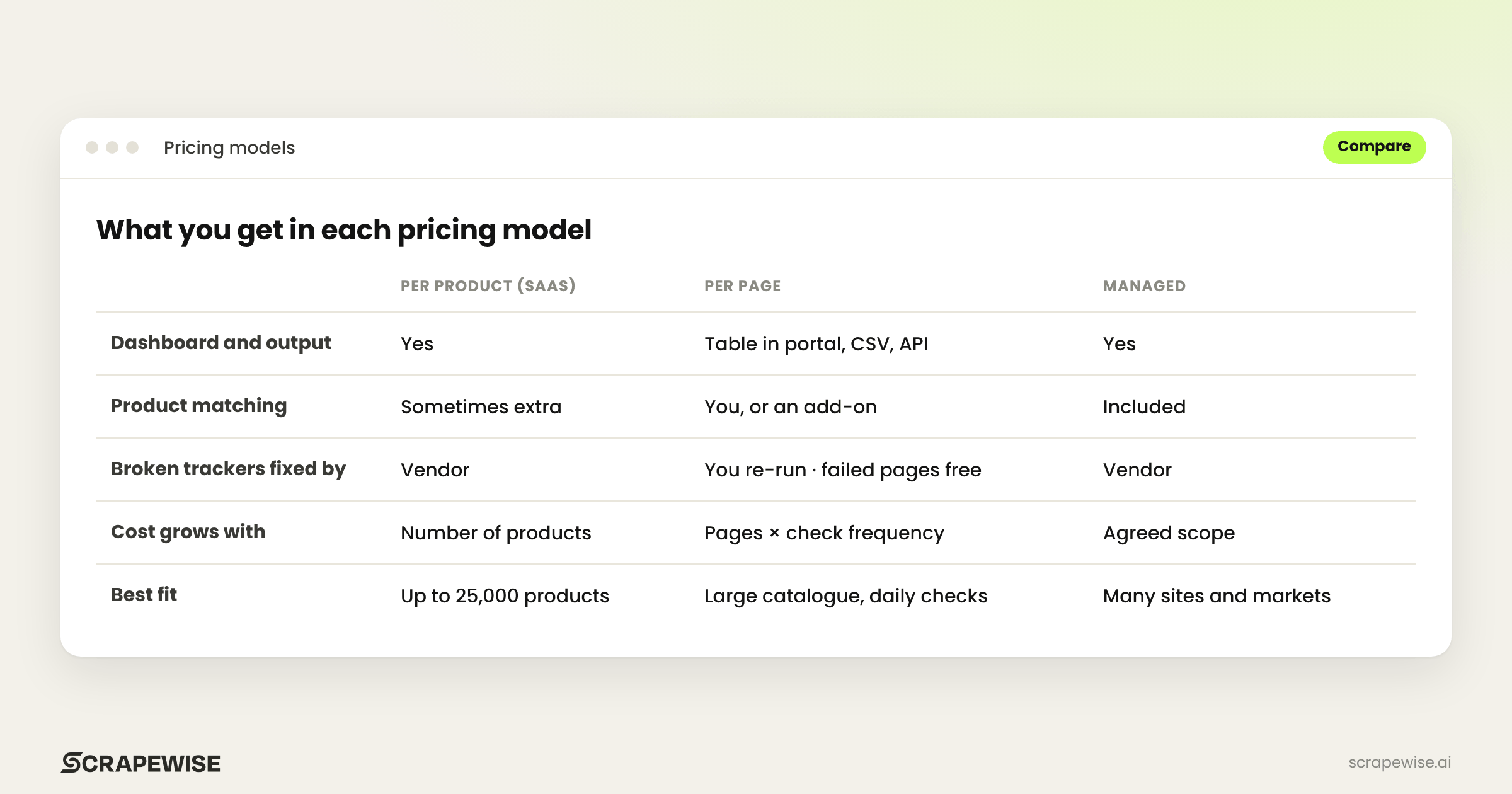
Product matching. This is the cost that's easiest to miss. Someone has to tell the tool that "Bosch GSR 18V-55 Professional" on one site is the same drill as "GSR 18V-55 2x2Ah" on another. Prisync offers competitor matching as a service you order separately. On usage-based tools you either do it yourself or pay for a matching layer. If you skip it, you compare the wrong products. Our guide to product matching in e-commerce covers why it fails and how to check it.
Your team's time. A cheap tool that needs a person to fix URLs every week isn't cheap. We did the full 12-month maths in in-house vs managed price monitoring. If you're still collecting prices by hand, here's what that costs.
Check frequency. Prisync's URL-based plans check up to three times a day (channel plans once), and Price2Spy's top plan up to eight. On per-page pricing, each extra check per day adds the same cost again. In our experience, daily is enough for most categories outside electronics and marketplaces.
Extras and seats. API access, extra channels, extra users, custom reports and annual contracts all sit on top of the headline price. Omnia's SMB plan includes 5 users and Price2Spy Premium includes 3. Ask every vendor for the full price list for your setup, not just the plan price.
MAP monitoring. For brands watching resellers, MAP monitoring is often a higher tier. On Prisync it's Platinum only ($399), on Pricefy it starts with Business ($189), and on Price2Spy it starts with Basic. Count it in if you need it.
How do you estimate your own price monitoring cost?
- Count products and competitors per category. Not every product needs every competitor.
- Decide the check frequency. Daily for most products, more often only where prices really move.
- Ask who does the matching. Ask every vendor whether it's included, extra, or your job.
- Ask about failures. What happens when a competitor site blocks the tool or changes its layout, and do you pay for pages that failed?
- Price the whole year, including setup, extras and the hours your team will spend.
Test before you buy. Prisync has a 14-day free trial, Pricefy a free plan for 50 SKUs, and ScrapeWise gives 5 free requests with no card, so you can run them on your own competitor URLs. Our competitor price tracking page shows how that works.
Which pricing model should you choose?
- Small catalogue on standard shop platforms, or you need prices several times a day: a per-product SaaS tool is simple and predictable.
- Large catalogue, a daily check is enough, and a team that can use raw data: per-page pricing is usually cheapest.
- Many markets, marketplaces, hard-to-read sites, or no one to look after it: a managed service costs more per month but less in staff time.
Whichever you choose, ask for a test on your own products before signing anything longer than a month.
Paste a competitor URL and start tracking prices
The shops you name, as a structured table once a day at most. No code, pay per page, the first 5 requests are free.
Not ready to sign up? See 40 rows of real Google Shopping price data →
5 free requests no credit card · pay per page, no monthly plan · book a 15-min call →