

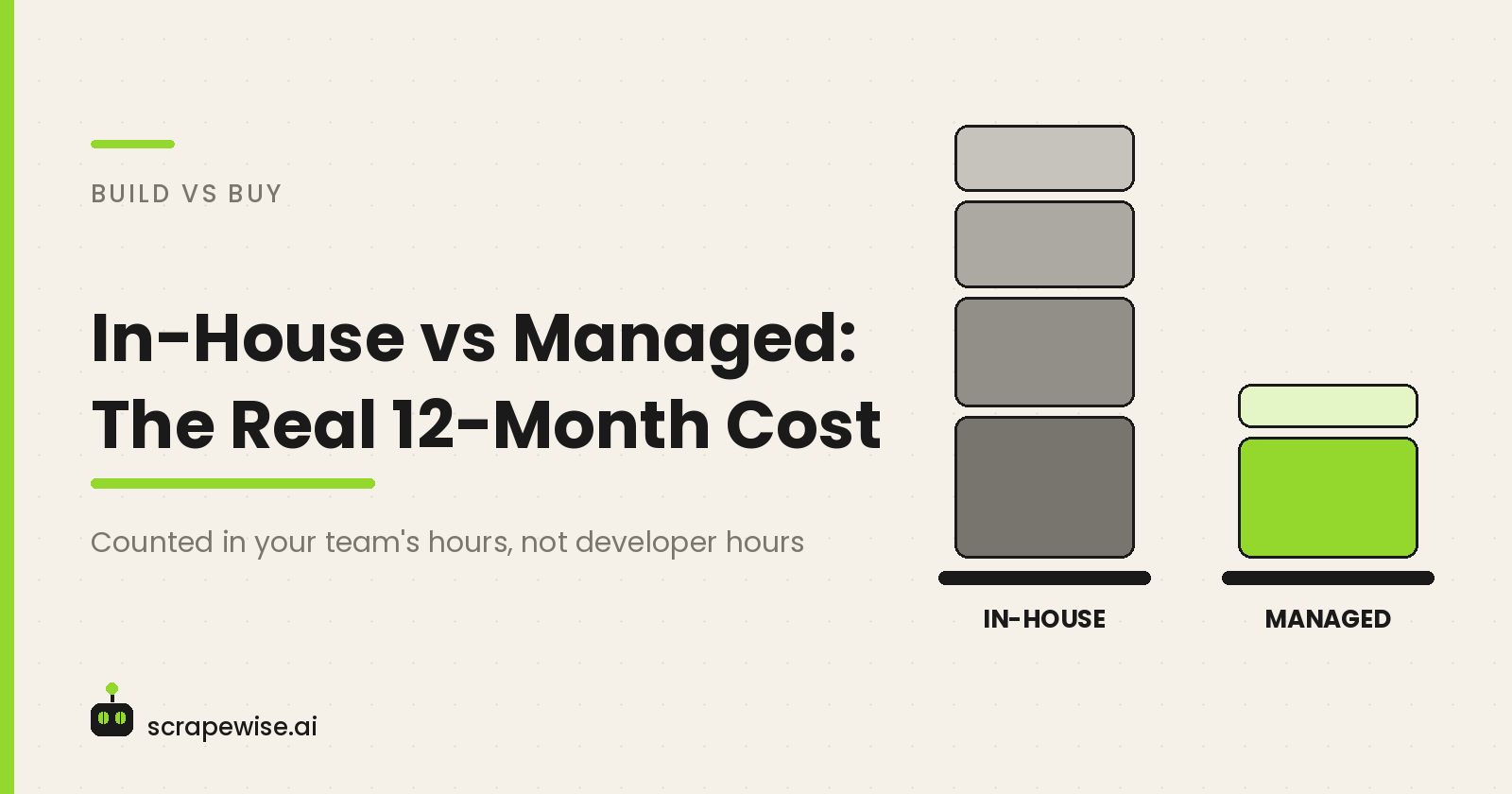
"Just build it in-house" sounds cheap until someone puts a number on it. So does "just hire an assistant to check it" and "just pay for a tool." Every option in competitor price monitoring looks affordable in isolation, because most cost comparisons only count the line item that's easy to see — the SaaS invoice or the contractor's day rate — and ignore the hours that quietly pile up around it.
This is a three-column, 12-month comparison of the three real paths retailers take: manual checking, an in-house build, and a managed feed. The costs are stated as assumptions you should adjust to your own numbers, not as universal truths — but the structure of where the cost hides is the same for every team we've seen run this comparison honestly.
The Assumptions, Stated Up Front
To keep this arithmetic honest, here's what's fixed across all three columns. Change any of these and the totals move — that's the point; the model is meant to be redone with your own numbers.
- Catalog: 2,000 SKUs tracked against 5 competitors, checked daily.
- Loaded cost of an in-house employee (salary + payroll tax + benefits): €60,000/year for a junior/mid analyst or engineer, €85,000/year for a senior data engineer. Adjust for your market — these are illustrative, not a market survey.
- Time horizon: 12 months, first-year cost including setup.
- What "done" means: daily price data per SKU, matched to your catalog, with less than 5% missing/stale rows on any given day.
Column 1 — Manual Checking
The visible cost: one merchandising assistant, roughly 30% of their time, at the junior loaded rate. 0.3 × €60,000 = €18,000/year in headcount.
The hidden cost: manual checking doesn't scale linearly with catalog size — it scales worse, because coverage degrades under time pressure long before the assistant's hours run out. At 2,000 SKUs × 5 competitors = 10,000 checks, even a fast 90 seconds per check is 250 working hours — over six working weeks of nothing but price-checking, which never happens in practice. What actually happens is what we documented in the real cost of manual price collection: coverage shrinks to whatever fits around other work, data goes stale between checks, and errors go uncaught because nothing flags them.
Column 1 total: ~€18,000/year in visible headcount cost, for a dataset that in practice covers a fraction of the catalog at unreliable freshness. The real cost isn't the salary line — it's the decisions made on the 70% of the catalog nobody had time to check.
Column 2 — In-House Build
The visible cost: most teams underestimate this to one engineer for a month. The realistic build for 2,000 SKUs across 5 competitor sites, including anti-bot handling and product matching, is closer to a senior engineer for 3 months of initial build (0.25 × €85,000 = €21,250), plus ongoing maintenance.
The maintenance line is the one that gets skipped in every in-house estimate we've seen. Competitor sites redesign, add anti-bot measures, or change their HTML structure — that's not a hypothetical risk, it's a certainty on any 12-month timeline, and every scraper break means checks silently fail until someone notices the data going stale. Budgeting even a conservative 20% of a mid-level engineer's time for ongoing fixes across 5 sites is 0.2 × €70,000 (blended junior/senior rate) = €14,000/year.
Column 2 total: ~€35,250 in year one (€21,250 build + €14,000 maintenance), and ~€14,000–20,000/year every year after — plus the opportunity cost of a senior engineer's time not spent on your product. This is the build vs. buy tradeoff most teams actually face: the build cost is one-time-ish, but the maintenance cost never goes away, and it's paid in your best engineering hours, not the cheapest ones.
Column 3 — Managed Feed
The visible cost: 2,000 SKUs × 5 competitors checked daily is 10,000 page fetches a day, or roughly 300,000 a month. A managed feed on pay-as-you-go pricing is billed per delivered page — €0.15 per 1,000 for a plain page, €0.75 with rendering, €1.50 through a residential proxy, €3.75 for both. That volume costs €45/month if the pages come back plain, €225–450/month for the render-or-proxy mix most retail sites need, and €1,125/month in the worst case where every page needs rendering and a residential proxy — call it €2,700–13,500/year as a planning range.
What's not hidden, because there's nothing to hide: no engineer hours, no maintenance line, no assistant reallocating 30% of their week. The provider absorbs site-redesign breakage as part of the service, because that's the job. The internal cost is closer to a few hours a month reviewing the data and acting on it — not collecting it.
Column 3 total: ~€2,700–13,500/year, fully loaded, no hidden maintenance tail. Cheaper than the manual column's visible number, and far cheaper than the in-house column's real number once maintenance is counted honestly — and the coverage and freshness are actually what was promised, not degraded under deadline pressure.
Side by Side
| Manual checking | In-house build | Managed feed | |
|---|---|---|---|
| Year 1 visible cost | €18,000 | €21,250 build | €2,700–13,500 |
| Year 1 hidden cost | Shrinking coverage, stale data, uncaught errors | €14,000 maintenance | Near-zero |
| Year 1 real total | €18,000 + unmeasured decision cost | ~€35,250 | €2,700–13,500 |
| Ongoing annual cost | €18,000, same limitations | €14,000–20,000 + engineer opportunity cost | €2,700–13,500, usage-based |
| Who owns breakage | Nobody notices until it's wrong | Your engineering team, every time | Provider, by design |
| Full-catalog coverage realistic? | Rarely — degrades under time pressure | Yes, if maintained | Yes |
Where Each Column Actually Wins
Manual checking wins on paper cost alone at very small scale — under a few hundred SKUs and one or two competitors, where the true hourly commitment is genuinely light and the coverage gap doesn't hide much. Past that, the visible cost stops reflecting reality.
In-house builds make sense when price data is a genuine strategic differentiator you need deep control over, or when the engineering team already has slack capacity and the skill set. They rarely make sense as a cost-saving move — the maintenance tax means an in-house build is usually a control decision, not a cheaper one. Our in-depth build-vs-buy breakdown covers the technical side of this tradeoff.
Managed feeds win when the honest 12-month number matters more than the headline monthly invoice — which, once maintenance and opportunity cost are counted, is most mid-market retailers above a few hundred SKUs.
How ScrapeWise Fits
ScrapeWise is the managed-feed column: a scheduled data feed matched to your catalog, with site-breakage, anti-bot handling, and product matching absorbed into the service rather than landing on your team's calendar. Pricing is pay-as-you-go — you top up a balance in euros and are charged per page delivered, with no plan, no monthly quota and no project or task limits. A page that doesn't come back is never charged, and the same URL is never charged twice in one run. The number in Column 3 above is therefore a planning range rather than a quote: what you actually spend depends on refresh frequency and how many of your competitor pages need rendering or a residential proxy.
Honest limitations: ScrapeWise doesn't disappear the internal cost entirely — someone still needs to review the data and act on it, and repricing logic or deeper analysis sits outside the feed itself. For teams with genuine engineering capacity to spare and a strategic reason to own the stack, in-house remains a legitimate choice — just not usually a cheaper one once maintenance is counted honestly.
Conclusion
The manual column's €18,000 and the in-house column's €21,250 build cost both look like the unavoidable cost of doing business until the hidden lines get added back in — degraded coverage on one side, a permanent maintenance tax on the other. Measured against a per-page bill that starts at €45/month for this catalog, neither is the cheap option. Redo this model with your own headcount rates and catalog size before deciding; the structure of where the cost hides won't change, even if the numbers do.
Want the real 12-month number for your own catalog and competitor set? See pay-as-you-go pricing →
Paste a competitor URL and start tracking prices
Any e-commerce site, any SKU count. Clean structured feeds on your schedule, no code required.
Not ready to sign up? See 40 rows of real Google Shopping price data →
97% accuracy on Amazon benchmarks · no credit card · book a 15-min call →