

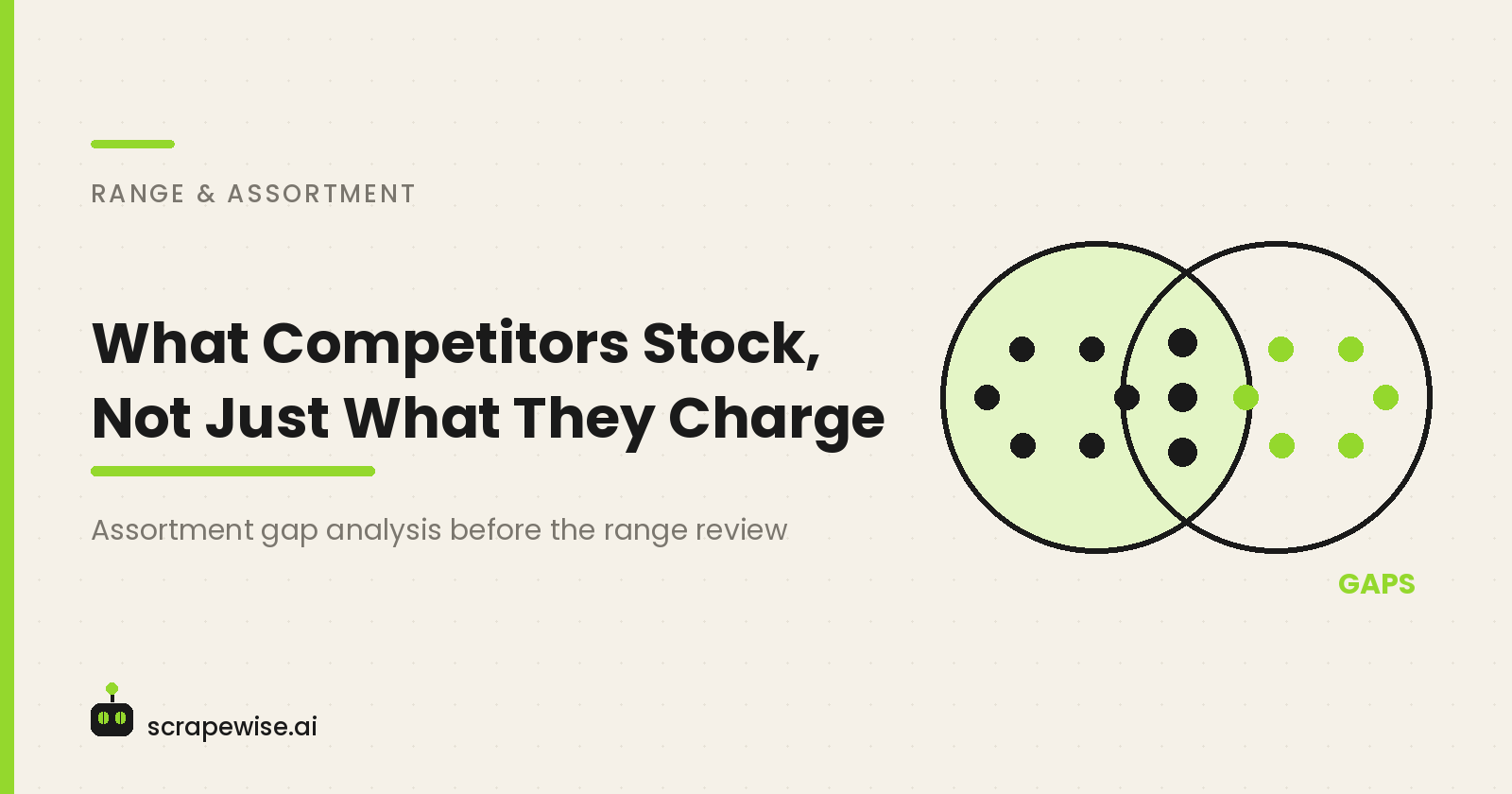
Category managers get judged on the range review, not just the price index. You can hold the sharpest prices in the category and still lose a buying meeting because a competitor quietly added 40 SKUs in a sub-category you don't carry at all — and nobody on your team noticed until a customer asked why you don't stock it.
Price monitoring answers "am I competitive on what I sell." Assortment gap analysis answers a different, equally important question: "am I even in the right fight." This guide walks through a practical method for tracking what competitors stock, drop and add, and turning that into range decisions you can defend in the buying meeting — not just a spreadsheet of missing SKUs.
Assortment Gap Analysis vs. Price Monitoring — Different Questions, Different Data
It's worth being precise about the distinction, because the two disciplines get lumped together and shouldn't be.
Price monitoring tracks a fixed set of SKUs you already carry and compares what you charge to what competitors charge for the same products. Assortment gap analysis tracks the full competitor catalog — including everything you don't carry — and asks which of those products represent genuine demand you're missing, versus dead stock everyone's holding for the wrong reasons.
The data requirement is different too. Price monitoring needs accuracy on a known SKU list. Assortment analysis needs breadth: full category coverage of every competitor's catalog, tracked over time so you can see what's new, what's been dropped, and what's persisted through multiple seasons — which is a much stronger buy signal than a SKU that just appeared last week.
A Practical Method: Four Steps Before the Range Review
Step 1 — Map the Category, Not Just Your Own Range
Start from the category, not your catalog. Pull the full assortment for every serious competitor in the category you're reviewing, not just the products that map cleanly to something you already stock. This is where most informal assortment reviews fail — someone compares "our 200 SKUs vs. their equivalent 200" and never sees the 60 SKUs the competitor carries that don't have an equivalent on your side at all, because those are exactly the gaps that matter.
Step 2 — Match Products Across Catalogs Properly
Once you have the full competitor range, you need to know which of their SKUs genuinely don't exist in your catalog versus which ones do exist but under different naming, packaging, or bundling. This is a product data matching problem, and getting it wrong in either direction is costly — false gaps waste buying time chasing products you already effectively carry, and missed matches hide genuine gaps behind an inconsistent SKU name. Where EAN or GTIN codes exist, matching is straightforward; where they don't — common in private-label and own-brand ranges — attribute-based matching (brand, size, material, model) becomes essential. Our guide to EAN/GTIN matching failure modes covers where this breaks down in practice.
Step 3 — Score Gaps by Signal Strength, Not Just Presence
Not every gap is worth filling. A SKU that one competitor added last week is weak evidence. A SKU that three or more competitors carry, that's persisted across multiple stock checks, and that shows healthy review velocity or consistent stock availability (rather than sitting permanently "in stock" with zero apparent movement) is strong evidence of real demand. Build a simple scoring framework:
| Signal | Weak evidence | Strong evidence |
|---|---|---|
| Number of competitors stocking it | Only one | Three or more |
| Time in catalog | Appeared in the last check | Persisted across multiple checks/seasons |
| Stock status pattern | Permanently available, never sells out | Cycles between in-stock and low-stock |
| Review/rating presence | None or very few | Active review volume |
| Price positioning | Deep discount only (possible clearance) | Full-price, stable pricing |
The SKUs that score well across most of these are your genuine range gaps. The rest are noise — products your competitors are also unsure about.
Step 4 — Track Drops, Not Just Additions
The reverse signal matters just as much. When multiple competitors quietly drop a SKU you still carry, that's an early warning — declining demand, a supply problem, or a category shift — often visible weeks before it shows up in your own sell-through data. Assortment tracking over time catches this; a one-off snapshot comparison never will, because a single check can't distinguish "just delisted" from "never carried."
Bringing It Into the Buying Calendar
Assortment gap analysis only pays off if it lands before the range review, not after. The practical cadence: run the full competitor catalog scan on a schedule that matches your buying cycle — monthly for fast-moving categories like electronics or fashion, quarterly for slower ones like home or DIY — so the gap list is current and defensible when the buying meeting happens, not a stale report from three months ago.
Pair it with the persistence scoring above and you walk into the range review with a ranked list: which gaps are strong, recurring, multi-competitor signals worth a buying decision, and which are one competitor's experiment that isn't worth chasing. That's a fundamentally different conversation than "I noticed we don't stock X."
Assortment analysis is one of several higher-margin uses of competitor data beyond simple price matching — if you want the fuller picture including promotion timing and MAP leakage, see beyond price tracking: 5 hidden ways competitor data scales margin.
How ScrapeWise Fits
ScrapeWise captures full competitor catalogs on a schedule — not just the SKUs you already track — with stock status, pricing, and review data alongside each product, and matches competitor SKUs against your own catalog so gaps and overlaps are visible without manual reconciliation. Because matching is attribute-driven rather than EAN-only, it holds up on private-label and own-brand ranges where clean identifiers don't exist.
Honest limitations: Assortment analysis is most valuable with a track record — a single snapshot tells you what's different today, but the persistence signal that separates a genuine gap from noise needs history, so the method gets more useful the longer it runs. We deliver the matched data; the buying decision itself still needs a category manager's judgment on brand fit, margin, and supplier relationships.
Conclusion
Price index tells you if you're competitive on what you already sell. Assortment gap analysis tells you if you're even stocking the right things. Run the full competitor catalog on a schedule, match it against your own range properly, score gaps by how persistent and multi-competitor the signal is, and bring a ranked list — not a hunch — into the next range review.
Want your competitors' full assortment matched against your catalog before your next buying round? Book a call →
Paste your first URL and get structured data
No code, no credit card. Connect to any website in minutes.
Not ready to sign up? See 12 rows of real Amazon data →
97% accuracy on Amazon benchmarks · no credit card · book a 15-min call →