

It's the Thursday before Black Week. Your category manager wants to know what the three main competitors will charge for the top 50 products. Someone opens 50 browser tabs, someone else starts a spreadsheet, and by Monday the numbers are already out of date.
Black Friday competitor price tracking means logging your competitors' prices, the "before" prices they show, shipping and stock at the same times every day, from about 30 days before the sale until prices recover in December. This checklist covers the 2026 dates, what to check each day, and the EU price rule that almost a third of the 314 online shops in last year's EU check got wrong.
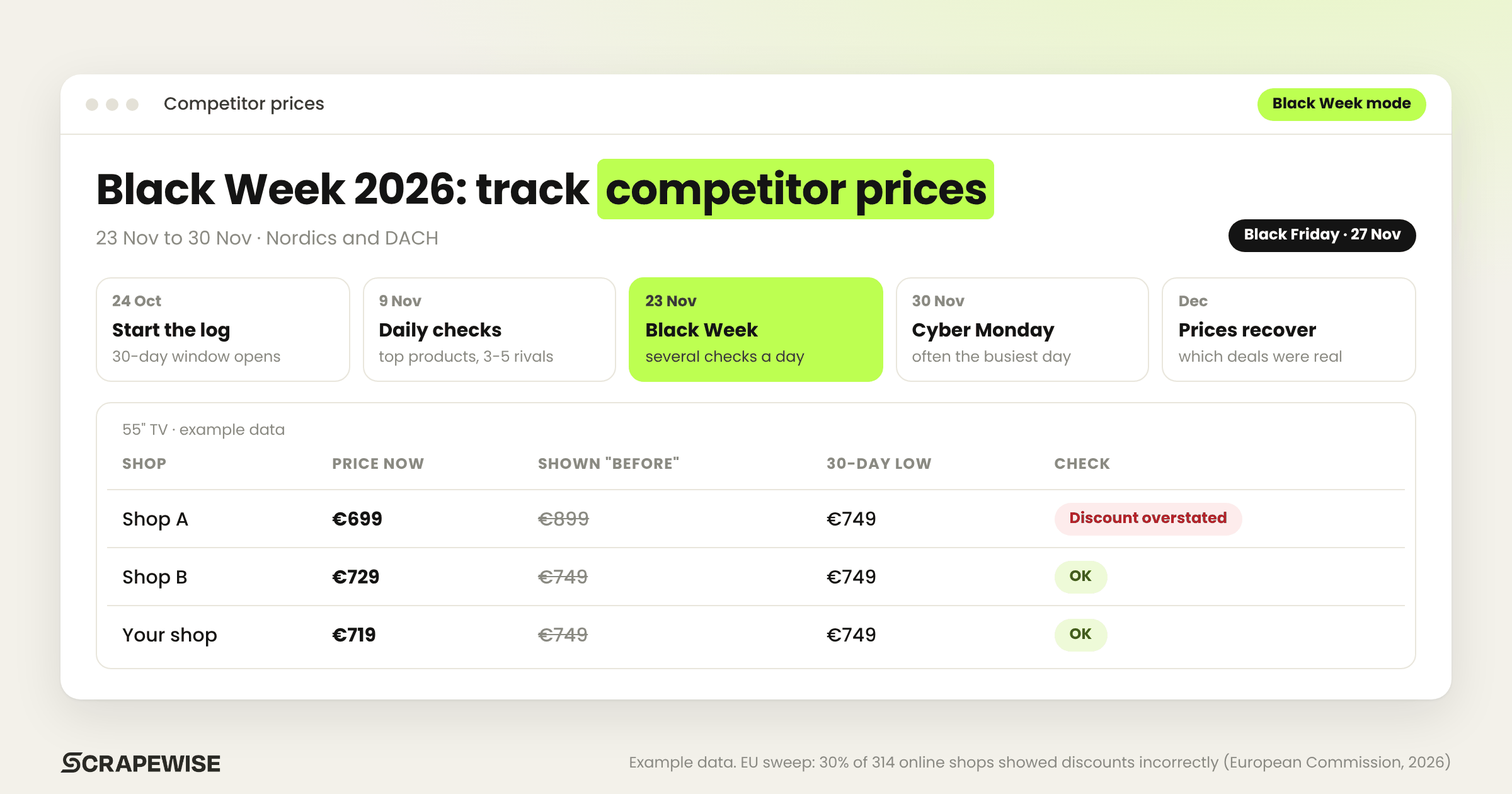
When is Black Friday and Black Week 2026?
Black Friday 2026 is 27 November. In Sweden, Black Week runs from 23 to 29 November, and Cyber Monday is 30 November. For price tracking, the date that matters most is 24 October: that's 30 days before a sale that starts on 23 November, so it's when the window that sets your "before" prices opens.
The dates come from nShift's peak-season data. Two things about the calendar change how you should track prices:
- Friday isn't the peak any more. In Viskan's data from Swedish online stores, Cyber Monday was the strongest sales day of Black Week in both 2024 and 2025, and Black Friday came seventh in 2025. If you only check competitor prices on Friday, you miss the days that sell most.
- Sales start earlier. Many shops run "early Black Week" deals from the start of November. Those early prices count toward the 30-day low, theirs and yours (see the 30-day rule below).
People still shop a lot that week. Svensk Handel's survey found that 57% of Swedes planned to shop during Black Week 2025. In Germany, the retail federation HDE expected EUR 5.8 billion in Black Friday and Cyber Monday sales for 2025. That was the first expected drop since HDE started collecting the data in 2016.
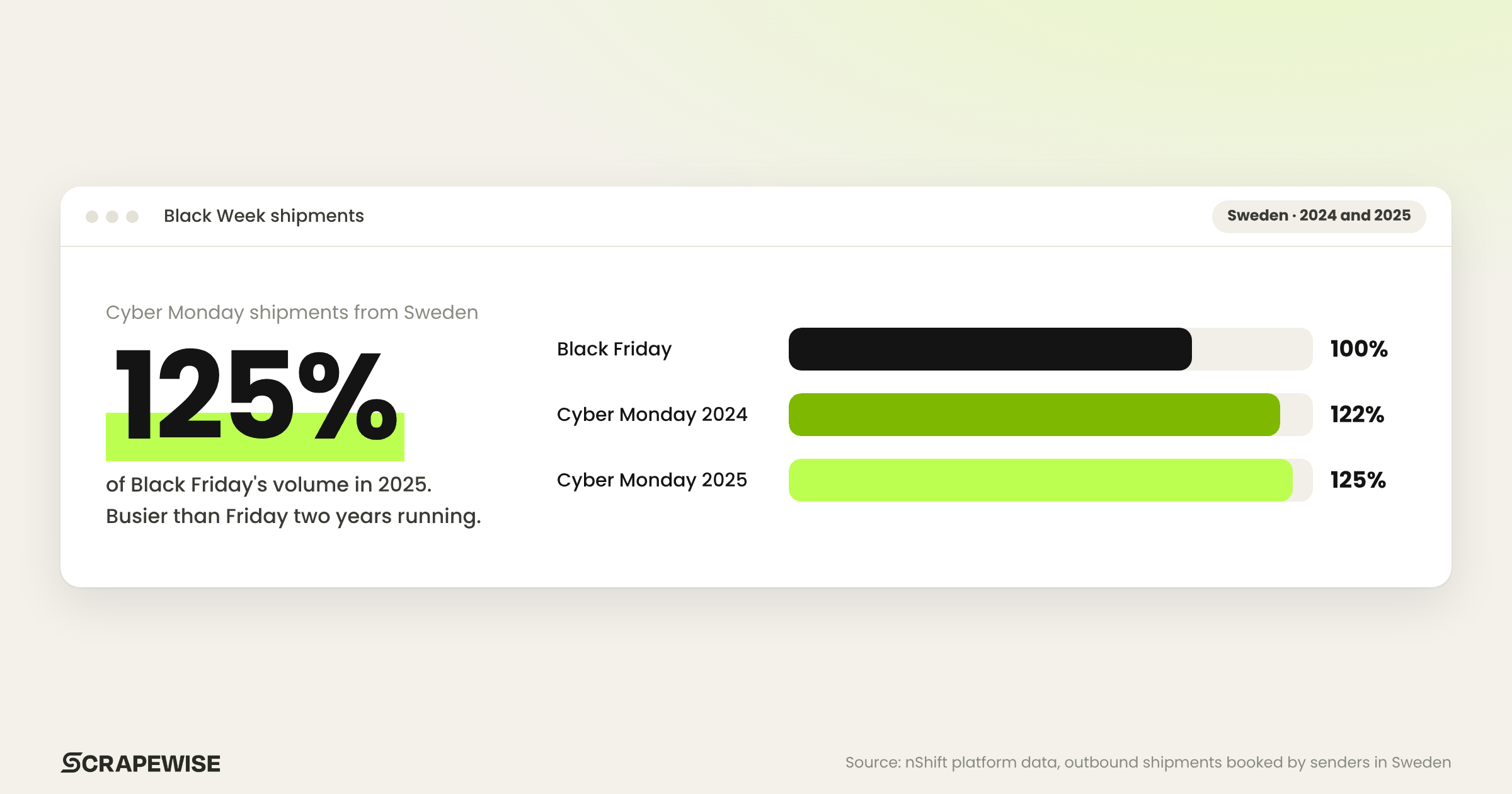
In nShift's data, Cyber Monday shipments from Sweden were 122% of Black Friday's in 2024 and 125% in 2025.
How many shops got Black Friday discounts wrong in 2025?
In the EU's check of Black Friday and Cyber Monday 2025, consumer authorities in 23 EU countries plus Iceland and Norway looked at 314 online shops. 30% showed their discounts against the wrong "before" price. The shops sold cosmetics, fashion, furniture and electrical goods. The European Commission published the results on 26 March 2026.
The Commission's summary found that:
- 30% showed discounts incorrectly. A discount has to be measured against the lowest price in the previous 30 days.
- 34% showed price comparisons, but 60% of those didn't explain where the reference price came from.
- 18% used pressure tactics like countdown timers or "almost sold out", and more than half of those were misleading.
- 10% added fees late in the checkout.
Ireland's CCPC, which took part, lists the product categories the check covered. National authorities can now act against the shops involved, so 2026 is not the year to be careless with strikethrough prices.
What is the EU 30-day lowest price rule?
The EU 30-day rule is Article 6a of the Price Indication Directive, in force since May 2022. When you announce a price cut, the "before" price must be the lowest price you charged in at least the 30 days before the cut. In 2024 the EU Court of Justice ruled that the percentage off must be worked out from that price too.
That ruling is the Aldi Süd case (C-330/23) of 26 September 2024, a German case. RPC's summary of the Commission's Article 6a guidance notes that 30 days is the minimum, and a cut that runs longer keeps the same reference price throughout.
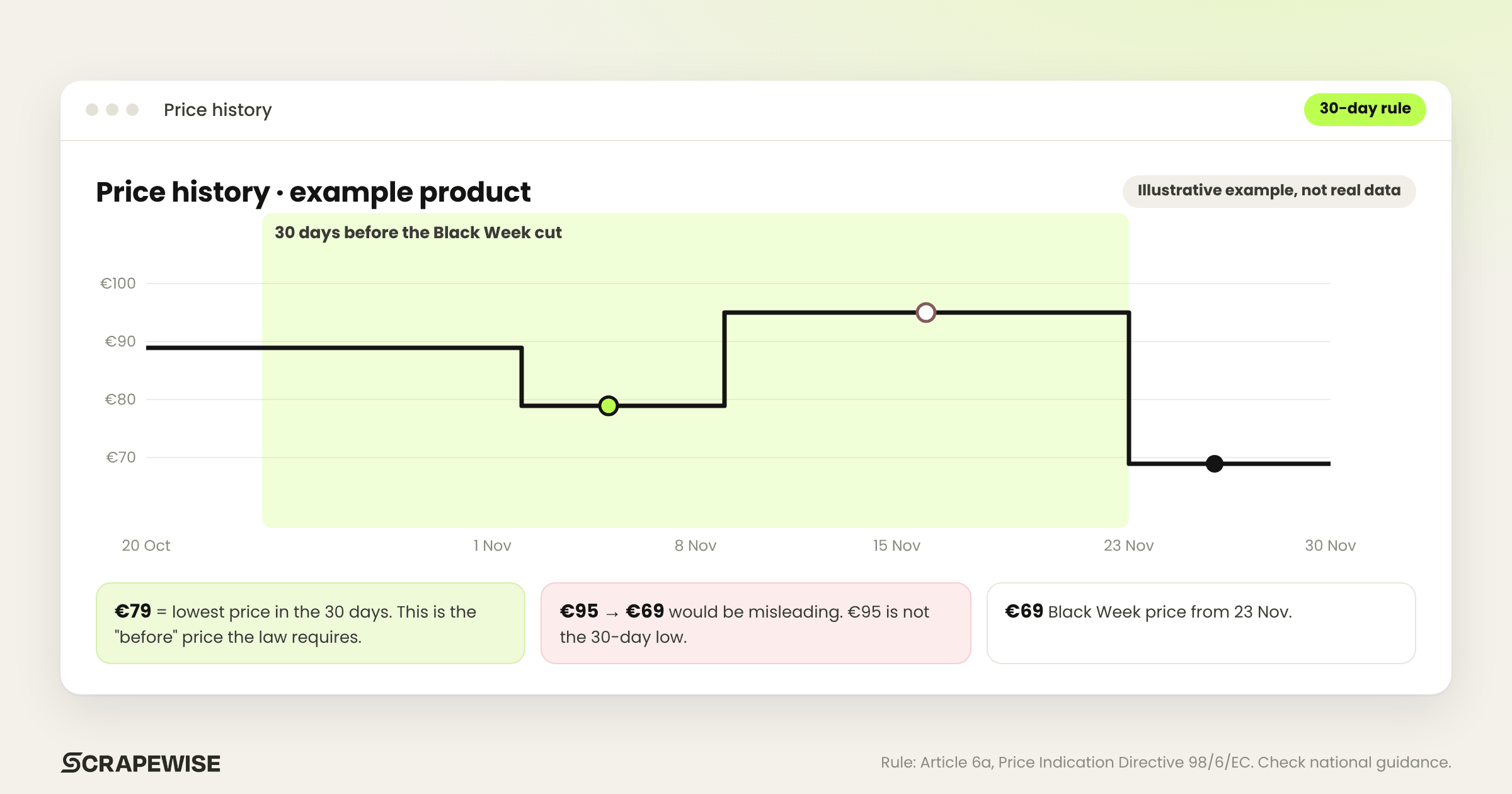
In practice this means:
- Your early-November promos set your Black Week reference price. In the example above, a €79 promo in early November makes €79 the "before" price for a Black Week cut on 23 November, even though the shelf price was €95 the week before.
- Raising prices before the sale doesn't help. The 30-day low stays the same, so the higher price can't be your "before" price.
- The window for Black Week 2026 opens around 24 October. If you don't have your own price history from then, you can't prove your reference prices.
Rules differ a little between countries. Poland's regulator UOKiK, for example, also applies the rule to bundles and loyalty-club discounts, which the Commission's guidance doesn't. Check with your national authority or a lawyer for your exact case. This post is not legal advice.
How to track competitor prices for Black Friday: a 13-step checklist
To track competitor prices for Black Friday, start a daily log about 30 days before your sale. Cover your top 50 to 200 products and three to five competitors per category. Log the price, the "before" price shown, shipping and stock. During Black Week, check top products several times a day and keep going through Cyber Monday.
The steps are the same for 50 products or 5,000.
Before the sale (ideally from 24 October)
- Pick the products. Start with the 50 to 200 products that make up most of your November revenue, plus the ones shoppers compare most (your key value items, or KVIs).
- Pick the competitors per category. Not every competitor matters for every category. Three to five per category is usually enough.
- Match the products properly. The same TV or jacket often has different names, bundles or pack sizes on each site. A price comparison is only useful if it's the same product. Our guide to product matching in e-commerce covers how to do this when EANs are missing.
- Start a daily log. Record date, time, price, the "before" price shown, shipping cost and stock status for each product. If you're starting later than 24 October, pull your own price history for the missing days from your shop system. For competitors, you'll only have what you log from now.
The week before (16 to 22 November)
- Watch for early deals. Note which competitors start early, and on which products.
- Check the comparison sites. Shoppers often see the market price on a comparison site before they reach yours: Prisjakt and PriceRunner in the Nordics, idealo in Germany and Austria. Our post on Nordic price monitoring with Prisjakt and PriceRunner covers what they show.
- Agree your price rules in advance. Decide now how far you will follow a competitor down, which products you won't match, and who signs off on changes during the week. Decisions made at 23:00 on Thursday are rarely good ones.
Black Week (23 to 30 November)
- Check several times a day on the top products. Prices move during the day, especially on marketplaces and in electronics.
- Log the "before" prices competitors show, not just the sale price. Compare them with your own log. A "40% off" claim against a price that only existed for a week tells you the real discount is smaller.
- Track stock as well as price. When a competitor sells out, you may not need to cut your price at all.
- Don't stop on Friday. Keep the same frequency through Cyber Monday.
After (December)
- Track when prices come back up. How fast competitors return to normal prices tells you which Black Week deals were real and which were stock clearance.
- Save the log. Next year's window opens in late October again, and this year's log shows you who discounts what. If you use ScrapeWise, export it: scraped data is kept for 90 days.
Should you track Black Friday prices by hand or automate it?
For about 20 products and three competitors, a spreadsheet works if one person copies prices at the same time every day. Past that, automate it. A tool collects prices on a fixed schedule, keeps the history and records the "before" price and stock, which you need for the 30-day comparison. Either way, start before 23 November.
| Spreadsheet by hand | Automated tracking | |
|---|---|---|
| Fits | ~20 products, 3 competitors | 50 to thousands of products |
| How often | Once a day at best | On a schedule, several times a day if you need it |
| Same time every check | Rarely | Yes |
| "Before" price, shipping, stock | Usually skipped | Collected each run |
| History for the 30-day check | Whatever someone saved | Kept and exportable |
| Main risk | Different times, lost files | Some sites block scrapers or need a login |
Past about 20 products, the manual version breaks down the same way every year: too many tabs, prices copied at different times of day, and nobody sure which file is the latest. We wrote about what manual competitor price collection costs if you want the full picture.
ScrapeWise is one of the options. With the self-serve scrapers, you list the competitor pages and the fields you want (price, shown "before" price, stock, shipping). You run them on a schedule (once a day at most) or start extra runs by hand during Black Week, and get the results as a table, CSV/Excel or API. There are no price alerts, so someone reads the table. You pay per page: 2,000 product pages checked daily with a browser render comes to about €45 a month. If you'd rather hand it off, our Managed Data team matches each listing to your SKUs and delivers one comparison table, up to once a day, from €1,500 a month. Our competitor price tracking page shows how it works.
What are the most common Black Friday price tracking mistakes?
- Comparing different products. A bundle with a free accessory isn't the same offer as the bare product. Check pack sizes and variants. Our guide to price per unit across pack sizes covers the maths.
- Ignoring shipping. One in ten shops in the EU check added fees late in checkout. Compare the price the shopper actually pays.
- Trusting competitor "was" prices. Your own log is the only reliable reference.
- Reacting to every change. Some price moves last an hour. Decide in advance how long a competitor price has to hold before you respond.
Next step
Pick your top 50 products and three competitors this week, and start logging prices today. That gives you two weeks of history before Black Week, and a full 30 days next year if you keep it running. If you'd rather not do it by hand, you can test ScrapeWise on your own competitor URLs. New accounts get 5 free requests, no card needed.
Paste a competitor URL and start tracking prices
The shops you name, as a structured table once a day at most. No code, pay per page, the first 5 requests are free.
Not ready to sign up? See 40 rows of real Google Shopping price data →
5 free requests no credit card · pay per page, no monthly plan · book a 15-min call →