

Most price monitoring tools were built for the US market, then bolted on "international coverage" that means Amazon in a few more countries. Point one at the Nordics and it quietly falls apart: it tracks the wrong reference sites, compares SEK to EUR without normalising, and misses that half your buyers checked Prisjakt before they ever landed on a retailer's page.
The Nordic market is small enough that vendors ignore it and structurally different enough that ignoring it breaks the data. Four countries, four currencies, four VAT regimes, and a comparison-engine layer that most of Europe doesn't have. If you sell in Sweden, Norway, Denmark or Finland — or you're a brand watching resellers there — generic monitoring will give you confidently wrong numbers.
This is what actually matters when you monitor prices in the Nordics.
Which Nordic Buyer Are You?
Before tooling, figure out what you're actually monitoring for. It changes everything downstream.
- A retailer defending margin in one or more Nordic markets. You need competitor prices normalised to a single currency, and you need the comparison engines because that's where price-sensitive shoppers decide.
- A brand protecting positioning across the region. You're watching resellers and marketplaces for MAP violations and gray-market pricing, and the reseller mix differs sharply by country.
- A distributor or wholesaler. You care about wholesale and distribution pricing signals, and the trade-vs-retail gap in the Nordics is wide.
All three hit the same four structural problems below. The difference is which data points you weight.
The Comparison Engines Are the Reference Layer
In the US, shoppers start on Amazon or Google. In the Nordics, a large share start on a price comparison engine — and retailers price to those engines, not just to each other.
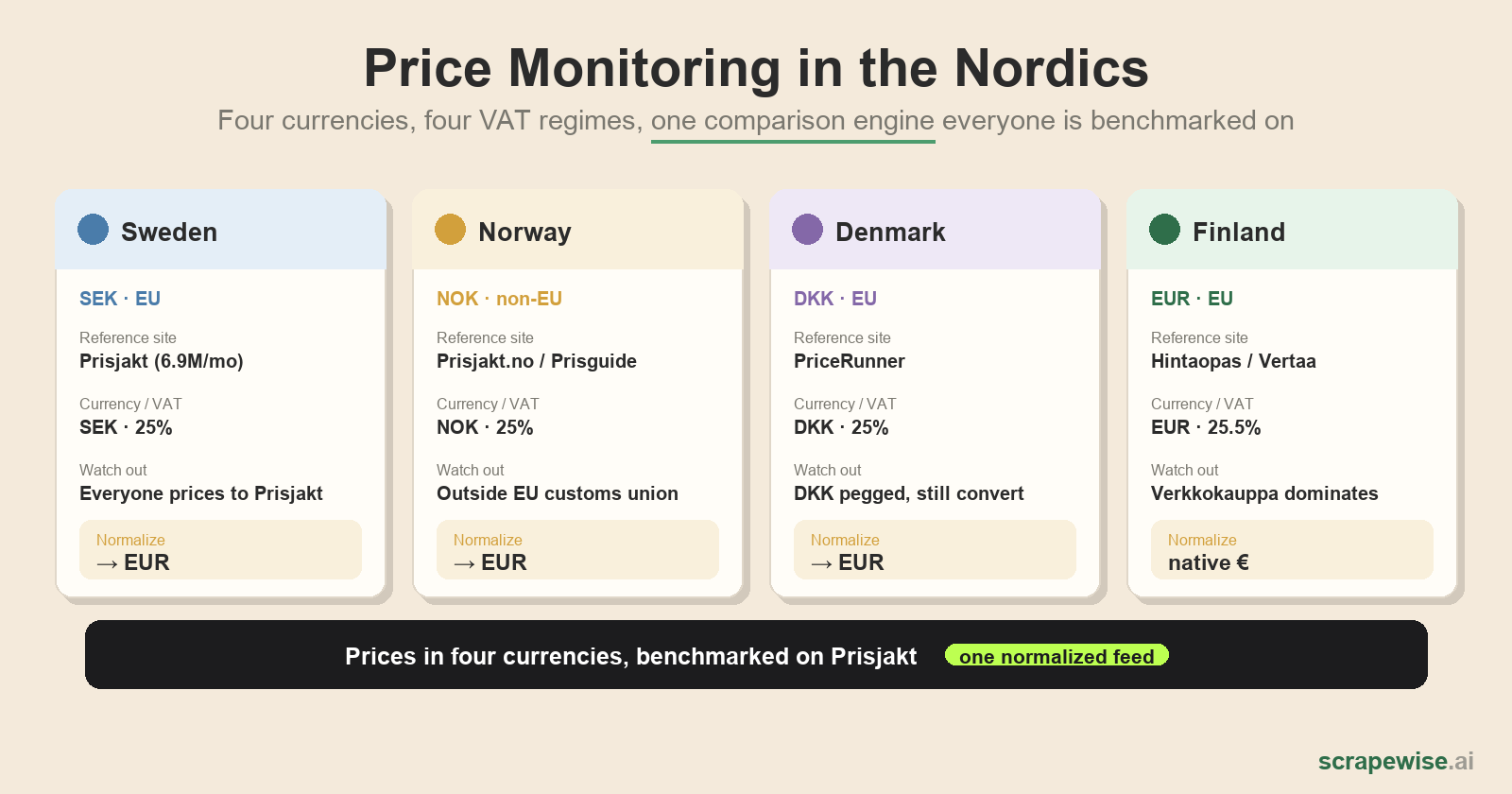
Prisjakt (owned by Schibsted, and operating as PriceSpy in some markets) is the dominant force in Sweden and Norway, drawing millions of monthly visits. For many categories, a retailer's rank on Prisjakt is the single biggest driver of click-through, which means retailers actively reprice to hold a position on the list. If you monitor only individual retailer sites and ignore Prisjakt, you're missing the layer that shapes their behaviour.
PriceRunner (owned by Klarna) is the reference engine in Denmark and a major player across the region. Hintaopas and Vertaa.fi serve the Finnish market.
The practical consequence: in the Nordics, your monitoring needs two layers — the comparison engines (to see the competitive landscape shoppers actually see and the position your rivals are fighting for) and the individual retailer storefronts (for the true price, promotions, and stock the engine may lag on). Tracking only one gives you half the picture.
Four Currencies, and One of Them Isn't in the EU
Here's where normalisation breaks naive tools.
| Market | Currency | VAT (standard) | Reference engine | The gotcha |
|---|---|---|---|---|
| Sweden | SEK | 25% | Prisjakt | Retailers reprice to hold Prisjakt rank |
| Norway | NOK | 25% | Prisjakt.no / Prisguide | Outside the EU customs union |
| Denmark | DKK | 25% | PriceRunner | DKK is pegged to EUR but still needs converting |
| Finland | EUR | 25.5% | Hintaopas / Vertaa | Verkkokauppa.com dominates the local landscape |
Three of the four currencies float against the euro, so a price comparison captured in SEK today isn't comparable to one captured in EUR last week unless you normalise at the exchange rate at capture time. Storing "€89" without the original SEK and the rate you used makes historical comparison meaningless when the krona moves 4% in a month.
Norway deserves its own warning. It's in the EEA but outside the EU customs union, which means import handling, VAT collection thresholds, and cross-border shipping economics differ from the EU three. A Norwegian competitor's shelf price reflects a different cost structure — comparing it head-to-head with a German or Swedish price without accounting for that leads to wrong conclusions about who's actually cheaper.
And Finland's VAT sits at 25.5% after the September 2024 increase — a detail that quietly shifts pre-tax margin comparisons against the 25% markets.
Why Standard Price Tools Break Here
Putting it together, the generic-tool failure modes in the Nordics are:
- Wrong reference sites. They track Amazon and maybe one local retailer, missing Prisjakt/PriceRunner entirely — the layer that drives pricing behaviour.
- Naive currency handling. They convert at today's rate or store only the normalised value, corrupting historical trend analysis.
- No account for Norway's status. They treat NOK like any other EU price, ignoring the customs and cost-structure differences.
- Thin local coverage. They miss regional champions like Verkkokauppa.com, Elgiganten, XXL, and Komplett that no US-built target list includes.
The right price monitoring tool for the Nordics is one you can point at the specific sites and engines that matter in each market — not one with a fixed, US-centric target list.
How to Monitor the Nordics Properly
Track both layers. Monitor the comparison engines (Prisjakt, PriceRunner, Hintaopas) for landscape and rank, and the individual retailer storefronts for true price, promo and stock.
Normalise at capture time. Store the original currency, the price, the timestamp, and the FX rate you applied. Keep the native value forever so you can re-normalise later. This is also what keeps you honest for 30-day price history obligations, which apply across these EU markets.
Segment by market, not by retailer. The same chain (Elgiganten, Power) prices differently per country. Treat each localised storefront as a separate monitoring target.
Build the local target list deliberately. Include the regional champions. Verkkokauppa.com in Finland, XXL and Komplett in Norway, Elgiganten across the region — these won't be in any off-the-shelf list.
Where ScrapeWise Fits — and Where It Doesn't
ScrapeWise is a managed data feed you point at the exact Nordic sites you care about — Prisjakt and PriceRunner listings, individual retailer storefronts, localised domains — and get back clean, timestamped data with the native currency preserved. Because it's AI-powered scraping rather than a fixed connector list, adding a regional champion like Verkkokauppa.com is just another URL, not a feature request.
Honest limitations: we deliver the data; we don't run the FX conversion or the repricing logic — that stays in your stack (we preserve the native currency and timestamp so you can normalise however your finance team prefers). Coverage is scoped to the sites and markets you specify, so pricing is custom and there's no self-serve free tier for a multi-market Nordic setup.
Conclusion
The Nordics punish generic price tools because the structure is genuinely different: a comparison-engine layer that drives repricing, three floating currencies plus a euro market, a non-EU-customs member, and regional champions no default list includes. Monitor both layers, normalise at capture time, segment by market, and build the target list on purpose. Do that and the Nordics stop being a blind spot and become one of the clearest competitive pictures you have.
Want Prisjakt, PriceRunner and your local competitor storefronts delivered as one clean feed? Get a quote scoped to your markets.
Paste a competitor URL and start tracking prices
Any e-commerce site, any SKU count. Clean structured feeds on your schedule, no code required.
97% accuracy on Amazon benchmarks · no credit card · book a 15-min call →