

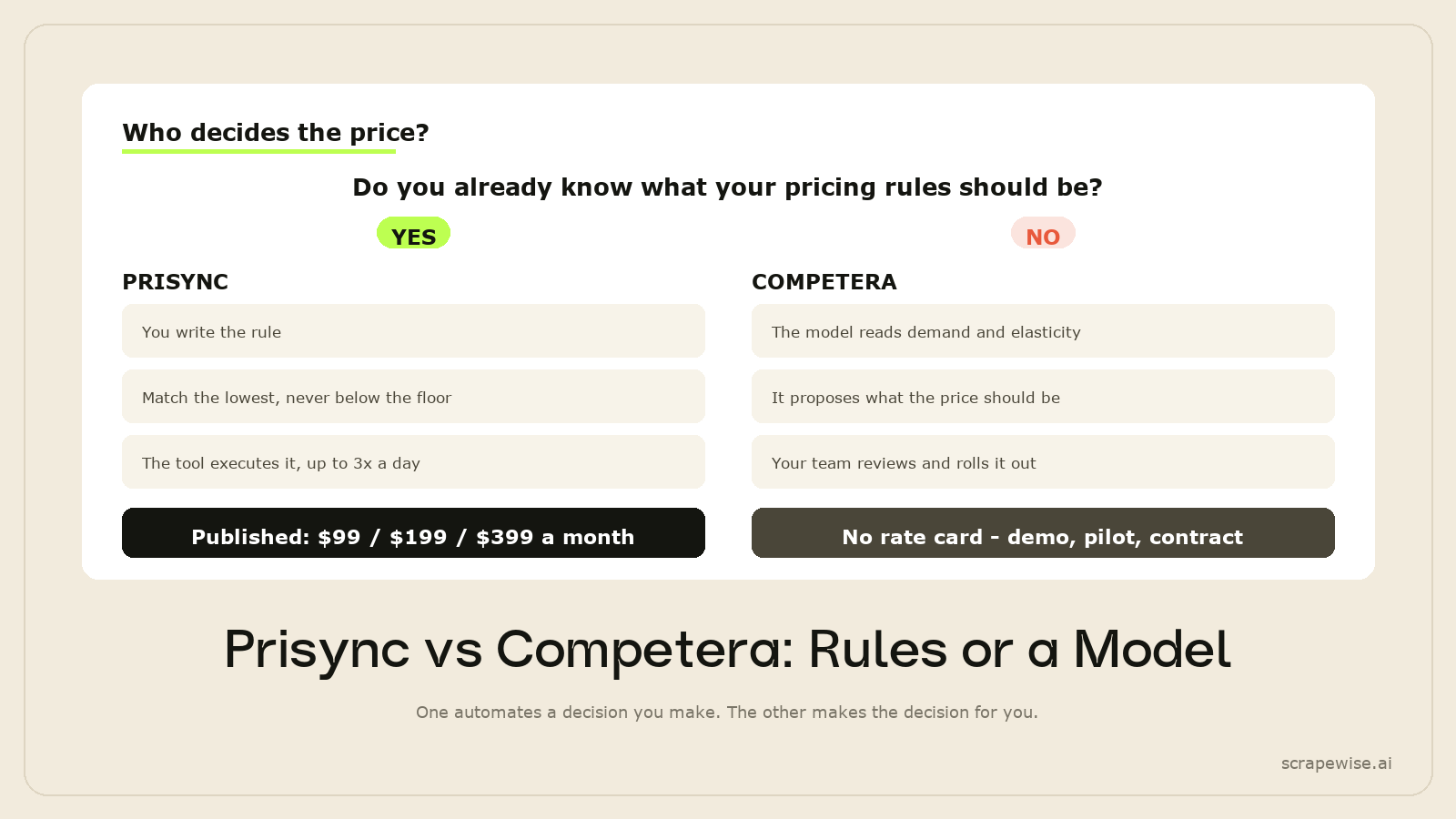
Short answer: Prisync if you want to write the pricing rules yourself and start this week — published plans from $99 to $399 a month for 100 to 5,000 products, a 14-day trial with no credit card, and a rule-based dynamic pricing engine from the Premium plan. Competera if you want a model to decide the price — demand modelling and recommended prices, sold through a demo, a pilot and a contract, with no published rate card. (Both checked on prisync.com and competera.ai in September 2026.)
They are usually compared as two price-monitoring tools. They are not. One automates a decision you make; the other makes the decision for you. Everything else in the comparison follows from that.
Choose Before You Read
| Your situation | Better fit |
|---|---|
| Under 5,000 products, want to start without a sales call | Prisync |
| You already know your pricing rules and want them enforced | Prisync |
| Fixed, predictable monthly cost | Prisync |
| Large assortment where nobody can hand-write the rules | Competera |
| You want demand modelling, not just competitor prices | Competera |
| Elasticity and margin trade-offs across categories | Competera |
| You want the raw competitor rows in your own model | Neither — see below |
Rules vs Recommendations
This is the whole decision, so it goes first.
Prisync automates a rule. You add your products and the competitor URLs for each one, prices refresh up to three times a day on URL-based plans, and from the Premium plan the dynamic pricing engine changes your price when the rule you wrote says it should — match the lowest, sit 2% under a named competitor, never go below a floor. The intelligence is yours. The tool executes it faithfully and quickly.
Competera recommends a price. It models demand and elasticity across your assortment and proposes what the price should be. The intelligence is the product. Your team reviews and rolls out.
Which is right depends on a question you can answer without a demo: do you know what your pricing rules should be?
If yes — and most retailers under a few thousand SKUs do, because the rules are "stay competitive on the 200 products customers actually compare, protect margin on the rest" — then you are buying execution. Paying for a model to rediscover a rule you already know is an expensive way to be told something you could have typed in.
If no — because the assortment is large enough that nobody can hold it in their head, cross-elasticities matter, and "match the lowest" destroys margin at scale — then rules are not the answer and Competera is the right category of product.
Side by Side
Prisync publishes its prices and limits, so its column is exact. Competera does not publish a rate card, so its column describes what Competera says its product does.
| Prisync | Competera | |
|---|---|---|
| Type | Self-service monitoring + rule-based repricing | Enterprise pricing optimisation |
| Pricing | Published: $99, $199, $399/month (URL-based) | Not published — demo, pilot, contract |
| Product limits | 100 / 1,000 / 5,000; larger by contact | Set per contract |
| Update frequency | Up to 3× a day (URL-based), daily (channel-based) | Per contract |
| What it produces | Competitor prices + a price your rule set | A recommended price from a demand model |
| Product matching | You maintain competitor URLs per product | Vendor-run |
| Time to first value | Same day (14-day trial, no card) | A pilot cycle |
| MAP monitoring | Platinum plans only | Not the core product |
| API | Adds 20% to the monthly fee | Per contract |
Two specifics worth pulling out of the table because they cost real money.
Prisync's API costs 20% on top. If you are planning to feed prices into an ERP or BI stack rather than read a dashboard, add that to every plan price before comparing. And MAP monitoring only exists on Platinum — if reseller policing is part of the job, the entry plans are not an option regardless of catalogue size.
Prisync's competitor URLs are your job. You maintain the list, and it grows with every product and every market you add. That is a real recurring cost that no plan price shows, and it is the most common reason teams outgrow URL-based tools. It is also, honestly, an advantage: you can open any match and see exactly which page the price came from, which vendor-run matching does not give you.
The Buying Process Is a Feature
Prisync is self-serve with a 14-day trial and no credit card. Competera starts with a demo and moves to a pilot and a contract.
This gets filed under procurement preference. It is not — it determines how fast you can falsify the vendor's claims.
With Prisync you load your 50 hardest SKUs, wait a day, and check by hand against the live competitor sites. You know the real coverage and the real match accuracy on your own catalogue, for free, before anyone signs anything.
With Competera your verification happens after a commitment exists. That is not a criticism — it is how enterprise pricing software is sold, the scoping and support you get in exchange are real, and a demand model genuinely cannot be evaluated in an afternoon. But be clear you are accepting a longer feedback loop, and push for the pilot to run on your SKUs and your categories rather than a curated set.
The test that actually separates them
Before either decision, run this on your own data. It costs nothing.
- Pull 12 months of price history on your 50 highest-revenue SKUs.
- Count how many price changes a simple rule would have got right — match the lowest of three named competitors, subject to a margin floor.
- Count where that rule would have destroyed margin — a competitor stockout, a clearance price, a marketplace seller undercutting on a single unit.
If the rule handles most of it and the exceptions are a short list, buy execution. Prisync. If the exceptions are the business — if the answer keeps being "it depends on the category and the season" — a rule engine will fight you every week and a model is worth the pilot. Competera.
Our write-up on reading a competitor's pricing strategy from price history covers how to run step 1 from your own exports.
The Layer Underneath Both
Whichever you buy, both products sit on the same foundation: is the competitor listing attached to your SKU actually the same product?
If a 500 g pack got matched to your 2 kg SKU, or a refurbished unit to your new one, or a bundle to a standalone, then Prisync enforces your rule against a wrong number and Competera trains its recommendation on one. Neither failure announces itself. Both produce a confident, precise, incorrect price that people act on for months.
Prisync's URL-based model makes this auditable — you can open a product and see the exact page. Vendor-run matching is faster to set up and harder to inspect. That is the real trade in the matching column, not "manual vs automatic". We cover the underlying problem in product data matching.
When Neither Is What You Are Buying
Both tools want to be the place your pricing decision happens. If you already have a pricing model, a margin engine or an ERP repricing job, and what you are missing is just accurate competitor data flowing into it, then you are buying a dashboard you do not need.
ScrapeWise collects prices, stock levels and any other field on the page from any public website you point it at, and delivers structured rows — through the portal data grid, a CSV or Excel export, or the REST API. Billing is per page delivered: €0.15 per 1,000 plain pages, €0.75 per 1,000 that need a browser, €1.50 per 1,000 that need residential proxies. No monthly plan, no product-count tier, no API surcharge, a balance you top up from €5 that never expires, and 5 free requests to test it on your own worst competitor sites.
Two honest limits. ScrapeWise does not reprice your products — it supplies the competitor data your rules or your pricing team work from. And it does not model demand or recommend a price; if the recommendation is the product you want to buy, Competera is the correct tool and we will say so.
So Which Should You Pick?
- Prisync — under 5,000 products, you know your pricing rules, and you want them running this week on a published, fixed monthly price. Add 20% if you need the API, and budget the ongoing URL maintenance.
- Competera — a large assortment where rules stop scaling, elasticity and cross-category effects matter, and a demand model is genuinely the thing you are buying. Insist the pilot runs on your own SKUs.
- Neither — you have the pricing logic already and only need reliable competitor rows landing in your own systems.
For the wider field, see the Prisync alternatives benchmark, the Competera alternatives guide, Prisync vs Wiser and our ranking of competitive price monitoring tools for 2026.
Paste a competitor URL — start tracking prices in 60 seconds
Any e-commerce site, any SKU count. Clean structured feeds on your schedule, no code required.
97% accuracy on Amazon benchmarks · no credit card · book a 15-min call →