

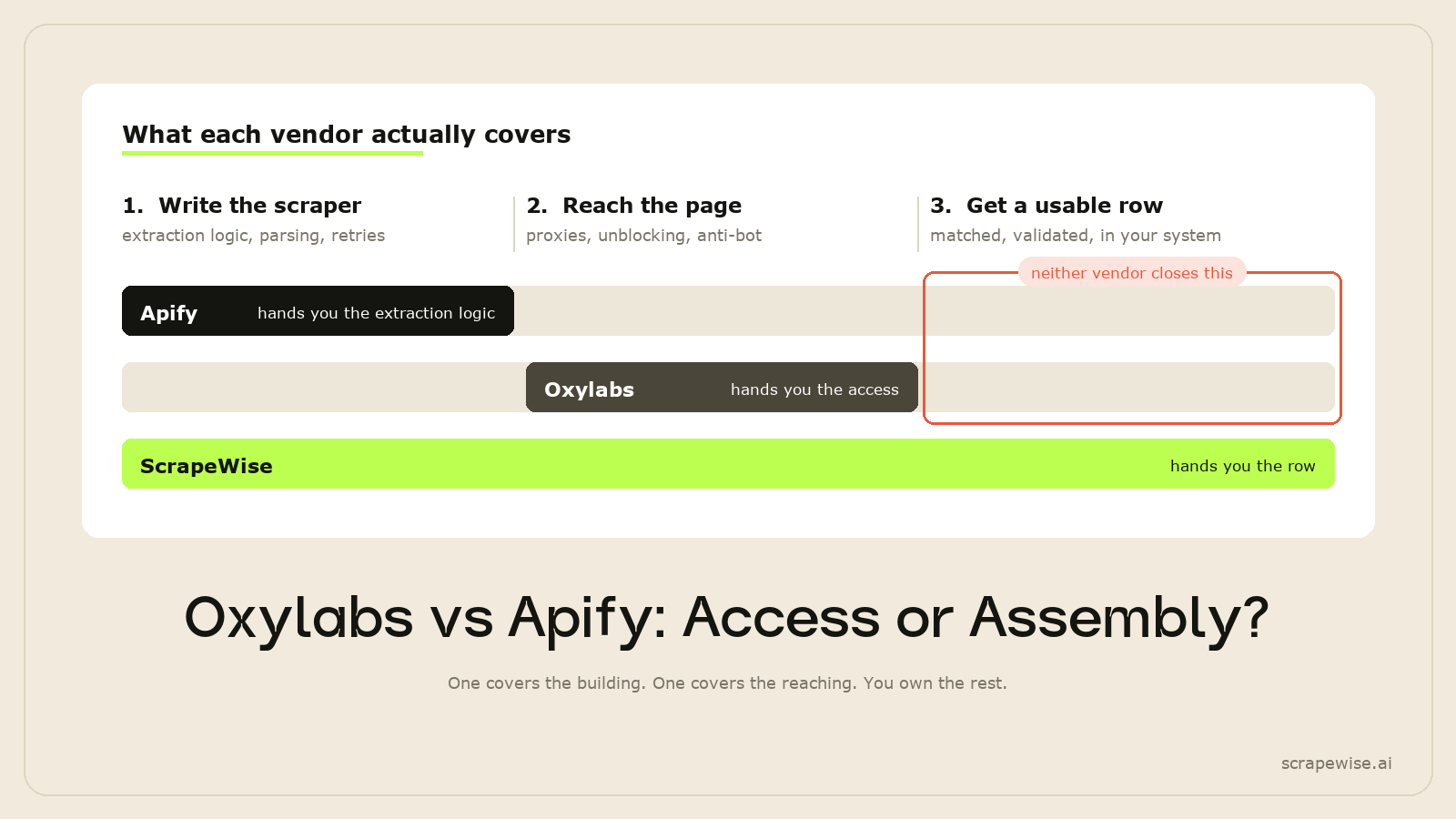
Short answer: pick Apify if you don't have scrapers yet and want to assemble them fast from a marketplace. Pick Oxylabs if your scrapers already work and the thing breaking them is access — blocks, bans, and geo-restrictions on well-protected sites.
They get compared constantly, but they aren't two versions of the same product. Apify sells assembly: a platform and Actor marketplace that gets a working scraper running quickly. Oxylabs sells access: enterprise proxy infrastructure and scraper APIs that get requests through. Choosing between them is mostly a question of which half of the job is currently costing you the most.
Choose Before You Read
| Your situation | Better fit |
|---|---|
| No scrapers yet, want something running this week | Apify |
| Scrapers exist, they're getting blocked | Oxylabs |
| Engineering team, want control over extraction logic | Apify |
| Enterprise procurement, compliance and support matter | Oxylabs |
| High-volume work on aggressive anti-bot targets | Oxylabs |
| You want the data, not a scraping operation | Neither — see below |
How They Compare
| Apify | Oxylabs | |
|---|---|---|
| Centre of gravity | Actor marketplace + platform | Enterprise proxy + scraper APIs |
| Best at | Assembling and renting scrapers | Unblocking and enterprise support |
| Pricing model | Compute units + proxy + Actor rental | Proxy/API usage, enterprise quotes |
| You still operate scrapers | Yes | Yes (or use their APIs) |
| Anti-bot handling | Your job, using their proxies | Strong unblocker products |
| Proxy network | Shared/dedicated datacenter, residential and Google SERP proxies; pool size not published; own proxies supported | Residential, mobile, datacenter and ISP; 175M+ residential IPs in 195+ countries (vendor claim, Sept 2026) |
| E-commerce | Ready-made Store Actors for Amazon, Shopify and other retailers, many community-maintained | Web Scraper API with dedicated sources for Amazon, Walmart, eBay, Target |
| AI and LLM data | Website Content Crawler outputs Markdown for RAG; MCP server lets agents run Actors | AI Studio, OxyCopilot, official MCP server |
| Best fit | Engineering teams, fast assembly | Enterprise, compliance-driven |
For exact per-request and per-GB rates, see our scraping API pricing comparison — those numbers move often enough that we keep them in one updated post rather than quoting them here.
Apify: Start From a Working Scraper
Apify's real asset is the Store. Instead of writing an Amazon scraper, you rent one someone already wrote, then adapt it. Around that sits the orchestration you'd otherwise build yourself: scheduling, storage, retries, and export to JSON, CSV or XML.
You bill on compute units, proxies, and Actor rental. That's flexible, but it's consumption-based — your cost moves with job difficulty, and a target that starts fighting back gets more expensive without anyone changing a setting.
The other caveat is maintenance ownership. Many Store Actors are maintained by community developers, so results can dip after a retailer changes its anti-bot setup and stay dipped until someone patches the Actor. That's fine for exploratory work and uncomfortable for a daily price feed.
Apify also accepts your own proxies, which is why "Apify and Oxylabs" is a real configuration rather than a contradiction.
Oxylabs: Get Through the Door
Oxylabs is shaped like an infrastructure vendor, because it is one. The core is a large proxy pool — residential, mobile, datacenter and ISP — with the Web Scraper API and unblocking products layered on top, sold with enterprise support and compliance paperwork.
If your bottleneck is that a site you need simply won't return pages at volume, this is the category of product that fixes it. Its Web Scraper API also runs dedicated e-commerce sources for Amazon, Walmart and eBay, handling the unblocking on its side rather than yours.
The trade-off is that you're buying access, not outcomes. Oxylabs gets the page back. Turning that page into clean, validated rows — and keeping it that way through layout changes — is still your team's job.
Oxylabs vs Apify for E-commerce Scraping
Apify gets you started fastest; Oxylabs holds up better under pressure.
If you're pulling a few hundred product pages to test an idea, a Store Actor is the shorter path. If you're monitoring competitor prices daily across marketplaces that actively fight scrapers, access quality becomes the whole game, and a community-maintained Actor with no unblocking guarantee is the weak link.
We measured how scrapers hold up on real retail targets in our Amazon and Shopify anti-bot benchmark, and covered adjacent options in Oxylabs alternatives for price monitoring.
Oxylabs vs Apify for AI and LLM Pipelines
Different strengths, and the distinction is clean.
Apify is better at turning websites into LLM-ready text. Website Content Crawler outputs Markdown suited to RAG pipelines, and its MCP server lets agents call Store Actors directly. It connects to LangChain, LlamaIndex, Pinecone and Qdrant.
Oxylabs is better at steady, high-volume supply of fresh web data from one vendor — proxies, Web Scraper API, AI Studio and an official MCP server, with live Google results through its API for search grounding.
If your model needs structured product and price data rather than raw pages, see real-time scraping APIs compared by cost per usable row.
The Cost Neither One Removes
Both hand you tools, not outcomes. You still own everything around the tool: writing and maintaining scrapers, rotating proxies, absorbing layout changes, parsing and cleaning, and re-fixing all of it each time a target updates its defences.
That maintenance is the recurring theme in our guide to scraping without getting blocked. The platform invoice is the visible cost. The engineer-weeks are the real one, and they don't appear in either vendor's pricing page.
When Neither Is the Right Answer
If what you actually want is competitor prices, stock levels and product data arriving in your systems — not a scraping operation to run — then this comparison is the wrong one to be having.
A managed feed like ScrapeWise sits a layer above both: we run the scrapers, the proxies and the anti-bot handling, and deliver structured, validated rows. You compare outcomes and reliability instead of compute units and proxy GB.
The honest trade-off: ScrapeWise is a feed, not a toolkit. If you want a platform to build on tonight, Apify gives you far more knobs. On price there's less to weigh — no plan and no compute units, just a balance you top up and a charge per delivered page from €0.15 per 1,000, with 5 free requests on every new account.
You can also call 36 ready-made scraping API endpoints directly, or read the two-way write-up of ScrapeWise as an Apify alternative.
So Which Should You Pick?
- Apify — you need scrapers and don't have them. The marketplace saves real build time, and you can live with consumption-based cost.
- Oxylabs — you have scrapers and they're getting blocked. Access is the bottleneck, and enterprise support and compliance are worth paying for.
- Both — Apify for orchestration, Oxylabs proxies plugged in for access. A common and entirely sensible setup.
- Neither — you want clean data on a schedule, and would rather pay for delivered rows than meter your own infrastructure.
For the wider field, see Apify vs Bright Data vs Oxylabs.
Paste a URL your current tool cannot reach
See why teams switch to ScrapeWise. 97% accuracy benchmark, no per-SKU pricing.
97% accuracy on Amazon benchmarks · no credit card · book a 15-min call →