

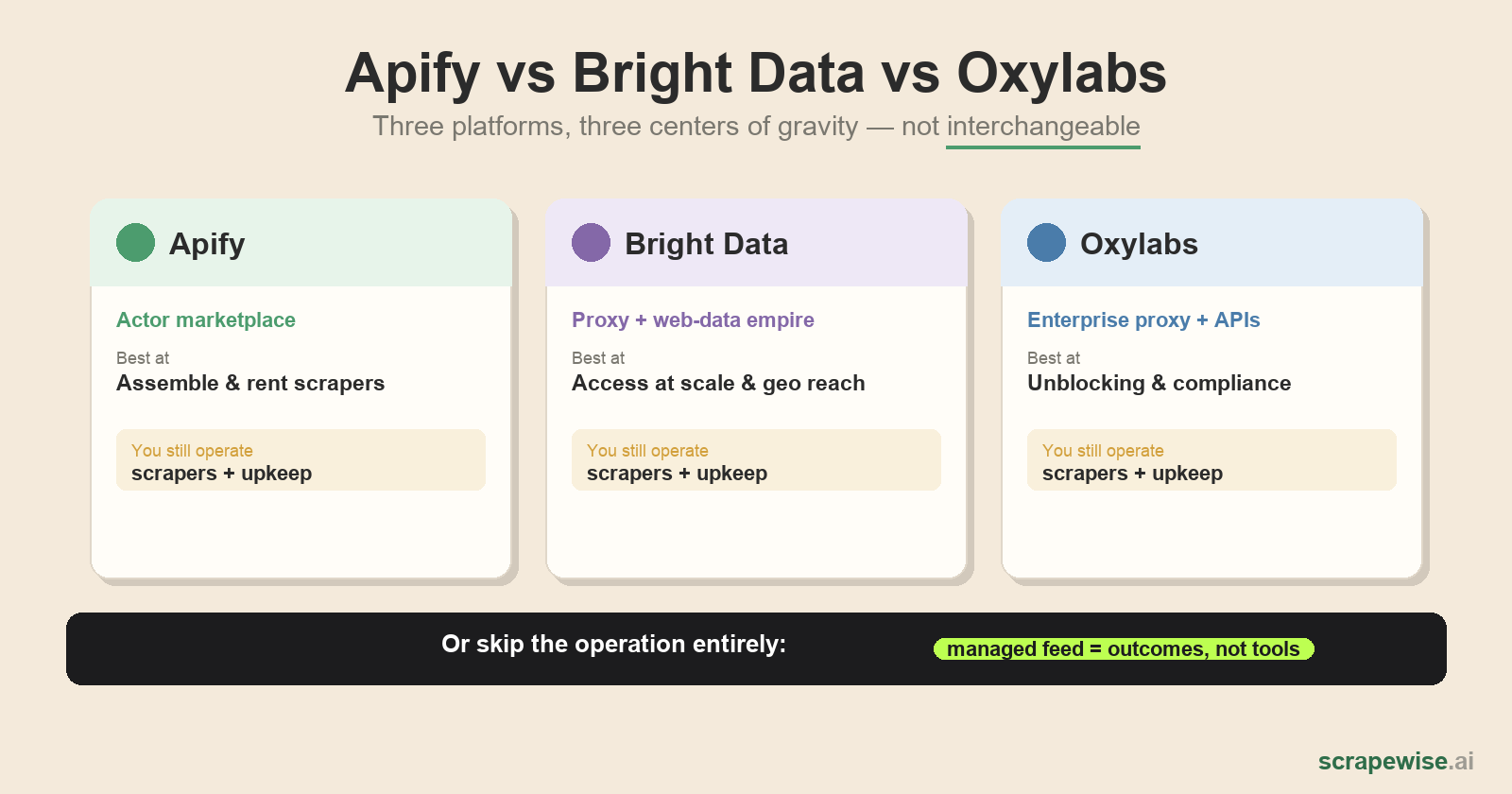
These three names come up in every web-scraping shortlist, which creates the impression they're interchangeable. They aren't. Apify, Bright Data, and Oxylabs are built around three different centers of gravity — an Actor marketplace, a proxy-and-data empire, and an enterprise proxy/scraper-API stack — and picking the wrong one means paying for capabilities you won't use while missing the one you needed.
This guide gives you the decision framework first, then what each platform is genuinely best at, how they price, and the option most "Apify vs Bright Data vs Oxylabs" comparisons leave out entirely.
Quick answer: choose Apify if your engineers want ready-made scrapers (Actors) they can rent, adapt and schedule. Choose Bright Data if getting past anti-bot systems at high volume, in many countries, is your hardest problem. Choose Oxylabs for similar proxy and scraper API strength with an enterprise contract and support. If you only want the data, a managed feed beats all three.
The Decision Framework: Start Here
Before comparing features, answer one question:
Do you want to operate scraping infrastructure, or do you just want the data?
- If you have engineers who will build, run, and maintain scrapers, you're choosing between these three platforms on the basis of marketplace, proxy quality, and price.
- If you want clean data delivered without running anything, none of the three is really your answer — you want a managed feed, and the comparison below tells you why.
A second tie-breaker for those staying DIY: is your bottleneck building scrapers or getting past anti-bot? If it's building, Apify's marketplace helps most. If it's blocking, Bright Data and Oxylabs compete on proxy/unblocking muscle.
All three bill on volume, so the first number you need is not a price — it's the size of the job. Our free product URL extractor takes one competitor category URL and returns the product pages inside it along with the URL patterns they sit under, which is the input to every cost model below. It also tells you whether that site answered a plain request or had to be reached through a proxy, which is the single biggest driver of what any of these three will actually charge you.
What Each Platform Is Built For
Apify is a developer platform and Actor marketplace. Its strength is reusable scrapers ("Actors") you rent or build, plus the orchestration to run them. You bill on compute units, proxies, and Actor rental — flexible, but consumption-based, so your cost moves with job difficulty. Best when you want to assemble scrapers fast and have engineers to wire them in.
Bright Data is a proxy and web-data empire. Its core is one of the largest residential proxy networks, layered with unblocking tools, scraper APIs, and pre-collected datasets. Best when your hardest problem is access — getting past aggressive anti-bot at scale and across geographies — and you'll pay for that reach.
Oxylabs is an enterprise proxy and scraper-API provider. Similar shape to Bright Data — strong proxy pools plus dedicated scraper APIs (SERP, e-commerce, web) — pitched at enterprise reliability, compliance, and support. Best for larger teams that want managed unblocking infrastructure with an enterprise relationship.
How They Compare
| Apify | Bright Data | Oxylabs | |
|---|---|---|---|
| Center of gravity | Actor marketplace + platform | Proxy network + web data | Enterprise proxy + scraper APIs |
| Best at | Assembling/renting scrapers | Access at scale & geo reach | Enterprise unblocking & support |
| Pricing model | Compute units + proxy + rental | Proxy GB + product tiers | Proxy/API usage, enterprise quotes |
| You still operate scrapers | Yes | Yes (or use their APIs) | Yes (or use their APIs) |
| Anti-bot handling | Your job (with their proxies) | Strong unblocker products | Strong unblocker products |
| E-commerce scraping | Ready-made Store Actors for Amazon, Shopify and other retailers, many maintained by community developers | Web Scraper API and Web Unlocker, plus ready-made datasets | Web Scraper API with dedicated sources for Amazon, Walmart, eBay, Target and other marketplaces |
| AI and LLM data | Website Content Crawler outputs Markdown for RAG pipelines; MCP server lets AI agents run Actors | SERP API, Web Unlocker and an MCP server for AI agents | AI Studio, OxyCopilot and an official MCP server |
| Proxy network | Shared and dedicated datacenter, residential and Google SERP proxies; pool size not published; own proxies supported | Residential, ISP, datacenter and mobile; 400M+ monthly residential IPs in 195 countries (vendor claim, Sept 2026) | Residential, mobile, datacenter and ISP; 175M+ residential IPs in 195+ countries (vendor claim, Sept 2026) |
| Extraction tooling | Build or rent Actors, with scheduling, storage and JSON, CSV or XML export | Web Scraper API, Browser API, Scraper Studio and datasets from 120+ sites | Web Scraper API with parsing, plus OxyCopilot to generate scraper code |
| Best fit | Engineering teams, fast assembly | Access-hard, high-volume jobs | Enterprise, compliance-driven |
For exact per-request and per-GB rates across these and other providers, see our scraping API pricing comparison — the numbers move often enough that we keep them in a dedicated, updated post rather than quoting them here.
Head-to-Head: Which Platform Wins for Your Use Case?
It depends on the job. Apify fits teams that want ready-made scrapers they can adapt and run on a schedule. Bright Data fits high-volume work that needs large proxy pools and unblocking. Oxylabs covers similar ground, with dedicated scraper targets for sites like Amazon, Walmart and eBay. Each question below covers one matchup.
Should You Use Apify or Oxylabs for Web Scraping?
Use Apify if you want to start from a ready-made scraper and adapt it. Its Store covers many popular sites, and you pay for the compute you use. Use Oxylabs if your scrapers already exist and the problem is access. Its residential proxies, Web Unblocker and Web Scraper API are built for high-volume work on well-protected sites, sold with enterprise support.
You can also combine them. Apify accepts your own proxies, so some teams keep Apify's tooling and buy access elsewhere.
How Does Apify Compare to Oxylabs for E-commerce Scraping?
Apify gets you started fastest, with ready-made Store Actors for Amazon, Shopify and other retailers. Many of those Actors are maintained by community developers, so results can dip after a retailer changes its anti-bot setup, until someone patches the Actor. Oxylabs runs dedicated e-commerce sources in its Web Scraper API, such as Amazon, Walmart and eBay, and handles unblocking on its side.
We measured how scrapers hold up on real retail targets in our Amazon and Shopify anti-bot benchmark, and looked at other options in Oxylabs alternatives for price monitoring. For ongoing price and stock monitoring, neither platform removes the upkeep, which is where a managed feed beats all three.
Apify vs Bright Data: Which Has Better Proxy Infrastructure?
Bright Data. Proxies are its core business: residential, ISP, datacenter and mobile networks, with 400M+ monthly residential IPs across 195 countries (vendor claim, Sept 2026) and geo-targeting included. Apify sells shared and dedicated datacenter, residential and Google SERP proxies, mainly as a convenience for running Actors. It does not publish a pool size, and you can plug in your own proxies.
If access is your hardest problem, compare Bright Data with Oxylabs rather than Apify, or read our Bright Data alternatives for price monitoring.
Apify vs Bright Data: Which Is Better for Data Extraction?
Apify is better if you want control over the extraction logic. You build or rent Actors, pick the fields, schedule runs and export JSON, CSV or XML. Bright Data is better if you want extraction as an API or as finished data. Its Web Scraper API returns structured records from 120+ sites, and its datasets let you skip scraping for those sites.
Either way, your team still owns the schema and fixes breakages when target sites change. That is the hidden cost covered below.
Bright Data vs Oxylabs vs Apify: Which Is Better for AI Search and Large-Scale Crawling?
For AI search grounding and large-scale crawling, Bright Data and Oxylabs have the edge. Both return live Google search results through their APIs, handle unblocking and run large proxy networks for high-concurrency crawling, and both offer MCP servers that AI agents can call. Apify is strongest at turning websites into LLM-ready text: its Website Content Crawler outputs Markdown for RAG pipelines.
If you are weighing real-time options on price, see our real-time scraping APIs compared by cost per usable row.
Oxylabs vs Apify: Which Is Better for AI Data Infrastructure?
Choose Oxylabs when AI data infrastructure means a steady, high-volume supply of fresh web data, with proxies, the Web Scraper API, AI Studio and an official MCP server from one vendor. Choose Apify when you build your own AI pipelines: agents can run Store Actors through its MCP server, and it connects to LangChain, LlamaIndex, Pinecone and Qdrant.
If your model needs structured product and price data rather than raw pages, ScrapeWise delivers validated rows by REST API or CSV that you can feed to any LLM, from 36 ready-made scraping API endpoints you call directly.
The Hidden Cost All Three Share
Every one of these platforms hands you tools, not outcomes. You still own the work that sits around the tool: writing and maintaining scrapers, choosing and rotating proxies, handling layout changes, parsing and cleaning data, and re-fixing everything each time a target updates its anti-bot. That maintenance is the recurring theme in our guide on scraping without getting blocked — it's the 80% of the work the demos don't show. The platform fee is the visible cost; the engineer-weeks are the real one.
When a Managed Feed Beats All Three
If your goal is competitor prices, stock, and product data landing in your systems — not a scraping operation — the platform comparison is the wrong comparison. A managed service like ScrapeWise sits one layer up: we run the scrapers, the proxies, and the anti-bot handling, and deliver structured, validated data on a scoped, predictable basis. You compare outcomes and reliability, not compute units and proxy GB.
The honest trade-off: ScrapeWise is a managed feed rather than a toolkit, so if what you want is a platform to build on tonight, one of these three gives you more knobs to turn. On price there's less to weigh up — no plan and no compute units, just a balance you top up and a charge per delivered page from €0.15 per 1,000, with 5 free requests on every new account. But if you've already learned that the tool is the easy part and the upkeep is the cost, a managed feed removes the part you were going to outsource to your own engineers anyway.
So Which Should You Pick?
- Choose Apify if engineers will assemble scrapers and the marketplace saves you build time — and you can budget consumption-based cost.
- Choose Bright Data if raw access at scale and geographic reach is your hardest problem.
- Choose Oxylabs if you want enterprise-grade unblocking infrastructure with the support and compliance an enterprise relationship brings.
- Choose a managed feed (ScrapeWise) if you want the data, not the operation — and would rather pay for clean records than meter your own infrastructure.
We also keep short two-way comparisons: Scrapewise as an Apify alternative and Scrapewise as a Bright Data alternative.
If that last line is you, book a call and we'll scope the exact sources, fields, and cadence you need — and tell you honestly if building it yourself on one of these platforms would serve you better. For a closer look at the DIY route, start with our Apify alternative breakdown.
Paste a URL your current tool cannot reach
See why teams switch to ScrapeWise. 97% accuracy benchmark, no per-SKU pricing.
97% accuracy on Amazon benchmarks · no credit card · book a 15-min call →