

Short answer: pick Apify if the thing standing between you and the data is that you have no scraper. Pick Bright Data if you have scrapers and the sites are refusing them. If you want the rows rather than the operation, neither is the shape you want — a managed feed charges from €0.15 per 1,000 delivered pages and there is nothing to meter.
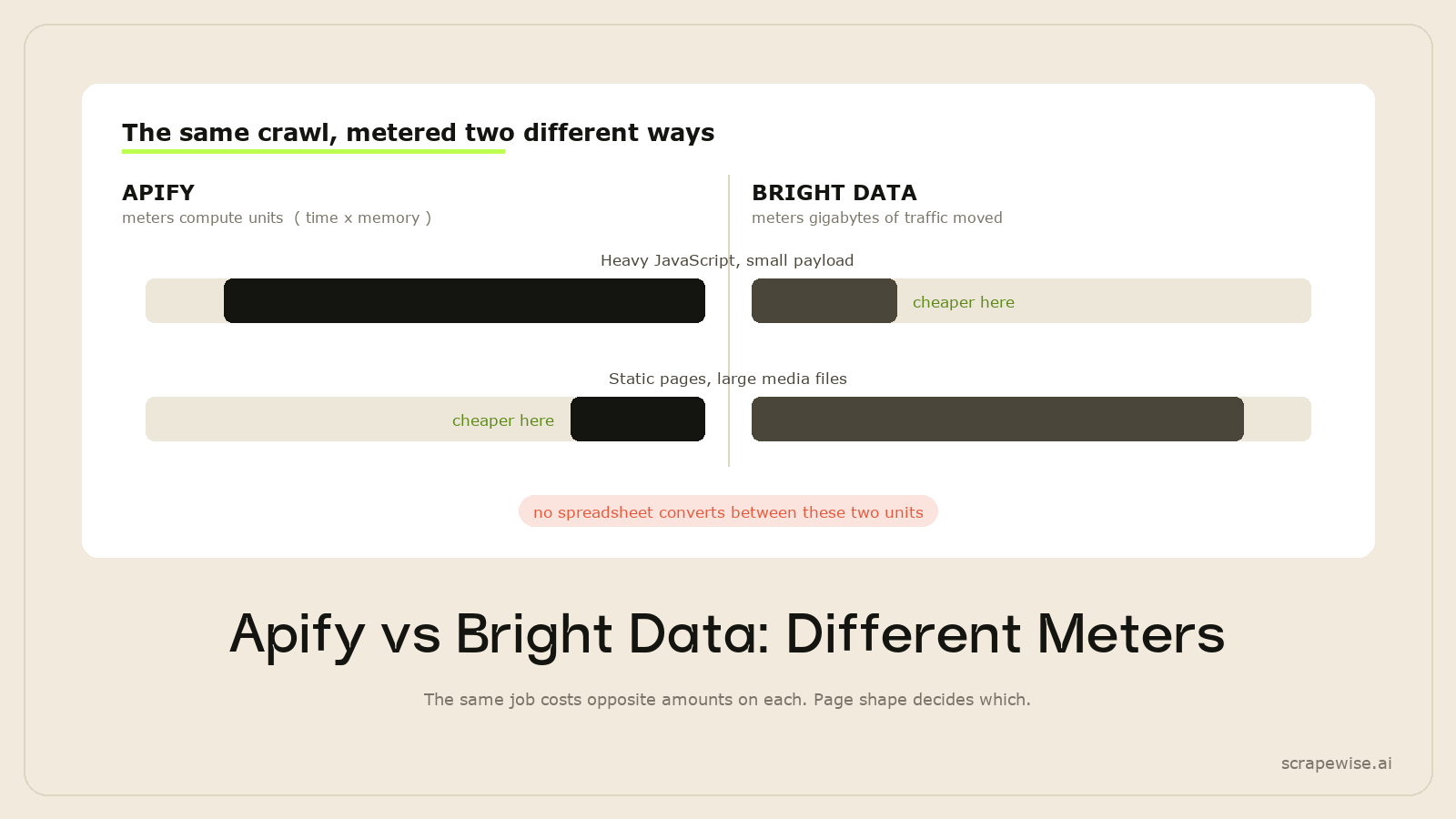
The two get shortlisted together constantly, which hides the fact that they are not competing products. Apify sells assembly. Bright Data sells access. The reason that distinction matters in euros rather than in adjectives is further down: the two platforms meter different units, so the same crawl can be cheap on one and expensive on the other with nothing about the job changing.
Choose Before You Read
| Your situation | Better fit |
|---|---|
| No scraper yet, want something running this week | Apify |
| Scrapers exist and work, but sites are blocking them | Bright Data |
| Heavy JavaScript pages, small payloads | Bright Data (see metering) |
| Light HTML pages, large payloads or many images | Apify |
| You need a specific country, city or carrier IP | Bright Data |
| You want to own and version the extraction logic | Apify |
| The site is already solved by someone else | Apify — rent the Actor |
| You want finished data for a site you don't want to crawl | Bright Data datasets |
| You want rows in your database, not a scraping stack | Neither — see below |
Two Different Products Wearing the Same Category Label
Apify is a developer platform wrapped around a marketplace. The asset is the Store: several thousand pre-built scrapers ("Actors") you rent or fork instead of writing (apify.com/store, checked September 2026). Around them sits the orchestration you would otherwise build — scheduling, retries, key-value and dataset storage, and export to JSON, CSV or XML. You supply the judgement about what to extract; Apify supplies the scaffolding and, often, the first draft.
Bright Data is a proxy network with products grown on top of it. The core is one of the largest residential pools in the market — 400M+ monthly residential IPs across 195 countries (vendor claim, Sept 2026) — plus ISP, datacenter and mobile. Web Unlocker, the Web Scraper API, Browser API, Scraper Studio and pre-collected datasets from 120+ sites (vendor claim, Sept 2026) are all layers that exist because the network exists.
So the honest framing is not "which platform is better". It is which half of the job is currently costing you more: writing the scraper, or getting the page back.
The Real Difference: They Meter Different Units
This is the part most comparisons skip, and it is the part that decides your invoice.
Apify meters work. Its unit is the compute unit — a function of how long a run takes and how much memory it holds while running. A page that takes a headless browser 30 seconds to settle costs roughly six times a page that settles in five, whether the response was 4 KB or 4 MB.
Bright Data meters traffic. Proxy products bill on gigabytes moved. A 4 MB page with hero images, web fonts and a video poster costs the same whether it rendered instantly or fought you for half a minute.
Those are not two prices for the same thing. They are two different shapes, and they invert:
| Page shape | Expensive on | Cheap on |
|---|---|---|
| Heavy JS, slow to settle, small HTML payload | Apify (long run, high CU) | Bright Data (few KB) |
| Static HTML, instant, media-rich | Bright Data (many MB) | Apify (short run) |
| Infinite scroll, many small XHR calls | Apify (long session) | Bright Data (small total) |
| PDF or image catalogues | Apify (fast) — cheap | Bright Data — expensive |
The practical consequence: you cannot compare these two on a price page. You have to know the shape of your target. A team quoting Apify against Bright Data on list rates alone is comparing a per-second rate to a per-megabyte rate and drawing a conclusion from neither.
How to settle it in an afternoon
- Take ten representative URLs from the actual sites you need — not the vendors' demo targets.
- Record, per URL: time to a fully settled DOM, and total transferred bytes. Browser DevTools gives you both.
- Multiply time by Apify's rate for the memory tier your job needs; multiply bytes by Bright Data's proxy rate.
- Note how many of the ten needed a proxy at all. Pages that answer a plain request are nearly free on either.
That last point is the biggest single swing, and it is the one people guess at. Our free product URL extractor takes one competitor category URL, returns the product pages inside it, and tells you whether the site answered directly or had to be reached through a proxy — which is the input to both sides of the arithmetic above.
For current per-request and per-GB rates across both vendors and others, we keep a separate scraping API pricing comparison rather than quoting numbers here that move every quarter. Apify's own metering model is broken down in compute units explained.
Apify vs Bright Data: Side by Side
| Apify | Bright Data | |
|---|---|---|
| Centre of gravity | Actor marketplace + platform | Proxy network + web data |
| Billing unit | Compute units (time × memory), proxy, Actor rental | Proxy GB, per-record API calls, dataset licences |
| Best at | Assembling and running scrapers fast | Getting through at scale and across geographies |
| Proxy network | Shared and dedicated datacenter, residential, Google SERP; pool size not published; own proxies supported | Residential, ISP, datacenter, mobile; 400M+ monthly residential IPs in 195 countries (vendor claim, Sept 2026) |
| Geo-targeting | Country level | Country, state, city, ASN and carrier |
| Anti-bot handling | Your job, using their proxies | Web Unlocker handles it as a product |
| E-commerce | Store Actors for Amazon, Shopify and other retailers, many community-maintained | Web Scraper API and Web Unlocker, plus ready-made retail datasets |
| Finished data available | No — you run something | Yes — datasets from 120+ sites |
| AI and LLM data | Website Content Crawler outputs Markdown for RAG; MCP server lets agents run Actors; LangChain, LlamaIndex, Pinecone, Qdrant integrations | SERP API, Web Unlocker and an MCP server for agents |
| Extraction logic ownership | Yours — fork the Actor, version it | Theirs on the API; yours in Scraper Studio |
| Who fixes a broken parser | Actor maintainer, or you | Bright Data, on their APIs |
| Procurement shape | Self-serve, card, usage-based | Self-serve to enterprise contract |
| Best fit | Engineering teams, fast assembly | Access-hard, high-volume, geo-specific work |
Apify's Real Asset Is the Store — and Its Real Risk Is Too
Renting an Amazon scraper instead of writing one is a genuine week saved, and it is why Apify wins evaluations where speed to first data is the criterion.
The part that deserves scrutiny is maintenance ownership. A large share of Store Actors are maintained by independent developers, not by Apify. When a retailer changes its markup or tightens its anti-bot, the Actor's output degrades — and it stays degraded until whoever owns it ships a patch. There is no SLA on a community Actor's response time, because there is no contract with the community.
That is an acceptable risk for exploration and an uncomfortable one for a daily price feed. The mitigation is knowable in advance, so check it before you commit:
- Who publishes it — Apify's own Actors behave differently from community ones.
- Last modified date. An Actor untouched for eight months against a site that redesigns twice a year is a liability.
- Issue backlog and response times, which are visible on the Store listing.
- Whether you can fork it. If the source is available, you inherit the ability to fix it yourself — which converts an unmanaged dependency into ordinary technical debt.
The failure mode to design around is quiet: the run still succeeds, the schema still validates, and a field comes back empty or stale. Whoever consumes that number downstream is the first to notice, usually after acting on it.
Bright Data's Real Asset Is Depth of Access
If your problem is that a site simply will not return pages at volume, Bright Data is the category of product that fixes it — and the depth of the network is the reason.
The dimension that matters more than raw pool size is targeting granularity. Country-level rotation is table stakes. Bright Data lets you pin state, city, ASN and mobile carrier, which is the difference between "German prices" and "the price this retailer shows a customer in Munich on a mobile network." For retailers who segment by region or device class, that is not a nicety; it is whether the number you collected is the number a shopper sees.
Web Unlocker is the other structural difference. On Apify, anti-bot is your problem solved with their proxies. On Bright Data it is a product with a success-based shape: you ask for a URL and it deals with the challenge, the fingerprint and the retry. You are buying an outcome at the request level rather than assembling one.
The trade-off is that you are buying access, not answers. Bright Data returns the page. Turning that page into clean validated rows, and keeping it that way through layout changes, is still yours — unless you use the Web Scraper API or a dataset for a site they already cover, in which case the parser is theirs to keep alive.
Apify vs Bright Data for E-commerce Scraping
Apify gets you to a first result fastest. Bright Data holds up better under sustained pressure.
For a one-off study — a few hundred product pages to size a market — a Store Actor is the shorter path and the cheaper one. For a daily competitor price feed across marketplaces that actively fight collection, three things change:
- Blocks compound. A 5% failure rate looks fine in a spot check and produces a visibly wrong average over a month, because blocks are not random — they concentrate on the biggest, best-defended retailers, which are the ones whose prices you most wanted.
- Coverage decays silently. Delisted URLs and redesigned templates shrink the dataset without failing the job. A green run on a shrinking set of URLs is indistinguishable from a healthy one unless you measure coverage explicitly.
- Matching is nobody's job. Neither platform decides that a competitor's listing is the same product as your SKU. That step decides whether a price comparison is true at all, and it sits outside both products.
We measured how scrapers hold up on real retail targets in our Amazon and Shopify anti-bot benchmark. For the adjacent shortlist, see Bright Data alternatives for price monitoring and Apify alternatives for e-commerce data.
Apify vs Bright Data for AI and LLM Pipelines
The split here is unusually clean.
Apify is better at turning websites into text a model can use. Website Content Crawler outputs Markdown shaped for RAG, and its MCP server lets an agent call Store Actors as tools. The integrations with LangChain, LlamaIndex, Pinecone and Qdrant mean the output lands where a retrieval pipeline expects it.
Bright Data is better at grounding and volume. Live Google results through the SERP API, Web Unlocker for pages that refuse agents, an MCP server of its own, and datasets when you want the corpus without the crawl.
The distinction in one line: Apify is better when you build the pipeline; Bright Data is better when the pipeline needs a supply it can trust to keep arriving. If your model needs structured product and price rows rather than page text, see real-time scraping APIs compared by cost per usable row.
Can You Use Both?
Yes, and it is a common configuration rather than a hedge.
Apify accepts external proxies. So the sensible hybrid is Apify for orchestration, scheduling and extraction logic, with Bright Data proxies plugged in for the targets that refuse Apify's own pool. You pay Apify for compute and Bright Data for access, and each vendor bills for the thing it is actually good at.
The cost to watch is that you now hold two contracts, two dashboards and two support relationships for one pipeline — and when data goes wrong, the first hour goes on establishing which layer failed.
Switching Between Them
If you are already on one and considering the other, the migration cost is asymmetric.
Apify → Bright Data is the harder direction. You are leaving the orchestration behind, not just the proxies. Scheduling, storage, retries and export all have to be rebuilt or bought elsewhere, and any Actor you rented is not portable — its extraction logic leaves with it unless you forked the source.
Bright Data → Apify is easier. Proxy configuration is a connection string; if you were using raw proxies, you point them at Apify and keep working. It gets harder in proportion to how much you relied on Web Scraper API parsers or datasets, because those are outputs you were not maintaining and now will be.
Either way, keep both running in parallel for a full billing cycle and diff the outputs. A silent field-level regression is the normal failure of a scraping migration, and it does not show up in a smoke test.
What Both Invoices Leave Out
Both hand you tools. You still own everything around the tool: writing and maintaining scrapers, rotating proxies, absorbing layout changes, parsing and validating, deciding which competitor listing corresponds to your SKU, and re-fixing all of it each time a target updates its defences.
That upkeep is the recurring theme in our guide to scraping without getting blocked. The platform invoice is the visible cost. The engineer-weeks are the real one, and they appear on neither pricing page.
When Neither Is the Answer
If what you want is competitor prices, stock levels and product data arriving in your systems — not a scraping operation to run — then this comparison is the wrong one to be having.
ScrapeWise sits a layer above both: we run the scrapers, the proxies and the anti-bot handling, match competitor listings to your SKUs, and deliver structured, validated rows by REST API or CSV. You compare outcomes and reliability rather than compute units and proxy gigabytes.
The honest trade-off: ScrapeWise is a feed, not a toolkit. If you want a platform to build on tonight, Apify gives you far more knobs. On price there is less to weigh — no plan and no compute units, just a balance you top up from €5 that never expires, and a charge per delivered page from €0.15 per 1,000, with 5 free requests on every new account.
You can also call 36 ready-made scraping API endpoints directly, or read the two-way write-ups: ScrapeWise as an Apify alternative and ScrapeWise as a Bright Data alternative.
So Which Should You Pick?
- Apify — you need scrapers and don't have them, your pages are light and fast, and you want to own the extraction logic. Budget for consumption-based cost that rises with job difficulty.
- Bright Data — you have scrapers and they're getting blocked, or you need city- and carrier-level geo-targeting, or you want finished data for a site you'd rather not crawl at all.
- Both — Apify for orchestration, Bright Data proxies for the targets that refuse it. Sensible, and cheaper than forcing either to do the other's job.
- Neither — you want clean rows on a schedule and would rather pay for delivered pages than meter your own infrastructure.
For the third name that usually appears on this shortlist, see Bright Data vs Oxylabs and Oxylabs vs Apify, or the full three-way overview.
Book a call and we'll scope the exact sources, fields and cadence — and tell you honestly if building it yourself on one of these platforms would serve you better.
Paste a URL your current tool cannot reach
See why teams switch to ScrapeWise. 97% accuracy benchmark, no per-SKU pricing.
97% accuracy on Amazon benchmarks · no credit card · book a 15-min call →