

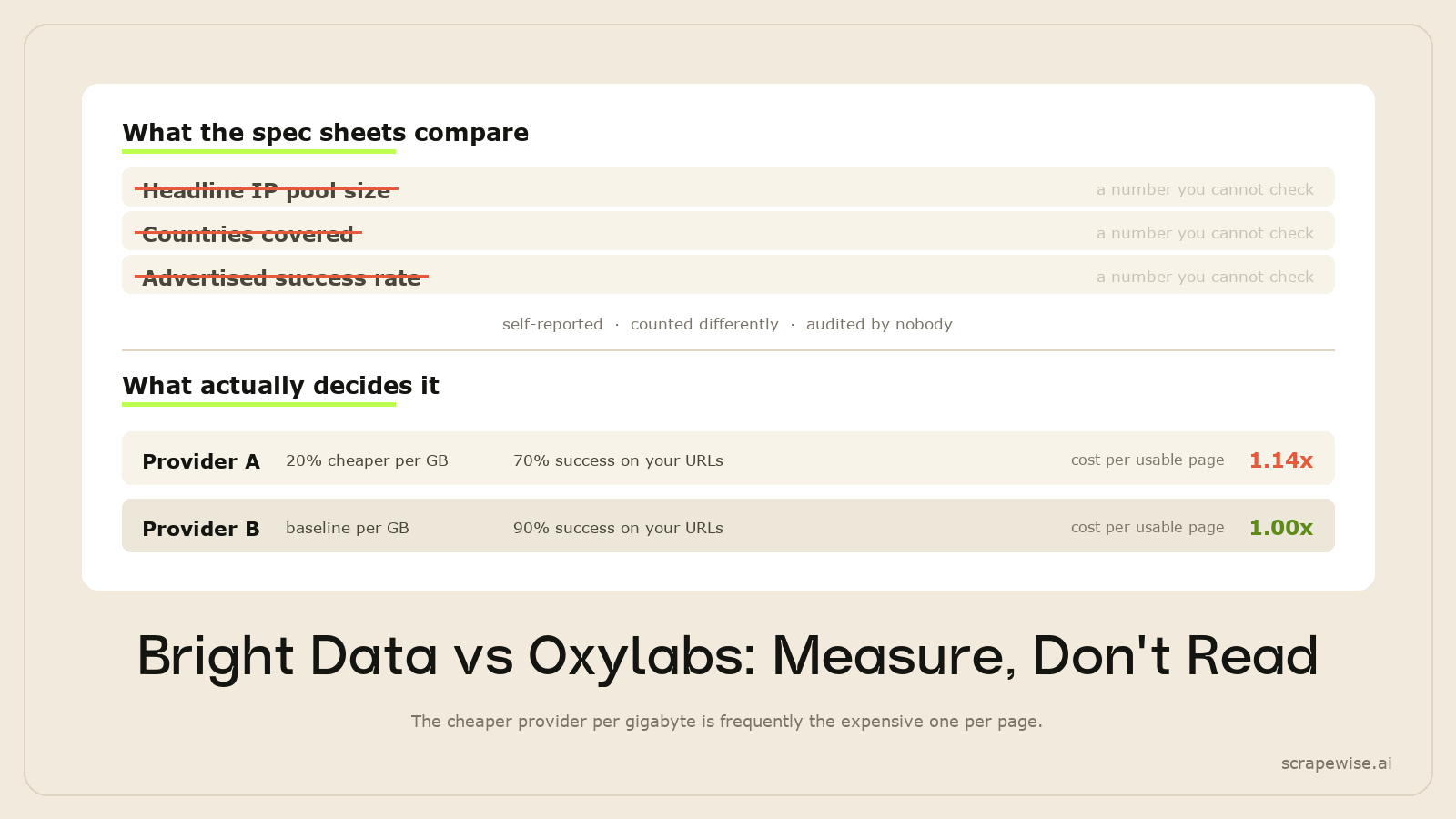
Short answer: these two are closer to each other than either is to anything else in the category, and the published specs will not separate them. Bright Data has the broader product surface and the deeper geo-targeting. Oxylabs has the tighter enterprise and compliance posture. On the thing that actually decides it — whether requests come back from your target sites — the only honest answer is a measurement you run yourself, and this post gives you the method.
That is an unsatisfying opening, so here is why it is the correct one. Nearly every Bright Data vs Oxylabs comparison online lines up two spec sheets and declares the bigger number the winner. Those numbers are self-reported, counted differently by each vendor, and audited by nobody. Buying a proxy network on advertised pool size is like buying a car on advertised top speed when your whole problem is a hill outside your house.
Choose Before You Read
| Your situation | Better fit |
|---|---|
| Need city, ASN or mobile-carrier level targeting | Bright Data |
| Enterprise procurement, compliance paperwork is a gate | Oxylabs |
| Want ready-made datasets rather than running crawls | Bright Data |
| Want a single vendor with strong support on a long contract | Oxylabs |
| Testing, budget under a few hundred euros a month | Neither — see below |
| You want matched product rows, not raw pages | Neither — see below |
Two Vendors Selling the Same Shape of Thing
Both companies are proxy-first infrastructure vendors that have layered scraping products on top. Both sell residential, mobile, datacenter and ISP proxies. Both sell an unblocking product that handles anti-bot work on their side. Both sell e-commerce-specific scraper endpoints. Both ship an MCP server so AI agents can call them. Both meter the same unit — gigabytes of traffic moved.
That last point matters more than it sounds, and it is the one genuine advantage of this comparison over most others in the category. When two vendors bill the same unit, a like-for-like comparison is actually possible. You cannot do that between, say, Apify and Bright Data, where one bills compute units and the other bills gigabytes, and no spreadsheet converts between them.
Here the units line up. So the comparison is winnable — just not from the pricing page.
The Spec Sheet Is the Wrong Comparison
Here is what each vendor publishes:
| Bright Data | Oxylabs | |
|---|---|---|
| Residential pool (vendor claim, Sept 2026) | 400M+ IPs | 175M+ IPs |
| Countries | 195 | 195+ |
| Targeting granularity | Country, state, city, ASN, mobile carrier | Country, state, city, ASN |
| Proxy types | Residential, mobile, datacenter, ISP | Residential, mobile, datacenter, ISP |
| Unblocking product | Web Unlocker, Scraping Browser | Web Unblocker, Web Scraper API |
| Pre-built datasets | Yes, 120+ sites | Limited |
| AI surface | MCP server, agent tooling | AI Studio, OxyCopilot, MCP server |
Read that table the way most buyers do and Bright Data wins on pool size, 400 against 175. Now consider three things that table cannot tell you.
The counts are not measuring the same thing. Residential pool figures are typically "unique IPs observed over a period", and the period is rarely stated in the same way twice. A pool counted over 30 days will be several times larger than the same pool counted at any instant. Neither figure is audited. Neither is comparable to the other without a methodology both vendors have no commercial reason to publish.
Pool size is not the binding constraint anyway. You are never using 400 million IPs. You are using however many are available in the country and city your target site cares about, with enough freshness that the target has not already seen and flagged them. A pool of 400 million that is thin in Estonia is worse for an Estonian retail crawl than a pool of 175 million that is dense there. The headline number tells you nothing about the slice you will actually draw from.
The bill follows bytes, not success. This is the one that costs real money. Residential proxy billing counts traffic moved, and a blocked response is traffic. A CAPTCHA page, a 403 with a full HTML body, a JavaScript challenge that loads before it refuses you — you are billed for all of them. Two providers quoting the same rate per gigabyte can differ substantially in what you pay per usable page, because one of them fails more often on your specific targets and you pay for every failure.
The number that actually decides it
Not cost per gigabyte. Cost per successful, parsed page on your own target list.
The arithmetic is unforgiving. Suppose provider A quotes 20% less per gigabyte than provider B. On your targets, A returns a usable page 70% of the time and B returns one 90% of the time. Ignoring the retry traffic entirely, A's effective cost per usable page is 0.8 / 0.7 = 1.14× B's. The cheaper provider is 14% more expensive, and that is before counting the bytes burned on the failures themselves — which, since blocked responses are billed, pushes the gap wider still.
Neither vendor can tell you those success rates, because they depend on your sites, your geographies, your concurrency and your request patterns. You have to measure them.
How to settle it in an afternoon
- Take 200 real URLs from your actual target set — not a benchmark list, not the vendor's demo site. Include the two or three sites that give you the most trouble today, because those are the ones the decision is really about.
- Run all 200 through both, same day, same concurrency, same geography, using each vendor's trial credit.
- Count three things per provider: how many returned a page you can parse, total bytes billed, and total wall-clock time.
- Divide billed spend by successful pages. That single number is your answer, and it is frequently the reverse of what the spec sheets imply.
Do this before you sign anything annual. Both vendors sell long contracts, and both will be happy to let you find out afterwards.
Where Bright Data Is Genuinely Ahead
Targeting granularity. Down to mobile carrier, which matters if you are checking whether a retailer prices differently for visitors on a given network, or verifying carrier-specific ad delivery. Oxylabs stops at ASN. For most price monitoring this is irrelevant. For the cases where it matters, nothing else substitutes.
Pre-built datasets. Bright Data sells finished datasets from 120+ sites (vendor claim, checked September 2026), which is a meaningfully different product from selling you access and wishing you luck. If one of those datasets matches your need exactly, you skip the crawl, the parser and the maintenance in one purchase. Check the coverage list before assuming this applies — the fit is either exact or useless.
Product surface. Web Unlocker, Scraping Browser, SERP API, datasets, agent tooling. More of the problem space is covered by one vendor. That is a real benefit if you want one invoice, and a real risk if you end up depending on four products from a single supplier.
Where Oxylabs Is Genuinely Ahead
Compliance posture as a procurement asset. Oxylabs positions harder on KYC, ethical sourcing and compliance documentation, per its own ethical proxy sourcing pages, checked September 2026. If your legal team has to sign off on where residential IPs come from — and in regulated industries or larger enterprises they will — the vendor that hands you that paperwork without a fight is worth more than a bigger pool. This is the single most common reason enterprise buyers pick Oxylabs, and it is not a technical reason at all.
Account management. Oxylabs is structured around named support on enterprise plans. When a crawl that ran fine on Tuesday collapses on Wednesday, the difference between a ticket queue and someone who knows your account is the difference between hours and days. Price that.
Narrower is not worse. Bright Data's breadth is genuinely an advantage; it is also more surface to evaluate, more products to be sold, and more places to end up on a plan you did not need. Oxylabs is easier to hold in your head.
Bright Data vs Oxylabs for E-commerce Scraping
Both sell dedicated e-commerce endpoints — Bright Data through its Web Scraper API and dataset catalogue, Oxylabs through Web Scraper API sources for Amazon, Walmart, eBay and Target.
For retail work, three things decide it, and none of them is pool size:
- Does the endpoint cover your actual retailers? Both cover the American majors comprehensively. Regional European retail — the Baltic, Nordic and DACH grocers and electronics chains where a lot of real price monitoring happens — is where coverage thins out on both, and where you will end up writing custom parsers regardless of which you choose.
- Does it survive a redesign? A dedicated endpoint that the vendor maintains is worth far more than a raw proxy, because the parser breakage is theirs. On sites where you are using raw proxies instead, that maintenance is permanently yours.
- What happens to price accuracy at the margin? A 92% success rate does not mean 8% missing data. It means 8% of your SKUs have a stale price, and stale prices look exactly like current ones in a dashboard. This is the failure mode that actually damages pricing decisions, and neither vendor surfaces it — you have to instrument coverage yourself.
We covered adjacent options in Oxylabs alternatives for price monitoring and Bright Data alternatives for e-commerce.
Bright Data vs Oxylabs for AI and LLM Pipelines
Both now sell into AI data supply, and both ship an MCP server so agents can call them as tools.
Bright Data leans on breadth: the dataset catalogue gives you bulk structured data without crawling, which suits training and enrichment work where you want volume now rather than a live pipeline.
Oxylabs leans on the live path: AI Studio and OxyCopilot sit on top of the scraper API, aimed at agents that need fresh pages on demand rather than a historical dump.
If what your model needs is structured product and price data rather than raw pages, the relevant comparison is real-time scraping APIs by cost per usable row, not proxy pool size.
Switching Between Them Is Cheap, Which Is Negotiating Power
Unusually for this category, the migration cost between these two is low. Both expose standard proxy endpoints. Both take credentials in the same place in your code. Moving a crawl from one to the other is a configuration change, not a rewrite.
Two consequences worth acting on:
You are not locked in, so do not negotiate as if you are. Annual commitments are the norm here and the discount is real, but a vendor that knows you can leave in an afternoon prices differently from one that knows you cannot.
The exceptions are where lock-in actually lives. Bright Data's datasets and Oxylabs' dedicated scraper sources are proprietary. A crawl built on raw proxies moves freely; a pipeline built on a Bright Data dataset or an Oxylabs Amazon source does not. If portability matters to you, keep the proprietary surfaces at the edge of your architecture rather than the centre.
The Cost Neither One Removes
Both sell access. Neither sells outcomes.
After the page comes back, you still own: parsing it, validating it, deciding which competitor listing corresponds to which of your SKUs, storing the history, detecting what changed, and re-fixing every one of those steps each time a retailer redesigns. That work does not appear on either pricing page and it does not stop.
The quiet version is the expensive one. A parser that breaks loudly gets fixed on Tuesday. A parser that silently returns the subscription price instead of the unit price produces a confident, wrong number that somebody makes a pricing decision on. Our guide to scraping without getting blocked covers the access half; the maintenance half is the one that compounds.
When Neither Is the Answer
If the outcome you want is competitor prices matched to your own catalogue, arriving on a schedule, then proxies are a component you are being asked to buy instead of a product.
A managed feed like ScrapeWise sits a layer above both: we run the proxies, the anti-bot handling, the parsers and — the part neither vendor sells at all — the matching that decides a competitor's listing is genuinely the same product as your SKU, across different titles, pack sizes and identifiers. You get validated rows, not pages.
The honest trade-off: ScrapeWise is a feed, not infrastructure. If you need raw proxy access to build something custom, both vendors here give you far more control than we do. On cost there is less to compare — no plan, no commitment, a balance you top up from €5 that never expires, and a charge per delivered page from €0.15 per 1,000 plain pages (€0.75 rendered, €1.50 for super/residential), with 5 free requests on every new account to run the 200-URL test above against us too.
You can also call 36 ready-made scraping API endpoints directly, or read the two-way write-ups of ScrapeWise as a Bright Data alternative and an Oxylabs alternative.
So Which Should You Pick?
- Bright Data — you need targeting granularity below country level, or one of their 120+ datasets matches your need exactly. Breadth is the reason, not pool size.
- Oxylabs — compliance documentation and named support are gating your purchase. This is a procurement decision more often than a technical one, and that is a perfectly good reason.
- Either, decided by measurement — for most buyers this is the real answer. Run 200 of your own URLs through both, divide billed spend by successful pages, and take the winner. The number frequently contradicts the spec sheets.
- Neither — you want matched, validated rows on a schedule and would rather not run scraping infrastructure to get them.
For the wider field, see Apify vs Bright Data vs Oxylabs, Apify vs Bright Data and Oxylabs vs Apify.
Paste a URL your current tool cannot reach
See why teams switch to ScrapeWise. 97% accuracy benchmark, no per-SKU pricing.
97% accuracy on Amazon benchmarks · no credit card · book a 15-min call →