

Short answer: this is not an either/or, and treating it as one is the most common mistake in the comparison. Camoufox is driven by Playwright. It exposes a Playwright-compatible API and returns a browser object your existing Playwright code can use. The real question is not "Camoufox or Playwright" — it is which browser binary you point Playwright at, and the honest answer is: stay on vanilla Chromium until a specific site blocks you, then switch only that job to Camoufox and accept a throughput ceiling roughly 15–20× lower.
That ceiling is the whole decision, and almost nobody prices it before committing. The rest of this post does.
Choose Before You Read
| Your situation | Use |
|---|---|
| Target has no active WAF, or a basic one | Playwright + Chromium |
| Getting blocked on Cloudflare Enterprise or PerimeterX | Playwright + Camoufox |
| 50,000+ pages per day on protected targets | Neither alone — see the arithmetic |
| Node.js codebase, do not want to adopt Firefox | Patchright |
| Mixed target list, some protected, some not | Both, routed per target |
| You want the data, not a browser fleet | Neither — see below |
The Framing Almost Everyone Gets Wrong
Playwright is an automation framework. It drives a browser over a protocol, exposes page.goto(), page.click(), selectors, waits and network interception, and it can drive Chromium, Firefox or WebKit.
Camoufox is a browser. Specifically, it is a fork of Firefox with stealth patches applied to the C++ source, so the signals anti-bot systems read — canvas fingerprinting, WebGL renderer strings, AudioContext behaviour, font metrics, network timing — are controlled at the binary level rather than patched over in JavaScript after the page loads.
These are different layers of the same stack. Camoufox ships a launcher that hands you a Playwright browser object. Your page logic — selectors, waits, extraction — does not change. What changes is what is underneath it.
So the comparison people mean when they type "camoufox vs playwright" is really:
Playwright + stock Chromium — fast, light, universally compatible, and detected instantly by any serious anti-bot system.
Playwright + Camoufox — 0% headless detection rate on standard bot-detection tests (vendor benchmark, checked September 2026), Firefox-only, and dramatically slower on challenged pages.
Framed that way, the question becomes answerable, because it collapses to a throughput question with actual numbers.
The 42-Second Ceiling Is the Whole Decision
Camoufox's headline benchmark is 0% headless detection. No other open-source Playwright stealth option matches it. The number that never appears next to it in a comparison post is this one:
42.49 seconds average to get through a Cloudflare Turnstile challenge (Camoufox's own published benchmarks, checked September 2026).
One important honesty note before the arithmetic: that 42 seconds is the challenged case. On a page that serves normally, Camoufox is roughly Firefox-speed and the penalty is small. The 42 seconds is what you pay on the pages that were blocking you — which, since those are precisely the pages you adopted Camoufox for, is the number that governs the jobs you actually run on it.
Work it through for one worker, running flat out:
| Playwright + Chromium (unchallenged) | Playwright + Camoufox (challenged) | |
|---|---|---|
| Time per page | ~2–3 s | ~42.5 s |
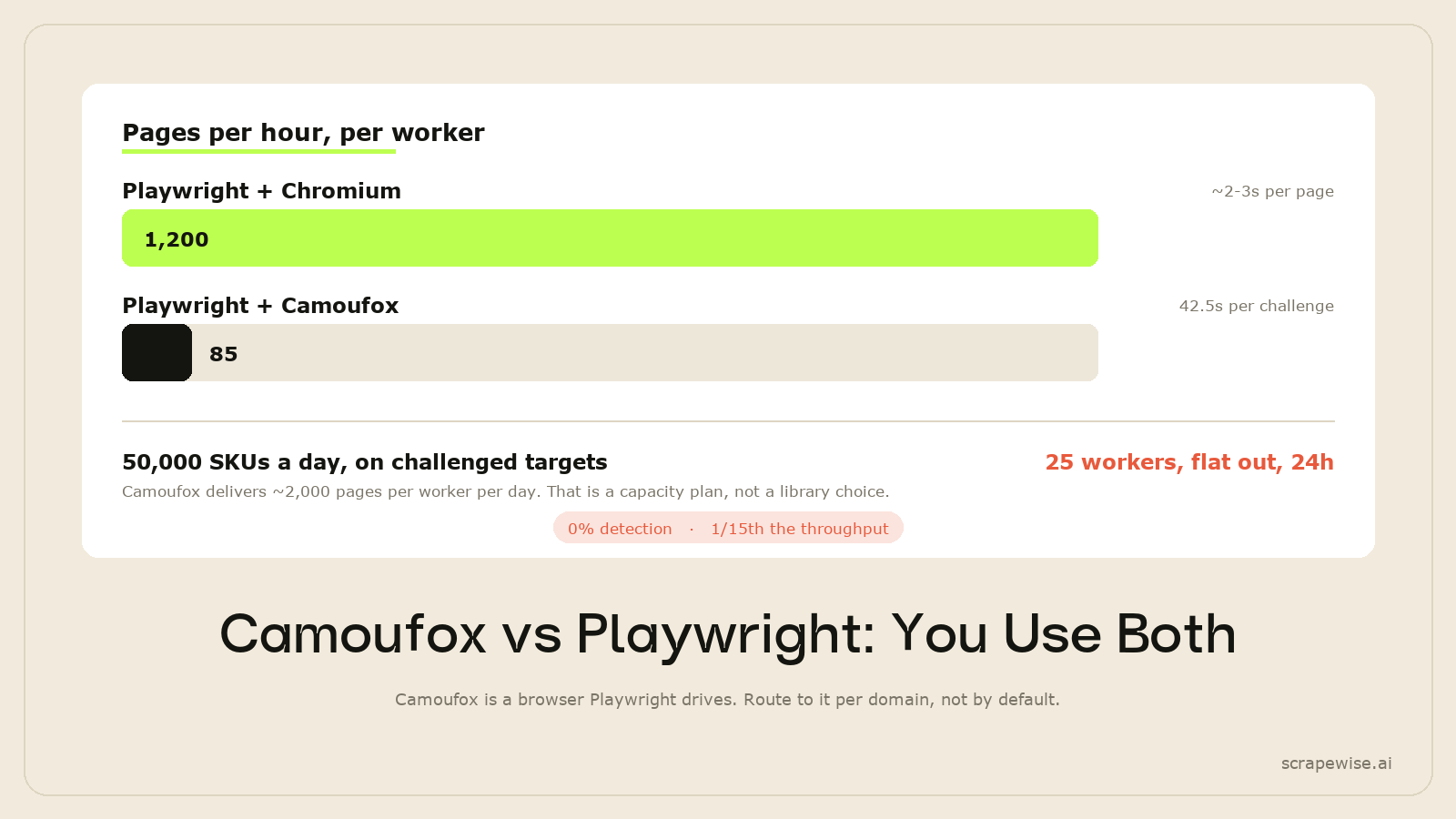
| Pages per hour, per worker | ~1,200–1,800 | ~85 |
| Pages per day, per worker | ~28,000–43,000 | ~2,000 |
| Memory per instance | ~200 MB | 200 MB+ per context |
Now put a real workload against it. 50,000 SKUs, refreshed daily, on Cloudflare-protected retailers:
50,000 ÷ 2,000 = 25 workers running flat out, 24 hours a day, at 200 MB+ each, with zero headroom for retries, redesigns or a target tightening its defences.
That is not a library choice. That is a capacity plan, a hosting bill and an on-call rota. The 0% detection rate is real and it is genuinely best in class — and it is affordable at low volume on high-value targets, and structurally unaffordable as a default.
The routing rule this implies
Do not pick one. Route per target.
- Default every job to Playwright + Chromium. It is 15–20× faster and it works on the majority of public retail pages, which do not run enterprise bot protection.
- Measure block rate per domain, not globally. A single 8% site-wide failure figure hides the fact that one target is failing 90% of the time and thirty others are at zero.
- Promote only the failing domains to Camoufox. Usually a small handful.
- Cap Camoufox concurrency separately from the rest of the fleet, because its memory and wall-clock profile is nothing like the default path.
This is the configuration that virtually every team converges on after paying for the alternative. It is worth skipping the tuition.
When Vanilla Playwright Is Genuinely Enough
There is a strong tendency to reach for stealth tooling at the first block. Often the block is not a fingerprinting problem at all, and Camoufox will not fix it.
Check these before switching browsers:
- Rate limiting. Getting 429s or sudden 403s after a burst is a request-rate problem. A stealthier browser sending the same burst gets blocked the same way, just 15–20× slower.
- Datacenter IP reputation. A flagged hosting-provider IP range is frequently refused outright rather than challenged. No browser fingerprint rescues a refused connection — that is a proxy problem, and the fix is residential or ISP egress, not a different binary.
- Missing or inconsistent headers. A mismatch between your User-Agent and the rest of your header set is a cheap tell and a cheap fix.
- Navigation patterns. Hitting 500 product URLs directly, in catalogue order, with no referrer and no session, reads as automation regardless of how the browser fingerprints.
Diagnose in that order. Switching to Camoufox to fix a proxy problem is expensive and does not work, and it is the single most common wasted migration in this space. Our guide to scraping without getting blocked walks the full diagnostic.
When Camoufox Earns Its Cost
The economics work when the data is high-value and low-frequency. Concretely:
- A protected retailer you cannot lose. If one Cloudflare Enterprise site holds a category you price against, 42 seconds a page for a few thousand pages a day is fine. Losing the source is not.
- Brand protection and MAP enforcement. You are checking a bounded set of listings for violations, not sweeping a catalogue. Volume is low, a false negative is expensive, and detection avoidance is worth paying for.
- Anything where being blocked mid-run corrupts the result. Partial coverage that looks complete is worse than a failure that announces itself.
The maintenance caveat is real and rarely mentioned. Camoufox is a Firefox fork maintained by a small team, and keeping pace with upstream Firefox security releases creates a lag. A detection vector discovered upstream may sit unpatched in the fork for a while. For a hobby project that is a shrug; for a pipeline a pricing team depends on, it belongs on the risk register.
Firefox-only is the other constraint. Some sites behave differently in Firefox — JS engine quirks, rendering differences, occasionally a Chrome-only code path. Your selectors may need work that vanilla Chromium never asked for. Budget for it.
Camoufox vs Playwright for E-commerce Price Monitoring
This is where the arithmetic bites hardest, because price monitoring is the definition of high-volume and repetitive.
A realistic mixed catalogue looks like this: 40 competitor domains, 30 of which serve pages normally, 8 of which run moderate protection, and 2 of which run Cloudflare Enterprise. The naive move is to standardise the whole fleet on Camoufox so everything "just works". The consequence is paying a 15–20× throughput penalty on the 30 domains that never needed it — and those 30 are the bulk of your page volume.
The routed configuration runs the 30 on Chromium at full speed, tries the 8 on Chromium with better proxies and headers first, and reserves Camoufox for the 2 that genuinely require it. Same coverage, a fraction of the fleet.
There is a second issue that no browser choice touches, and it is the one that actually determines whether your price data is correct. Once the page comes back, something has to decide that the competitor's listing is the same product as your SKU — across different titles, different pack sizes, different identifiers, and variant pages that look identical and are not. Fold a 500 g listing into a 2 kg SKU and you get a confidently wrong price comparison that no amount of stealth prevents. We cover that problem in product data matching.
Where Patchright Fits
If you are on Node.js and do not want to adopt Firefox, Patchright is the middle option: it patches Playwright's Chromium-driving layer to remove automation signals at no added time overhead, clearing Cloudflare's standard tier without Camoufox's throughput cost — but it does not reach 0%, and against Cloudflare Enterprise or PerimeterX it is the weaker tool.
The full matrix of which tool clears which anti-bot system is in Playwright stealth in 2026; how Patchright compares to plain Playwright and the Camoufox and Patchright head-to-head cover the rest.
The Browser Is the Cheap Part
Both options hand you a browser. Neither hands you data.
What remains yours in either configuration: writing selectors and re-writing them after every redesign, running and rotating proxies, managing sessions, retry logic, storage, change detection, and the matching layer that turns rows into a usable price comparison.
The browser is the part of this problem that gets the most attention and consumes the least ongoing time. The parser maintenance is the part that never ends, and it fails quietly — the request succeeds, the field comes back empty or wrong, and the first person to notice is whoever trusted the number downstream.
When Neither Is the Answer
If what you want is competitor prices and stock levels arriving in your systems on a schedule, then the browser layer is an implementation detail you are being asked to become an expert in.
A managed feed like ScrapeWise sits above both: we run the browsers, the stealth tooling, the proxies, the anti-bot escalation and the parsers, and deliver matched, validated rows. Whether a given page needed Chromium or something heavier is our problem, not a line item on your capacity plan.
The honest trade-off: ScrapeWise is a feed, not a framework. If you are building custom browser automation — testing, agents, anything interactive — Playwright is the right tool and we are not a substitute for it. For data delivery there is less to weigh: no plan, no compute units, a balance you top up from €5 that never expires, and a charge per delivered page from €0.15 per 1,000 plain pages (€0.75 rendered, €1.50 for super/residential on the hardest targets), with 5 free requests on every new account.
You can also call 36 ready-made scraping API endpoints directly.
So Which Should You Pick?
- Playwright + Chromium — your default, and correct for most targets. Do not pay a stealth tax on sites that are not charging one.
- Playwright + Camoufox — specific domains behind Cloudflare Enterprise or PerimeterX, where the data is high-value and the volume is bounded. Plan for ~2,000 pages per worker per day.
- Playwright + Patchright — Node.js, blocked on standard Cloudflare, unwilling to adopt Firefox. The best cost-to-capability ratio in the middle of the range.
- Routed — the configuration most teams end up at: Chromium by default, heavier browsers promoted per domain on measured block rate.
- Neither — you want matched rows on a schedule and would rather not run a browser fleet to get them.
Book a call and we'll scope the exact domains, fields and cadence — including an honest read on which of your targets genuinely need a stealth browser and which never did.
Paste a URL your current tool cannot reach
See why teams switch to ScrapeWise. 97% accuracy benchmark, no per-SKU pricing.
97% accuracy on Amazon benchmarks · no credit card · book a 15-min call →