

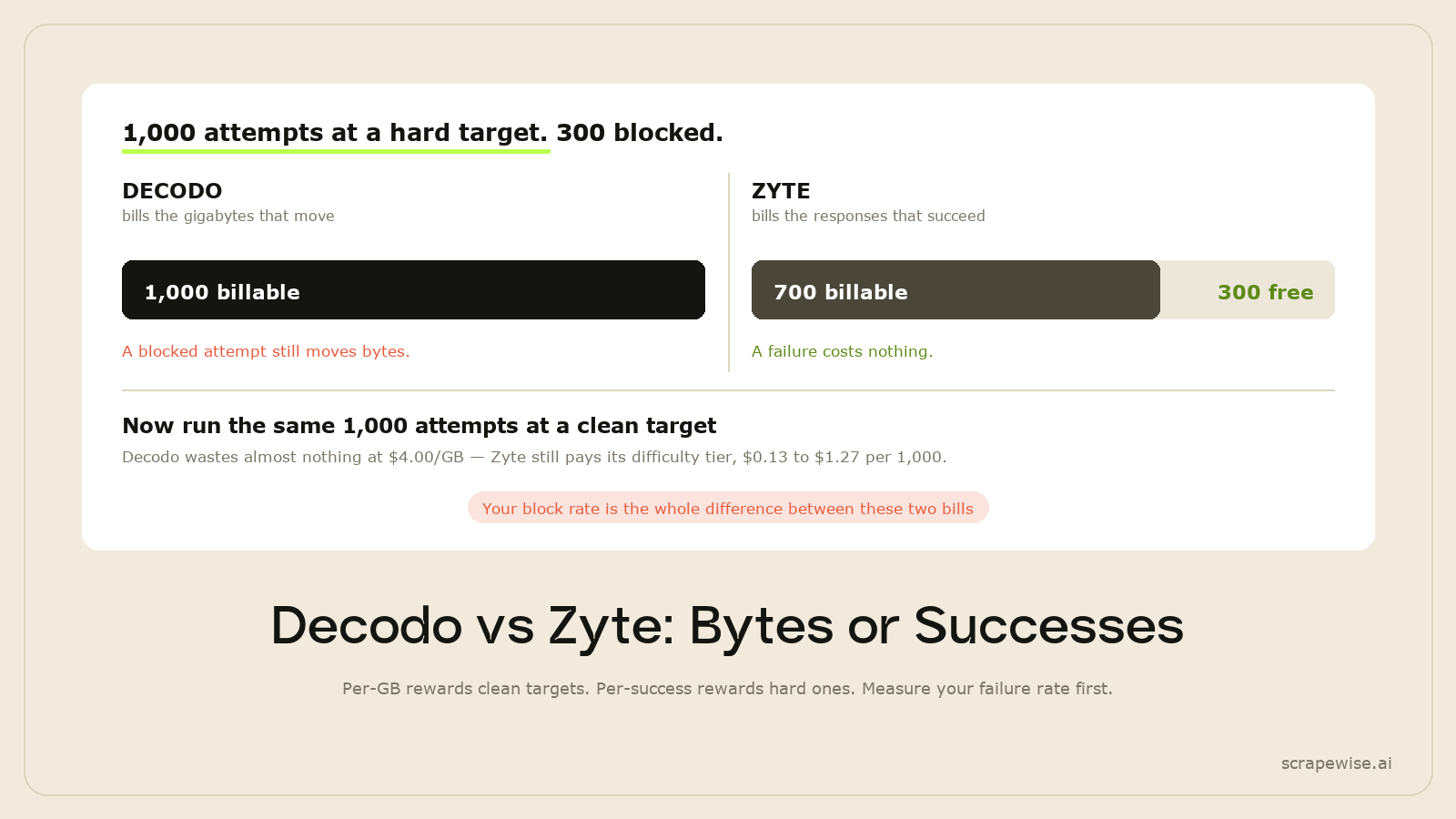
Short answer: Decodo if the job depends on where the request comes from — it does US state, city and ZIP-code targeting on residential proxies from $4.00/GB pay-as-you-go. Zyte if the job depends on the page coming back parsed — its API bills $0.13–$1.27 per 1,000 successful responses and charges nothing for failures. (Both checked on decodo.com and zyte.com in September 2026.)
They are not competing products. They sit at different layers, and the question that actually decides it is which billing unit matches your failure rate — because on a hard target, per-GB and per-success price the same job very differently.
Choose Before You Read
| Your situation | Better fit |
|---|---|
| Need an IP in a specific US state, city or ZIP | Decodo |
| Local price checks, local SERPs, geo-gated content | Decodo |
| You already have scrapers and only lack clean egress | Decodo |
| You want to stop writing parsers | Zyte |
| Hard targets where a high share of requests fail | Zyte |
| Country-level US is geographically precise enough | Zyte |
| You want the rows, not a layer to build on | Neither — see below |
Two Different Layers, Not Two Competitors
Decodo (formerly Smartproxy, based in Vilnius, Lithuania) is proxy-first. You get residential, mobile and datacenter pools, a Site Unblocker, and Web Scraping APIs on top. The distinguishing capability is geo-precision: US state, city and ZIP-code targeting on the residential pool. Residential starts at $4.00/GB pay-as-you-go; the Web Scraping API is billed per 1,000 requests.
Zyte (Cork, Ireland, with a US office in White Plains, New York) is API-first. You send a URL to Zyte API; it handles unblocking, browser rendering where needed, and can return extracted data rather than raw HTML. Geolocation is country-level, US included. Billing is per 1,000 successful responses, tiered by site difficulty — HTTP requests run $0.13 to $1.27 per 1,000 pay-as-you-go.
The shape of the difference: Decodo sells you access and you build on it. Zyte sells you a page that came back, and you build less.
The Billing Unit Is the Real Decision
This is the part that gets skipped, and it is the only part that changes the answer at scale.
Decodo charges for bandwidth you consume, successful or not. A blocked request still moved bytes. A challenge page still moved bytes. A retry loop on a hard target bills three or four times for one row of data, and the bill grows with how badly the target is fighting you.
Zyte charges only for responses that came back. Failures are free. What you pay for instead is difficulty tiering — a hard site costs up to roughly 10× a plain one per successful response.
So the two pricing models invert depending on one number: your success rate on the target.
| Decodo (per GB) | Zyte (per success) | |
|---|---|---|
| Easy target, high success rate | Cheap — you pay for bytes you wanted | Cheap — low difficulty tier |
| Hard target, low success rate | Cost inflates silently with every retry | Cost is bounded — failures are free |
| Heavy pages (images, JS bundles) | Expensive — you pay for every byte | Unaffected — billed per response |
| Light pages, huge volume | Cheap — bytes are small | Cost scales linearly with page count |
The practical read: per-GB rewards clean targets and light pages; per-success rewards hard targets and heavy pages. If you are scraping image-dense product pages behind a bot wall, per-GB is the worse deal twice over. If you are pulling thin JSON endpoints off a cooperative site at volume, per-GB wins easily.
Measure before you choose. Pull your own numbers: average page weight in KB, and success rate per domain. Those two figures decide this, and neither vendor's pricing page can tell you what they are.
The US Geo-Targeting Split
This is the one capability difference where there is no workaround, and it is why the US question comes up so often.
Decodo does US state, city and ZIP-code targeting. Zyte does country-level. If your job is any of these, the choice is already made:
- Local price and promotion checks — a US retailer showing different prices or availability by store region
- Local SERPs — search results that differ by metro area
- Geo-gated content — inventory, delivery windows or ad creative that vary below the country line
- Regional compliance checks — verifying what a specific market actually sees
If none of those apply, country-level US is fine, and you are back to arguing about the billing unit rather than the geography.
One honesty note that cuts the other way: geo-precision is a claim about where the IP sits, not about what the site believes. Many US retailers key regional pricing off a store selection or a delivery ZIP held in a cookie, not off your IP at all. Before paying for ZIP-level proxies, open the target in a browser, change the ZIP by hand, and watch whether the price moves — if it tracks the cookie rather than the connection, ZIP-targeted egress buys you nothing.
What Each One Leaves You Holding
Both are infrastructure. Neither delivers a finished dataset. The difference is how much is left.
With Decodo you still write and maintain: the scraper itself, every parser, retry and backoff logic, session handling, and the detection of when a redesign has silently broken a selector.
With Zyte you still write and maintain: your crawl logic and scheduling, plus the parsing that automatic extraction does not cover — anything outside its supported page types comes back as HTML you have to handle yourself.
That last point is the most common surprise in a Zyte evaluation. Automatic extraction is genuinely good on the page shapes it knows. Outside those shapes you are parsing HTML again, just through a nicer pipe. Ask for extraction coverage on your target list before you assume it applies.
And the failure mode both share: a parser that breaks quietly. The request succeeds, the field comes back empty or wrong, and the first person to notice is whoever trusted the number downstream. Our guide to scraping without getting blocked covers the diagnostic order for the noisy failures; the quiet ones need validation you build yourself.
The Test That Decides It
Run this on both. It takes an afternoon.
- Pick 20 URLs from your hardest domain — not your easiest. Easy targets make every vendor look identical, which is why vendor demos use them.
- Run all 20 through each, same day, same hour.
- Record three numbers per vendor: success rate, total spend, and spend per correct row — not per request.
- Check the rows by hand. A response that came back 200 with an empty price field is a failure that both vendors will bill you for as a success.
- Repeat on your easiest domain. If the winner flips between the two lists, you have a routing problem, not a vendor problem — and the answer is to use both.
Step 3 is the one that matters. Headline unit prices are not comparable across billing models; cost per correct row is the only figure that is.
When Neither Layer Is What You Want
Both products hand you a layer to build on. If what you actually need is competitor prices and stock levels arriving in your systems on a schedule, you are being asked to become an expert in an implementation detail.
ScrapeWise delivers structured rows — through the portal data grid, a CSV or Excel export, or the REST API. Billing is per page delivered: €0.15 per 1,000 plain pages, €0.75 per 1,000 that need a browser, €1.50 per 1,000 that need residential proxies. No monthly plan, no GB meter, a balance you top up from €5 that never expires, and 5 free requests to run the 20-URL test above against us on the same terms. For common sources there are also ready-made data APIs priced per call.
Two honest limits. ScrapeWise does not sell raw proxy access — if you want IPs to point your own crawler at, Decodo is the right shape and we are not. And we do not offer ZIP-level geo-targeting as a product knob; if sub-country US precision is the requirement, that is Decodo's job.
So Which Should You Pick?
- Decodo — you need US state, city or ZIP-level egress, you already own working scrapers, and your targets are light enough that per-GB stays cheap.
- Zyte — you would rather not write parsers, your targets are hard enough that free failures matter, and country-level geolocation is sufficient.
- Both, routed per domain — geo-sensitive jobs on Decodo, hard-to-parse jobs on Zyte. More common than either vendor's marketing suggests.
- Neither — you want matched rows on a schedule and would rather not operate a scraping stack to get them.
For the wider field, see the Decodo (Smartproxy) alternatives guide, the Zyte alternatives guide, and Apify vs Zyte if a platform with an actor marketplace is also on your list.
Paste a URL your current tool cannot reach
See why teams switch to ScrapeWise. 97% accuracy benchmark, no per-SKU pricing.
97% accuracy on Amazon benchmarks · no credit card · book a 15-min call →