

Short answer: Apify if you want maximum control and a marketplace of working scrapers to start from — you rent an Actor, adapt it, and own the result. Zyte if you want maximum abstraction — you send a URL to Zyte API, it unblocks and can return extracted data, and you pay $0.13 to $1.27 per 1,000 successful responses with failures free (zyte.com, checked September 2026).
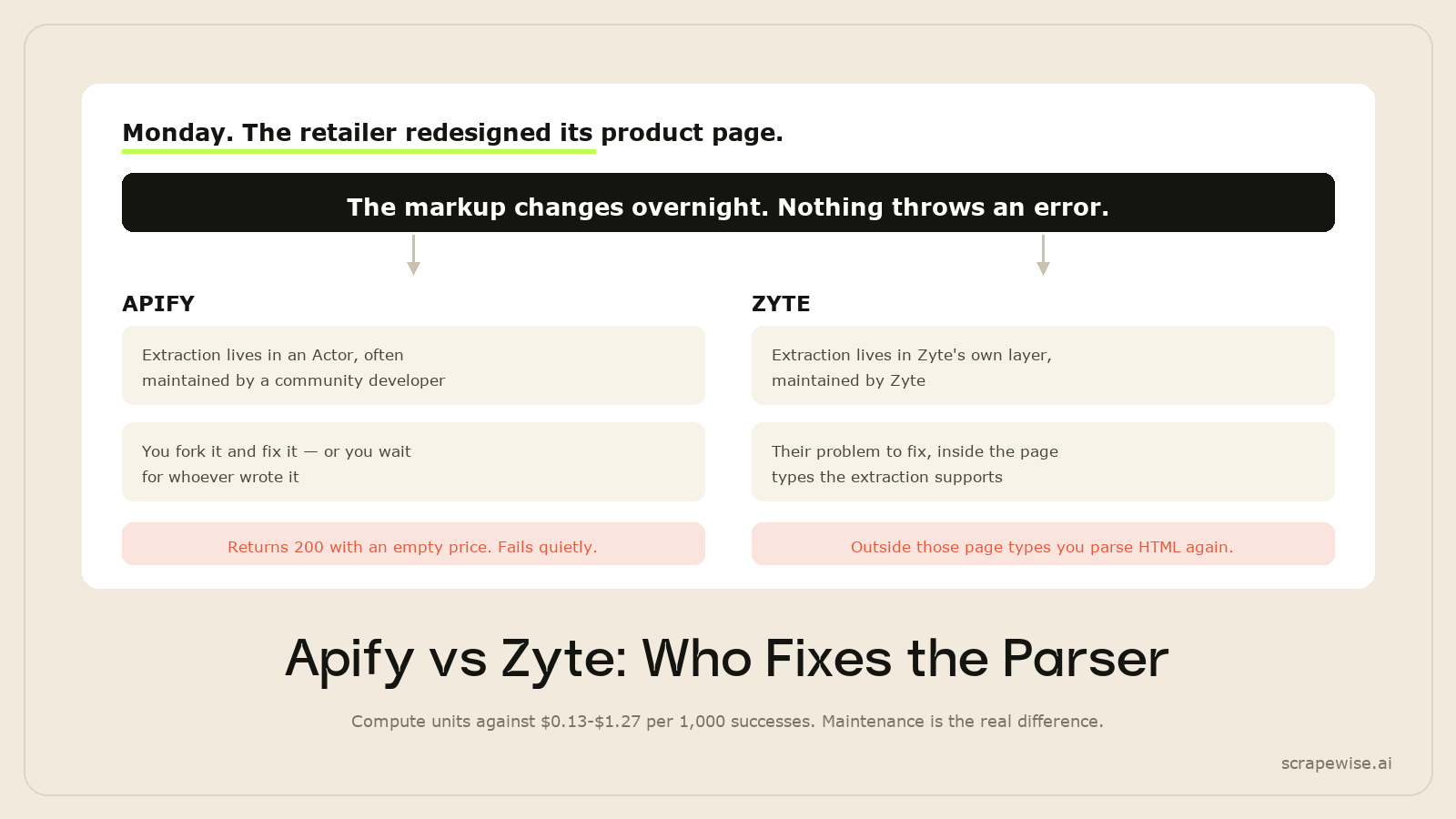
The question that actually decides it is not features or price. It is who owns the extraction logic the morning a retailer redesigns its product page — because those two answers produce very different Mondays.
Choose Before You Read
| Your situation | Better fit |
|---|---|
| No scrapers yet, want something running this week | Apify |
| Want to stop writing and maintaining parsers | Zyte |
| Need full control over extraction logic | Apify |
| Hard targets where a large share of requests fail | Zyte |
| Orchestration, scheduling and storage in one platform | Apify |
| Predictable per-page cost regardless of target difficulty | Zyte |
| You want the rows, not a platform | Neither — see below |
Two Philosophies, Not Two Feature Sets
Apify sells assembly. Its real asset is the Store: instead of writing an Amazon scraper you rent one someone already wrote, then adapt it. Around that sits the orchestration you would otherwise build — scheduling, storage, retries, and export to JSON, CSV or XML. It also accepts your own proxies. Billing is compute units, proxies and Actor rental.
Zyte (Cork, Ireland) sells abstraction. You send a URL to Zyte API; it handles unblocking, browser rendering where needed, and can return extracted data rather than raw HTML. Billing is per 1,000 successful responses, tiered by site difficulty. Failures cost nothing.
The trade in one line: Apify gives you more knobs, Zyte gives you fewer things to turn.
Who Fixes It When the Page Changes?
This is the comparison that matters and it almost never appears in a feature table.
On Apify, extraction logic lives in an Actor. Many Store Actors are maintained by community developers, not by Apify. When a retailer changes its markup or tightens its anti-bot setup, results can dip and stay dipped until whoever maintains that Actor gets to it. You can fork and fix it yourself — that is the point of the model — but then you own it.
On Zyte, extraction lives in Zyte's automatic extraction layer, maintained by Zyte. When a page shape changes, that is their problem, for the page types the extraction covers.
Both have a catch, and they are different catches:
| Apify | Zyte | |
|---|---|---|
| Who maintains extraction | You, or a community Actor author | Zyte, within supported page types |
| Failure when a site redesigns | Actor returns wrong or empty fields until patched | Extraction degrades or falls back to HTML |
| Your lever | Fork the Actor and fix it yourself | File a ticket and wait |
| Coverage limit | Whatever Actors exist for your sources | Whatever page types automatic extraction supports |
The Zyte catch is the one that surprises people mid-evaluation. Automatic extraction is genuinely strong on the page shapes it knows. Outside those shapes you are parsing HTML again, just through a nicer pipe. Before assuming it applies, ask for extraction coverage against your target list — not a demo list.
The Apify catch is quieter and worse. A community Actor that has not been patched does not usually fail loudly. It returns a 200, a row lands, and one field is empty or stale. Nobody notices until someone downstream makes a pricing decision on it. That is fine for exploratory work and uncomfortable for a daily feed.
The Billing Models Are Not Comparable
Do not try to compare headline prices. The units measure different things.
Apify bills consumption — compute units, proxy usage and Actor rental. It is flexible and it is also coupled to difficulty: a target that starts fighting back gets more expensive without anyone changing a setting. Retries burn compute. A heavier page burns compute. Your bill moves for reasons outside your control and outside your change log.
Zyte bills successful responses, tiered by difficulty. Failures are free, which caps the retry-loop problem cleanly. What you pay instead is a difficulty premium — a hard site can cost roughly 10× a plain one per successful response.
| Apify (compute units) | Zyte (per success) | |
|---|---|---|
| Easy target, high success rate | Cheap | Cheap — low difficulty tier |
| Hard target, many retries | Cost inflates with every attempt | Failures are free; tier is the cost |
| Cost predictability per page | Varies with job difficulty | Known once the tier is known |
| Cost visibility before you run | Hard to forecast | Forecastable from tier + volume |
The only honest comparison is cost per correct row, measured on your own targets. Headline rates across two different billing units tell you nothing.
For current per-request and per-GB rates across the field, we keep the numbers in one updated place: the scraping API pricing comparison.
Coverage: Where Each One Is Actually Stronger
Apify is stronger where an Actor already exists. For mainstream sources — Amazon, Shopify storefronts, major marketplaces, social platforms — the Store often has something working, and "already exists" beats any amount of API elegance. Its Website Content Crawler also outputs Markdown suited to RAG pipelines, and its MCP server lets agents call Store Actors directly, which makes it the better fit for LLM data work.
Zyte is stronger on the long tail of ordinary sites. No Actor needed and no Actor to maintain: you point the API at a URL and it does the unblocking. For a list of 200 mid-sized retailers that no marketplace has ever heard of, that is a materially smaller build.
The honest test is your own source list. Count how many of your targets have a maintained Actor. If most do, Apify saves you weeks. If most do not, you were going to build on Apify anyway, and the marketplace advantage evaporates.
The Test That Decides It
Run both on the same list. An afternoon of setup, a day of waiting.
- Pick 20 URLs across your three hardest domains. Not your easiest — easy pages make every platform look identical, which is why demos use them.
- On Apify, check the Actor's last update date for each source before you run it. An Actor last touched eight months ago on a site that redesigned in the meantime is a known-bad starting point.
- On Zyte, check whether automatic extraction covers those page types, or whether you are getting HTML back.
- Run both, same day, same hour.
- Count cost per correct row — verify the fields by hand against the live pages. A 200 response with an empty price is a failure both platforms will bill you for as a success.
Step 5 is the one people skip and the only one that measures the thing you are buying.
When Neither Platform Is the Answer
Both hand you a platform. Neither hands you a finished dataset.
What remains yours either way: crawl scheduling decisions, change detection, storage and validation, and — the one that actually determines whether e-commerce data is correct — deciding that a competitor's listing is the same product as your SKU across different titles, pack sizes and identifiers. Fold a 500 g listing into a 2 kg SKU and you get a confidently wrong price comparison that no platform prevents. We cover that in product data matching.
ScrapeWise delivers structured rows rather than a platform to build them on — through the portal data grid, a CSV or Excel export, or the REST API. Billing is per page delivered: €0.15 per 1,000 plain pages, €0.75 per 1,000 that need a browser, €1.50 per 1,000 that need residential proxies. No plan, no compute units, a balance you top up from €5 that never expires, and 5 free requests to run the 20-URL test above against us on the same terms.
The honest trade-off: ScrapeWise is a feed, not a toolkit. If you want a platform to build on tonight, Apify gives you far more knobs and we do not pretend otherwise. You can also call ready-made data APIs priced per call directly.
So Which Should You Pick?
- Apify — you need scrapers and do not have them, your sources have maintained Actors, and you want control over extraction. Budget for owning any Actor you depend on daily.
- Zyte — you would rather not write parsers, your targets are hard enough that free failures matter, and automatic extraction covers your page types. Verify that last clause before signing.
- Both — Apify for orchestration and LLM-facing crawls, Zyte API for the hard-to-unblock long tail. A sensible and fairly common split.
- Neither — you want matched rows on a schedule and would rather not operate a scraping platform to get them.
For the wider field, see the Zyte alternatives guide, Oxylabs vs Apify, Apify vs Bright Data, and the two-way write-up of ScrapeWise as an Apify alternative.
Paste a URL your current tool cannot reach
See why teams switch to ScrapeWise. 97% accuracy benchmark, no per-SKU pricing.
97% accuracy on Amazon benchmarks · no credit card · book a 15-min call →