

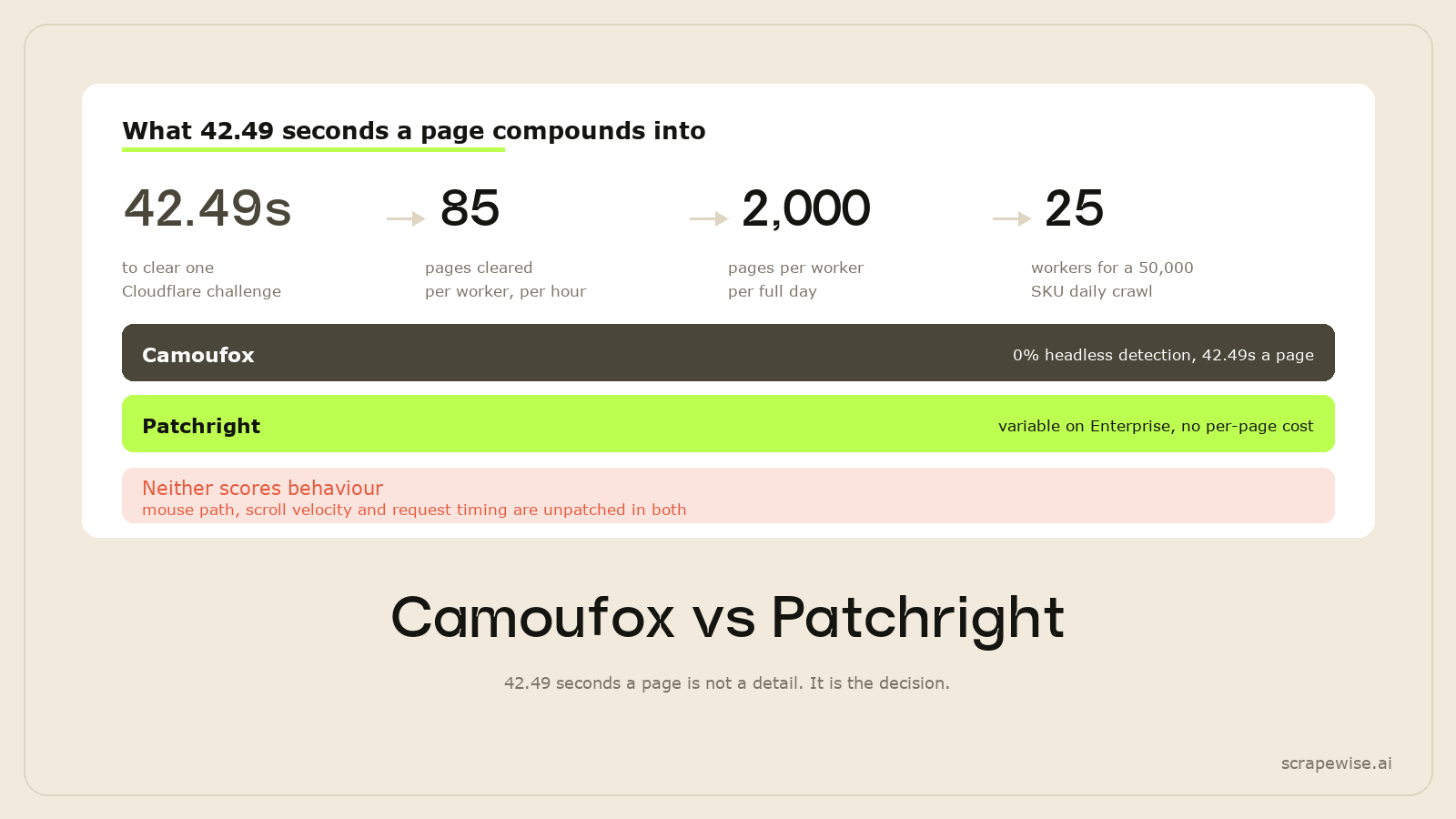
Short answer: start with Patchright. It costs one import line and adds no overhead over standard Chromium. Move to Camoufox only when Patchright is passing fingerprint checks and still getting blocked, and the target is worth 42.49 seconds a page.
That number is the entire comparison. Camoufox has the better detection record — 0% headless detection on standard tests, which no other open-source option matches. It pays for that with an average bypass time that makes a daily catalogue crawl arithmetically impossible. Patchright is faster because it is doing less, and doing less is correct until it isn't.
Choose Before You Read
| Your situation | Use |
|---|---|
| Node.js stack, Cloudflare blocking you | Patchright |
| Patchright passing fingerprint tests, still blocked | Camoufox |
| Tens of thousands of pages a day | Patchright — Camoufox does not scale to this |
| A handful of high-value pages on a hard target | Camoufox |
| Target behaves differently in Firefox | Patchright |
| Blocked by behavioural scoring, not fingerprinting | Neither fixes this |
| You want the data, not a stealth stack | See the last section |
Two Different Patch Layers
Both tools solve the same problem by patching a browser rather than injecting JavaScript into a page. They patch different browsers, at different depths, with different bills.
Patchright patches the Chromium binary at build time and keeps Playwright's API. It removes the HeadlessChrome user-agent string compiled into the build, the WebDriver capability exposure, and the Runtime.enable CDP call that Cloudflare's current detection watches for. Three targeted removals, applied before the browser process starts.
Camoufox forks Firefox's source and patches at the C++ level. Not three signals — the whole surface: canvas fingerprinting, WebGL renderer strings, AudioContext behaviour, font metrics, network timing. Every value an anti-bot script can read is controlled in the binary rather than corrected afterwards in the page.
The difference in ambition explains the difference in cost. Patchright removes the tells that say automation. Camoufox constructs a complete, internally consistent identity for a browser that does not exist.
Camoufox vs Patchright: Side by Side
| Patchright | Camoufox | |
|---|---|---|
| Browser | Chromium | Firefox fork |
| API | Playwright, drop-in | Playwright-compatible, Firefox |
| Patch depth | Three signals, build time | Full fingerprint surface, C++ |
| Headless detection rate | Passes standard tests | 0% |
| Average Cloudflare bypass | No added overhead | 42.49 seconds |
| Memory per instance | ~200MB | 200MB+ per context |
| Cloudflare BotFight | Passes | Passes |
| Cloudflare Enterprise / Turnstile | Variable by target | Passes |
| Akamai Bot Manager v4 | Variable by target | Passes |
| PerimeterX / HUMAN | Variable by target | Passes |
| DataDome | Variable by target | Passes |
| Behavioural scoring | Not addressed | Not addressed |
| Maintenance | Small independent team | Small team, tracks Firefox releases |
| Best fit | Volume on mid-tier targets | Low volume on hard targets |
The 42 Seconds Is the Whole Decision
Run the arithmetic before choosing, because it decides for you.
At 42.49 seconds per solved challenge, one Camoufox worker clears roughly 85 pages an hour, or about 2,000 a day at full utilisation. A 50,000-SKU daily crawl therefore needs on the order of 25 workers running flat out with no failures, no retries and no headroom — at 200MB+ per context each. That is a real server bill and a real orchestration problem, for data that is worth what it is worth regardless of how you collected it.
Patchright at no added overhead does the same crawl on a fraction of that, and gets blocked on some of it. Which is the trade: Camoufox buys completeness at a price per page, Patchright buys throughput at a price in coverage.
So the question is not "which is more stealthy". It is how many pages, how often, and what is a miss worth. A weekly pull of 300 competitor prices from a Cloudflare Enterprise retailer is a Camoufox job. A nightly refresh of 50,000 SKUs is not, at any configuration.
Firefox Is Not a Free Swap
Camoufox is a Firefox fork, and that carries consequences beyond the stealth question.
Target sites behave differently across engines. Layout, JavaScript quirks and rendering differences mean selectors validated in Chromium are not guaranteed in Firefox, and a site that quietly serves a different code path to Firefox can need separate extraction logic. If you already have a working Chromium scraper, adopting Camoufox is a rewrite of the parts that touch the DOM, not a swap of the launcher.
There is a maintenance dimension too. Camoufox is maintained by a small team keeping pace with Firefox's own security releases. That creates a potential lag between a newly-discovered detection vector and a patched build — the same class of risk Patchright carries, on a larger codebase.
Neither One Fixes Behaviour
Both tools address technical fingerprinting. Every modern WAF also scores behaviour, and neither one touches it.
Mouse-movement paths, scroll velocity, dwell time before the first interaction, keystroke cadence, the timing distribution of requests across a session — a perfectly fingerprinted browser that loads a page, reads the DOM and leaves still looks like what it is. Camoufox's 0% figure is a headless-detection result, not a promise about behavioural scoring, and on the highest-security configurations behaviour is what catches both tools.
Neither gives you proxies either. A flawless fingerprint arriving from a datacentre IP that has already been flagged is refused at the edge before any of the patching matters.
The full five-way matrix, including playwright-extra, the Python playwright-stealth line and noDriver, is in our Playwright stealth benchmark. If you are choosing between vanilla Playwright and a patched build in the first place, start with Patchright vs Playwright.
The Cost Neither One Removes
Both are libraries, and libraries decay. Each anti-bot vendor ships detection updates, each update needs a corresponding patch, and the gap between the two is downtime on whichever data source you were depending on. That weekly cycle is the recurring cost, and it does not appear in any install command or benchmark table.
If what you need is competitor prices, stock levels and product data arriving in your systems rather than a stealth stack to keep alive, this comparison is the wrong one to be having. ScrapeWise runs the browsers, the proxy rotation and the challenge handling and delivers structured, validated rows. It is a feed, not a toolkit: no plan and no compute units, just a balance you top up and a charge per delivered page from EUR 0.15 per 1,000, with 5 free requests on every new account.
You can also call 36 ready-made scraping API endpoints directly, or see how this feeds competitor price tracking and brand protection.
So Which Should You Pick?
- Patchright — default. One import line, no overhead, clears Cloudflare BotFight and a good share of Enterprise. Start here and find out whether you need more.
- Camoufox — Patchright is passing fingerprint checks and still getting blocked, the target runs Enterprise-grade protection, and the volume is low enough that 42 seconds a page is affordable.
- Both — Patchright for the bulk of the catalogue, Camoufox reserved for the handful of targets that refuse it. Common, and cheaper than running Camoufox across everything.
- Neither — you want delivered rows on a schedule and would rather not maintain a stealth stack at all.
Paste a URL your current tool cannot reach
See why teams switch to ScrapeWise. 97% accuracy benchmark, no per-SKU pricing.
97% accuracy on Amazon benchmarks · no credit card · book a 15-min call →