

If you run pricing in Germany, Austria or Switzerland, you have three fundamentally different places to get competitor prices: a broad comparison engine like Idealo, a category-deep one like Geizhals, or the retailer storefronts themselves. Most teams pick one by habit and never revisit it — and that choice quietly decides how fresh, how complete, and how trustworthy their pricing data is.
The instinct is that a comparison engine is obviously best: one page, thousands of shops, done. That instinct is wrong often enough to cost real margin. Comparison engines optimise for consumer discovery, not for the completeness and freshness a pricing team needs. Sometimes they're exactly right. Sometimes they're the reason your repricing decisions are three hours late on a fast-moving SKU.
Here's how to decide — per category, not once for everything.
The Real Question: Breadth, Depth, or Truth?
The three sources map cleanly onto three different jobs. Pick based on the job, not the brand.
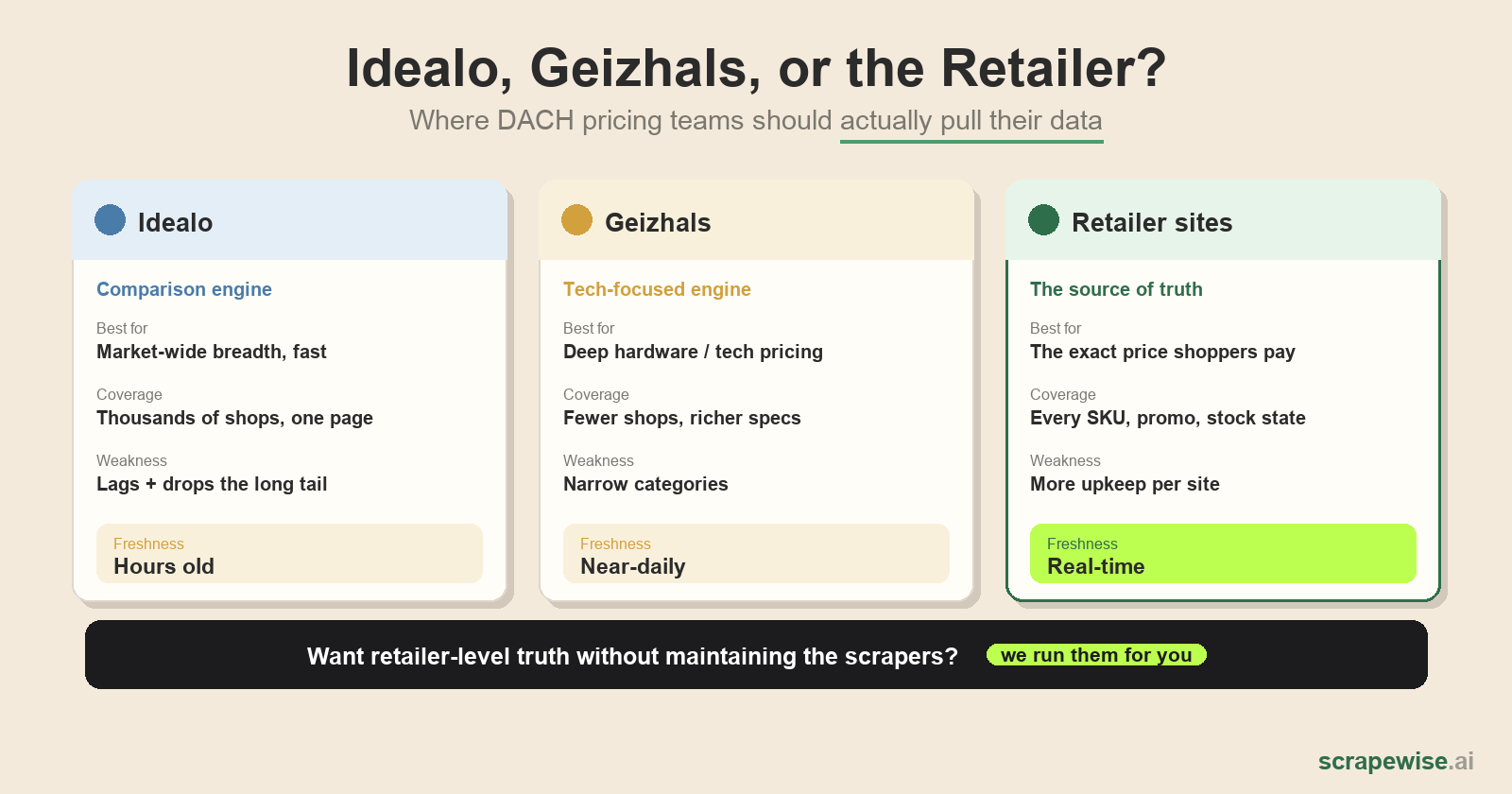
| Source | Best for | Coverage | Freshness | Main weakness |
|---|---|---|---|---|
| Idealo | Market-wide breadth, fast | Thousands of shops, one page | Hours old | Lags and drops the long tail |
| Geizhals | Deep hardware / tech pricing | Fewer shops, richer specs | Near-daily | Narrow categories (AT/DE tech focus) |
| Retailer sites | The exact price shoppers pay | Every SKU, promo, stock state | Real-time | More upkeep per site |
If you only remember one thing: comparison engines are a map, retailer sites are the territory. A map is faster to read and covers more ground. But when the map and the ground disagree — because the engine cached a price, or a shop dropped off the listing, or a flash promo hasn't propagated — the ground is what your customer actually pays.
When Idealo Is the Right Source
Idealo is the breadth play. For a first pass across a wide catalogue — "roughly where do we sit versus the market on 5,000 SKUs" — it's unbeatable on effort. One product page aggregates dozens of shops, so you get a competitive snapshot without building and maintaining dozens of individual scrapers.
Use Idealo when:
- You need a wide, approximate market picture quickly.
- The category is mainstream and well-listed (consumer electronics, appliances, mainstream brands).
- You're doing landscape analysis, not triggering automated repricing on the number.
Idealo's weaknesses are structural, not fixable by trying harder. It lags — listed prices can be hours behind the shop's real price, which is fatal for fast-moving SKUs. It drops the long tail — niche products, smaller shops, and new SKUs are under-listed or missing. And you're seeing what Idealo chooses to show, filtered by its own commercial relationships and ranking.
There's also the access question. Idealo has historically restricted programmatic access, and "idealo api" is a common search precisely because a clean official feed isn't freely available to most retailers. In practice, teams that need Idealo data at scale collect it the same way they'd collect any storefront: structured price scraping on a schedule.
When Geizhals Is the Right Source
Geizhals (Geizhals/Preisvergleich, strong in Austria and Germany) is the depth play for technology. For PC components, hardware, electronics and similar categories, it carries richer specification data, price history, and a more engaged, price-sensitive audience than a general engine. In its categories, it's frequently more accurate and more granular than Idealo.
Use Geizhals when:
- You're in hardware, components, or consumer tech.
- You need spec-level matching and price history, not just a current number.
- Your competitive set is the enthusiast/tech retailer crowd that lists there.
Its weakness is the flip side of its strength: it's narrow. Outside tech-adjacent categories, coverage thins out fast. It's a scalpel, not a dragnet.
When You Should Go Straight to the Retailer
Retailer storefronts are the source of truth. The price on MediaMarkt's, Otto's, or Conrad's own product page is — by definition — the price the customer pays. No aggregation lag, no listing filter, no dropped long tail. You also get everything the engines flatten away: the actual promotion mechanics, bundle pricing, stock status, and shipping costs.
Go direct when:
- You're triggering automated repricing and need the real, current number.
- Stock availability matters (a competitor's price is irrelevant if they're out of stock).
- You care about promos, bundles, and shipping — the things engines strip out.
- The SKU is in the long tail the engines don't list.
The cost is maintenance. Every retailer site is its own target, each JavaScript-heavy and prone to layout changes and anti-bot measures. Ten competitors is ten scrapers to keep alive. This is exactly the upkeep that sinks DIY efforts — and where self-healing infrastructure changes the economics, because the maintenance stops being your team's problem.
The Practical Answer: Layer Them
The mature DACH setup isn't "pick one." It's:
- Comparison engines for breadth and landscape. Use Idealo (and Geizhals in tech) to keep a wide, cheap map of where you sit and to spot movements worth investigating.
- Retailer sites for the SKUs that drive decisions. For your top-revenue and most price-sensitive SKUs — the ones where you'll actually change a price — go direct to the retailer for the true, current number.
This mirrors the decision framework for choosing any monitoring setup: match the data source to the decision it feeds. Landscape analysis tolerates lag; automated repricing does not.
Where ScrapeWise Fits — and Where It Doesn't
ScrapeWise collects all three: Idealo and Geizhals listings for breadth, and retailer storefronts for truth — delivered as one clean, timestamped feed. Because targets are just URLs, you can start with engine-level breadth and add retailer-direct coverage for your decision SKUs without switching tools or fighting anti-bot yourself.
Honest limitations: where a comparison engine restricts or throttles access, collection cadence is constrained by what can be responsibly gathered — we don't bypass hard technical or legal limits, and for those sources retailer-direct is often the more reliable long-term answer. Coverage is scoped to the sources and SKUs you specify, and because billing is per delivered page the cost follows that scope directly.
Conclusion
Idealo, Geizhals, and the retailer aren't competitors for the same job — they're three tools for three jobs. Breadth, depth, and truth. Use the engines to keep a cheap, wide map; go direct to the retailer for the SKUs where you'll actually pull the pricing trigger. Teams that layer them get both a fast landscape and a trustworthy number where it counts. Teams that pick one by habit get whichever weakness bites first.
Want Idealo, Geizhals and retailer-direct prices in one feed? Get a quote for your DACH competitor set.
Paste any URL — ScrapeWise handles the anti-bot
Managed infrastructure that adapts when sites change. No proxies, no code, no per-request fees.
97% accuracy on Amazon benchmarks · no credit card · book a 15-min call →