
Key takeaways
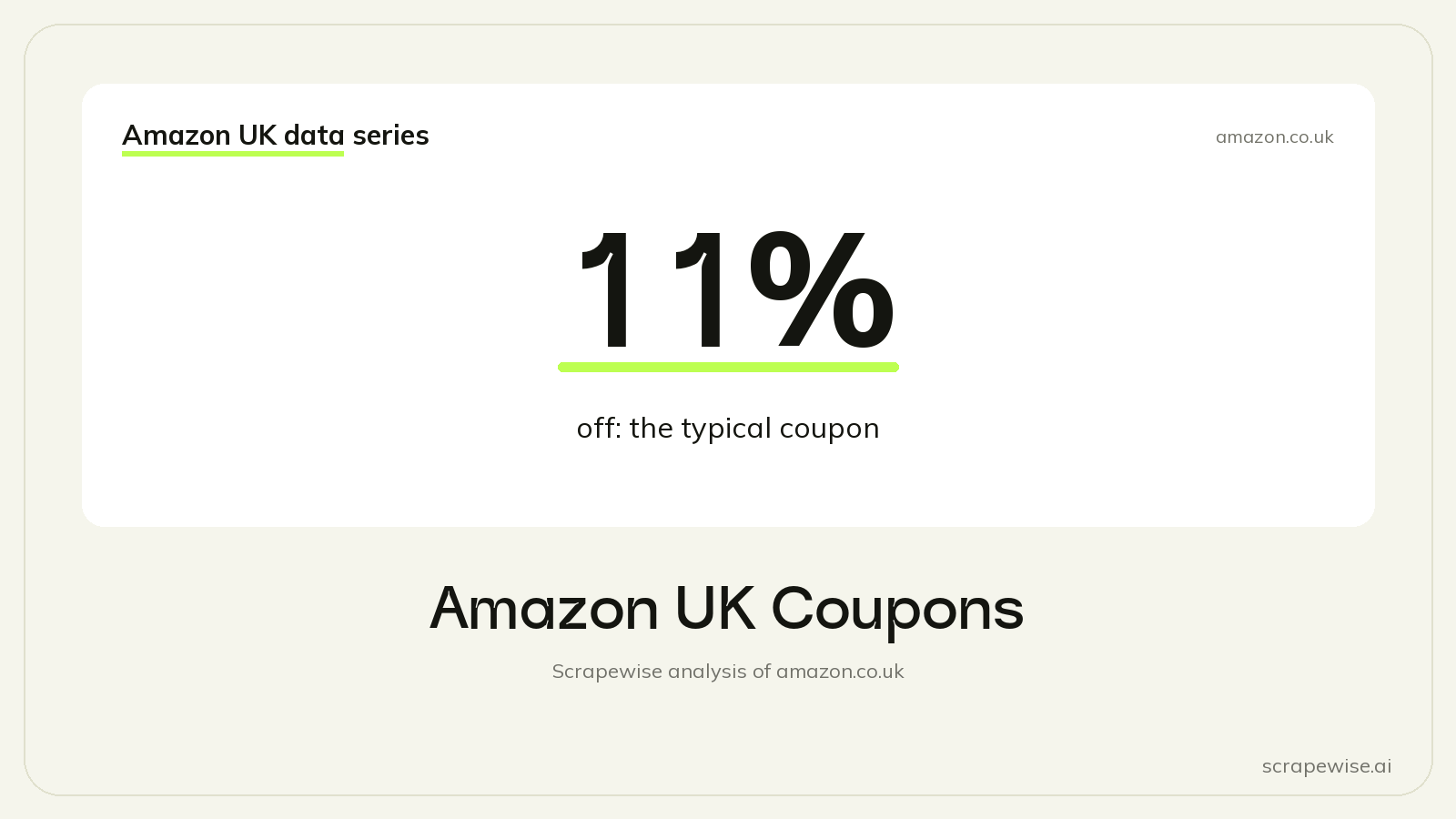
- The median Save X% coupon took 11% off, across 6,207 coupon listings on Amazon UK.
- Coupons of 50% or more were rare, at 1.4% of coupon listings, and 48.1% of coupons took 10% or less.
- On single-seller listings, deal badges appeared on 8.4% of China-based and 10.7% of Hong Kong-based sellers' listings, against 3.3% for UK-based sellers.
The typical Amazon UK coupon takes 11% off: across 6,207 coupon listings in our sample, the median Save X% discount was 11%, and just 1.4% of coupons offered 50% or more. We read every coupon from search results in a snapshot of amazon.co.uk taken on 23 to 24 September 2026.
The Data
People search for the Amazon coupon average discount, but a mean is the wrong tool here. A handful of very large coupons would drag it upwards, so we report the median, the coupon in the middle of the pile. That coupon takes 11% off.
| Coupon measure | Value |
|---|---|
| Coupon listings in the sample | 6,207 |
| Median coupon | 11% off |
| Coupons at 10% or less | 48.1% |
| Top tenth of coupons starts at | 31% off |
| Coupons at 50% or more | 1.4% |
| Largest coupon we saw | 81% off |
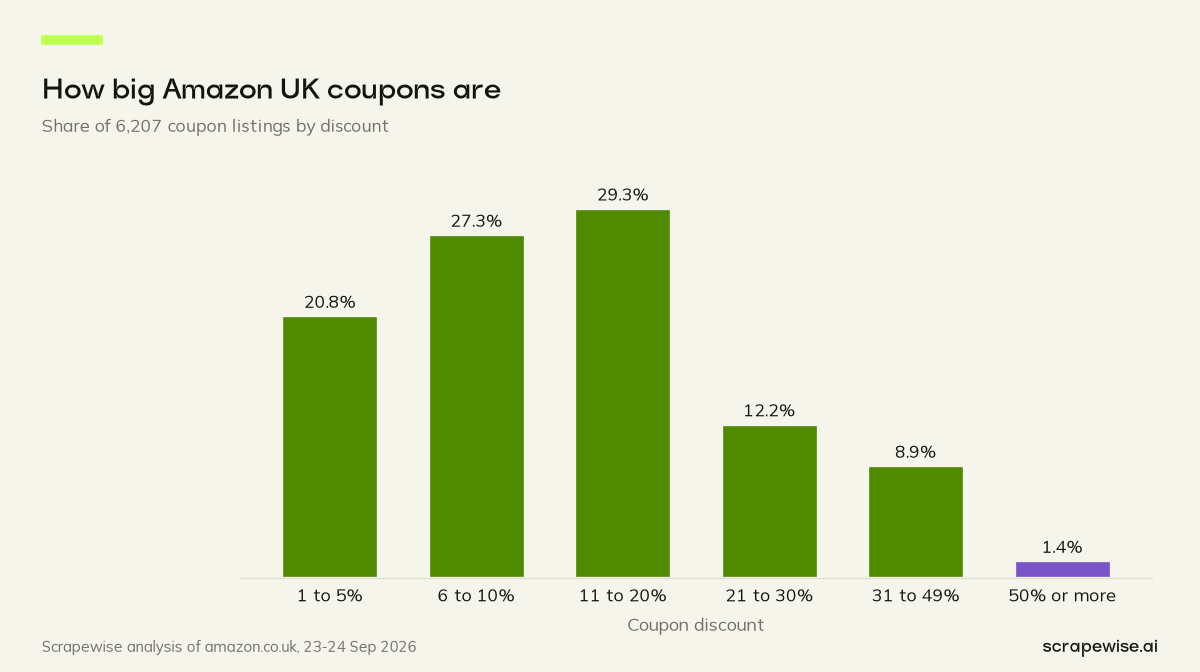
Most coupons on Amazon UK are modest: 48.1% of them take 10% or less off. The median coupon takes 11% off, a fair reward for the effort of ticking a box. A coupon big enough to change a buying decision on its own is much rarer: the top tenth starts at 31% off, and coupons of 50% or more make up just 1.4% of the set. The single largest coupon we found took 81% off.
Coupons Are Not Deal Badges
Amazon shows two different kinds of discount on a search result, and they are easy to mix up.
- A coupon is a Save X% offer that the shopper applies on the listing, usually with one click.
- A deal badge marks a limited-time offer, often with an "Ends in" countdown. It is a promotion with an end date.
Across all 197,022 products in our sample, 8.6% carried a deal or a coupon of some kind. The rest showed a plain price with no discount. The share varies a lot by search. Among the larger searches, cabin bags led at 30.1%, followed closely by solar lights at 29.9%, then garden hoses at 25.8% and suitcases at 25.2%. Luggage, it seems, likes to travel at a discount. At category level, fashion and travel products carried a deal or coupon 14.0% of the time.
Which Sellers Use Deal Badges
The deal badge share also differs by where the seller is based. To keep the comparison clean, we looked only at single-seller listings, where the badge belongs to one known seller, and grouped sellers by the business address they declare on their seller profile.
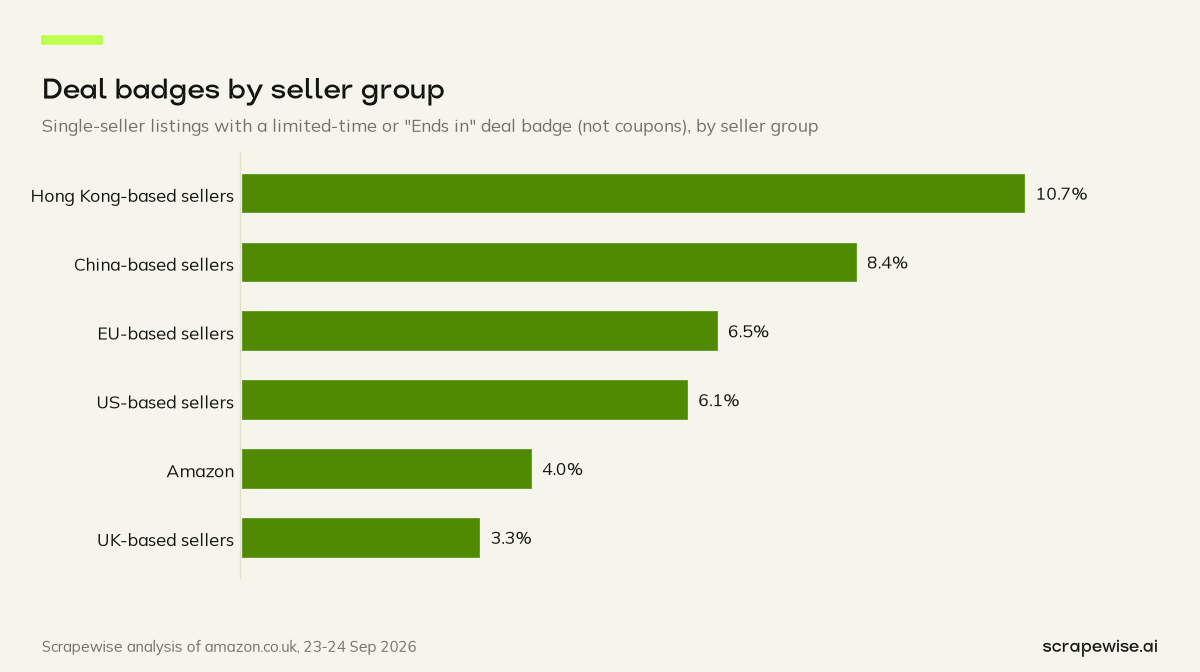
On single-seller listings, the deal badge rates were:
| Seller group (declared address) | Share with a deal badge |
|---|---|
| Hong Kong | 10.7% |
| China | 8.4% |
| EU | 6.5% |
| US | 6.1% |
| Amazon | 4.0% |
| UK | 3.3% |
Our data shows how often each group uses the badge, not why. Deal badges depend on the categories a seller works in, the tools it uses and how it plans its promotions, and none of that is visible on a search page. Amazon itself, at 4.0%, sits near the bottom of the table, next to UK-based sellers.
The badge is a count of promotions, not a measure of price. A listing with a badge may still cost more than a listing without one. If you want to see how price endings and charm pricing work alongside these promotions, read our post on psychological pricing on Amazon.
What It Means for Sellers and Brands
If you run coupons, 11% is the middle of the market, and 48.1% of coupons take 10% or less, so a modest coupon is normal rather than stingy. A coupon of 31% or more lands in the top tenth. Whether a bigger coupon sells more is not something a snapshot can prove, so test it on your own listings before you commit margin to it.
If you compete in a search with a high deal share, such as cabin bags or solar lights, expect many of the listings around yours to show a discount. A plain price will look less exciting next to them, even when it is lower. Compare the final price, not the badge.
If you track competitors, record coupons and deal badges as separate fields. A price that looks stable can hide a coupon, and a coupon that appears on Monday may be gone by Friday. A price history that ignores coupons will misread both. Our guide to how to track competitor pricing covers the wider routine.
If you also sell in the EU, discount claims come with rules about the previous price. Our note on the Omnibus Directive and price history explains why a price history matters there. For the ad side of the same search pages, see how sponsored listings are priced against organic results, and for every other angle on this dataset, the complete Amazon UK marketplace study.
How to Benchmark Your Own Coupons
A useful coupon benchmark comes from your own searches rather than the whole market. Pull the results pages for the keywords you sell in, record the Save X% text and the deal badge for each product, and work out three numbers: the share of listings with a coupon, the median coupon, and the share with a deal badge. Compare them with the 11% median here, and with your own coupon.
Then repeat it. A coupon can be switched on or off at any time, so one reading tells you where a search stands today. A few weeks of readings show which competitors run coupons constantly, which save them for busy periods, and which never use them at all.
How We Collected This Data
The coupon and deal figures came from the three Scrapewise Amazon scrapers working as a chain. The Amazon Search API read the first seven pages of 868 amazon.co.uk searches and returned each result's price, Save X% coupon text and deal badge. The Amazon Offers API returned the sellers on each product, which told us which listings had one seller and whether that seller was Amazon. The Amazon Seller API returned each seller's declared business address, which set the seller groups; we publish only aggregates. The Amazon Deals API was not used in this study, because every coupon and badge above came from ordinary search results. The three scrapers share one price, €0.00015 per call, or €0.15 per 1,000 calls, and each of them can run daily, every few days, weekly or monthly, or on demand. Create an account to log coupons on the searches you sell in.
Curious how the coupons in your own category compare with the 11% median? Check with 5 free requests; after that you pay as you go. Sign up here or compare pricing.
Paste a marketplace URL — get structured market data
Size categories, track assortments, monitor trends. Clean feeds ready for your BI stack.
97% accuracy on Amazon benchmarks · no credit card · book a 15-min call →