
Key takeaways
- In the same search, sponsored listings have a median price 1.41 times that of organic results, across 543 keywords.
- Comparing like with like in the same search, sponsored listings were cheaper in only 76 of 543 keywords (14%).
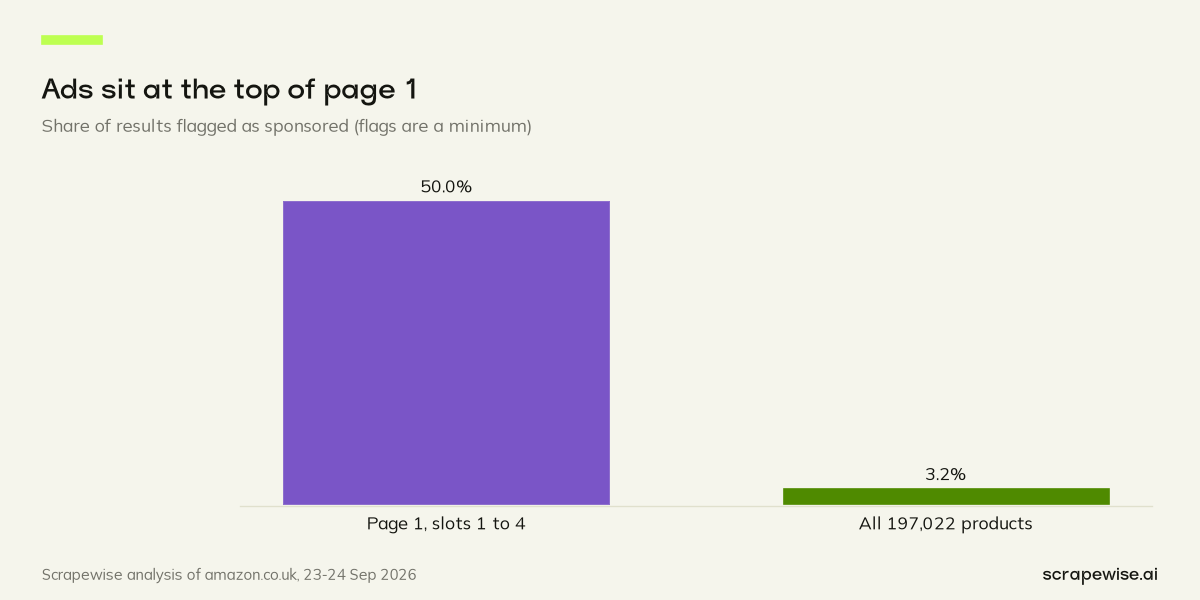
- Half of page 1 slots 1 to 4 were sponsored in our sample, and sponsored flags are a minimum.
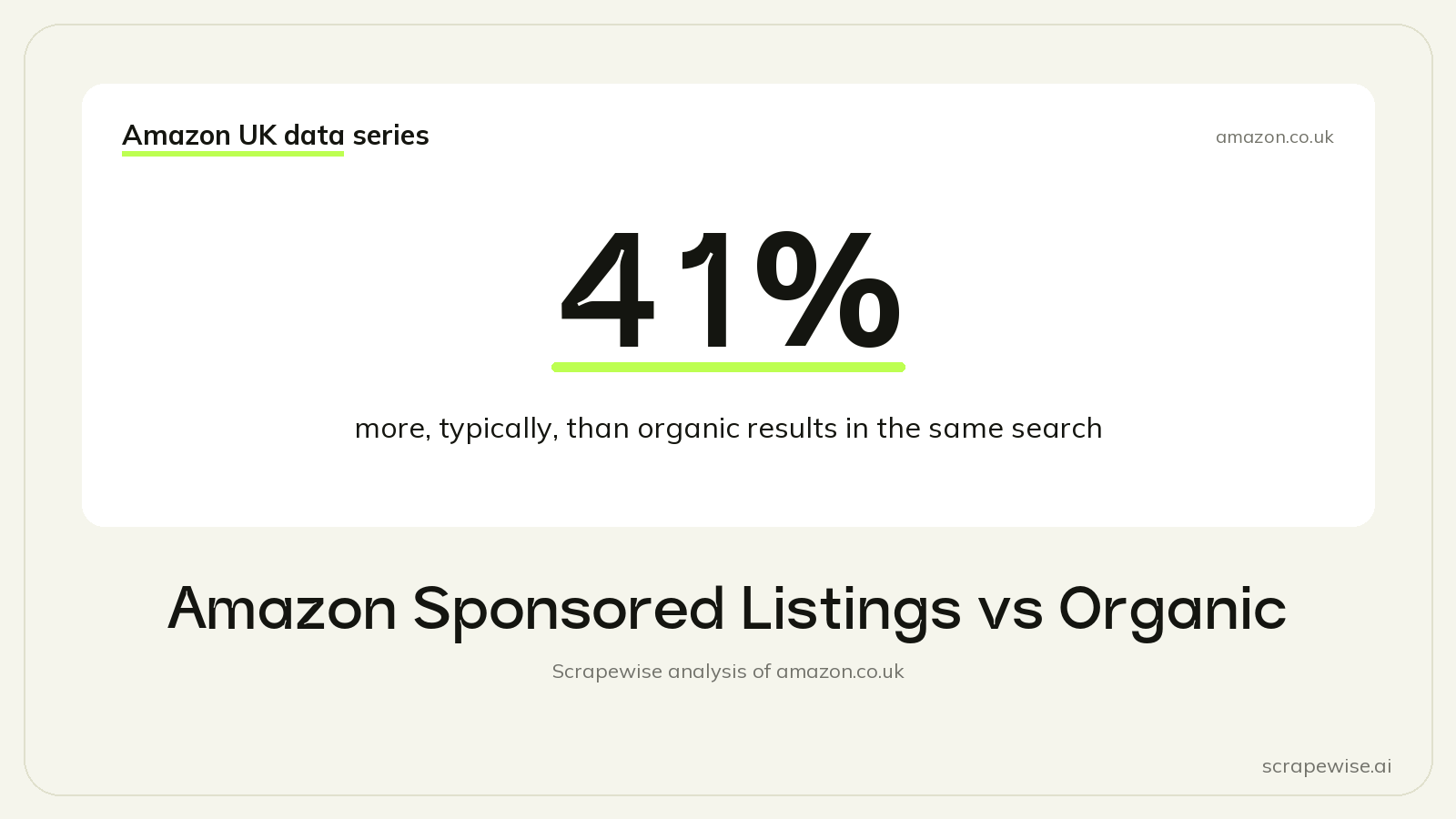
Amazon sponsored products are priced higher than the organic results around them: in the same search, the typical sponsored listing costs 41% more, across 543 keywords we could compare. The comparison uses every priced sponsored and organic result we found on amazon.co.uk on 23 to 24 September 2026.
The Data
The simplest comparison pools every listing. Across all priced products, sponsored listings have a median price of £24.95, and organic listings £16.99. That gap is large, but a pooled number can mislead: if ads cluster in dearer searches, the gap would appear even if every ad were priced like its neighbours.
So we compared like with like. For each keyword with enough sponsored and organic prices, we divided the sponsored median price by the organic median price.
| Measure | Value |
|---|---|
| Searches compared | 543 |
| Median same-search price ratio, sponsored vs organic | 1.41x |
| Searches where sponsored listings were cheaper | 76 (14%) |
| Median price, all priced sponsored listings | £24.95 |
| Median price, all priced organic listings | £16.99 |
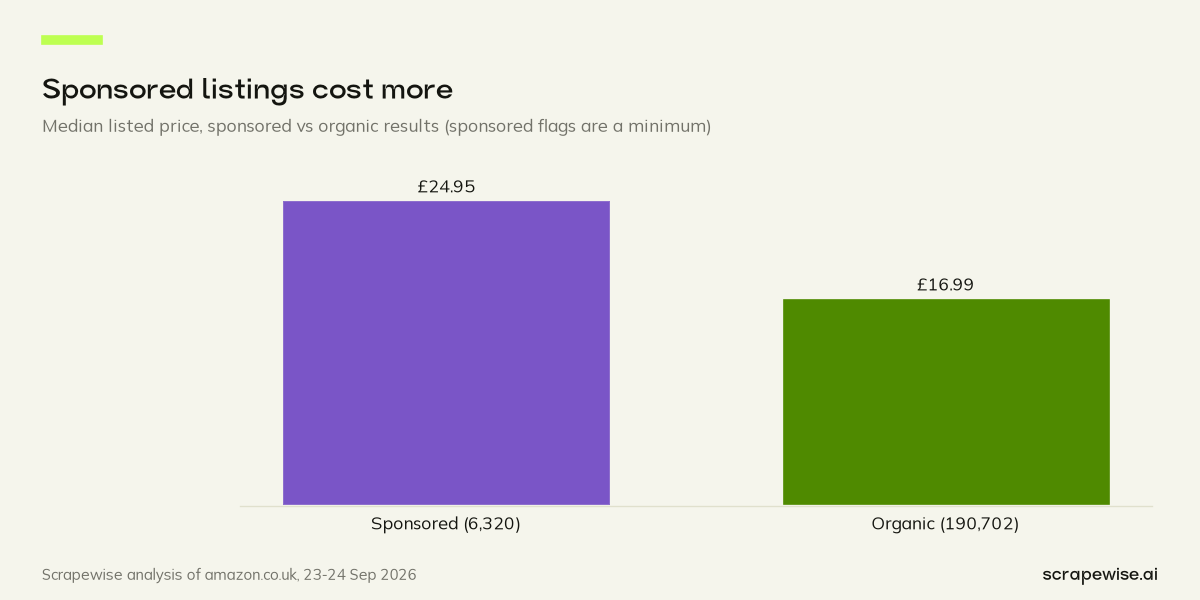
The same-search ratio still lands at 1.41x. In the typical search, the sponsored median price sits 41% above the organic median in that search. So the gap holds even when ads are only compared with their own neighbours.
How the Gap Looks Search by Search
A median ratio hides the spread, so look at the searches one by one. Sponsored listings were cheaper than organic ones in only 76 of the 543 searches, which is 14% of the set. In the other searches, the ads cost the same or more.
Two caveats belong next to these numbers. First, the sponsored count is a floor. We saw the sponsored label on 3.2% of products, and some ads are not marked in a way our page reader could catch, so the real share of ads is likely higher. If the missed ads were cheaper than the ones we caught, the true gap would be smaller. We have no evidence either way, which is why we say "typically" and not "always".
Second, a ratio of medians is not a statement about any single product. It says that in a given search, the middle sponsored price is higher than the middle organic price. A shopper can still find a sponsored listing that is the cheapest thing on the page.
Where the Ads Sit on Page 1
Ads matter most where attention is highest. On page 1, slots 1 to 4 are the first rows most shoppers see. In our sample, half of those top slots (50.0%) carried a sponsored label, and 29.3% carried an Amazon's Choice badge. Both figures come from the same set of page 1 listings.
For a shopper, the first result in a search is not always the cheapest. It is sometimes simply the one that paid to be there.
This connects to the ranking data in how to rank on page 1 of Amazon, where organic page 1 listings carry far more reviews than those further down. Buying a sponsored slot is the shortcut past that queue, and our numbers suggest it is used more for higher-priced products. For the badge side of the top slots, see how to get the Amazon's Choice badge.
What It Means for Sellers and Brands
Our data cannot say why sponsored listings are dearer. A plausible reading is margin: a dearer product earns more per sale, so it can afford to pay for more clicks per sale than a cheap one. That is a reading, not a finding.
What the data does support is a few practical checks:
- Compare your ad price with the organic median in the same search. If your product is sponsored and priced well above the organic middle, the ad has to do more work. Shoppers see the cheaper organic listings a few rows down.
- Look at the search, not the category. The pooled gap (£24.95 vs £16.99) is bigger than the typical same-search gap, which suggests ads also gather in dearer searches. Benchmark against the keyword you bid on.
- Treat the 14% as a signal. In 76 searches, sponsored listings were cheaper than the organic ones. Those are searches where advertisers compete on price as well as placement, and they are worth a closer look before you bid.
For brands that watch resellers, a sponsored slot can put any seller at the top of a search. If you track pricing rules on Amazon, our guide to Amazon repricing and MAP violation software covers the monitoring side.
How to Check Your Own Searches
The same test works on the keywords you care about, and it takes four steps:
- Pull the first few results pages for each keyword, with the price, position and sponsored flag of every product.
- Split the rows into sponsored and organic, and take the median price of each group per keyword.
- Divide the sponsored median by the organic median. Above one means the ads in that search are dearer than the organic results.
- Repeat on a schedule. Prices and ads change, so one snapshot tells you where a search stands today, not where it will be next month.
Keep the searches where the ratio is well above one on a short list. Those are the places where a lower-priced ad has the most room to stand out.
Notes for Analysts
If you build a market price from Amazon search results, tag sponsored rows and report them separately. Mixing them in raises the median, and the effect varies by search. Use the median, not the mean, for the same reason we do: a few extreme prices can move a mean a long way, and a median barely notices them.
Also record the page and position. A sponsored listing near the top of page 1 and one several pages down are not the same kind of ad spend, and a model that treats them alike will blur the picture. For the wider context of price levels by category, see average price on Amazon UK by category, and for every other angle on this dataset, the full Amazon UK market study.
How We Collected This Data
The Amazon Search API did all the collecting for this post. We pointed it at results pages 1 to 7 on amazon.co.uk for 868 keywords, and for each product it recorded the page, the position, the price, the sponsored flag and any Amazon's Choice badge. Those five fields are enough to build every ratio and slot share above. The price is €0.00015 per call (€0.15 per 1,000 calls), and each call covers one results page. Runs can be scheduled daily, every few days, weekly or monthly, or started on demand, with rows delivered through the REST API or a CSV/Excel export. Sign up to run the same check on the keywords you bid on.
Are the ads in your searches priced above the organic results? Test a few keywords with 5 free requests, then pay as you go. Open the portal or read our pricing.
Paste a marketplace URL — get structured market data
Size categories, track assortments, monitor trends. Clean feeds ready for your BI stack.
97% accuracy on Amazon benchmarks · no credit card · book a 15-min call →